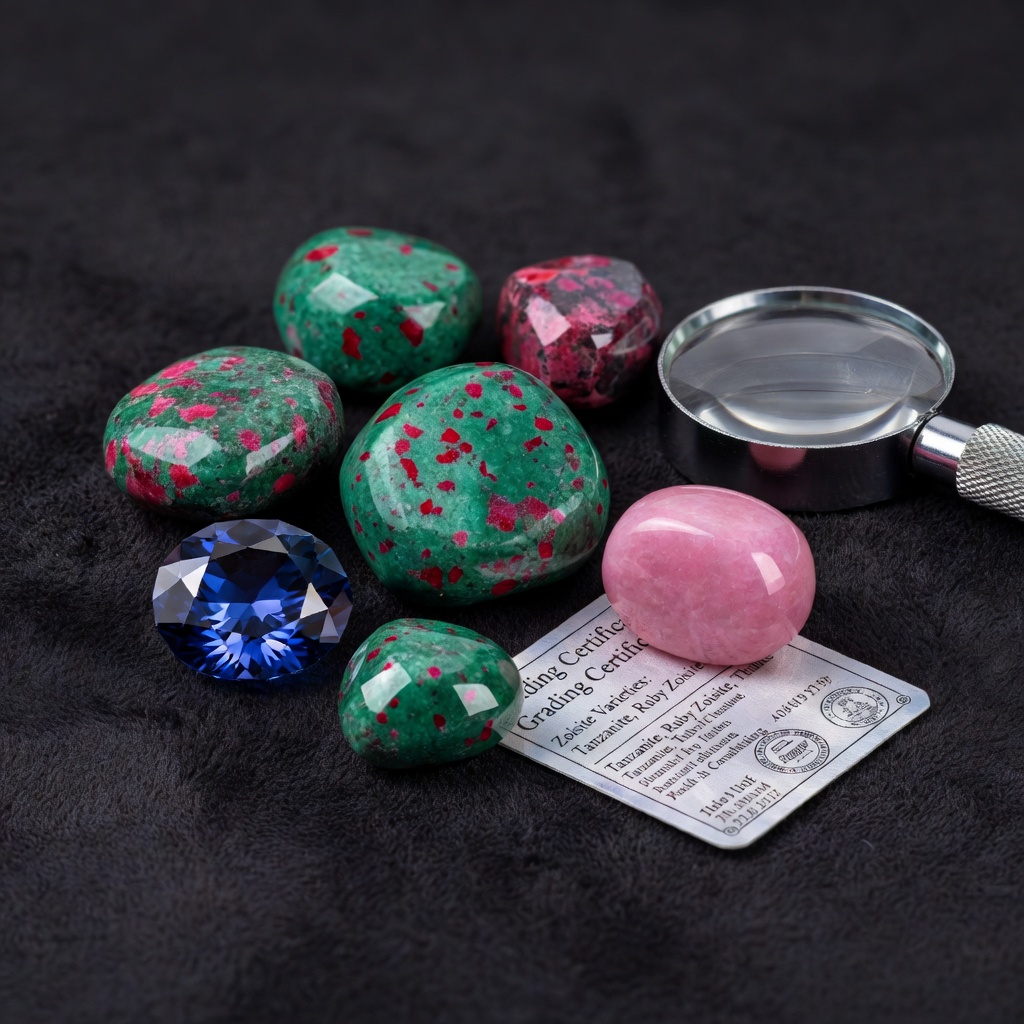
Comprehensive Zoisite Buying Guide: Navigating Tanzanite, Ruby Zoisite, and Thulite
Navigating the diverse world of zoisite gemstones requires understanding the distinct characteristics that separate investment-grade specimens from commercial offerings. As a mineral family encompassing some of the most visually striking gemstones available today, zoisite varieties offer collectors and jewelry enthusiasts options ranging from the exotic blue-violet tanzanite to the dramatic ruby zoisite and delicate pink thulite. This comprehensive Zoisite Buying Guide provides the essential knowledge needed to evaluate quality, authenticate natural stones, and make informed purchasing decisions across all zoisite varieties.
Introduction to Zoisite Varieties
Zoisite is a calcium aluminum hydroxy sorosilicate mineral that forms under specific metamorphic conditions, typically in regional metamorphism of calcium-rich rocks. While mineralogists recognize zoisite as a single species, the gem trade identifies three primary market varieties distinguished by their unique trace element compositions and color phenomena. Understanding these distinct types of zoisite is fundamental to recognizing value and selecting appropriate specimens for your collection or jewelry projects.
The most celebrated member of this mineral family is tanzanite, the blue to violet variety discovered in 1967 by Maasai tribesman Ali Juuyawatu in the Merelani Hills of Tanzania. This calcium aluminum silicate achieves its mesmerizing color through the presence of vanadium and the geological miracle of natural or induced heat treatment. Meanwhile, ruby zoisite (also known by its varietal name anyolite) presents a dramatic combination of green zoisite matrix intergrown with opaque red corundum crystals, first documented in the Longido mining district of Tanzania near Mount Kilimanjaro.
Thulite, the manganese-rich pink to red variety, derives its name from the mythical island of Thule, believed to be ancient Scandinavia. Premium specimens originate primarily from Norway, specifically the Lom region and Sauland in Telemark, where the manganese content creates colors ranging from pale pink to deep raspberry. Additional sources include North Carolina in the United States and Western Australia, though Norwegian material remains the standard for high-quality thulite gemstone specimens.
Understanding Tanzanite Quality Factors
When applying tanzanite buying tips to select superior specimens, color evaluation demands primary attention. The ideal tanzanite displays a deep saturated blue-violet hue, often described as "velvety" in the trade. Gemologists grade tanzanite color on a scale ranging from A (pale lavender-blue) to AAA (deep royal blue with strong violet undertones). The most valuable stones exhibit strong pleochroism, showing intense blue when viewed along one crystal axis and violet-purple along another, with minimal brown or gray secondary tones.
Clarity standards for transparent tanzanite follow Type I gemstone classification, meaning buyers should expect eye-clean specimens without visible inclusions when viewed at six inches under normal lighting. However, collectors occasionally accept minor inclusions in exceptional color stones exceeding five carats. When examining tanzanite clarity grades, reject stones with surface-reaching fractures or visible feather inclusions that compromise durability, as these significantly reduce both beauty and structural integrity.
Cut precision dramatically affects tanzanite's value and visual performance. Master cutters orient the table facet perpendicular to the crystal's length to display the blue pleochroic color rather than the brownish-purple axis. Cushion and oval cuts typically command premiums because they maximize color saturation while retaining weight, whereas poorly cut stones may window (show light leakage through the pavilion) or exhibit uneven color distribution. Investment-grade tanzanite typically starts at two carats for fine quality, with significant price escalations at five carats and ten carats for stones exhibiting exceptional tanzanite color grades.
Evaluating Ruby Zoisite (Anyolite) Specimens
Assessing ruby zoisite quality involves analyzing the interplay between the green zoisite matrix and the red ruby corundum inclusions. Premium specimens display a balanced ratio of approximately 40-60% ruby inclusions distributed evenly throughout the green matrix, creating the distinctive "Christmas stone" appearance prized by lapidaries. When examining rough or cabbed material, look for sharp color boundaries between the ruby crystals and zoisite host; the best specimens show no bleeding or muddy transitions between these contrasting colors.
Natural color zoning represents a critical authentication factor for anyolite buying guide considerations. Genuine ruby zoisite exhibits distinct crystallographic patterns where the red corundum maintains hexagonal crystal habits within the monoclinic zoisite matrix. Dyed imitations often show unnatural color saturation along fracture lines or display uniform color distribution that lacks the organic randomness of natural mineral growth. To verify authenticity, examine the stone under 10x magnification: natural specimens show mineral inclusions within both the ruby and zoisite components, while dyed stones may reveal concentrated pigment along cracks or surface pits.
The matrix pattern aesthetics significantly influence whether a specimen suits cabochon cutting or carving applications. Stones with bold, isolated ruby crystals scattered against translucent green zoisite command higher prices for freeform cabochons, while material with dense, intergrown ruby formations better serves sculptural carving projects. When selecting ruby zoisite for jewelry, prioritize specimens with stable ruby inclusions that do not protrude from the surface, as exposed corundum crystals may separate from the matrix during setting or wear.
Thulite and Lesser-Known Zoisite Types
High-quality thulite gemstone material originates almost exclusively from manganese-rich deposits in Norway, where the mineral forms in metamorphosed manganese ores and pegmatites. Superior specimens display an intense pink to raspberry red color caused by manganese substitution in the crystal lattice, with the most valuable stones exhibiting uniform color saturation without white calcite veining or black manganese oxide dendrites. Norwegian thulite from the Leksvik and Sauland deposits typically shows better translucency and more vivid color than material from Australian or American localities.
Distinguishing between ornamental-grade and jewelry-grade pink zoisite requires evaluating both transparency and structural integrity. Jewelry-grade thulite suitable for faceting or delicate cabochons must be free of fractures and exhibit at least partial translucency when held to light, allowing the warm pink glow to permeate the stone. Ornamental-grade material, while suitable for bookends, spheres, or large decorative objects, typically shows opaque texture with abundant black veining or matrix patterns that preclude fine jewelry use but create interesting visual textures for display pieces.
Clinozoisite, the high-pressure polymorph of zoisite, occasionally appears in specialized collector markets. This green to grayish-green variety forms in high-grade metamorphic rocks and eclogite facies environments, displaying properties similar to zoisite but with distinct optical characteristics and slightly different chemical composition. While rarely faceted due to limited transparency, exceptional clinozoisite crystals from Austria or Pakistan appeal to systematic mineral collectors seeking complete representation of the epidote mineral supergroup.
Clarity and Inclusion Assessment
Zoisite clarity grades vary significantly across the mineral family's different varieties, requiring tailored evaluation criteria for each type. For transparent tanzanite, buyers should demand eye-clean clarity, meaning no inclusions visible to the unaided eye at a distance of six to eight inches under normal lighting conditions. Acceptable inclusions include minute crystal inclusions or faint growth zoning that does not affect transparency, while rejecting stones showing "silk" (rutile needle inclusions), surface-reaching feathers, or internal fractures that create whitish reflective planes.
In opaque ruby zoisite, clarity assessment shifts from transparency evaluation to structural integrity and surface quality. Examine specimens for micro-fractures within the green matrix that might cause chipping during cutting or setting. The ruby inclusions themselves should be solid corundum crystals rather than crumbly, altered material. While some matrix pitting is acceptable in rough specimens, finished cabochons should present smooth, polished surfaces without undercutting where softer zoisite has eroded around harder ruby crystals.
Thulite presents unique clarity considerations due to its typical manganese veining and calcite inclusions. For cabochon cuts, subtle white veining can enhance the stone's organic appearance and verify natural origin, provided these patterns do not create structural weaknesses. However, faceted thulite requires exceptional clarity with minimal veining to prevent light leakage through the pavilion. When evaluating thulite for gemstone inclusions, avoid specimens showing black manganese oxide dendrites that reach the surface, as these create entry points for chemical damage during cleaning or environmental exposure.
Certification and Authentication Essentials
Natural zoisite identification relies heavily on documentation from reputable gemological laboratories, particularly for high-value tanzanite purchases. Certificates from GIA (Gemological Institute of America), AGS (American Gem Society), or independent laboratories such as AGL (American Gemological Laboratories) should specify the species (zoisite), variety (tanzanite, thulite, etc.), and any detectable treatments. For tanzanite, certification must disclose heat treatment status, as virtually all commercial material undergoes heating to 500-600 degrees Celsius to develop the blue-violet color from the raw brownish-yellow crystals.
Understanding heat treatment detection methods helps buyers verify natural color origin. Untreated tanzanite is extraordinarily rare and commands significant premiums; laboratory reports use advanced spectroscopy to identify treatment signatures. Infrared spectroscopy can detect structural changes in water content caused by heating, while Raman spectroscopy identifies mineral inclusions that might indicate natural versus enhanced color. For ruby zoisite, certification should confirm that both the green zoisite and red corundum components are natural, untreated minerals.
Distinguishing natural zoisite from synthetic simulants requires awareness of common substitutes. Synthetic corundum (sapphire) has been sold as tanzanite, though it lacks zoisite's distinctive trichroism and lower refractive index. Glass imitations of ruby zoisite often show gas bubbles under magnification and lack the crystalline structure of natural anyolite. Cubic zirconia (CZ) may simulate tanzanite but exhibits higher dispersion (fire) and different specific gravity. Always request specific gravity testing and refractive index measurements on certification reports to confirm natural zoisite identification rather than simulant materials.
Price Guide and Budget Planning
Understanding zoisite price factors enables realistic budget allocation across different varieties and quality levels. Current market values for tanzanite range from $200 to $800 per carat for commercial-grade stones with moderate saturation and slight inclusions, escalating to $1,000-$1,500+ per carat for investment-grade specimens exceeding three carats with deep violet-blue color and exceptional clarity. Ruby zoisite remains significantly more accessible, typically commanding $2-$20 per carat depending on the richness of ruby inclusions and the artistry of cutting, with sculptural-grade rough material priced by the kilogram rather than carat weight.
Thulite pricing reflects both color intensity and geographic origin, with fine Norwegian material ranging from $5 to $50 per carat. Pale, opaque pink specimens from secondary localities may sell for less than $5 per carat, while translucent, intensely colored material suitable for faceting commands the higher end of the spectrum. When evaluating tanzanite cost specifically, recognize that prices increase exponentially rather than linearly with size; a five-carat fine tanzanite may cost five to ten times more per carat than a one-carat stone of similar quality due to rarity in larger sizes.
Market trends indicate continued appreciation for investment-grade tanzanite as the Merelani mines approach depletion, while ruby zoisite and thulite remain stable, affordable options for jewelry designers and collectors. Factors creating premium pricing include unheated color status in tanzanite (commanding 50-100% premiums), exceptional clarity in thulite, and artistic matrix patterns in ruby zoisite suitable for museum-quality carvings. When budgeting, allocate additional funds for protective settings, as the relative softness of zoisite varieties (Mohs 6-7) necessitates mounting designs that guard against impact and abrasion.
Choosing Reputable Sellers and Avoiding Scams
When deciding to buy zoisite online or through physical dealers, recognizing red flags protects both your investment and your safety. Unrealistic pricing represents the most common warning sign; tanzanite offered at $50 per carat for "AAA grade" material invariably proves to be glass, synthetic, or heavily included commercial quality misrepresented through photo enhancement. Vague origin claims such as "African tanzanite" without specific mention of Tanzania, or sellers who cannot provide specific mining location details for ruby zoisite, suggest potential misrepresentation or conflict-sourced material.
Verifying ethical sourcing practices distinguishes reputable gemstone dealers from exploitative operations. Established sellers provide documentation of fair-trade mining practices, particularly important for tanzanite sourced from the Merelani Hills where artisanal mining conditions vary significantly. Look for dealers who maintain direct relationships with Tanzanian mining cooperatives or Norwegian thulite quarries, and who can articulate their chain of custody from mine to market. Membership in professional organizations such as the American Gem Trade Association (AGTA) or International Colored Gemstone Association (ICA) indicates adherence to ethical sourcing standards.
Comparing online marketplaces versus brick-and-mortar gem shows reveals distinct advantages for zoisite purchases. Online platforms offer broader selection and competitive pricing but require careful evaluation of return policies, particularly for tanzanite where color appearance varies dramatically between monitors. Physical gem shows allow direct examination of pleochroism in tanzanite and matrix patterns in ruby zoisite under various lighting conditions. Regardless of venue, insist on independent laboratory certification for purchases exceeding $500, and verify that the seller offers at least a seven-day inspection period with full refund rights.
Care Requirements and Durability Considerations
Zoisite care requires understanding the mineral's physical limitations, specifically its Mohs hardness of 6 to 7 and perfect cleavage in one direction. While harder than opal or pearl, zoisite remains susceptible to scratching from everyday dust (which contains silica at hardness 7) and vulnerable to chipping along cleavage planes upon sharp impact. Tanzanite exhibits particular brittleness due to its crystallographic structure, making it unsuitable for daily wear in rings unless mounted in protective bezel settings that shield the girdle and pavilion from direct blows.
Proper cleaning techniques preserve the polish and structural integrity of zoisite jewelry. Clean specimens using lukewarm water mixed with mild dish detergent and a soft-bristled brush, gently working around prongs and settings to remove accumulated oils and debris. Never subject zoisite to ultrasonic cleaners, as the vibrations can exacerbate existing inclusions into visible fractures or cause stones with internal feathers to cleave apart. Similarly, avoid steam cleaning, harsh chemical solvents, and sudden temperature changes that might induce thermal shock and cracking.
Storage recommendations focus on isolation and environmental stability. Store zoisite pieces individually in soft cloth pouches or lined jewelry boxes to prevent contact with harder gemstones like diamonds, sapphires, or rubies that could scratch the surface. Maintain consistent humidity and temperature in storage areas, as extreme dryness can affect some treated tanzanite stones over decades. For thulite specimens containing manganese, avoid prolonged exposure to direct sunlight which can potentially fade the pink coloration over extended periods, though this sensitivity is less pronounced than in amethyst or kunzite.
Final Purchase Checklist
A comprehensive zoisite buying checklist ensures thorough evaluation before finalizing transactions. Begin with a pre-purchase inspection protocol using a 10x jeweler's loupe in natural daylight to examine the stone for surface-reaching fractures, chips on the girdle, or uneven facet junctions that indicate poor cutting. View tanzanite under both daylight and incandescent lighting to verify consistent color without undesirable gray or brown modifiers. For ruby zoisite, check that the matrix shows no signs of dye concentration in fractures by examining edges and natural pits under magnification.
Essential documentation must accompany any significant zoisite purchase. Require a detailed sales receipt specifying the exact variety (tanzanite, thulite, or ruby zoisite), dimensions, carat weight, and any treatments applied. For tanzanite exceeding one carat in value, insist on origin reports confirming Tanzanian source material and treatment disclosure certificates. Verify that the seller's return policy allows sufficient time for independent verification by your own gemologist, ideally providing a minimum of fourteen days for full refund if the stone proves misrepresented.
Before finalizing the transaction, ask specific questions that reveal seller expertise and stone authenticity. Inquire about the specific mining location within Tanzania for tanzanite (Merelani Hills Block D, C, or B indicate different quality tiers), or the Norwegian locality for thulite. Question whether the tanzanite has undergone heating and request written confirmation. For ruby zoisite, ask about the stability of the ruby inclusions and whether the stone has been stabilized with resin or opticon. Reputable dealers welcome these inquiries and provide detailed responses that demonstrate their commitment to transparency and customer education.
Frequently Asked Questions
What is the difference between zoisite and tanzanite?
Tanzanite is actually the blue to violet variety of the mineral zoisite. While all tanzanite is zoisite, not all zoisite is tanzanite. Other varieties include ruby zoisite (green with red corundum inclusions) and thulite (pink manganese-rich zoisite), each with distinct colors and value propositions.
How much should I expect to pay for quality tanzanite?
Quality tanzanite typically ranges from $200-$800 per carat for commercial-grade stones with good color, to $1,000-$1,500+ per carat for investment-grade specimens with deep violet-blue saturation and excellent clarity. Ruby zoisite is significantly more affordable at $2-$20 per carat, while thulite falls between $5-$50 per carat depending on color intensity.
Is ruby zoisite naturally colored or treated?
Natural ruby zoisite (also called anyolite) derives its colors from natural geological processes—green from chromium and vanadium in the zoisite, and red from corundum inclusions. However, the market does contain dyed imitations. Always request certification and examine the stone under magnification to verify natural color zoning.
What clarity grade should I look for when buying zoisite?
For tanzanite, aim for eye-clean stones (no visible inclusions to the naked eye) to maximize brilliance. Ruby zoisite is typically opaque and valued for its artistic matrix patterns rather than clarity. Thulite may show natural manganese veining, which is acceptable if it doesn't compromise the stone's structural integrity.
Can zoisite gemstones be worn daily in rings?
With a Mohs hardness of 6-7 and perfect cleavage, zoisite requires protective settings for daily wear. Tanzanite is particularly brittle and prone to chipping upon impact; it's best reserved for earrings, pendants, or occasional wear rings with protective bezels. Ruby zoisite is slightly more durable but still benefits from protective settings.
How can I tell if my zoisite is natural or synthetic?
Natural zoisite displays unique characteristics including color zoning, specific inclusion patterns (like hair-like inclusions in tanzanite), and strong pleochroism (showing different colors when viewed from different angles). Synthetic versions often appear too perfect. Always purchase from reputable dealers who provide independent laboratory certification.
Does zoisite have any special metaphysical properties?
While not recognized by mainstream gemology, crystal healing traditions attribute different properties to zoisite varieties: tanzanite is associated with spiritual awakening and communication, ruby zoisite with vitality and passion, and thulite with heart healing and compassion. These beliefs don't affect the gemological value or physical properties of the stones.
What is the best cut for tanzanite to maximize its color?
Cushion and oval cuts typically best display tanzanite's pleochroic blue-violet hues by orienting the table perpendicular to the crystal's length. Step cuts (emerald cut) emphasize clarity and create a sophisticated look, while brilliant cuts maximize sparkle but may dilute the body color. Always view tanzanite under natural daylight and incandescent lighting before purchasing.