Why Turquoise Prices Vary Dramatically: A Comprehensive Turquoise Price Guide
The turquoise market presents one of the most dramatic pricing spectrums in the gemstone industry, with specimens ranging from $1 per carat for mass-produced beads to over $1,000 per carat for museum-quality Persian cabs. This extraordinary variation stems from a complex interplay of geological rarity, cultural significance, and treatment methods that can transform soft, porous chalk into durable jewelry-grade material. Understanding these value drivers is essential for collectors, jewelry designers, and investors who want to navigate this ancient gemstone market without overpaying for inferior material or missing opportunities to acquire genuine treasures.
Unlike diamonds or rubies with relatively standardized pricing structures, turquoise value fluctuates wildly based on seemingly subtle differences in origin, matrix patterns, and enhancement levels. A stabilized stone from an unknown Chinese mine might cost $15 per carat, while an untreated nugget from Arizona's defunct Sleeping Beauty mine commands $400 per carat or more. Throughout this turquoise price guide, we will dissect the specific characteristics that justify these massive price differentials, providing you with practical tools to evaluate stones, verify authenticity, and make purchasing decisions aligned with your budget and collecting goals.
5 Critical Factors That Determine Turquoise Value
Origin and Rarity: Why Persian and Certain American Mines Command Premium Prices
The geographical source of turquoise often serves as the primary value determinant, with historical prestige and mine depletion creating scarcity-driven markets. Persian turquoise from Iran's Nishapur mines has dominated the high-end market for millennia, prized for its intense robin's-egg blue color free of matrix inclusions. American mines contribute their own premium tiers, particularly Sleeping Beauty (Arizona), Bisbee (Arizona), and Lander Blue (Nevada), where limited production runs and mine closures have created collector frenzies. When the Sleeping Beauty mine ceased operations in 2012, natural material from this source immediately appreciated 300-400%, demonstrating how origin rarity directly impacts turquoise value per carat.
Treatment Classification: Natural, Stabilized, Enhanced, and Replicated Turquoise Values
The gemological community categorizes turquoise into distinct treatment classes that dramatically affect pricing, with natural, untreated stones representing the gold standard for serious collectors. Stabilized turquoise undergoes pressure treatment with clear epoxy or resin to harden soft, porous material, a common process that makes otherwise unusable rough suitable for jewelry but reduces value by 60-90%. Enhanced turquoise involves dyeing or waxing to improve color, while reconstituted material comprises crushed turquoise dust mixed with resin—a composite worth pennies compared to solid natural stone. When evaluating turquoise value per carat, always verify treatment status, as undisclosed stabilization remains the industry's most common consumer deception.
Color and Clarity: The Impact of Robin's Egg Blue vs. Greenish Hues on Pricing
Color saturation and tone significantly influence market desirability, with pure sky blue without green overtones traditionally commanding the highest premiums in Western markets. This preference stems from historical Persian imports, which established the "robin's egg" standard centuries ago. However, certain green turquoise varieties from Nevada's Carico Lake or Damele mines fetch premium prices due to their unique chartreuse and lime hues, proving that exceptional color—regardless of the specific shade—drives value when coupled with clarity. Stones exhibiting even color distribution without dead zones or brownish patches typically justify 40-50% higher prices than mottled or variegated specimens of similar origin.
Hardness and Durability: How Mohs Scale Rating Affects Both Wearability and Worth
Turquoise ranks between 5 and 6 on the Mohs hardness scale, but individual specimens vary dramatically in density and structural integrity, directly correlating to value. High-grade natural turquoise from hard-rock deposits tests at 5.5-6.0 Mohs, suitable for rings and bracelets that withstand daily wear. Conversely, "chalk turquoise"—soft, porous material testing below 5.0 Mohs—requires stabilization to prevent crumbling and absorbs skin oils, causing discoloration over time. When assessing turquoise value per carat, hardness serves as a quality proxy, with gem-grade hardness stones commanding prices 20-30 times higher than their chalk counterparts, even before considering color or origin factors.
Matrix Patterns: Spiderweb vs. Clean Stones and Collector Preferences
The host rock inclusions within turquoise, known as matrix, create distinctive patterns that either enhance or detract from value depending on current market trends and cultural context. Clean, matrix-free stones traditionally command higher prices in Persian and Victorian markets, where pure color remains paramount. However, American Southwest collectors often prize intricate spiderweb matrix patterns—delicate black or brown veining resembling spiderwebs—which can equal or exceed the value of clean stones when the patterning is symmetrical and aesthetically pleasing. The famous "bird's eye" matrix from Nevada's Number 8 mine or the golden webbing from Arizona's Kingman deposits demonstrate how specific matrix styles become collectible categories unto themselves.
Turquoise Value Per Carat: Complete Market Breakdown
Low-Grade Turquoise: $0.50-$5 Per Carat for Chalk or Heavily Treated Material
Entry-level turquoise encompasses reconstituted material, dyed magnesite or howlite imitations, and heavily stabilized chalk turquoise sold primarily in tourist markets and mass-market jewelry. At this price point, expect vivid but unnatural colors—electric blues and greens achieved through dyes rather than natural mineralization—and uniform appearance lacking the subtle variations of genuine stone. While suitable for fashion jewelry that prioritizes color over authenticity, these materials hold no investment value and may deteriorate within months as stabilizing resins break down or dyes fade. Savvy buyers recognize that authentic turquoise simply cannot be mined, cut, polished, and distributed for under $5 per carat without significant quality compromises.
Mid-Grade Stones: $10-$50 Per Carat for Decent Quality Stabilized Turquoise
The commercial jewelry market predominantly operates within this bracket, offering stabilized turquoise from active mines in Arizona, Nevada, and China that provides durability and consistent color at accessible prices. Kingman turquoise stabilized through the Zachery process or similar treatments falls into this category, providing jewelry makers with material hard enough for daily wear without the fragility of untreated chalk. While these stones lack the prestige and appreciation potential of natural material, they represent honest value for consumers seeking turquoise's aesthetic appeal without premium prices. Expect to pay $15-$25 per carat for well-cut cabochons with attractive matrix patterns and reliable hardness suitable for pendants and earrings.
High-Grade Natural: $100-$500 Per Carat for Top-Tier American Varieties
Serious collectors and high-end jewelry designers focus on this segment, where natural, untreated turquoise from renowned American mines commands significant premiums based on provenance and quality. Natural Sleeping Beauty turquoise currently trades between $200-$400 per carat depending on size and clarity, while natural Bisbee material with its characteristic smoky matrix ranges from $150-$600 per carat. This tier requires authentication through reputable dealers or gemological laboratories, as the financial incentive for misrepresenting stabilized material as natural becomes substantial. Stones in this category typically exhibit Mohs hardness above 5.5, cutting weight retention indicating minimal porosity, and color stability that improves with wear rather than degrading.
Exceptional Specimens: $1,000+ Per Carat for Rare Persian or Collectible Pieces
The apex of the turquoise market features museum-grade Persian material from Iran's historic mines, matched only by the finest examples from depleted American deposits like Lander Blue or Candelaria. These stones exhibit perfect robin's-egg blue coloration, gem hardness, and often substantial carat weights exceeding 10 carats—rare for natural turquoise, which typically forms in thin veins. Auction records show exceptional Persian turquoise cabochons exceeding $1,500 per carat, while matched sets from defunct American mines can command similar premiums from serious collectors. At this investment grade, documentation becomes crucial, with certificates of origin and treatment status from laboratories like the Gemological Institute of America (GIA) or American Gemological Laboratories (AGL) justifying the substantial turquoise value per carat.
Natural vs. Treated Turquoise: Understanding the Price Gap
Definitions: What Qualifies as Natural, Stabilized, Enhanced, or Reconstituted Turquoise
Natural turquoise refers to material cut from the rough and polished without any chemical or physical treatment beyond cutting and polishing—a rarity representing perhaps 10% of the market. Stabilized turquoise involves impregnating porous rough with clear epoxy resins under pressure, hardening the stone and preventing color change from skin oils, a process that renders soft material usable but must be disclosed under Federal Trade Commission guidelines. Enhanced turquoise includes dyeing, waxing, or oiling to improve color, while reconstituted material combines pulverized turquoise fragments with plastic resins to form blocks that are then sliced and polished. Understanding these distinctions proves essential when evaluating natural turquoise price differentials, as untreated material from the same mine typically commands 10 to 100 times the price of its treated equivalent.
Price Differential: Why Natural Commands 10-100x Premium Over Treated Material
The dramatic price gap between natural and treated turquoise reflects both scarcity and permanence, as untreated stones represent a finite resource that cannot be manufactured while stabilized material can be produced indefinitely from low-grade rough. A stabilized Sleeping Beauty cabochon might retail for $30 per carat, while an identical-appearing natural stone from the same rough batch sells for $300-$500 per carat. This disparity intensifies with origin prestige; natural Persian turquoise price points start around $300 per carat for decent quality, while stabilized Iranian material—rarely seen on the market—would theoretically sell for a fraction of that if produced. Collectors and investors pay these premiums because natural turquoise appreciates as mines deplete, whereas stabilized stones depreciate like manufactured goods.
Identification Methods: Simple Tests Buyers Can Use to Verify Treatment Status
While laboratory analysis provides definitive answers, collectors can employ several field tests to screen for treatments before purchasing. The hot needle test—touching a heated needle to an inconspicuous edge—reveals plastic fillers or reconstituted material through melting or acrid odors, though this damages the stone and should be performed only on rough or cheap specimens. Natural turquoise feels noticeably cooler to the touch than plastic imitations due to higher thermal conductivity, and under 10x magnification, natural stones show color zoning and matrix irregularities absent in dyed materials. Specific gravity testing provides another clue, as reconstituted material often contains plastics that reduce density below natural turquoise's 2.6-2.9 range.
Market Reality: Why Stabilized Turquoise Dominates and When It's Acceptable to Buy
Stabilized turquoise comprises approximately 80% of the commercial market because natural rough suitable for jewelry has become prohibitively expensive and physically fragile for daily wear. For consumers prioritizing durability and color consistency over investment potential, stabilized stones offer practical value, particularly when sellers transparently disclose treatments and price accordingly. The stigma against stabilization applies primarily to misrepresentation; an honest $25 per carat stabilized stone serves jewelry makers better than a fraudulently sold "natural" stone that turns out to be dyed chalk. Acceptable contexts for purchasing stabilized material include costume jewelry, pieces subject to hard wear like rings, and beginner collections where the educational value outweighs investment considerations.
Famous Turquoise Varieties and Current Market Values
Sleeping Beauty Turquoise: Why This Mine-Closed Variety Commands $200-$800 Per Carat
The Sleeping Beauty mine in Globe, Arizona, produced turquoise renowned for its pure sky-blue color and minimal matrix from 1976 until its closure in 2012, creating an instant classic in the collector market. Named after the mountain resembling a sleeping woman, this material dominated the high-end Southwestern jewelry market during its production years, favored by Native American artisans for its consistency and workability. Since the mine's closure, natural Sleeping Beauty turquoise has appreciated steadily, with gem-grade cabochons now selling for $200-$400 per carat and exceptional large specimens reaching $800 per carat. The mine's definitive closure ensures that supply remains fixed while demand grows, making this variety a benchmark for stabilized turquoise value comparisons and a blue-chip holding for turquoise investors.
Persian Turquoise: The Historical Gold Standard and Modern Pricing of $300-$1,500 Per Carat
For over two millennia, turquoise from Iran's Nishapur mining district has set the global standard for quality, prized by ancient Egyptian pharaohs, Persian shahs, and European royalty for its intense, uniform blue color often described as "robin's egg" or "sky after a storm." Unlike American varieties that often display matrix patterns, top Persian material appears clean and translucent, with the finest specimens exhibiting a slightly waxy luster and hardness exceeding 5.5 Mohs. Current Persian turquoise price structures reflect both political export restrictions and mine depletion, with decent quality material starting at $300 per carat and investment-grade cabs exceeding $1,500 per carat for stones over 5 carats. The historical prestige of Persian turquoise ensures continued demand among serious collectors, though American varieties now compete on quality if not cultural pedigree.
Kingman, Bisbee, and Royston: Regional American Mines and Their Price Ranges
Arizona's Kingman mine, one of the oldest and largest producers in the Southwest, offers a broad spectrum from affordable stabilized material at $20 per carat to natural high-grade spiderweb specimens at $200+ per carat. The Bisbee mine, closed since the 1970s, produced distinctive turquoise with chocolate-brown matrix against deep blue backgrounds, with natural specimens now commanding $150-$600 per carat depending on matrix density and color intensity. Nevada's Royston mine yields material ranging from pale blue to rich green, often with heavy black matrix, priced between $50-$300 per carat for natural material. Each mine produces distinctive visual signatures—Bisbee's smoky webbing, Kingman's black dendritic patterns, Royston's color banding—that allow experienced collectors to identify origin by sight, affecting provenance premiums.
Chinese vs. American Turquoise: Quality Comparisons and Value Misconceptions
Chinese turquoise mines, particularly those in the Hubei province, have flooded the market with material ranging from world-class gem grade to worthless chalk, creating confusion about Asian turquoise's overall quality reputation. High-grade Chinese turquoise exhibits colors rivaling Sleeping Beauty or Persian material, with some specimens displaying unique apple-green hues rare in American deposits, and commands $100-$300 per carat for verified natural pieces. However, the market also contains enormous volumes of stabilized, dyed, or reconstituted Chinese material selling for pennies per carat, leading to an unfair blanket characterization of all Chinese turquoise as inferior. Discerning buyers evaluate each stone individually rather than dismissing origin, recognizing that China's geological potential equals that of the American Southwest, though documentation of Chinese natural turquoise price points remains less standardized than American markets.
Understanding the Turquoise Grading Scale: From AAA to C Grade
Industry Grading Standards: What AAA, AA, A, B, and C Actually Mean for Turquoise
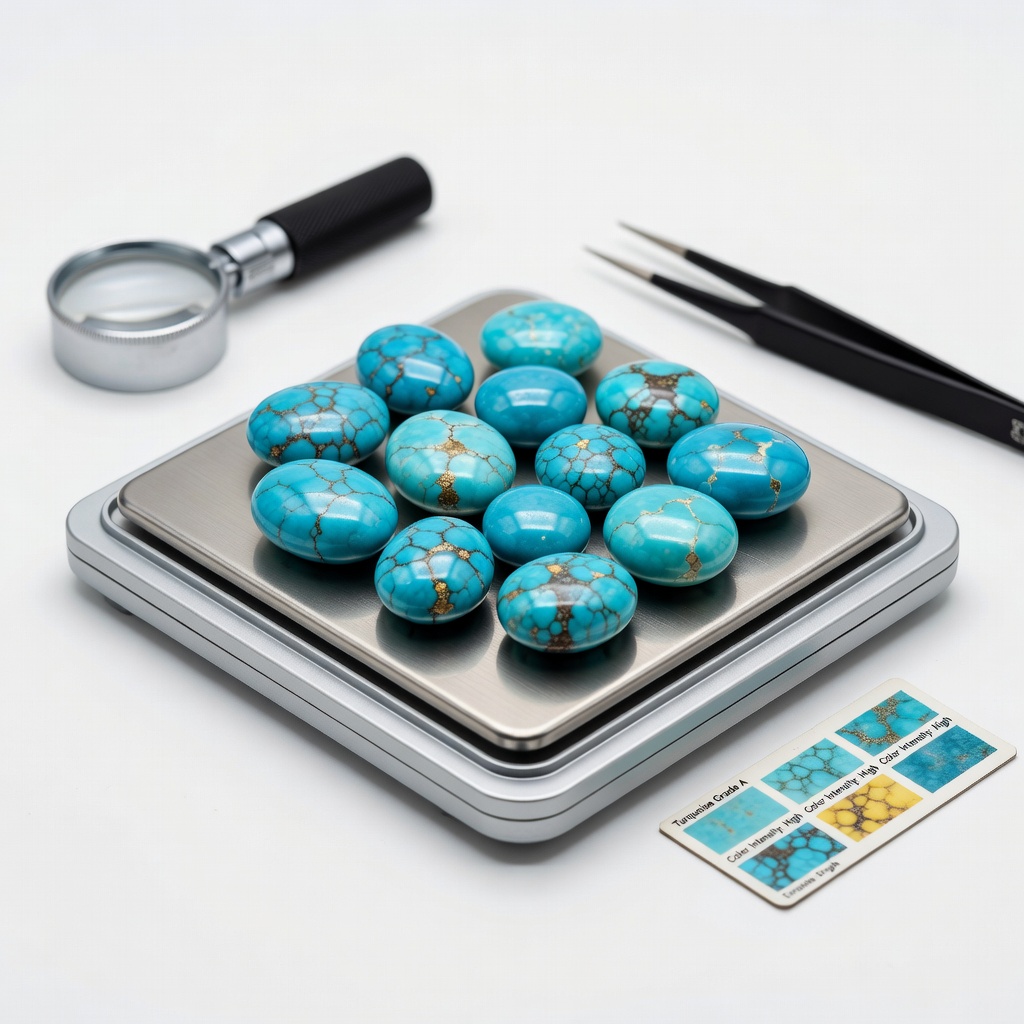
The turquoise industry employs a letter-grade system that, unlike diamond grading, lacks universal standardization, though generally accepted parameters help buyers understand quality tiers. AAA grade represents gem-quality natural turquoise with intense color, high hardness (5.5+ Mohs), excellent polish, and minimal matrix or pleasing symmetrical patterns, comprising less than 1% of mined material. AA grade indicates very good quality with slight color variations or minor matrix inclusions, while A grade shows good color but may include visible matrix or minor surface imperfections. B and C grades encompass softer material requiring stabilization, uneven coloration, or heavy matrix that interferes with the stone's appearance, typically selling for commercial jewelry production rather than fine collector pieces.
Visual Indicators: Color Saturation, Matrix Patterns, and Surface Blemishes by Grade
AAA grade turquoise displays saturated, even color throughout the stone without pale spots or brownish discolorations, while matrix—if present—forms symmetrical, aesthetically pleasing patterns that enhance rather than detract from the overall appearance. AA stones may show slight color zoning or matrix that cuts across the stone asymmetrically but remains attractive, whereas A-grade material often contains visible host rock inclusions or "water web" patterns of pale matrix lines. B-grade turquoise typically exhibits chalky spots, uneven color distribution, or matrix that appears muddy or blotchy, while C-grade shows significant surface pitting, cracks, or pale, washed-out color requiring heavy treatment to become salable. When applying the turquoise grading scale, examine stones under natural daylight rather than jewelry store lighting, which can mask color deficiencies and make low-grade material appear more vibrant than reality.
Price Multipliers: How Each Grade Level Impacts Per-Carat Value
The financial implications of grading prove substantial, with each step down the quality ladder reducing value by 50-70% within the same origin category. Natural AAA Sleeping Beauty turquoise might retail for $400 per carat, while AA material from the same mine sells for $200-$250 per carat, and A-grade commands $100-$150 per carat. These multipliers compound with treatment status; AAA stabilized turquoise sells for $40-$60 per carat compared to $400 for natural, demonstrating how grading and treatment interact to determine final pricing. Smart buyers use these ratios to evaluate deals, recognizing that a "natural AAA" stone priced at $50 per carat likely represents misrepresented lower-grade material or outright fakery.
Certification Importance: Why Reputable Lab Reports Matter for Expensive Purchases
Given the high stakes of natural turquoise pricing, gemological certification from recognized laboratories provides essential verification of treatment status, origin, and quality claims. The GIA, AGL, and certain specialist laboratories like Stone Group Labs can identify stabilization, dyeing, and reconstruction treatments that even experienced dealers might miss, with reports costing $50-$200 depending on service level. For purchases exceeding $1,000, the cost of certification represents cheap insurance against fraud, particularly when buying Persian turquoise or high-end American varieties where natural turquoise price premiums justify documentation. Certificates should specify treatment status (natural vs. stabilized), origin if determinable, and any detectable enhancements, providing recourse if the stone proves different from represented specifications.
Expert Tips for Buying Valuable Turquoise
Red Flags: Too-Perfect Stones, Unrealistically Low Prices, and Fake Matrix Patterns
Professional buyers remain vigilant for specific warning signs that indicate treated, imitation, or fraudulent turquoise masquerading as natural high-grade material. Stones displaying uniform, electric-blue color without any matrix variations or natural inclusions often indicate dyed howlite, magnesite, or plastic composites, as even the finest Persian turquoise shows subtle color gradations under magnification. Prices significantly below market rates—such as "natural Sleeping Beauty" at $30 per carat—almost certainly indicate stabilization or misrepresentation, as legitimate dealers cannot acquire rough at prices supporting such retail discounts. Artificial matrix patterns appear too regular or geometric compared to natural veining, which follows geological stress fractures and mineral deposition patterns; painted black lines that stop abruptly at edges or form perfect symmetrical designs suggest manufactured rather than natural origins.
Reputable Sellers: American Gem Trade Association (AGTA) Members and Established Dealers
The AGTA represents the gold standard for ethical gemstone dealing, requiring members to adhere to strict disclosure guidelines regarding treatments and origins, with expulsion as the penalty for misrepresentation. Established dealers specializing in Southwestern or Persian turquoise often maintain decades-long relationships with specific mines or cutting houses, providing provenance documentation impossible for fly-by-night operators. Seek sellers who welcome independent verification, offer detailed return policies (minimum 30 days), and provide educational resources about turquoise care and characteristics rather than high-pressure sales tactics. The stabilized turquoise value market contains many honest dealers who clearly label treated material at appropriate prices, whereas suspicious vendors typically push "natural" claims while avoiding specific mine designations or treatment disclosures.
Documentation Essentials: Certificates of Authenticity, Origin Disclosure, and Return Policies
Legitimate turquoise transactions include written documentation specifying treatment status, country of origin, mine name if known, and any enhancements applied to the stone. For vintage or antique pieces, provenance documentation connecting the item to specific artisans or periods adds significant value, particularly for Native American jewelry from the 1970s-1980s when natural material remained plentiful. Return policies should allow sufficient time for independent appraisal—ideally 30 days or more—protecting buyers who discover undisclosed treatments or origin misrepresentation after purchase. Savvy collectors photograph all documentation alongside the stone, creating records that enhance resale value and provide insurance documentation, as the stabilized turquoise value differential makes treatment status a critical factor in secondary market transactions.
Negotiation Strategies: How to Compare Prices Across Vendors and Validate Market Rates
Effective turquoise purchasing requires market research across multiple platforms, comparing prices for specific varieties like natural Kingman spiderweb or Persian cabs of similar size and quality. Wholesale gem shows such as the Tucson Gem and Mineral Show provide baseline pricing intelligence, allowing buyers to calibrate retail markup expectations (typically 100-300% over wholesale for fine pieces). When negotiating, reference specific comparable sales or auction results rather than making vague lowball offers, demonstrating market knowledge that commands respect from professional dealers. For expensive acquisitions, consider offering cash discounts or volume purchases to achieve 10-20% reductions, but remain wary of deals exceeding 50% off apparent market value, which usually indicate quality problems rather than buyer skill.
Investment Potential: Is Turquoise a Smart Purchase?
Market Trends: Recent Appreciation Rates for Top-Tier Natural Turquoise
The investment turquoise market has demonstrated robust appreciation over the past decade, with natural material from closed mines like Sleeping Beauty, Bisbee, and Lander Blue showing annual appreciation rates of 15-25%, significantly outpacing traditional investments. This growth reflects fundamental supply constraints; unlike diamonds or gold, turquoise cannot be synthesized economically, and each mine closure permanently reduces future supply of specific varieties. Persian turquoise price trends remain strong despite geopolitical complications, with high-grade material doubling in value between 2015 and 2023 as Iranian export restrictions tightened availability. However, these appreciation rates apply exclusively to verified natural, untreated stones with documentation; stabilized or treated turquoise depreciates like consumer goods, losing value the moment of purchase similar to automobiles.
Best Investment Types: Which Varieties and Grades Hold Value Over Time
Investment-grade turquoise concentrates in specific categories: natural material from defunct mines (Sleeping Beauty, Bisbee, Number 8, Lander Blue), exceptional Persian cabs over 5 carats, and historic pieces with documented Native American provenance. Within these categories, AAA grade with pleasing matrix patterns or clean robin's-egg blue coloration shows the strongest liquidity and appreciation potential. Matched sets for earrings or necklaces command premiums over single stones due to the difficulty of finding color-matched pairs in natural material. Avoid investment in treated material, modern Chinese turquoise (due to market flooding), or stones under 3 carats, as these lack the scarcity and visual impact necessary for serious collector interest.
Storage and Care: How to Maintain Turquoise Value Through Proper Handling
Turquoise requires specific storage protocols to prevent color degradation and structural damage that would devastate investment value. Store stones away from direct sunlight, which can fade some varieties, and maintain stable humidity levels to prevent dehydration cracking in natural material. Chemical exposure poses severe risks; remove turquoise jewelry before applying perfumes, lotions, or cleaning products, as porous natural stones absorb chemicals causing permanent discoloration. Store pieces separately in soft cloth to prevent scratching from harder gemstones, and consider professional restringing of vintage beaded pieces every few years, as the silk or nylon cords deteriorate faster than the stones themselves.
Liquidity Considerations: Resale Markets and Finding Buyers for Your Collection
Unlike gold or publicly traded securities, turquoise represents an illiquid asset requiring specialized knowledge to sell at full market value. Auction houses like Heritage Auctions or Bonhams handle fine turquoise and Native American jewelry, reaching serious collectors but charging 10-25% commissions. Direct sales through specialized forums, gem shows, or established relationships with dealers offer better returns but require networking and authentication documentation. The Persian turquoise price premium and name recognition of specific American mines facilitate faster sales than generic "natural turquoise" listings, emphasizing the importance of documented provenance when building an investment collection. Plan for holding periods of 5-10 years to maximize appreciation, as quick sales typically result in wholesale pricing 40-60% below retail value.
Where to Buy Quality Turquoise at Fair Prices
Online Marketplaces: Etsy, eBay, and Specialized Gem Sites - Pros and Cons
Digital marketplaces offer unprecedented access to global turquoise inventory, with platforms like Etsy hosting individual lapidary artists selling directly to consumers, often at prices 30-50% below retail jewelry stores. However, the anonymity of online selling facilitates misrepresentation, with "natural turquoise" listings frequently describing stabilized or imitation material, particularly from overseas sellers. eBay provides auction formats for rare specimens but requires extreme vigilance regarding seller ratings and return policies, as counterfeit turquoise remains rampant in unvetted listings. Specialized sites like TurquoiseMountain or private dealer websites with established reputations offer safer purchasing environments, though typically at higher price points reflecting authentication guarantees and expertise.
Physical Locations: Gem Shows, Southwestern US Trading Posts, and Jewelry Districts
The annual Tucson Gem and Mineral Show represents the world's largest turquoise marketplace, where direct access to rough dealers and cutters allows educated buyers to acquire material at wholesale-adjacent prices. Southwestern trading posts in Santa Fe, Albuquerque, and Scottsdale offer curated selections of Native American jewelry featuring documented natural turquoise, though tourist-oriented locations often carry substantial markups. Los Angeles' jewelry district and New York's 47th Street provide access to wholesale dealers who typically require business licenses but offer significant savings for serious collectors. When visiting physical locations, bring a 10x loupe for inspection, request written treatment disclosures, and take time to compare pricing across multiple vendors before committing to significant purchases.
Price Comparison: How to Research Going Rates for Specific Turquoise Varieties
Establishing fair market value requires monitoring completed sales on auction sites, consulting price guides from the AGTA, and networking with collector communities who share recent transaction data. For natural turquoise price research, examine specimens of similar size, origin, and treatment status across at least five different venues before determining reasonable price ranges. Subscription services like GemWorld or the Guide Gemstone Pricing Guide provide wholesale pricing benchmarks, though retail consumers should expect to pay 100-200% above these figures for single-piece purchases. Document your research with screenshots or catalog references, creating a personal database that accelerates future purchasing decisions and identifies genuine deals when they appear.
Buyer Protection: Return Windows, Payment Methods, and Avoiding Scams
Protecting your investment begins with payment method selection; credit cards offer chargeback protection unavailable with wire transfers or cryptocurrency, while PayPal Goods and Services provides dispute resolution for undelivered or misrepresented items. Insist on written return policies allowing at least 14 days for independent appraisal, and verify that "natural" claims appear in writing rather than verbal assurances. For international purchases, require customs declarations matching the purchase price to avoid duty complications, and consider third-party escrow services for transactions exceeding $5,000. Red flags indicating potential scams include pressure to complete transactions outside platform protections, reluctance to provide origin documentation, or sellers claiming that "all turquoise is treated" to justify undisclosed stabilization.
Frequently Asked Questions About Turquoise Pricing
How Much Is Turquoise Worth Per Carat?
Turquoise ranges from $0.50 per carat for low-grade chalk material to over $1,000 per carat for rare, natural Persian or top American mine specimens. Most commercial stabilized turquoise sells for $10-$50 per carat, while quality natural stones typically start around $100 per carat.
What Is the Most Expensive Type of Turquoise?
Persian turquoise from Iran's Nishapur mines historically commands the highest prices, with exceptional pieces reaching $1,500+ per carat. Among American varieties, gem-grade natural Sleeping Beauty turquoise (mine closed since 2012) now sells for $200-$800 per carat due to scarcity.
How Can I Tell If Turquoise Is Real and Valuable?
Real turquoise feels cool to touch, has natural matrix variations, and shows color variations under magnification. Perform a scratch test (turquoise ranks 5-6 on Mohs scale) or hot needle test (plastic fakes melt). For valuable pieces, always request a gemological certificate verifying natural, untreated status.
Does Old Turquoise Jewelry Have Value?
Age alone doesn't guarantee value. Vintage Native American pieces with natural turquoise from renowned mines (Bisbee, Lander Blue) can be extremely valuable. However, much vintage jewelry contains stabilized turquoise worth only the craftsmanship value. Authentication by a tribal art specialist is essential.
Why Is Some Turquoise So Cheap?
Inexpensive turquoise is typically either reconstituted (turquoise dust mixed with resin), dyed howlite or magnesite, or heavily stabilized chalk turquoise. These materials cost pennies to produce vs. natural turquoise that requires mining, cutting, and often remains untreated, justifying the 10-100x price difference.
Is Stabilized Turquoise Worth Buying?
Stabilized turquoise offers good value for jewelry wearers seeking durability and affordable color. It's worth buying for personal use if priced appropriately ($10-$30 per carat), but has minimal investment potential. Always ensure sellers clearly disclose stabilization, as transparency is legally required.
What's the Difference Between Persian and American Turquoise Prices?
Top Persian turquoise historically commanded premium prices due to its pure robin's-egg blue color and centuries-old prestige ($300-$1,500/carat). American turquoise (Sleeping Beauty, Kingman) offers comparable quality with more matrix variety, typically priced at $100-$500/carat for natural high-grade material. Both are valuable; Persian carries antique prestige while American offers modern collectibility.
Is Turquoise a Good Investment in 2024?
High-grade natural turquoise from depleted mines shows strong appreciation potential, with some varieties doubling in value over 5 years. However, it's a niche collectible market requiring expertise. Focus on authenticated natural stones from closed mines, avoid treated material for investment purposes, and plan for long-term holding periods to maximize returns.