Introduction to Tsavorite Garnet Pricing
Discovered in 1967 by Scottish geologist Campbell Bridges in the mineral-rich hills of Tanzania, tsavorite garnet represents one of the most significant colored gemstone finds of the twentieth century. This rare green variety of grossular garnet derives its name from Tsavo National Park in Kenya, where commercial mining operations later established the gem's global reputation for exceptional beauty and rarity. Unlike abundant red garnet varieties found worldwide, tsavorite forms only under specific geological conditions requiring the presence of both chromium and vanadium in calcium-rich rock formations, creating a vivid green hue that rivals fine emerald without the characteristic inclusions.
Current market dynamics position tsavorite within the premium colored gemstone category, with prices ranging from $200 to over $3,000 per carat depending on quality characteristics and size. This substantial price variation reflects the gem's extreme scarcity in commercial quantities, as mining operations consistently yield smaller rough crystals rarely exceeding five carats in finished size. When compiling a comprehensive Tsavorite Garnet Price Guide, collectors must understand that this gem commands premium valuations compared to other garnet varieties due to its limited geographical distribution, superior clarity, and growing demand among luxury jewelry connoisseurs seeking alternatives to treated emeralds.
Understanding Price Per Carat Ranges
The tsavorite price per carat follows a tiered structure that reflects clarity, color saturation, and size, creating distinct market segments for different buyer categories. Commercial-grade stones typically trade between $200 and $500 per carat, featuring lighter mint-green to yellowish-green tones with visible inclusions that may affect transparency under magnification. These entry-level specimens suit fashion jewelry and casual wear, though they lack the investment potential and visual impact of finer materials found in high-end collections.
Fine-quality tsavorites command between $500 and $2,000 per carat, displaying vivid forest-green coloration with good clarity that appears eye-clean to the unaided observer. Stones in this category often originate from specific pockets within the Scorpion Mine or Block D deposits, exhibiting the saturated chromium-rich color that defines the variety's aesthetic appeal. For investors and serious collectors, investment-grade specimens featuring top-color saturation, exceptional clarity, and sizes exceeding two carats can reach $2,000 to $8,000 per carat, with museum-quality stones over five carats occasionally exceeding $15,000 per carat at specialized auctions.
When evaluating rare green gemstone prices, size creates exponential rather than linear valuation increases due to tsavorite's inherent rarity in larger crystals. A calibrated 1-carat fine-quality stone might retail for $1,500 per carat, while an identical-quality 3-carat specimen could command $4,000 per carat, reflecting the statistical improbability of finding large, clean rough material. This pricing phenomenon distinguishes tsavorite from more abundant green alternatives like peridot or green tourmaline, where larger sizes remain readily available at moderate premiums.
The 4Cs: Color, Clarity, Cut, and Carat
Understanding tsavorite garnet quality factors requires intimate knowledge of how the 4Cs interact to determine both beauty and market value in this distinctive gem. Color grading spans from light, yellowish-green "mint" tones to deep, slightly bluish-green "forest" hues, with vivid saturation and medium-dark tones commanding the highest premiums from discerning collectors. The most coveted stones display a "electric" or "neon" quality under natural daylight, caused by chromium content combined with vanadium traces, creating an internal glow that distinguishes fine tsavorite from darker, less lively green garnets originating in secondary deposits.
Clarity standards for tsavorite exceed those applied to emeralds, as this garnet variety typically forms with fewer inclusions than its beryl counterpart. Eye-clean stones represent the benchmark for fine jewelry, meaning no visible inclusions appear when viewed from six inches without magnification, though minor inclusions acceptable under loupe examination may reduce prices by 10-20 percent. Heavy inclusions, surface-reaching fractures, or cloudiness significantly diminish value, particularly in stones over two carats where clarity expectations intensify proportionally with carat weight.
Precision cutting plays a crucial role in maximizing tsavorite's optical performance, with well-executed brilliant cuts or modified step cuts enhancing the stone's inherent brilliance and color saturation. Poor cutting that results in windowing (see-through areas), extinction (dark spots), or improper proportions can reduce a stone's apparent value by 30-40 percent despite good rough material. Carat weight impacts pricing exponentially, as stones exceeding two carats become increasingly rare, with each additional carat above this threshold typically multiplying the per-carat price rather than simply adding linear value.
Origin Impact on Market Value
Geographic provenance significantly influences tsavorite origin price premiums, with subtle color variations between Tanzanian and Kenyan sources creating distinct collector preferences in the marketplace. Tanzanian material from the Lemeshuku and Merelani Hills often displays a slightly bluish-green hue with exceptional clarity, while Kenyan stones from the Tsavo region frequently exhibit richer, more saturated forest-green tones with occasional yellowish undertones. Experienced dealers and connoisseurs may pay 10-15 percent premiums for documented material from specific historic mines known for exceptional color, such as the original Block D discovery site or the more recent Scorpion Mine production.
The limited geographical distribution of tsavorite deposits creates inherent supply constraints that support long-term price stability and appreciation potential. Unlike diamonds or rubies sourced from multiple continents, viable tsavorite mining remains restricted to a narrow geological belt spanning the Kenya-Tanzania border, with most deposits showing declining yields as surface resources deplete. This geographical concentration means that political instability, environmental regulations, or mining challenges in East Africa immediately impact global supply, creating price volatility that benefits existing inventory holders.
Ethical sourcing and traceability documentation increasingly add 10-15 percent to retail prices as consumers demand transparency regarding mining conditions and environmental impact. Reputable dealers now provide chain-of-custody documentation verifying stones originate from licensed mining operations adhering to fair labor practices, particularly important given the artisanal nature of many East African gem extractions. These ethical premiums reflect growing market sophistication, where provenance assurance matches color and clarity as a value determinant for socially conscious collectors and institutional investors.
Tsavorite vs Other Green Gemstones
Comparing tsavorite vs emerald price structures reveals compelling value propositions for collectors seeking premium green gemstones without the inherent risks of treated stones. Fine tsavorites typically trade at 30-50 percent lower cost per carat than equivalent-quality Colombian emeralds, while offering superior clarity, greater durability, and no requirement for oiling or fracture-filling treatments common in emerald enhancement. A 2-carat vivid green tsavorite with eye-clean clarity might retail for $3,000 per carat, whereas a comparable emerald with visible inclusions requiring oiling could command $6,000 per carat or more, making tsavorite an attractive alternative for engagement rings and daily-wear jewelry.
The green garnet value proposition extends beyond price comparisons to include significant durability advantages that affect long-term ownership costs and insurance considerations. Tsavorite registers 7.5 on the Mohs hardness scale with excellent toughness due to its garnet structure, resisting chipping and abrasion better than emerald (7.5-8 hardness but poor toughness) or peridot (6.5-7 hardness). This durability means tsavorite requires no special wearing precautions or periodic re-oiling treatments, reducing lifetime maintenance costs while providing peace of mind for active jewelry enthusiasts.
When positioned against chrome tourmaline and peridot, tsavorite offers superior rarity and prestige, though chrome tourmaline sometimes rivals tsavorite in color intensity at lower price points. However, tourmaline's pleochroism (different colors viewed from different angles) and lower hardness (7-7.5) make it less suitable for high-impact jewelry applications where tsavorite excels. For investment-oriented collectors, tsavorite's limited supply and growing recognition among Asian luxury markets suggest stronger appreciation potential than more abundant green alternatives, particularly for stones over three carats that demonstrate true rarity in the current market.
Certification and Authentication Essentials
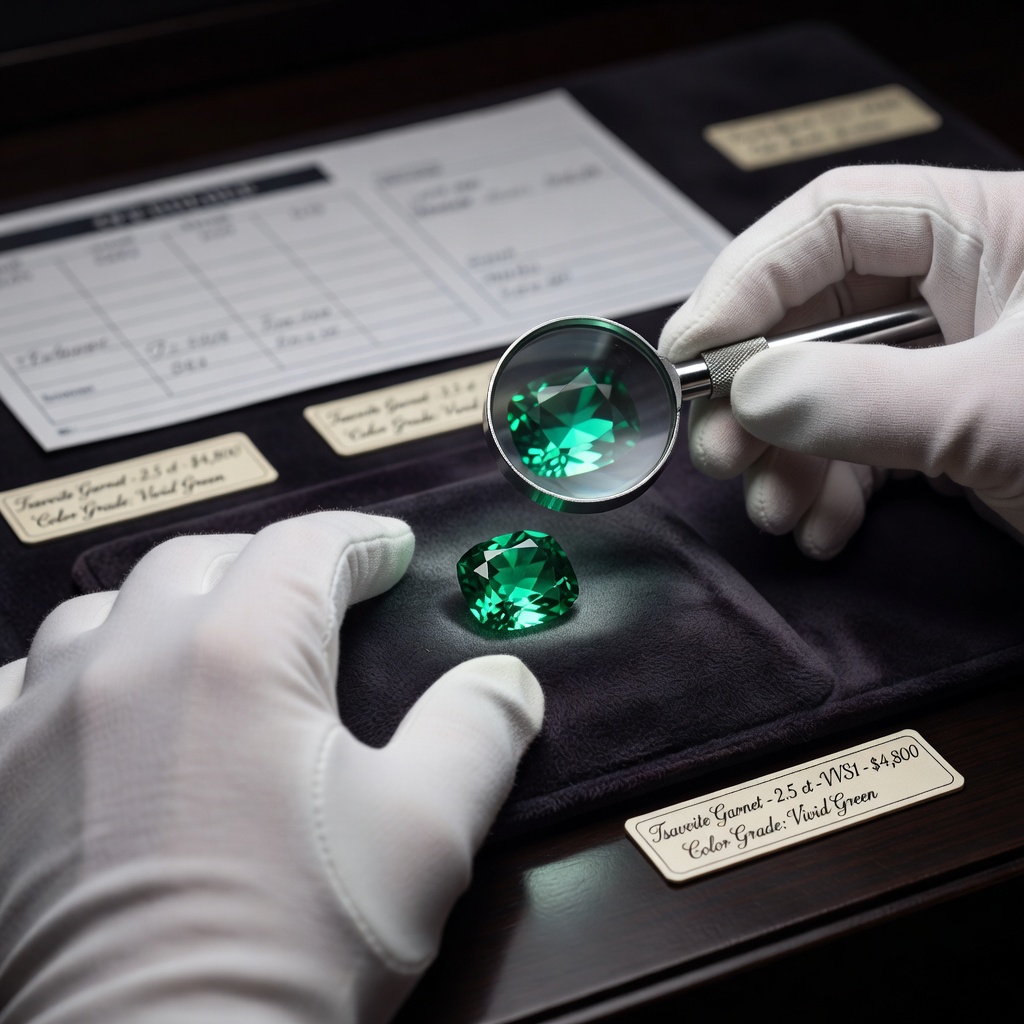
Acquiring certified tsavorite garnet documentation from recognized gemological laboratories provides essential protection against misrepresentation, treatments, and synthetic simulants in today's complex marketplace. Reputable institutions including the Gemological Institute of America (GIA), American Gem Society (AGS), and Gübelin Gem Lab provide detailed reports verifying natural origin, color grade, clarity characteristics, and geographic source when determinable through advanced spectroscopic analysis. For stones exceeding one carat or valued over $1,000, certification represents non-negotiable due diligence, providing baseline documentation for insurance appraisals and future resale transactions.
Treatment disclosure requirements significantly impact valuation, as untreated stones command 40-60 percent premiums over heated or fracture-filled specimens in the collector market. While high-quality tsavorites rarely require enhancement due to their natural clarity and stable color, some lower-grade material undergoes heat treatment to improve transparency or fracture filling to mask surface-reaching inclusions. Laboratory reports should explicitly state "no indications of heating" or "no clarity enhancement" to justify investment-grade pricing, with treatment disclosure statements serving as critical negotiation points when comparing seemingly similar stones across different vendors.
Synthetic tsavorite production using flux-grown or hydrothermal methods presents growing challenges for authentication, though current laboratory-grown material remains relatively rare compared to synthetic emeralds or rubies. Advanced detection requires sophisticated spectroscopic analysis available only at major laboratories, distinguishing natural chromium/vanadium absorption patterns from synthetic analogs. Buyers should insist on recent laboratory reports (less than five years old) for significant purchases, as detection capabilities continuously evolve, and older certificates may not address newer synthetic production methods entering the market.
2024 Market Trends and Investment Outlook
Current tsavorite investment value trends reflect significant supply chain disruptions affecting East African mining operations, with intermittent electricity shortages, regulatory changes, and environmental restrictions reducing rough material availability by an estimated 20-30 percent compared to five-year averages. These supply constraints coincide with explosive demand growth in Asian markets, particularly China and Thailand, where wealthy collectors increasingly favor tsavorite as a status symbol distinct from traditional emerald collections. Market analysis indicates consistent 8-12 percent annual price appreciation for fine-quality stones over the past decade, outpacing inflation and many traditional investment vehicles while offering tangible asset security.
Recent auction highlights underscore the gem's ascending status among ultra-high-net-worth collectors, with a 5.05-carat vivid green tsavorite from Tanzania selling for $15,400 per carat at a Hong Kong jewelry auction in early 2024, setting new records for the variety. This sale followed several 3-carat-plus stones achieving $8,000-$12,000 per carat at Geneva and New York auctions, demonstrating robust institutional confidence in tsavorite's blue-chip potential. Investment advisors specializing in tangible assets now recommend allocating 5-10 percent of precious gemstone portfolios to fine tsavorites over two carats, citing limited new deposit discoveries and declining yields from existing mines as fundamental support for continued appreciation.
Market specialists anticipate continued volatility in commercial-grade pricing while investment-grade material experiences steady appreciation driven by collector competition for increasingly scarce large stones. The closure of several marginal mining operations in Tanzania during 2023 further constrained supply of fine material, while luxury brands including Tiffany & Co. and Cartier increasingly feature tsavorite in high-jewelry collections, validating the gem's prestige status. For investors entering the market now, stones in the 2-5 carat range with vivid color and eye-clean clarity represent optimal value retention, balancing liquidity concerns against the exponential premiums commanded by museum-quality specimens over five carats.
Smart Buying Strategies and Budget Planning
Developing an effective tsavorite buying guide requires identifying optimal value sweet spots that balance quality, size, and budget constraints for different collector categories. First-time buyers should target the 1-2 carat range, where fine-quality vivid green stones with good clarity offer the best combination of visual impact and liquidity, typically ranging from $1,200 to $2,500 per carat depending on exact specifications. This size category provides sufficient presence for ring or pendant settings while avoiding the exponential premiums attached to stones exceeding three carats, allowing collectors to acquire high-color material without stretching into investment-grade budgets.
Vendor vetting criteria must include comprehensive return policies allowing independent appraisal within 72 hours of receipt, laser inscription of certification numbers on the girdle to prevent stone switching, and documented upgrade programs permitting trade-ins toward larger or finer specimens. Reputable dealers should provide high-resolution photography under multiple lighting conditions, including daylight-equivalent and incandescent sources, to verify color stability and saturation across environments. Requesting vendor references from previous high-value transactions and verifying membership in professional organizations such as the American Gem Trade Association (AGTA) or International Colored Gemstone Association (ICA) provides additional security when purchasing remotely.
Red flags indicating potential misrepresentation include prices 30 percent or more below market averages for stated quality, vendors unable to provide specific mine origin information, and stones offered without laboratory certification claiming "old stock" or "estate" provenance. Synthetic or glass-filled imitations often appear at tourist markets in East Asia or East Africa, where aggressive sales tactics and false certification documents accompany artificially low pricing. Always verify that certification documents include holographic security features and match the stone's exact weight and measurements, and consider conducting a specific gravity test or refractive index verification with an independent gemologist when purchasing uncertified material.
Maintenance, Insurance, and Resale Considerations
Proper tsavorite garnet care ensures long-term preservation of both beauty and value, with maintenance requirements generally less demanding than those for emeralds or opals due to the gem's inherent stability. Ultrasonic cleaners remain safe for untreated tsavorites, effectively removing accumulated oils and debris from jewelry settings without risking damage to the stone, though steam cleaning should be avoided if the stone contains significant liquid inclusions. Routine cleaning using warm water, mild dish soap, and a soft brush suffices for daily maintenance, while professional jewelry cleaning twice annually ensures prong security and setting integrity for valuable pieces.
Insurance appraisal requirements demand updated documentation every three to five years, reflecting current market values rather than original purchase prices, which may significantly undervalue appreciated stones. Appraisals should specify "replacement value" rather than "cash value," ensuring coverage adequate for acquiring equivalent quality stones in the event of loss, with detailed photographs and certification copies stored securely separate from the physical jewelry. High-value pieces exceeding $10,000 require scheduled riders on standard homeowner's policies or specialized jewelry insurance through companies like Jewelers Mutual or Chubb, providing coverage for mysterious disappearance and international travel that standard policies often exclude.
Secondary market liquidity for tsavorite remains strong for fine-quality stones over two carats with established provenance and current certification, though selling requires patience and access to specialized colored stone dealers rather than general pawn shops or gold-buying operations. Auction houses such as Bonhams, Christie's, and Heritage Auctions regularly feature tsavorite in their jewelry sales, particularly when mounted in signed pieces by prestigious designers, though consignment fees typically range from 10-20 percent of hammer price. Private sales through colored stone dealers often yield better net returns than auctions for stones under $20,000, with established relationships with specialty dealers providing the most reliable exit strategy for investors seeking to liquidate holdings.
Frequently Asked Questions
Why is tsavorite garnet more expensive than other garnet varieties?
Tsavorite commands premium prices due to its extreme rarity—it forms in specific geological conditions found only in East Africa. Unlike abundant red garnets, tsavorite deposits are limited and smaller in size, with stones over 3 carats being exceptionally rare. Its vivid green color, caused by chromium and vanadium, rivals fine emerald but without the inclusions, creating high demand among collectors.
How much should I expect to pay for a 1-carat tsavorite garnet?
A 1-carat tsavorite typically ranges from $400 to $2,500 depending on quality. Commercial-grade stones with lighter green color and visible inclusions cost $400-$800. Fine quality vivid green stones with good clarity run $1,200-$2,000, while top-color, investment-grade specimens can exceed $2,500 per carat. Always verify certification for purchases over $1,000.
Are tsavorite garnets a good investment compared to emeralds?
Tsavorites offer compelling investment potential with 8-12% annual price appreciation over the past decade, outpacing inflation. They provide advantages over emeralds: superior durability (no oiling required), better clarity at lower price points, and limited supply from shrinking East African mines. However, emeralds currently maintain stronger brand recognition and liquidity in resale markets.
What color tsavorite garnet is most valuable?
The most valuable tsavorites display vivid, saturated forest green to slightly bluish-green hues with medium-dark tone, similar to fine Colombian emerald color. Stones with yellowish undertones or overly dark 'closed' colors command lower prices. The ideal tsavorite shows strong fluorescence under daylight, appearing to glow from within, with even color distribution throughout the stone.
Do tsavorite garnets require special certification?
Yes, certification from reputable labs like GIA, AGS, or Gübelin is essential for tsavorites over 1 carat or costing over $1,000. The certificate should confirm natural origin, indicate any treatments (high-quality tsavorites are typically untreated), and verify geographic origin when possible. Certification protects against synthetics, simulants, and undisclosed treatments that significantly affect value.
Can tsavorite garnets be treated or enhanced to improve appearance?
Unlike emeralds that commonly receive oiling, high-quality tsavorites are rarely treated due to their natural clarity and color stability. However, some lower-quality stones may undergo fracture filling or heat treatment. Always demand disclosure of treatments, as untreated stones command 40-60% higher prices. Reputable dealers will provide lab reports confirming 'no indications of heating' for investment-grade pieces.
Where is the best place to buy tsavorite garnet?
Purchase from established gem dealers specializing in colored stones, high-end jewelry stores with GIA-certified gemologists, or reputable online vendors offering detailed photography, 360-degree videos, and return policies. Avoid tourist traps in East Africa where stones may be misrepresented. The Tucson Gem Show and Hong Kong jewelry fairs offer competitive wholesale pricing for serious collectors with proper vetting.
How do I know if I'm paying a fair price for tsavorite?
Compare prices across 3-4 reputable vendors for similar specifications (carat, color grade, clarity). Request independent appraisal within the return period. Fair pricing aligns with the Rapaport-color stone pricing guides or GemGuide wholesale listings plus standard retail markup. Be wary of deals 30%+ below market average, which often indicate synthetic stones, glass imitations, or undisclosed treatments.