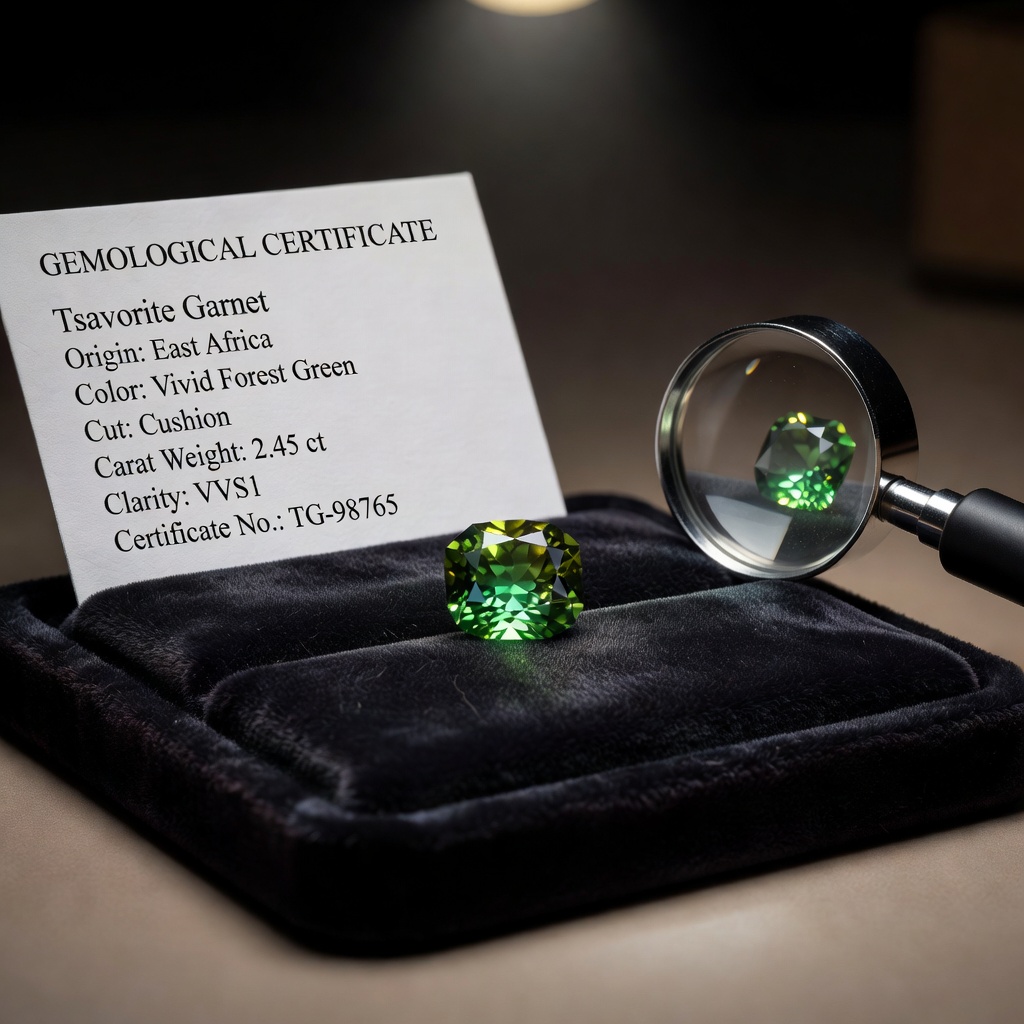
What Is Tsavorite Garnet? Understanding the Basics
Tsavorite represents the pinnacle of green grossular garnet varieties, distinguished by its remarkable chromium and vanadium coloring agents that produce an intense green hue rivaling fine emerald. This rare green tsavorite gemstone belongs to the garnet family's calcium-aluminum silicate branch, specifically the grossular species, yet stands apart from its yellow, orange, and colorless cousins through its extraordinary color saturation and brilliance. Unlike many colored gemstones that require heat treatment or other enhancements to achieve marketable color, tsavorite's vivid green occurs entirely through natural geological processes involving specific trace element combinations during crystallization.
The modern discovery of tsavorite traces back to 1967 when Scottish geologist Campbell Bridges encountered vivid green crystals while prospecting in northeastern Tanzania. Following political complications in Tanzania, Bridges relocated his mining operations across the border into Kenya, where he established the legendary Scorpion Mine in the Taita-Taveta district. The gemstone received its moniker from Henry Platt, then-president of Tiffany & Co., who combined "Tsavo"—the name of the vast national park spanning the Kenya-Tanzania border—with the mineralogical suffix "-ite" to create a marketable identity that would rival established green gems.
Tiffany & Co.'s marketing muscle positioned tsavorite as the premium green garnet variety, emphasizing its natural, untreated status and exceptional rarity compared to emeralds. Today, Kenyan tsavorite from the original Scorpion Mine district and surrounding claims remains the benchmark for quality, though deposits in Tanzania's Merelani Hills and emerging sources in Madagascar contribute to global supply. The gem's extreme scarcity—crystals suitable for faceting larger than two carats are geological anomalies—cements its status as a collector's stone rather than a mass-market commodity.
Color Grading: The Primary Value Determinant
When evaluating a green tsavorite gemstone, color saturation and tone serve as the most critical value determinants, often accounting for sixty to seventy percent of a stone's market price. The ideal tsavorite displays a vivid, medium to medium-dark green with strong saturation that appears almost "electric" or "neon" under natural daylight conditions. Stones exhibiting pure green without yellowish or bluish secondary hues command the highest premiums, while those showing excessive yellow modifiers sell as commercial grade at significantly reduced tsavorite garnet prices.
The distinctive green coloration stems from trace amounts of chromium and vanadium substituting for aluminum in the crystal lattice, with chromium contributing the pure green component and vanadium enhancing depth and saturation. This chemical composition means tsavorite maintains its color consistency better than many gems under different lighting conditions, though connoisseurs should always examine stones under natural daylight and incandescent lighting before purchasing. Daylight typically reveals the true potential of the stone's green saturation, while incandescent lighting may slightly warm the appearance, emphasizing any yellow components present.
The "neon" or "electric" green premium factor separates investment-grade specimens from commercial material, with the most desirable stones exhibiting a glowing, self-illuminated appearance reminiscent of high-quality Colombian emeralds but with superior brilliance. When examining potential purchases, look for stones that remain vibrant rather than appearing blackish or "closed" in indoor lighting. Case studies from major auction houses demonstrate that tsavorites displaying this electric quality in sizes above two carats have appreciated over 300% in the past decade, underscoring the importance of prioritizing color over absolute clarity in this gem variety.
Clarity Standards and Inclusion Evaluation
Understanding tsavorite clarity grades requires adjusting expectations from diamond standards, as this garnet variety typically contains characteristic inclusions that serve as fingerprints of its geological formation. Common internal features include small crystal inclusions (often diopside or graphite), feather-like fractures, and needle-like growth tubes that reflect the turbulent conditions of the East African deposits where these gems form. Unlike emeralds, which almost always contain visible "jardin" (garden) inclusions accepted as typical, tsavorite collectors generally demand cleaner appearance standards due to the gem's higher transparency and brilliance potential.
The industry distinguishes between "eye-clean" stones, which show no visible inclusions to the unaided eye at a distance of six to twelve inches, and "loupe-clean" specimens that remain inclusion-free under ten-power magnification. For most jewelry applications, eye-clean clarity represents the practical standard, offering excellent value while maintaining aesthetic appeal. However, investment-grade material typically requires loupe-clean or near-loupe-clean status, particularly in sizes exceeding two carats where inclusions become more noticeable and potentially affect durability.
Inclusion placement significantly impacts both durability and setting considerations, with feathers or fractures near the girdle or sharp points (corners) of emerald-cut stones presenting heightened breakage risks during setting or daily wear. When working with a tighter budget, prioritize stones with inclusions clustered near the pavilion (bottom) rather than the table (top), as these will be less visible once set while maintaining structural integrity. Reputable dealers following proper tsavorite garnet buying guide protocols will disclose any surface-reaching inclusions that might compromise the stone's longevity, particularly important for engagement ring selections where daily wear exposure is guaranteed.
Cut, Shape, and Carat Weight Considerations
Master cutters face unique challenges when fashioning tsavorite rough, as the gem's pleochroic nature and tendency toward irregular crystal formations require expert orientation to maximize color saturation while minimizing weight loss. Cushion, oval, and emerald cuts prove most popular for this green tsavorite gemstone, as these shapes with their generous pavilion depths help concentrate color and prevent the "windowing" effect—where light passes directly through the stone rather than reflecting back to the eye. Brilliant rounds, while available, often sacrifice desirable body color for brilliance, making them less common in fine material.
Carat weight availability presents the most significant constraint for collectors, with crystals yielding clean faceted stones over three carats representing less than one percent of total production. This extreme scarcity creates exponential jumps in tsavorite garnet prices at specific thresholds: stones crossing the one-carat mark typically command 40-50% premiums per carat compared to 0.90-carat equivalents, while the two-carat and three-carat barriers trigger even more dramatic price escalations. For investors tracking tsavorite investment potential, these size premiums reflect genuine rarity rather than arbitrary marketing, as mining operations report finding fewer than ten clean crystals suitable for cutting above five carats annually across all East African deposits.
Poor cutting quality manifests through two primary defects: windowing, where the center of the stone appears washed out or "dead," and extinction, where dark patches dominate the face-up appearance due to overly deep pavilion angles. When evaluating cut quality, tilt the stone slightly from side to side under a single light source; well-cut tsavorites should maintain relatively even color distribution without obvious dark zones or transparent centers. Given the material's value, insist on symmetry ratings of "Good" or better, as asymmetrical cuts not only reduce aesthetic appeal but also indicate potential structural weaknesses or attempts to hide inclusions through awkward faceting.
Geographic Origins: Kenya vs. Tanzania vs. Madagascar
The provenance of tsavorite significantly influences collector perception and market value, with Kenyan tsavorite from the Taita-Taveta district historically commanding the strongest premiums due to its association with Campbell Bridges' original discoveries and the legendary Scorpion Mine. Kenyan material typically exhibits the deep, forest-green tones with yellow undertones that defined the gem's early reputation, though modern mining in the region faces increasing challenges from depth limitations and regulatory changes. The Scorpion Mine and adjacent claims continue producing the benchmark material against which all other sources are measured, particularly for stones exhibiting the coveted "electric" green saturation.
Tanzanian deposits, particularly those in the Merelani Hills near Arusha, produce significant quantities of commercial-grade material and occasional fine specimens that rival Kenyan quality. Tanzanian tsavorite often displays slightly lighter, more yellowish-green tones compared to Kenyan material, though exceptional pockets yield deeply saturated gems indistinguishable from their northern neighbors to the untrained eye. Political stability and mining infrastructure improvements in Tanzania have actually increased the country's market share in recent years, though purists still seek Kenyan certificates when building high-end collections.
Madagascar represents the newest frontier in tsavorite mining, with discoveries in the island's southern regions offering potential alternatives to East African supplies. While Malagasy material sometimes shows slightly bluish-green modifiers uncommon in Kenyan or Tanzanian stones, cutting-edge deposits are improving in quality and size availability. From an investment perspective, origin documentation matters less for stones under two carats, where color quality supersedes geographic provenance, but for museum-quality specimens exceeding five carats, Kenyan origin certificates from laboratories like Gubelin or AGL can add 15-25% premiums to tsavorite garnet prices at auction.
Tsavorite vs. Emerald: The Smart Alternative
The tsavorite vs emerald debate centers on durability, treatment status, and value proposition, with tsavorite offering distinct advantages for the knowledgeable buyer seeking green gemstone jewelry. While both gems register approximately 7.5 on the Mohs hardness scale, tsavorite possesses superior toughness due to its garnet structure's lack of cleavage planes—meaning it resists chipping and breaking better than emerald, which exhibits distinct cleavage that requires protective settings and careful handling. This toughness advantage makes tsavorite particularly suitable for engagement rings and daily wear pieces where emerald might require excessive caution.
Treatment differences represent perhaps the most significant distinction between these green rivals. The vast majority of emeralds undergo oiling or resin filling to improve clarity appearance, treatments that require periodic reapplication and affect long-term value stability. Conversely, tsavorite is typically untreated; heating is exceptionally rare and generally only performed to improve stones with slight brownish components, with most fine material entering the market entirely natural. This untreated status appeals to purists and investors concerned about disclosure issues that periodically rock the emerald market, providing peace of mind regarding long-term stability and resale transparency.
From a visual standpoint, tsavorite offers superior brilliance and fire due to its higher refractive index (1.74 vs. emerald's 1.58-1.60), resulting in more "life" and scintillation under lighting. While emerald maintains cachet through historical association and royal connections, tsavorite garnet prices currently offer exceptional value—fine tsavorite typically costs 25-40% less than equivalent-quality Colombian emerald, despite being significantly rarer. For collectors building forward-looking portfolios, tsavorite represents an undervalued asset with room for appreciation, whereas emerald prices have already reached mature market levels with less upside potential for new entrants.
Current Market Pricing and Investment Outlook
Current tsavorite garnet prices reflect a stratified market where quality parameters create enormous valuation spreads, with commercial-grade material (light green, visible inclusions, small sizes) trading between $200-$500 per carat, while fine vivid green stones in the 1-2 carat range command $1,000-$3,000 per carat. Exceptional specimens exceeding three carats with top color and clarity represent true investment-grade material, regularly achieving $8,000-$15,000 per carat at specialty auctions and high-end dealer networks. These price levels, while substantial, remain below equivalent-quality emerald pricing, suggesting continued upside potential for early adopters recognizing tsavorite investment potential.
Price appreciation drivers include increasing mining difficulties as deposits deplete, environmental regulations limiting new claim development in Kenya's Tsavo region, and growing consumer awareness displacing lower-quality alternatives like green glass or treated quartz. The gem's liquidity, while not matching diamond or ruby markets, has improved significantly with the rise of specialized colored stone dealers and online platforms catering to serious collectors. However, investors should recognize that tsavorite remains a "connoisseur's stone" requiring specialized knowledge to liquidate profitably, unlike more standardized commodities.
For those considering tsavorite as a tangible asset, focus on "collectible sizes"—stones between 2-5 carats with vivid green color, eye-clean clarity, and fine cutting from reputable dealers providing origin documentation. Case studies from the past decade show that such stones have appreciated at compound annual rates of 8-12%, outperforming many traditional investments while providing wearable enjoyment. When building an investment position, prioritize a few exceptional stones over numerous mediocre specimens, as the ultra-high-end market (5+ carats, top color) shows the strongest price inelasticity and collector demand.
Certification, Treatments, and Authentication
Protecting your investment in fine green tsavorite gemstone material requires rigorous authentication protocols, as the high value of top specimens has attracted synthetic producers and treatment laboratories seeking to enhance inferior material. Fortunately, tsavorite rarely undergoes treatment compared to other gems; heating is uncommon and typically only applied to lighten overly dark stones or remove brownish tints, with the vast majority of fine material sold entirely natural. However, verification through independent laboratories remains essential, as undisclosed heat treatment or fracture-filling occasionally appears in lower-quality commercial goods attempting to masquerade as fine specimens.
Recommended certification laboratories include the Gemological Institute of America (GIA), GemResearch Swisslab (GRS), American Gemological Laboratories (AGL), and Gubelin Gem Lab, each providing detailed reports on color origin, geographic source, and treatment status. For investment-grade purchases, insist on "Origin Reports" that confirm Kenyan tsavorite or Tanzanian provenance, as these documents significantly impact resale value and insurance valuations. Reports should explicitly state "no indications of heating" and provide clarity diagrams plotting the location of any inclusions that might affect durability.
Red flags in documentation include vague "appraisals" substituting for laboratory reports, certificates from unknown laboratories lacking ISO accreditation, and sellers claiming "museum quality" for stones under one carat. When examining tsavorite clarity grades on reports, understand that "slightly included" in tsavorite terminology often indicates eye-clean material, whereas "heavily included" should be avoided for fine jewelry. Synthetic tsavorites, while rare, do exist; they typically show overly perfect clarity and slightly "off" color tones that appear too uniform compared to natural material's subtle variations.
Setting Selection and Daily Wear Practicality
Translating your green tsavorite gemstone into wearable jewelry requires careful setting selection that balances aesthetic presentation with physical protection, particularly given the stone's value and relative softness compared to sapphire or diamond. For engagement rings or daily wear pieces, protective settings such as bezels, partial bezels, or halo designs with diamond accents provide crucial edge protection against the knocks and impacts that occur during normal activities. Prong settings, while maximizing light exposure, should feature robust six-prong configurations for stones over one carat, with the girdle (widest part) fully protected rather than exposed.
Metal choices significantly impact the perceived color of tsavorite, with yellow gold enhancing any yellowish secondary tones in the stone while platinum and white gold emphasize the pure green component and provide contemporary contrast. Rose gold creates distinctive vintage appearances but may clash with the cool green tones of fine material. From a practical standpoint, 18-karat gold offers optimal balance between purity (rich color) and hardness (scratch resistance), while platinum's density provides superior security for valuable center stones despite higher initial cost.
Maintenance protocols for tsavorite jewelry include professional cleaning every six months using ultrasonic or steam methods (safe for untreated stones), home cleaning with mild soap and soft brushes, and removal during heavy physical activities, gardening, or household cleaning involving chemicals. While tsavorite's hardness of 7-7.5 suits daily wear, it can scratch if stored alongside harder gems like diamonds or sapphires; always store pieces in individual soft pouches or compartmented jewelry boxes. With proper setting selection and care protocols, tsavorite jewelry provides decades of wear while maintaining the investment integrity that serious collectors demand.
Frequently Asked Questions
What exactly is tsavorite garnet and why is it so expensive?
Tsavorite is a rare green variety of grossular garnet colored by chromium and vanadium. Its high price stems from extreme rarity—deposits are limited to East Africa, mining is difficult, and crystals over 2 carats are exceptionally scarce, making fine specimens more valuable than emeralds of equivalent quality.
How much should I expect to pay for quality tsavorite per carat?
Commercial quality tsavorite ranges $200-$500 per carat, while fine quality with vivid green color commands $1,000-$3,000 per carat. Exceptional stones over 3 carats with top color can exceed $8,000-$15,000 per carat due to extreme rarity.
Is tsavorite a better investment than emerald?
Tsavorite often offers better investment potential than emerald because it's typically untreated (unlike oiled emeralds), has superior durability due to higher toughness, and prices are still appreciating from a lower base. However, the resale market is less liquid than established emerald markets.
What color should I prioritize when buying tsavorite?
Prioritize a vivid, saturated green with medium to medium-dark tone. The most valuable tsavorites display a 'electric' or 'neon' green without excessive yellow or blue modifiers. Avoid stones that appear too dark (blackish) or too light (minty), as these significantly reduce value.
How can I verify that a tsavorite is natural and untreated?
Always request certification from reputable laboratories like GIA, GRS, or AGL. Natural tsavorite is rarely treated, but verification papers should explicitly state 'no indications of heating.' Be wary of unusually cheap stones or sellers who cannot provide origin documentation.
Is tsavorite durable enough for an engagement ring?
Yes, with a hardness of 7-7.5 on the Mohs scale and excellent toughness (no cleavage planes), tsavorite is suitable for daily wear engagement rings. However, choose protective settings like bezels or halos for stones over 2 carats, and remove the ring during heavy physical activities.
Where is the finest tsavorite garnet mined?
The most prestigious tsavorite historically comes from the Scorpion Mine in Kenya's Taita-Taveta district, producing the deepest green colors. Tanzania's Merelani Hills also produce fine material, while Madagascar is an emerging source. Kenyan material typically commands premium prices in the current market.
What size tsavorite offers the best value for money?
Stones between 1.00-1.50 carats offer the optimal balance of visual impact and affordability. While specimens under 1 carat are more affordable per carat, they often lack the color saturation of larger stones. The price jumps significantly at 2+ carats, making the 1-1.5ct range the 'sweet spot' for collectors.