Tektite Buying Guide: Navigating the World of Impact Glass Collecting
Collecting tektites offers a unique opportunity to own tangible evidence of cosmic events that shaped Earth's geological history. This comprehensive Tektite Buying Guide provides essential knowledge for both novice enthusiasts and serious impactite collectors seeking to acquire these fascinating natural glass formations. Whether you are drawn to the olive-green allure of moldavite or the mysterious black forms of indochinite specimens, understanding the scientific principles behind these meteorite impact products ensures you make informed purchasing decisions. From verifying tektite authenticity to navigating market pricing, this guide covers every aspect of building a meaningful collection of these extraordinary geological treasures.
What Are Tektites? Understanding Cosmic Impact Glass
Formation Through Meteorite Impact
Tektites represent one of the most dramatic examples of terrestrial transformation caused by extraterrestrial forces, formed when massive meteorite strikes melt surface rock and eject it into the atmosphere. Unlike volcanic glass such as obsidian, these objects originate from the hyper-velocity impact of asteroids or comets traveling at speeds exceeding eleven kilometers per second. The intense heat generated—reaching temperatures of 1,700 to 2,100 degrees Celsius—melts silica-rich surface materials including sand, clay, and soil, flinging molten droplets hundreds or thousands of kilometers from the impact site. As these incandescent projectiles travel through the atmosphere, they cool rapidly while spinning, creating the distinctive aerodynamic shapes characteristic of many tektite varieties before landing in designated areas called strewn fields.
Distinguishing Tektites from Obsidian and Slag
Authentic tektite identification requires understanding key physical differences that separate genuine impactite glass from common terrestrial alternatives like obsidian or industrial slag. While both tektites and obsidian are natural glasses, obsidian typically contains crystalline inclusions and exhibits conchoidal fracturing patterns indicative of volcanic cooling rather than atmospheric flight. Industrial slag, often sold as fake tektites, usually contains bubbles of uniform size, visible flow banding, or metallic inclusions from the smelting process that natural meteorite glass lacks. Genuine specimens display irregular surface textures with microscopic pitting caused by ground residence and chemical weathering, along with internal flow structures and lechatelierite inclusions—pure silica glass formed only under extreme thermal shock conditions impossible to replicate in standard glass manufacturing.
The Four Major Strewn Fields
Tektite distribution follows specific geographic patterns known as strewn fields, with four primary regions containing distinct varieties that differ in age, chemistry, and morphology. The Australasian strewn field represents the largest and youngest deposit, covering much of Southeast Asia and Australia with black indochinite specimens and australites formed approximately 790,000 years ago. The Central European strewn field, created by the Ries impact crater in Germany roughly 15 million years ago, produced the coveted green moldavite found primarily in the Czech Republic. North America's strewn field, dating to 35 million years ago, yielded bediasites from Texas and georgiaites from Georgia, while the Ivory Coast strewn field contains rare black tektites associated with the Bosumtwi impact crater in Ghana.
Chemical Composition and Physical Properties
Chemical analysis reveals that tektites consist predominantly of silica (SiO2) ranging from 68 to 98 percent content, with varying amounts of aluminum, iron, magnesium, and potassium oxides depending on the target rock composition at the impact site. This high silica content creates a glassy, amorphous structure devoid of crystalline organization, though some varieties contain relict mineral grains or shocked quartz crystals that survived the melting process. Physical properties include conchoidal fracture patterns when broken, specific gravity measurements between 2.3 and 2.5 (lighter than most crystalline rocks but heavier than standard bottle glass), and refractive indices ranging from 1.48 to 1.52. These measurable characteristics provide objective criteria for meteorite glass identification and differentiate authentic specimens from counterfeits.
Popular Tektite Varieties for Collectors
Moldavite from the Czech Republic
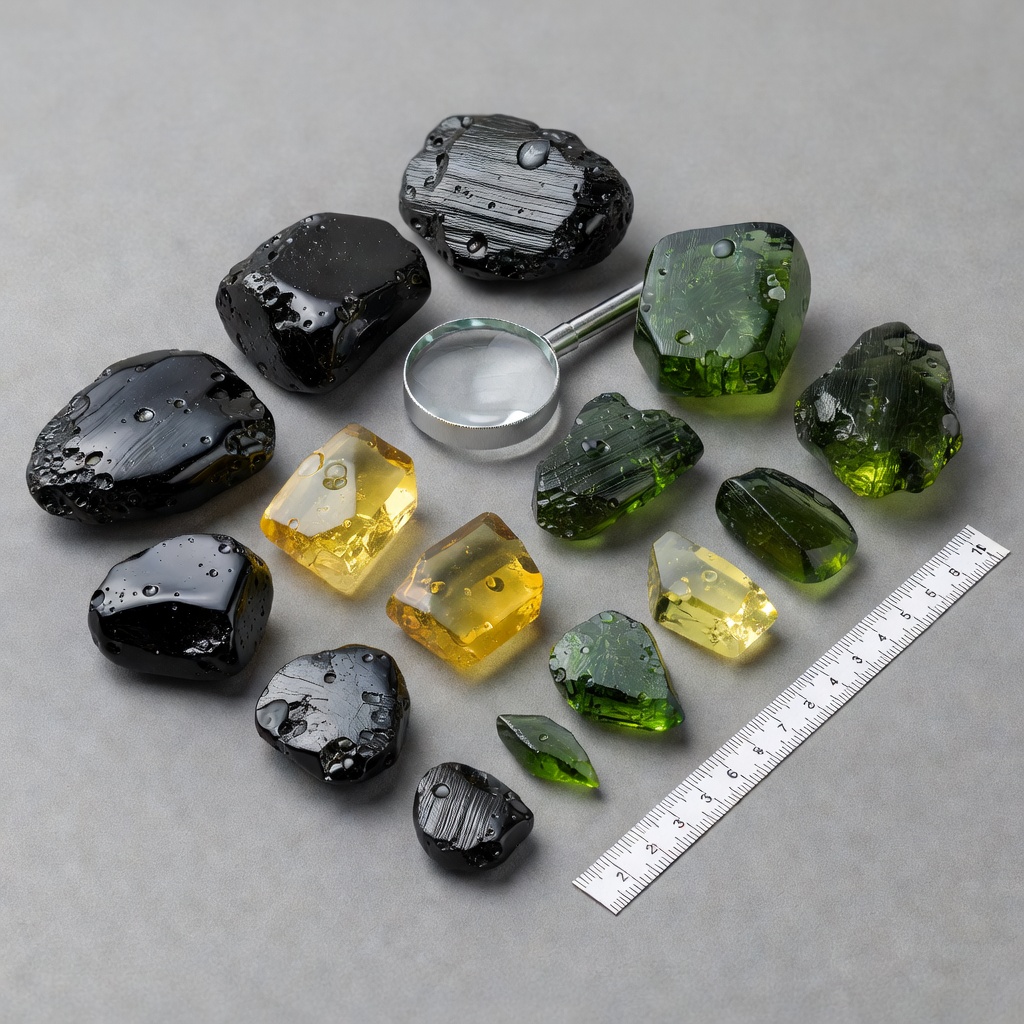
Moldavite stands as the most celebrated and valuable tektite variety, distinguished by its translucent olive-green to forest-green coloration and intricate surface sculpture resembling wrinkled leather or feathery textures. Formed during the Miocene epoch when a massive asteroid struck the Nördlinger Ries crater in Germany, these specimens traveled northwest to land primarily in the Vltava River basin of Bohemia and Moravia. When considering Moldavite buying tips, collectors should examine the surface texture carefully—authentic pieces display characteristic shallow pitting, U-shaped grooves, and etch marks created by millions of years of ground residence in acidic soil conditions. High-quality specimens exhibit gem-like transparency with internal swirls and bubbles, though the market has seen an influx of counterfeit green glass from China that lacks the natural surface weathering and internal flow structures of genuine Czech moldavite.
Indochinite Specimens from Southeast Asia
Indochinite specimens comprise the most abundant tektite variety, appearing as opaque black to dark brown glass distributed across Thailand, Vietnam, Cambodia, Laos, and southern China within the vast Australasian strewn field. These specimens display remarkable morphological diversity, ranging from splash-form buttons and dumbbells to teardrops and irregular chunks, with larger layered specimens known as Muong Nong types showing distinct internal stratification. Collectors prize indochinites for their dramatic surface features, including deep furrows, pitting, and etched patterns created by chemical weathering in tropical environments over hundreds of thousands of years. Unlike the translucent moldavite, these opaque black specimens offer affordable entry points for beginning collectors while still providing excellent examples of aerodynamic shapes formed during atmospheric ablation.
Libyan Desert Glass
Libyan Desert Glass represents one of the most visually striking tektite varieties, characterized by its transparent to translucent yellow-green to pale yellow coloration found scattered across the Great Sand Sea of western Egypt and eastern Libya. Dating to approximately 29 million years ago, these specimens vary from milky opaque fragments to crystal-clear pieces with gem-quality clarity, with the most prized examples displaying a lemon-yellow hue without internal clouding. Historical significance adds to their allure—archaeologists discovered carved scarabs of this material in Tutankhamun's tomb, indicating ancient Egyptian appreciation for these cosmic stones. When evaluating Libyan Desert Glass, collectors should note that high-clarity specimens command premium prices, while pieces containing dark inclusions or bubbles (called "schlieren") offer interesting scientific specimens at more moderate price points.
Australites, Bediasites, and Regional Varieties
Beyond the three primary varieties, specialized collectors seek regional tektites including australites from Australia, which display unique flanged button shapes created by precise aerodynamic heating and ablation during atmospheric entry. These specimens often show a distinctive flange or rim around the periphery, representing some of the most perfectly shaped natural glass objects known to science. North American collectors pursue bediasites from Texas—dark olive to black specimens dating to the Eocene epoch—and the rarer georgiaites, which appear as translucent pale green to yellow-green fragments found primarily in gravel deposits. Each regional variety offers distinct collecting challenges and rewards, with australites particularly prized for their aesthetic perfection and bediasites valued for their historical significance as the first tektites scientifically linked to meteorite impacts.
How to Verify Tektite Authenticity
Surface Texture Analysis Techniques
Authenticating tektites requires careful examination of surface features under magnification, as natural specimens display complex textures impossible to replicate in manufactured glass. Genuine tektites exhibit irregular pitting ranging from microscopic pinpricks to larger depressions, often arranged in linear patterns following the direction of atmospheric flight or chemical etching during ground residence. Unlike machine-tumbled or acid-etched fakes, natural specimens show variation in pit depth and distribution, with U-shaped grooves and parabolic etch marks created by differential chemical weathering. When examining potential purchases for tektite authenticity, use a 10x loupe to look for flow lines on the surface—fine ridges and grooves indicating the direction of molten glass movement during formation—and avoid pieces showing perfectly uniform texture, concentric drilling marks, or the mold seams characteristic of cast glass imitations.
Specific Gravity Testing Methods
Specific gravity testing provides a quantitative method for verifying tektite identity using basic equipment available to most collectors, offering definitive differentiation from common glass fakes. To perform this test, weigh the specimen in air using a digital scale accurate to 0.01 grams, then suspend it from a thin wire and weigh it submerged in distilled water at room temperature. Divide the air weight by the difference between air and water weights to obtain specific gravity—authentic tektites typically range between 2.32 and 2.50 depending on variety, with moldavite generally testing 2.32-2.38 and indochinites 2.40-2.50. Industrial glass usually measures 2.50-2.60, while obsidian ranges 2.35-2.60 but can be distinguished by its crystalline inclusions, making specific gravity a reliable secondary test when combined with visual examination for fake tektites detection.
Optical Properties and UV Fluorescence
Advanced authentication involves examining optical characteristics including refractive index and ultraviolet fluorescence patterns that vary predictably across tektite varieties. Using a refractometer with refractive index fluid, authentic tektites generally register between 1.48 and 1.52, significantly lower than most crystalline gemstones but consistent across genuine specimens. Under short-wave and long-wave ultraviolet light, most tektites appear inert or show weak yellowish-green fluorescence, though some moldavite varieties display distinct green or white reactions. Be wary of pieces showing strong blue fluorescence (indicating optical brighteners in manufactured glass) or perfect transparency without internal swirls, bubbles, or flow structures, as these characteristics suggest modern glass production rather than ancient cosmic impact events.
Quality Grading and Valuation Factors
Color Intensity and Consistency
Color evaluation forms the foundation of tektite quality grades, with premium specimens displaying saturated, consistent hues throughout the matrix without muddying or zoning. For moldavite, the most valuable pieces exhibit deep forest green to olive-green tones with high translucency, while pale yellow-green or brownish specimens command lower prices; similarly, Libyan Desert Glass achieves maximum value with intense lemon-yellow coloration free from milky clouding. Indochinites and other black varieties should appear uniformly opaque without brownish oxidation spots or reddish surface staining that indicates weathering or mineral staining. When assessing valuable specimens, examine the piece under both natural and artificial lighting to ensure color stability, as some treated or fake stones show color shifts or unnatural fluorescence under different light sources.
Surface Sculpture and Primary Features
The quality of surface sculpture significantly impacts aesthetic and monetary value, with collectors seeking specimens that retain primary features formed during the original cooling and flight phases. Primary surfaces display flow ridges, pitting, and aerodynamic sculpturing created during atmospheric entry, while secondary surfaces show etching and pitting from chemical weathering during ground residence—both types hold value, though unetched primary surfaces command premiums for their rarity. Avoid specimens showing fresh conchoidal fractures or chipped edges that disrupt the natural contours, as damage reduces both visual appeal and scientific value. Museum-grade pieces typically exhibit complete, undamaged surfaces with dramatic sculptural elements such as deep grooves, flanges, or distinct button rims that demonstrate the formative aerodynamic forces.
Inclusions and Clarity Considerations
Internal characteristics require careful evaluation, as certain inclusions enhance scientific value while others may indicate fakery or lower quality. Desirable inclusions include lechatelierite threads—wispy strands of pure silica glass formed only under extreme thermal shock—and spherical or teardrop-shaped bubbles distributed irregularly throughout the matrix. However, excessive clouding, banded layering (unless characteristic of Muong Nong types), or perfectly round bubbles arranged in patterns suggest manufactured glass. For transparent varieties like moldavite and Libyan Desert Glass, clarity grading follows gemstone standards, with eye-clean specimens (no visible inclusions at 12 inches) commanding the highest prices, though collectors sometimes prefer included pieces that definitively prove natural origin.
Damage Assessment Standards
Condition evaluation follows strict standards similar to mineral and fossil collecting, where even minor chips or fractures significantly impact value depending on the specimen's rarity and size. Examine edges and high points carefully under magnification for fresh fractures that appear concoidal and glassy rather than weathered and dulled, indicating recent damage rather than ancient breakage. For common varieties like indochinites, minor edge wear is acceptable and expected, but museum-quality specimens must be pristine. Large moldavite or Libyan Desert Glass pieces showing damage may lose 50-75 percent of their potential value, making condition assessment crucial when purchasing expensive specimens. Always request detailed photographs showing all angles and any damage disclosure before completing high-value transactions.
Size, Weight, and Display Considerations
Weight Ranges by Tektite Variety
Understanding typical tektite sizes by variety helps collectors set realistic expectations and budget appropriately for specimens of different weights. Moldavite rarely exceeds 100 grams, with most museum-quality pieces ranging between 10 and 50 grams; specimens over 100 grams command extreme premiums due to rarity. Indochinite specimens offer greater size diversity, with common pieces available from 1 gram to over 1 kilogram, though aerodynamically shaped buttons typically range 10-50 grams. Libyan Desert Glass occurs in fragments ranging from small chips under 5 grams to massive pieces exceeding 20 kilograms, though transparent gem-quality material becomes exponentially rarer above 50 grams. When planning purchases, remember that collector pieces in the 20-100 gram range offer optimal display presence while maintaining liquidity in the resale market.
Complete Specimens Versus Fragments
Collectors must decide between acquiring complete, shaped specimens versus fragments, with each category offering distinct advantages for different collecting goals. Complete specimens—those retaining their original aerodynamic forms such as buttons, teardrops, or dumbbells—provide the best examples of atmospheric ablation processes and typically command 200-500 percent premiums over fragments of equivalent weight. However, fragments often display superior internal clarity and larger surface areas for viewing flow structures, making them preferable for scientific study or lapidary purposes. For display purposes, complete specimens require less interpretation for viewers to appreciate their cosmic origin, while large fragments of premium material like gem-grade Libyan Desert Glass may actually cost less per gram while offering more impressive visual mass.
Display Requirements and Case Specifications
Proper display protects tektites from environmental damage while showcasing their unique optical properties and surface textures. Use museum-quality display cases with UV-protective acrylic or glass, as prolonged exposure to ultraviolet light can fade the color of sensitive varieties like moldavite over decades. Individual stands or padded mounts prevent rolling and edge damage for rounded specimens, while risers and angled supports create dramatic lighting effects that highlight translucency in thinner pieces. For indochinites and other opaque varieties, matte black backgrounds enhance the visibility of surface sculpturing and etch patterns. Consider humidity-controlled display environments, particularly for specimens stored in wooden cases that may off-gas acids, and avoid direct sunlight that can create thermal shock through greenhouse effects in sealed cases.
Market Pricing and Budget Planning
Price Per Gram Comparisons
Tektite prices vary dramatically across varieties and quality grades, requiring careful buying budget planning based on current market conditions. Common indochinite specimens typically trade between $1 and $5 per gram for standard quality, making them accessible for beginners, while moldavite ranges from $20 to $100+ per gram depending on color, clarity, and size—with exceptional pieces exceeding $200 per gram. Libyan Desert Glass occupies the premium tier, with translucent yellow material commanding $50 to $200 per gram, and museum-grade pieces fetching significantly more. These prices reflect both scarcity and demand, with moldavite experiencing significant price appreciation due to metaphysical market interest while scientific-grade indochinites remain stable, affordable options for impactite collecting.
Rarity Premiums and Locality Factors
Beyond base pricing, specific locality premiums and unusual characteristics can multiply values exponentially for certain specimens. Moldavite from specific mines such as Chlum or famous localities like Besednice commands 50-100 percent premiums over generic Czech material due to superior color and surface sculpture. Australites with perfect flanges or unusual shapes like "turkey tracks" (paired specimens) may sell for $10-20 per gram despite being chemically identical to common indochinites. Libyan Desert Glass containing dark streaks or "ghost" inclusions of cristobalite (high-temperature quartz) appeals to scientific collectors and may command premiums over clear material. Always verify locality claims through provenance documentation, as unscrupulous sellers may mislabel common material as rare localities to inflate prices.
Budget Recommendations for All Collector Levels
Establishing a realistic budget requires balancing acquisition goals with quality requirements, whether you are assembling a teaching collection or investing in museum-grade specimens. Entry-level collectors should allocate $50-200 initially, focusing on small (5-20 gram) indochinite specimens or lower-grade moldavite fragments to learn identification skills without significant financial risk. Intermediate collectors with $500-2,000 budgets can acquire high-quality complete indochinites, smaller gem-grade moldavite pieces (2-5 grams), or modest Libyan Desert Glass fragments. Advanced collectors investing $5,000+ should target large moldavite specimens over 20 grams, pristine australite buttons, or transparent Libyan Desert Glass over 50 grams, prioritizing pieces with documented provenance and authentication certificates from recognized geological institutions.
Where to Buy: Dealers, Shows, and Online Markets
Reputable Mineral Dealers and Authentication Guarantees
Finding authentic specimens requires identifying established dealers who specialize in meteorites and impactites rather than general gemstone or novelty sellers. Seek dealers belonging to recognized organizations such as the International Meteorite Collectors Association (IMCA) or the Meteoritical Society, as these memberships require adherence to ethical standards and accurate representation practices. Reputable dealers provide detailed provenance documentation including collection locality, previous ownership history, and often laboratory analysis certificates for high-value specimens. When evaluating where to buy tektites, verify that dealers offer reasonable return policies (minimum 14 days) and guarantees of authenticity, allowing you to have specimens independently tested before finalizing purchases.
Gem and Mineral Shows for Hands-On Selection
Attending major gem and mineral shows provides unparalleled opportunities for hands-on evaluation and direct comparison of specimens from multiple reputable dealers simultaneously. The Tucson Gem and Mineral Show held annually in Arizona represents the world's largest gathering of meteorite and tektite dealers, offering access to museum-grade specimens and competitive pricing due to high vendor concentration. European collectors should consider the Munich Mineral Show or Sainte-Marie-aux-Mines in France, while the Denver Gem and Mineral Show serves central North America. At shows, bring a 10x loupe, a digital scale, and a small UV flashlight to test specific gravity and fluorescence characteristics before purchasing, and take advantage of the ability to compare multiple similar specimens to calibrate your eye for quality assessment.
Navigating Online Marketplaces Safely
While online platforms offer convenience and selection, they present significant risks for tektite authenticity due to the prevalence of counterfeit moldavite and misrepresented specimens. Avoid general marketplace sites like eBay or Etsy for high-value purchases unless dealing with established dealers with hundreds of positive reviews specifically mentioning tektite or meteorite sales. When purchasing online, request high-resolution photographs showing surface details under magnification, specific gravity test results, and proof of locality documentation. Be extremely wary of prices significantly below market rates—if a 20-gram moldavite specimen costs $100 when comparable pieces sell for $800, it is almost certainly manufactured glass from China. Insist on secure payment methods offering buyer protection, and never purchase using direct bank transfers or cryptocurrency from unknown sellers.
Collection Care and Long-term Storage
Proper Cleaning Techniques
Maintaining tektite care standards ensures specimens retain their aesthetic and scientific value for decades without suffering damage from improper handling or harsh cleaning methods. Clean specimens using only distilled water and soft natural bristle brushes, gently removing dust from surface pits without applying pressure that could chip fragile edges. Never use ultrasonic cleaners, which can cause fractures in stressed glass, or acidic solutions including vinegar or commercial cleaners that may etch the surface or alter the patina developed over millions of years. For specimens with stubborn clay or matrix attachments, prolonged soaking in distilled water followed by gentle mechanical removal with wooden picks preserves surface integrity better than chemical or abrasive cleaning methods.
Environmental Controls and Humidity Management
Storing specimens requires attention to environmental stability, as extreme temperature fluctuations and humidity variations can cause microfractures or surface degradation over time. Maintain storage environments between 40-50 percent relative humidity to prevent moisture accumulation in surface pits that could lead to chemical weathering or biological growth. Store tektites in acid-free tissue paper or unbleached cotton within archival-quality polyethylene or polypropylene boxes, avoiding PVC containers that off-gas hydrochloric acid over time. For valuable collections, consider silica gel packets in sealed containers to regulate humidity, and maintain stable temperatures between 65-75 degrees Fahrenheit to prevent thermal expansion stress on these ancient glass objects.
Documentation and Insurance Standards
Proper documentation protects both the scientific and financial value of your collection while facilitating insurance claims in case of loss or damage. Photograph each specimen from multiple angles under consistent lighting conditions, including scale references (rulers or coins) and close-ups of diagnostic features, storing both physical prints and cloud-based digital backups. Maintain a detailed inventory spreadsheet recording purchase dates, prices, dealer information, locality data, weight measurements, and specific gravity readings for each specimen. For collections exceeding $10,000 in value, obtain professional appraisals from certified gemologists familiar with meteorites and impactites, and ensure your homeowner's insurance policy includes specific riders for mineral collections or secure separate collectibles insurance covering mysterious disappearance and transit damage.
Common Scams and Misrepresentations to Avoid
Man-Made Glass and Industrial Slag
The most prevalent tektite scams involve manufactured glass sold as natural tektites, with Chinese factories producing convincing moldavite fakes and industrial slag misrepresented as indochinites. These fakes typically display perfect color uniformity, perfectly spherical bubbles, and surface textures that are either too smooth or show artificial etching patterns unlike natural ground residence weathering. Industrial slag often contains visible metallic inclusions, flow banding from pouring processes, or conchoidal fracture surfaces that look freshly broken rather than weathered. When examining potential purchases for buyer beware red flags, look for the presence of mold seams, perfectly symmetrical shapes, or prices significantly below wholesale market rates for genuine material.
Heat-Treated and Altered Specimens
Some unscrupulous sellers alter common tektites to mimic rarer varieties, using heat treatment to darken pale moldavite or change indochinite colors to appear more unusual. Heat-treated stones often show color concentrations in fractures, uneven color distribution, or surface cracking from thermal shock that differs from natural weathering patterns. Acid-etching of ordinary glass or obsidian creates fake surface textures resembling tektite pitting, but these artificial etches typically appear too uniform or geometrically regular compared to the random, organic pitting of genuine specimens. Always examine specimens under magnification for crackled surface patterns or color zoning that suggests artificial enhancement rather than natural formation processes.
Geographic Mislabeling Practices
Misrepresentation of locality constitutes another common deception, where sellers label common indochinites as rare australites or claim moldavite originates from depleted mines to justify inflated prices. Verify locality claims by researching the typical characteristics of specimens from claimed locations—true Besednice moldavite exhibits distinct spiky surface sculpture unlike smoother Moravian material, while genuine australites show specific flange structures not found in Asian indochinites. Request documentation of collection circumstances and be skeptical of "new discoveries" from classic localities that have been extensively mined for decades. When building an impactite collecting strategy, prioritize specimens with documented chain-of-custody from reputable field collectors over pieces with vague "old collection" provenance that cannot be verified.
Frequently Asked Questions
How much should I expect to pay for a genuine tektite?
Prices vary significantly by variety. Common indochinites typically cost $1-5 per gram, while high-quality moldavite ranges from $20-100+ per gram. Rare Libyan Desert Glass can command $50-200 per gram depending on clarity and size.
Can tektites be faked, and how can I spot counterfeits?
Yes, fake tektites exist, usually made from industrial glass or melted bottle glass. Authentic tektites have irregular surfaces with microscopic pitting and flow lines, while fakes often show uniform texture, perfect symmetry, or conchoidal fractures without natural weathering.
What is the difference between moldavite and other tektites?
Moldavite is distinguished by its olive-green to forest-green color, translucent quality, and feathery surface texture. Most other tektites like indochinites are opaque black, while Libyan Desert Glass is transparent yellow-green. Moldavite is also significantly rarer and more valuable.
Are tektites safe to handle and keep in the home?
Yes, tektites are completely safe. Despite their cosmic origin, they are natural glass with no radioactivity. However, sharp edges on raw specimens can cut skin, so handle carefully and wash hands after touching raw pieces to remove any silica dust.
Do tektites have metaphysical or healing properties?
While many crystal healing practitioners attribute spiritual properties to tektites, particularly moldavite, these claims are not scientifically verified. From a geological standpoint, tektites are valued for their scientific significance as evidence of ancient meteorite impacts.
Where is the best place to buy authentic tektites online?
Purchase from established mineral dealers with physical galleries, members of mineralogical societies, or reputable auction houses specializing in meteorites and impactites. Avoid general marketplace sites unless the seller provides provenance documentation and return policies.
How do I verify the authenticity of a tektite before purchasing?
Request specific gravity testing results (tektites range 2.3-2.5), examine surface texture under magnification for natural pitting, check for internal bubbles and flow structures, and verify the seller's reputation through mineralogical associations or customer reviews.
What size tektite is best for beginner collectors?
Beginners should start with specimens between 5-20 grams, which offer good value and display presence without high investment risk. Smaller pieces allow you to learn identification features before committing to expensive large specimens.