Tanzanite Price Guide: Understanding Gemstone Value in 2024
Tanzanite has emerged as one of the most captivating colored gemstones in the luxury market, captivating collectors and jewelry enthusiasts with its mesmerizing violet-blue hues and remarkable rarity. As a gemstone found exclusively in a tiny mining district at the foothills of Mount Kilimanjaro, understanding the nuances of tanzanite valuation requires knowledge of multiple quality factors that extend far beyond simple carat weight. This comprehensive tanzanite price guide examines current market valuations, grading standards, and investment considerations to help you make informed purchasing decisions in an increasingly complex marketplace.
What Makes Tanzanite Valuable? Key Price Factors
The extraordinary value of tanzanite stems primarily from its absolute geological rarity, with all known deposits confined to a single eight-square-kilometer area in Tanzania's Merelani Hills. Unlike diamonds, rubies, or sapphires that occur on multiple continents, tanzanite's single-source origin creates a finite supply scenario that fundamentally supports its market position. Mining experts estimate that current extraction rates may deplete economically viable deposits within the next 20-30 years, creating urgency among collectors seeking to acquire specimens before scarcity drives prices substantially higher.
One of tanzanite's most distinctive optical properties is its pleochroism, a phenomenon where the gemstone displays different colors when viewed from various angles. High-quality specimens exhibit a dramatic trichroism, simultaneously showing deep blue, rich violet, and subtle burgundy tones depending on crystal orientation. This optical complexity means that skilled lapidaries must carefully orient the rough crystal during cutting to maximize the desirable blue-violet face-up appearance, with improperly oriented stones appearing muddy or washed-out despite having excellent rough material.
Tanzanite color quality follows a strict hierarchy that directly impacts pricing structures across all market segments. Vivid violet-blue stones with intense saturation command premium pricing that can exceed 300% compared to pale lavender specimens of identical size and clarity. The most valuable hue combines approximately 70% royal blue with 30% violet secondary tones, creating the electric appearance that has made tanzanite famous worldwide. Stones lacking sufficient saturation appear grayish or washed-out, relegating them to commercial-grade pricing regardless of their clarity characteristics.
Carat weight significantly influences tanzanite value per carat, with pricing following an exponential rather than linear progression as size increases. While one-carat stones in commercial grades might retail for $300-$500 per carat, exceptional specimens exceeding five carats with AAA color grades can command $3,000-$6,000 per carat or more. This dramatic price escalation occurs because large crystals with top color saturation are extraordinarily rare; most rough material either fractures during extraction or lacks the chemical composition necessary for fine color in larger dimensions.
Tanzanite Grading System Explained
The tanzanite grading system employed by major gemological laboratories and reputable dealers categorizes stones based on color saturation, clarity, and cut quality using a tiered structure from commercial to exceptional grades. AAA+ represents the pinnacle of quality, describing stones that display intense violet-blue saturation with excellent clarity and masterful cutting that comprise less than 1% of total production. These top-tier specimens exhibit no windowing (areas where light passes through without reflecting back), display consistent color across the entire table facet, and maintain their vivid appearance under various lighting conditions.
Historical provenance plays a significant role in tanzanite valuation, particularly regarding the legendary Block D mining area within the Merelani Hills. Block D historically produced crystals with the finest color saturation and largest clean rough, establishing a reputation that persists in today's market despite the deposit being nearly depleted. Contemporary buyers should approach "Block D" claims with skepticism unless accompanied by blockchain documentation or verified provenance records, as unscrupulous dealers frequently misattribute lower-quality material to this prestigious origin.
As a Type I gemstone in the GIA clarity classification system, tanzanite typically forms without the heavy inclusions found in stones like emeralds or rubies. Most high-quality specimens are loupe-clean, meaning they show no visible inclusions under 10x magnification, though some inclusions may be acceptable in very large stones where color saturation compensates for minor clarity characteristics. Eye-clean standards require that no inclusions are visible to the unaided eye when viewed from approximately six inches away, a benchmark that separates fine grades from commercial material.
Cut quality profoundly impacts both aesthetic appeal and market value, potentially accounting for 30-40% of a stone's final price. Expert cutters must navigate tanzanite's perfect cleavage and pleochroic nature to maximize face-up color while minimizing weight loss. Premium cutting involves precise facet alignment that creates broad flashes of color rather than windowed areas, with well-cut stones commanding significant premiums over poorly executed counterparts even when color and clarity grades are identical.
Current Tanzanite Prices Per Carat (2024 Market)
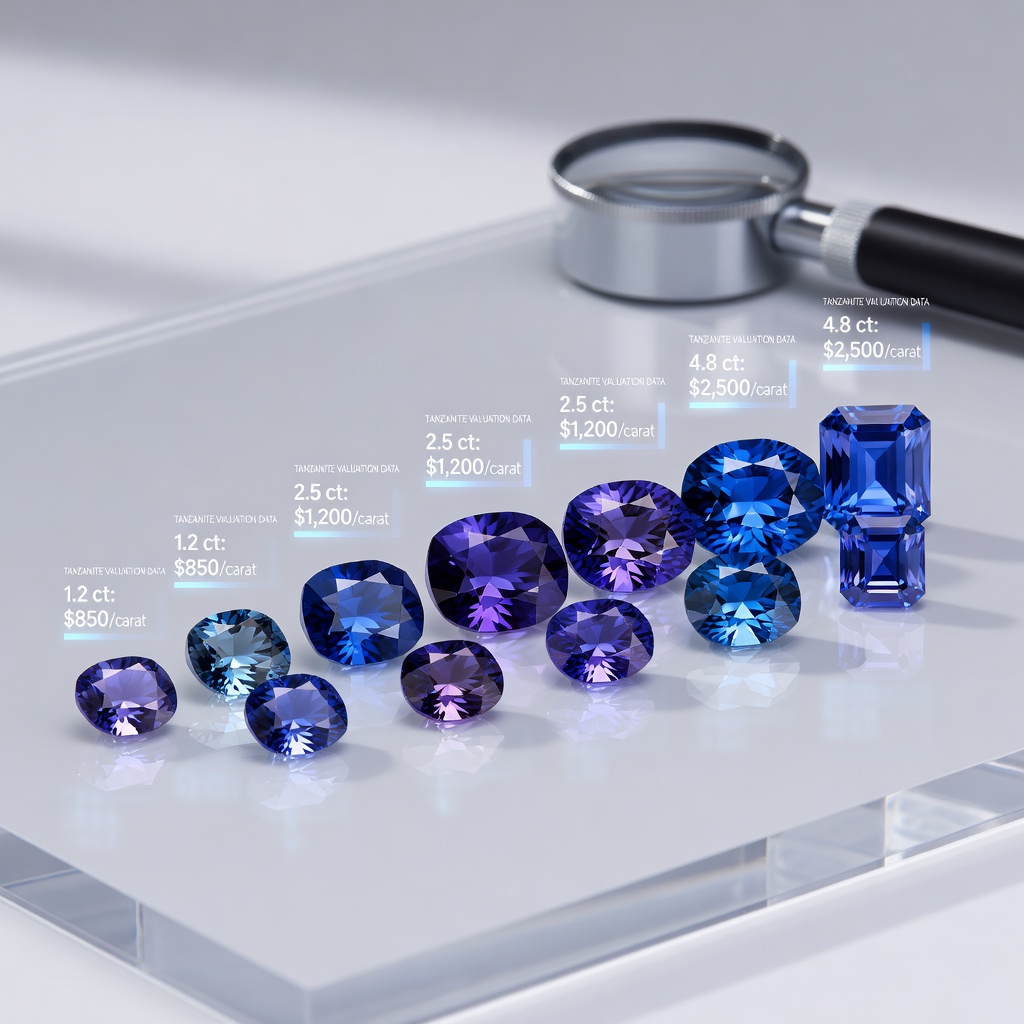
Understanding tanzanite value per carat requires examining distinct quality tiers that separate commercial material from collector-grade specimens. Commercial-grade tanzanite, characterized by pale lavender to light violet-blue colors with visible inclusions or poor cutting, currently trades between $300-$500 per carat in the wholesale market. These stones typically weigh under two carats and serve the mass-market jewelry sector, offering accessible entry points for consumers prioritizing size over color intensity.
Fine-grade material represents the sweet spot for many serious buyers, offering medium to medium-strong violet-blue saturation with eye-clean clarity and good cutting proportions. These stones command $600-$1,200 per carat depending on exact color distribution and size, providing excellent jewelry presence while maintaining reasonable liquidity in the secondary market. Most engagement ring centers and statement pendants utilize this grade, balancing visual impact with cost considerations.
AAA-grade tanzanite with vivid, saturated color starts at approximately $1,500 per carat for stones under three carats, escalating rapidly with size. Three to five-carat specimens in true AAA grades regularly achieve $2,500-$3,500 per carat, while exceptional stones exceeding ten carats with top color can surpass $4,000-$6,000 per carat at auction. These prices reflect tanzanite market trends showing sustained demand for investment-quality material despite economic fluctuations affecting other luxury goods.
Museum-quality specimens over twenty carats with exceptional color and clarity represent a separate market entirely, often selling through private channels rather than retail environments. These stones appreciate at rates of 8-12% annually historically, outpacing many traditional investment vehicles while providing tangible aesthetic enjoyment. However, liquidity concerns exist at this price point, as the pool of potential buyers narrows significantly above $50,000 per stone.
Color Quality: The Primary Value Driver
Tanzanite color quality operates on a saturation spectrum that creates dramatic price differentials between seemingly similar stones. Gemological assessments measure saturation through standardized lighting conditions, with the highest grades displaying vivid, electric violet-blue hues that remain consistent under incandescent, fluorescent, and natural daylight. Stones showing 80% or better saturation receive premium designations, while those below 60% saturation fall into commercial classifications regardless of other quality factors.
The most valuable color combination presents as deep royal blue with vivid violet flashes, specifically requiring a dominant blue component of approximately 70% with violet comprising the remaining 30%. This specific ratio creates the "Velvet Peacock" appearance highly prized by collectors and connoisseurs. Stones leaning too heavily toward violet appear washed out and command lower prices, while those showing excessive gray or brown secondary tones face significant devaluation even if saturation levels are technically high.
Heat treatment plays a universal and accepted role in tanzanite enhancement, with virtually all market material undergoing controlled heating to 400-500 degrees Celsius to develop the desirable blue-violet color. Untreated stones showing natural blue coloration without heat enhancement are extraordinarily rare and command premiums of 50-100% over treated material, though detection requires advanced spectroscopic analysis. Reputable dealers always disclose heat treatment, which is considered a permanent and stable enhancement that does not require special care or affect durability.
Pleochroism creates unique challenges and opportunities during the cutting process, as crystal orientation determines the final face-up color. Skilled cutters must align the table facet perpendicular to the crystal's c-axis to maximize blue transmission while minimizing the less desirable yellow-brown or burgundy pleochroic colors. This orientation process typically sacrifices 60-70% of the original rough weight, explaining why well-cut tanzanite commands substantial premiums over native-cut or poorly oriented stones that show uneven color distribution or "dead" zones.
Size Impact on Tanzanite Investment Potential
Tanzanite investment potential varies dramatically based on carat weight, with sub-one-carat stones offering limited appreciation prospects due to abundant supply and high consumer turnover. These smaller stones, while beautiful in jewelry applications, function primarily as consumable luxury goods rather than stores of value, typically retaining only 30-50% of retail purchase price upon resale. Investors seeking appreciation should generally avoid material under two carats unless acquiring exceptional AAA+ grades at wholesale pricing.
The three to five-carat range currently offers the optimal balance of affordability and investment liquidity for serious collectors. Stones in this size bracket with fine to AAA grades appreciate steadily while maintaining sufficient market depth to facilitate resale when necessary. This category attracts the broadest range of buyers, from jewelry enthusiasts upgrading their collections to investors diversifying into tangible assets, creating reliable demand that supports price stability.
Museum-quality specimens exceeding twenty carats with exceptional color saturation historically appreciate 8-12% annually, outperforming many equity markets over extended holding periods. However, these stones require substantial capital commitments often exceeding $100,000 and face liquidity constraints during market downturns. Successful investment in this category requires long-term holding capabilities and specialized insurance coverage that accounts for replacement value rather than simple purchase price.
Market demand remains strongest for two to four-carat stones in fine to AAA grades, representing the standard size range for high-end jewelry while remaining accessible to affluent consumers. This category shows consistent price growth of 6-8% annually according to recent tanzanite market trends, driven by increasing Asian demand and shrinking supply from deepening mining operations. Investors should focus on this size range for optimal risk-adjusted returns while maintaining reasonable liquidity.
Origin and Ethical Sourcing Considerations
The singular tanzanite origin Tanzania defines every aspect of this gemstone's market dynamics, with all known deposits confined to an eight-square-kilometer strip in the Merelani Hills near Mount Kilimanjaro. This extreme geographic restriction makes tanzanite approximately 1,000 times rarer than diamond, creating a supply ceiling that fundamentally supports long-term pricing structures. No secondary deposits have been discovered despite extensive geological surveys across East Africa, cementing Tanzania's monopoly on this unique gem variety.
Tanzanian government export tariffs and mining regulations significantly impact international pricing, adding 10-15% to wholesale costs through export duties and value-added taxes. Recent government interventions have established centralized trading centers intended to increase transparency and capture greater revenue for local communities, though implementation challenges persist. These regulatory costs ultimately pass to consumers, contributing to the steady price appreciation observed over the past decade.
Fair-trade mining initiatives have emerged within the tanzanite sector, adding 5-10% premiums to certified stones while ensuring ethical procurement practices and improved safety standards for miners. These programs provide documented chain-of-custody records from extraction through cutting, appealing to socially conscious consumers and investors concerned with provenance. While still representing a minority of production, ethical certification is rapidly becoming a standard expectation in European and North American markets.
Blockchain certification technology now tracks some high-value tanzanite specimens from mine to market, creating immutable records of ownership, treatment history, and quality assessments. This technological innovation addresses historical concerns about misrepresentation and origin fraud, particularly regarding Block D claims. Investors should prioritize stones with blockchain documentation or established provenance papers when acquiring material over $5,000, as these records significantly enhance resale value and insurability.
Market Trends and Price Forecasting
Current tanzanite market trends indicate robust price appreciation, with 2024 showing approximately 12% year-over-year increases driven by escalating mining depths and limited new discoveries. Surface deposits have been largely exhausted, forcing operations to pursue primary deposits at depths exceeding 800 meters where extraction costs increase exponentially. These operational realities ensure continued price pressure as producers must charge higher prices to maintain profitability against rising extraction expenses.
Chinese and Indian markets have emerged as primary demand drivers for three to ten-carat investment-grade material, with affluent collectors in these regions viewing tanzanite as a store of value comparable to fine sapphire or spinel. This Asian demand surge has absorbed increasing percentages of annual production, particularly for stones over five carats with AAA color grades. Western markets continue steady demand but face increasing competition for limited fine material from these emerging economic powerhouses.
Laboratory-grown tanzanite alternatives have entered the market at price points 60-70% below natural material, though they remain chemically distinct synthetic forsterite or corundum rather than true tanzanite (zoisite). These simulants appeal to fashion jewelry consumers but carry no investment value and require clear disclosure to avoid consumer confusion. Advanced spectroscopic testing easily distinguishes natural from synthetic material, protecting informed buyers from misrepresentation.
Industry experts predict 15-20% price growth over the next five years as supply diminishes and mining operations face increasing geological challenges. This forecast assumes stable global economic conditions and continued Asian market expansion. Tanzanite investment potential appears strongest for fine to AAA grades over three carats, which should outperform inflation and general equity markets while providing portfolio diversification benefits through low correlation with traditional asset classes.
Essential Buying Tips and Dealer Selection
When evaluating tanzanite value per carat, always require GIA (Gemological Institute of America) or AGS (American Gem Society) certification for stones exceeding $2,000, as these laboratories provide standardized assessments of color, clarity, and treatment status. Reputable certificates include detailed color diagrams, clarity plotting for inclusions, and explicit confirmation of natural origin versus synthetic material. This documentation proves essential for insurance purposes and future resale, typically adding 15-20% to realized values compared to uncertified stones.
Physical comparison shopping under controlled lighting conditions remains essential for accurate color assessment, as tanzanite's appearance varies dramatically under different light sources. Always examine stones under natural daylight equivalent lighting (5500K color temperature) to evaluate true saturation levels, avoiding warm incandescent lighting that artificially enhances violet tones. Comparing three to five stones side-by-side reveals subtle saturation differences that significantly impact value but might be missed when viewing single specimens.
Reputable online dealers typically offer 20-30% savings compared to brick-and-mortar retail stores due to reduced overhead costs, though buyer diligence becomes paramount when purchasing sight-unseen. Established online vendors provide detailed photography under standardized lighting, 360-degree video inspection, and generous return policies that allow physical evaluation before final commitment. Verify dealer credentials through Better Business Bureau ratings, gemological association memberships, and customer review platforms before transmitting payment.
Negotiate mounting costs separately from the center stone purchase to understand the true gem cost and avoid hidden markups in package pricing. Many retailers subsidize ring settings while inflating center stone prices, making apparent "deals" actually expensive propositions. Request itemized invoices showing separate values for the tanzanite, precious metal, and accent stones, enabling accurate insurance scheduling and future resale documentation.
Red Flags: Avoiding Scams and Overpaying
The tanzanite grading system lacks federal regulation, creating opportunities for misrepresentation regarding "Block D" origins, with industry estimates suggesting 90% of such claims are fraudulent due to the deposit's depletion years ago. Any dealer claiming Block D provenance must provide blockchain records, mining certificates, or documented historical papers tracing the rough crystal to that specific claim. Without such documentation, treat Block D claims as marketing fiction and evaluate stones solely on visual merit rather than supposed origin.
Synthetic tanzanite produced through flame fusion or hydrothermal growth processes costs $50-$100 per carat and requires sophisticated laboratory testing for definitive detection. These synthetics match natural tanzanite's chemical composition but lack the geological history and investment value of mined material. Purchase only from dealers who provide explicit synthetic/natural disclosure and verify claims through independent laboratory testing when certificates are not provided.
Marketing terms like "investment grade" or "museum quality" carry no standardized definitions within the tanzanite grading system and frequently describe mediocre material to unwary buyers. Insist on specific color and clarity grades (AAA, AA, A) backed by recognized gemological certificates rather than vague superlatives. True investment-grade material requires documentation of color saturation percentages, clarity characteristics, and treatment history to justify premium pricing.
Pricing below $200 per carat for stones marketed as "fine quality" indicates either misrepresented material (glass, synthetic, or heavily treated low-grade rough) or fraudulent business practices. Quality tanzanite simply cannot be mined, cut, certified, and distributed at these price points while maintaining legitimate profit margins. Extreme deals typically indicate synthetic material, heavily included commercial-grade stones misrepresented as fine quality, or outright scams targeting uninformed consumers.
Final Verdict: Is Tanzanite Worth the Investment?
Evaluating tanzanite investment potential requires honest assessment of your financial objectives and risk tolerance, as this gemstone suits collectors and jewelry enthusiasts more appropriately than pure financial speculators. While top-grade material has appreciated steadily, tanzanite lacks the universal liquidity of gold or blue-chip stocks, requiring specialized knowledge and appropriate holding periods to realize gains. Approach purchases primarily as acquisitions of beauty with appreciation potential as a secondary benefit rather than guaranteed financial returns.
Diversification strategies prove more successful than concentrating capital in single high-end stones, with portfolios balanced across two to three quality grades providing better risk management. Consider allocating funds across several fine-grade stones (2-4 carats) rather than one exceptional specimen, maintaining liquidity while capturing appreciation across multiple market segments. This approach also allows for gradual liquidation if necessary without flooding limited resale channels.
Proper insurance coverage represents an essential component of tanzanite ownership, requiring scheduled coverage on homeowner's policies or specialized jewelry insurance rather than generic blanket coverage. Annual reappraisals prove necessary given market volatility and steady price appreciation, ensuring coverage limits keep pace with replacement costs. Maintain all certificates, purchase receipts, and appraisal documentation in secure locations separate from the physical jewelry to facilitate claims processing if loss occurs.
Ultimately, tanzanite rewards educated buyers who prioritize quality over size, demand proper documentation, and purchase from reputable sources with transparent grading standards. The gemstone's finite supply and singular origin provide fundamental support for long-term value retention, while its breathtaking beauty offers daily enjoyment that purely financial investments cannot match. For those willing to conduct proper due diligence, tanzanite represents a compelling addition to both jewelry wardrobes and alternative investment portfolios.
Frequently Asked Questions
How much should I expect to pay for a good quality tanzanite?
For fine-quality tanzanite featuring medium violet-blue saturation and eye-clean clarity, expect to invest between $600 and $1,200 per carat for stones under three carats. AAA-grade specimens displaying vivid, saturated color with excellent cutting start at approximately $1,500 per carat and can exceed $3,000 per carat for larger specimens with exceptional characteristics. Commercial-grade material with lighter colors or visible inclusions typically ranges from $300 to $500 per carat, suitable for fashion jewelry but offering limited investment potential.
What is the most important factor in tanzanite pricing?
Color saturation serves as the primary price driver in tanzanite valuation, with vivid violet-blue stones commanding premiums of 200-300% over pale lavender specimens of identical size and clarity. The highest grades display approximately 70% royal blue and 30% violet from the face-up view, creating the electric appearance that defines premium material. While clarity and cut quality significantly influence value, they cannot compensate for insufficient color saturation, making hue assessment the critical first step in any purchase decision.
Does tanzanite increase in value over time?
Top-grade tanzanite has historically appreciated 8-12% annually, particularly for stones exceeding five carats with AAA color grades and exceptional clarity. However, commercial-grade stones show minimal appreciation and often depreciate immediately after purchase due to abundant supply and limited secondary market demand. The finite supply from a single geological source supports long-term value growth projections, though liquidity constraints mean tanzanite functions best as a five to ten-year holding rather than a short-term speculative vehicle.
Is certified tanzanite worth the extra cost?
Professional certification from GIA or AGS adds $100 to $300 to purchase costs but provides essential verification of natural origin, heat treatment disclosure, and quality parameters that protect your investment. This documentation typically increases resale value by 15-20% over uncertified stones while proving necessary for adequate insurance coverage and estate valuation. For stones exceeding $2,000, certification represents essential due diligence that prevents costly misidentification of synthetic material or undisclosed treatments.
What's the difference between Block D and other tanzanite?
Block D of the Merelani Hills historically produced tanzanite with the finest color saturation and largest clean crystals, establishing a legendary reputation among collectors and connoisseurs. However, this specific mining block was depleted years ago, making any contemporary "Block D" claims highly suspect without blockchain documentation or verified historical provenance. Modern top-quality stones originate from various blocks within the mining district and should be evaluated strictly on visual merit—color, clarity, and cut—rather than supposed mining location.
How can I avoid buying fake or overpriced tanzanite?
Protect yourself by purchasing only from dealers employing GIA graduate gemologists on staff, requiring independent laboratory certificates for stones exceeding $1,000, and comparing prices across three to four reputable sources before committing. Be extremely wary of deals pricing "fine quality" material below $300 per carat, as legitimate tanzanite cannot be profitably mined, cut, and distributed at these levels. Always obtain independent appraisal from a non-selling gemologist before finalizing significant purchases to verify quality claims and fair market value.
What size tanzanite offers the best value for money?
The two to three-carat range provides optimal value, offering substantial visual presence and good color saturation without the exponential price jumps occurring at five carats and above. Prices per carat increase significantly at whole carat milestones, making just-under sizes such as 1.9 carats or 2.9 carats particularly advantageous for budget-conscious buyers seeking maximum size appearance. This range also maintains excellent liquidity in the secondary market while providing sufficient material for impressive jewelry settings.