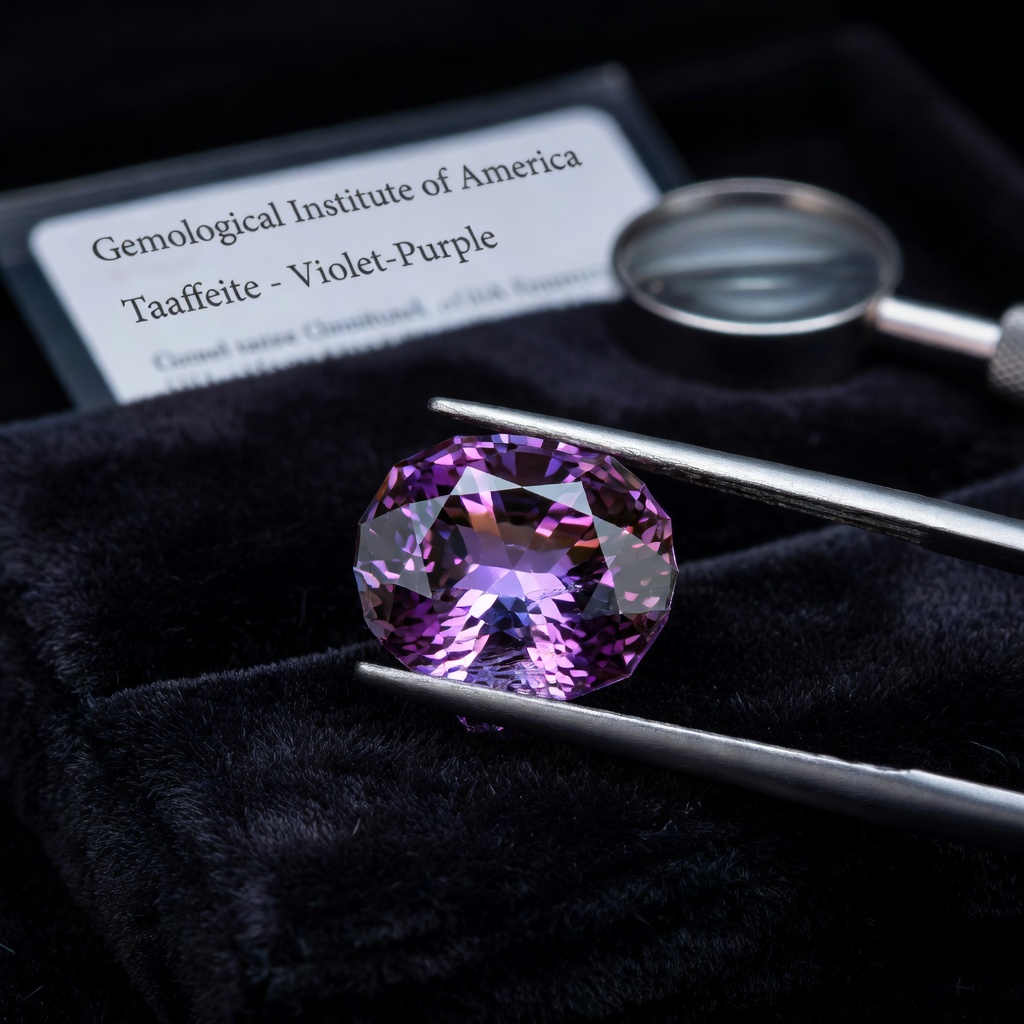
What is Taaffeite? Understanding the World's Rarest Gemstone
The discovery of taaffeite remains one of the most fascinating chapters in gemological history, forever changing how experts approach gemstone identification. In 1945, Austrian gemologist Richard Taaffe examined a cut stone that had been cataloged as spinel, but he noticed something extraordinary: double refraction visible to the naked eye. This observation was impossible for spinel, which exhibits only single refraction, leading to the identification of an entirely new mineral species. This moment marked taaffeite as the only gemstone in history initially recognized while already faceted, rather than being identified in rough crystal form.
Chemically classified as magnesium aluminum oxide (MgAl₂O₄ with trace elements), taaffeite shares a similar chemical foundation with spinel yet possesses distinct crystallographic properties that set it apart. The gemstone's hexoctahedral crystal system creates the double refraction Taaffe observed, with birefringence measuring between 0.004 and 0.005. This optical phenomenon causes light to split into two distinct paths within the crystal, creating subtle doubling of facet junctions when viewed through the pavilion with a loupe. For collectors and gemologists, this characteristic serves as the primary diagnostic feature distinguishing genuine taaffeite from its more common lookalikes.
The extreme scarcity of taaffeite cannot be overstated in any comprehensive Taaffeite Buying Guide. Gemological institutes estimate that only 5,000 to 6,000 faceted specimens exist worldwide, making this taaffeite gemstone approximately one million times rarer than diamond. This scarcity stems from limited geological formation conditions requiring specific beryllium and magnesium concentrations in pegmatite environments. Primary sources include alluvial deposits in Sri Lanka (Ceylon), the Mogok Stone Tract in Myanmar (Burma), and more recently, the Umba Valley in Tanzania. However, production from these regions has diminished significantly, with many historical mines now exhausted or producing only sporadic small crystals rarely suitable for cutting.
Why Invest in Taaffeite? Rarity and Value Factors
For ultra-high-net-worth individuals seeking alternative investments, rare gem investment opportunities like taaffeite offer compelling portfolio diversification beyond traditional stocks and real estate. The mathematical reality of taaffeite's rarity creates an inherent supply constraint that no amount of market demand can overcome through increased production. Unlike diamonds, which benefit from extensive mining operations across multiple continents, taaffeite relies entirely on sporadic alluvial discoveries in specific geographic pockets. As existing mines deplete their recoverable material, the circulating supply of high-quality specimens actually decreases as stones enter permanent museum and private dynasty collections.
Historical market data reveals remarkable price appreciation trajectories for collector gemstones of this caliber. Over the past decade, fine quality taaffeite has demonstrated 200-300% value growth, significantly outperforming many traditional investment vehicles during the same period. For example, a 2.5-carat vivid purple taaffeite purchased for $15,000 per carat in 2014 might command $35,000-$40,000 per carat at current auction estimates. This appreciation reflects not merely inflationary adjustments but genuine scarcity premium recognition as sophisticated collectors increasingly understand the stone's geological uniqueness.
The demand dynamics for taaffeite have shifted dramatically with the rise of Asian luxury markets, particularly in China, Hong Kong, and Singapore. Wealthy collectors in these regions prize the stone's association with rarity and exclusivity, driving competitive bidding at international auctions. Major auction houses report that Asian buyers now represent 60-70% of participants in rare colored stone sales, with taaffeite specifically benefiting from cultural appreciation for purple and violet hues traditionally associated with imperial authority. This demographic shift suggests sustained long-term demand pressure against an immutably limited supply.
Taaffeite Color Grading: From Lavender to Violet-Red
Understanding color evaluation is essential when navigating the Taaffeite Buying Guide, as color variations dramatically impact both aesthetic appeal and market valuation. Taaffeite exhibits strong pleochroism, an optical property causing the gemstone to display different colors when viewed from various crystallographic directions. When rotated under daylight-equivalent lighting, high-quality purple taaffeite shifts between reddish-purple and bluish-purple tones, creating a dynamic visual experience unmatched by single-hue gemstones. This phenomenon results from differential absorption of light waves vibrating in different planes within the crystal structure.
The color hierarchy for taaffeite places saturated violet-red and intense purple varieties at the apex of desirability. Stones displaying rich, saturated purple without gray or brown modifiers command the highest taaffeite price per carat premiums, particularly when the color remains vivid under various lighting conditions. Conversely, pale lavender, mauve, or grayish-purple specimens, while still rare, trade at significant discounts compared to their vivid counterparts. True red taaffeite represents the rarest color expression, with fewer than ten documented specimens exceeding one carat in this hue, making them virtually unobtainable outside institutional collections.
Color zoning presents both challenges and opportunities for lapidaries working with taaffeite rough. Unlike uniformly colored sapphires or rubies, taaffeite frequently exhibits uneven color distribution, requiring expert orientation during the cutting process to maximize face-up color saturation. Experienced cutters may sacrifice carat weight to position the table perpendicular to the optimal color axis, transforming a pale-looking rough crystal into a vibrant finished gem. Additionally, fluorescence under ultraviolet light serves as a quality indicator; natural taaffeite typically shows weak to moderate red or orange-red fluorescence under long-wave UV, while inert stones may warrant additional spectroscopic investigation to confirm natural origin.
Clarity and Cut: Quality Indicators for Taaffeite
Clarity assessment in taaffeite follows stringent standards appropriate for a rare gem investment, where even minor inclusions significantly impact valuation. Typical inclusion patterns include fingerprint-like fluid inclusions, hollow growth tubes, and minute crystal inclusions of apatite or zircon. These characteristics, while common, must not compromise the stone's transparency or durability. For investment-grade specimens, "eye-clean" clarity—meaning no visible inclusions to the unaided eye at six inches—represents the minimum acceptable standard. Loupe-clean stones, showing no inclusions under 10x magnification, command substantial premiums and represent less than 15% of the already limited taaffeite supply.
The relationship between cut quality and value extends beyond mere symmetry and polish in taaffeite evaluation. Optimal cutting styles must account for both pleochroism and the material's limited availability. Cushion and oval cuts often prove most successful, allowing cutters to orient the stone to display both color axes while maximizing weight retention from irregular rough crystals. Brilliant cutting styles with appropriate crown and pavilion angles enhance the stone's moderate refractive index (1.719-1.730), creating lively brilliance despite taaffeite's relatively subdued optical performance compared to diamond or zircon. Poorly cut stones that "window" (allow light to pass through without reflection) or exhibit "extinction" (dark areas) suffer severe value penalties regardless of color quality.
Carat weight scarcity creates exponential rather than linear pricing structures in the taaffeite market. While stones under one carat appear occasionally in the market, specimens exceeding two carats represent extreme rarities, with fewer than fifty documented faceted stones over five carats known to exist globally. This size limitation stems from the original crystal morphology; taaffeite typically forms as small, water-worn pebbles in alluvial gravels rather than large primary crystals. Consequently, each incremental increase in carat weight above one carat can multiply the per-carat price by factors of two or three, making large, clean specimens the undisputed sovereigns of collector gemstones portfolios.
Taaffeite vs Spinel: How to Tell the Difference
The confusion between taaffeite and spinel dates back to the very discovery of taaffeite, and distinguishing these lookalikes remains crucial for any serious collector. The fundamental difference lies in optical properties: taaffeite exhibits double refraction (birefringence), while spinel shows only single refraction. Practically, this means that when viewing a taaffeite through its pavilion facets with a jeweler's loupe, you will observe doubling of the facet junctions or inclusions—a ghosting effect where edges appear duplicated. In spinel, these lines remain singular and sharp. This distinction requires only basic gemological equipment but demands proper lighting and magnification technique to observe reliably.
Physical constants provide additional diagnostic confirmation for taaffeite vs spinel identification. Taaffeite possesses a specific gravity ranging from 3.60 to 3.62, slightly higher than spinel's range of 3.58 to 3.61. While this difference seems minimal, precision hydrostatic weighing can distinguish the species when combined with refractive index readings. Taaffeite's refractive index ranges from 1.719 to 1.730, compared to spinel's 1.712 to 1.762, though the overlap in ranges necessitates careful measurement. Advanced gemological laboratories utilize spectroscopic analysis, where taaffeite shows distinct iron-related absorption bands absent in spinel, providing definitive identification even for mounted stones where specific gravity testing proves impossible.
Beyond gemological constants, the historical significance of taaffeite as the only gemstone identified after cutting lends it unique provenance value. When Richard Taaffe purchased his original specimen from a Dublin jeweler in 1945, it had already been faceted and set, having passed through the hands of dealers who assumed it was merely an unusual spinel. This discovery story underscores the importance of rigorous testing for any "spinel" showing unusual optical properties. Today, responsible dealers automatically test all mauve-to-purple spinel-appearing material for birefringence, ensuring that potentially valuable taaffeite specimens receive proper identification and pricing.
Pricing Guide: Taaffeite Price Per Carat in 2024
Current market valuations for taaffeite reflect a tiered structure based on quality parameters, with entry-level specimens accessible to serious enthusiasts while museum-grade stones remain exclusive to the world's wealthiest collectors. Commercial grade taaffeite, characterized by pale colors, visible inclusions, or suboptimal cutting, currently trades between $1,500 and $5,000 per carat. These stones typically weigh under one carat and display light lavender or grayish-purple hues. While representing the most accessible entry point into taaffeite ownership, these specimens offer limited investment upside due to their abundance relative to finer material and weaker demand from serious collectors.
Fine quality taaffeite commands substantially higher taaffeite price per carat ranges of $8,000 to $18,000, reflecting superior color saturation, eye-clean clarity, and expert cutting. Stones in this category display rich purple or violet-red colors with strong pleochroism, weighing typically between 0.5 and 2.0 carats. For example, a 1.5-carat vivid purple, eye-clean taaffeite with excellent cut proportions might retail through specialized dealers at approximately $22,500 total, or $15,000 per carat. These stones represent the sweet spot for rare gem investment, offering both aesthetic satisfaction and documented appreciation potential while maintaining some market liquidity.
Museum grade specimens—defined as stones over 2 carats with vivid color saturation, loupe-clean clarity, and prestigious provenance—regularly achieve $25,000 to $35,000+ per carat at major auctions. In 2023, a 3.12-carat unheated violet-red taaffeite from Sri Lanka sold at a Hong Kong auction for $108,000, equivalent to over $34,600 per carat. Such exceptional pieces benefit from multi-factorial pricing where size, color, clarity, and documented origin (particularly historic Sri Lankan material) create multiplicative rather than additive value effects. When evaluating these ultra-rare pieces, provenance documentation including previous auction records or famous ownership history can add 20-30% premiums above intrinsic gemological value.
Certification and Authentication: Avoiding Fakes
Given taaffeite's high value and limited familiarity among general jewelers, comprehensive Taaffeite certification from internationally recognized laboratories constitutes non-negotiable due diligence for any acquisition. The Gemological Institute of America (GIA), Swiss Gemmological Institute (SSEF), Gübelin Gem Lab, and American Gemological Laboratories (AGL) represent the gold standard for taaffeite identification reports. These institutions possess the advanced spectroscopic equipment necessary to distinguish natural taaffeite from synthetics and simulants, while also detecting treatments that might affect value. A proper certificate should specify color origin (natural versus treated), geographic origin when determinable, and clarity enhancement status.
Synthetic taaffeite production, while not as prevalent as synthetic corundum or spinel, does exist in limited quantities through flux-growth and hydrothermal methods. These laboratory-created stones possess identical chemical and physical properties to natural material, making visual identification impossible without advanced testing. Raman spectroscopy and photoluminescence analysis can often detect subtle differences in crystal growth patterns and trace element chemistry between natural and synthetic origins. Additionally, some unscrupulous sellers may offer synthetic spinel or cubic zirconia as taaffeite, though these simulants lack the double refraction and specific gravity of genuine material.
Beyond synthetic detection, certification must screen for treatments that compromise investment value. While taaffeite rarely undergoes the heating treatments common to ruby or sapphire, fracture filling with glass or oil occasionally appears in included material to improve apparent clarity. Surface coatings to enhance color represent another potential treatment, though less common than in stones like andalusite or topaz. Spectroscopic analysis reveals these treatments through characteristic absorption patterns or fluorescence anomalies. When purchasing significant taaffeite specimens, insist on "untreated" or "no indications of heating" designations on laboratory reports, as treated stones trade at 40-60% discounts in the collector market.
Where to Buy Taaffeite: Trusted Dealers and Auctions
Acquiring authentic taaffeite requires navigating a specialized marketplace distinct from conventional jewelry retail. Reputable high-end jewelers specializing in rare colored stones, such as those located in New York's 47th Street district, London's Hatton Garden, or Geneva's rue du Rhône, maintain inventories of certified taaffeite. These established dealers typically belong to professional organizations like the American Gem Trade Association (AGTA) or the International Colored Gemstone Association (ICA), requiring adherence to ethical disclosure standards. When approaching such dealers, request to view stones under various lighting conditions and examine certification documents before negotiation.
Major auction houses including Christie's, Sotheby's, and Bonhams represent primary venues for museum-quality taaffeite acquisitions, particularly through their Hong Kong, Geneva, and New York jewelry sales. These institutions employ rigorous gemological vetting processes and provide detailed condition reports describing color, clarity, and any treatments. Auction environments also offer price transparency through public bidding, establishing market benchmarks for specific quality tiers. However, buyers should factor buyer's premiums (typically 20-25%) into budget calculations and arrange pre-sale viewings to examine stones personally, as auction photography often fails to capture pleochroism and liveliness accurately.
Online marketplaces present significant risks for taaffeite purchases, requiring extreme caution and comprehensive verification protocols. Red flags include sellers offering "taaffeite" at prices significantly below market rates (under $1,000 per carat), lack of specific laboratory certification, or vague descriptions using terms like "taaffeite-like" or "taaffeite spinel." When considering online acquisitions, verify the seller's physical business address, membership in trade organizations, and willingness to offer escrow services through platforms like Escrow.com. Insist on return periods of at least 14 days to allow independent verification by your own gemologist, and never proceed with wire transfers to unfamiliar entities without these protections.
Caring for Your Taaffeite: Storage and Maintenance
Despite its status among elite collector gemstones, taaffeite requires surprisingly straightforward maintenance thanks to its favorable hardness characteristics. Rating 8 to 8.5 on the Mohs hardness scale, taaffeite resists scratching from everyday dust and contact with most jewelry materials, making it suitable for occasional wear in protected settings like pendants or earrings. However, this hardness falls below that of diamond (10), sapphire, and ruby (9), meaning taaffeite jewelry should never be stored loose with these harder gems. A diamond ring tossed carelessly into a jewelry box with a taaffeite pendant could leave permanent scratches on the taaffeite's surface, significantly diminishing its value.
Cleaning taaffeite requires gentle methods appropriate for precious but non-porous gemstones. Prepare a solution of warm water with mild dish soap, then use a soft-bristled brush (a baby toothbrush works excellently) to gently remove accumulated oils and debris from the stone's surface and setting. Avoid ultrasonic cleaners and steam cleaning devices, as these can potentially loosen stones from their settings or exacerbate existing inclusions. After brushing, rinse thoroughly under lukewarm running water and pat dry with a lint-free cloth. For heavily included stones or antique mountings, professional cleaning by a jeweler familiar with rare gems provides the safest option.
Proper storage extends beyond preventing scratches to include insurance and documentation considerations. Store taaffeite pieces individually in soft pouches or compartmentalized jewelry boxes lined with acid-free materials. Maintain updated appraisals every two to three years from certified gemologist appraisers who understand the current taaffeite market, as general jewelry appraisers often undervalue rare specimens. Ensure your insurance policy specifically covers "mysterious disappearance" and provides replacement value rather than cash settlement, as finding a comparable replacement taaffeite can prove challenging given the stone's rarity. Keep all purchase receipts, laboratory certificates, and appraisal documents in a secure location separate from the jewelry itself.
Investment Outlook: Future of Taaffeite Market
The supply-side fundamentals for taaffeite suggest continued scarcity that should support long-term value appreciation for existing specimens. The alluvial deposits of Sri Lanka that produced the majority of historic taaffeite have yielded virtually no significant new material in the past decade, with miners reporting that traditional washing operations recover only occasional sub-carat fragments. Similarly, Myanmar's political instability and environmental restrictions have limited access to the Mogok Stone Tract, while Tanzania's Umba Valley produces taaffeite only sporadically and in limited sizes. Unlike diamonds or colored stones with active primary mining, taaffeite faces an inevitable supply contraction as existing stocks enter permanent collections.
Demand trajectories indicate strengthening markets, particularly as wealth creation in Asia and the Middle East continues to generate new collectors seeking unique alternative assets. Chinese collectors specifically have demonstrated increasing sophistication in recognizing gemological rarities beyond traditional jade and ruby, with taaffeite benefiting from its "million times rarer than diamond" narrative. Auction results from 2020-2024 show consistent price increases of 15-20% annually for fine specimens, with liquidity improving as more auction houses include taaffeite in their rare gem sections. This secondary market activity provides exit opportunities for investors that were unavailable two decades ago, when taaffeite rarely appeared at public sale.
Comparative analysis with traditional investment vehicles suggests taaffeite occupies a unique niche within diversified portfolios. While lacking the daily liquidity of stocks or bonds, fine taaffeite has outperformed gold and many equity indices over ten-year holding periods, while offering portfolio diversification uncorrelated with financial markets. However, prospective investors should approach taaffeite with 5-10 year minimum holding periods and capital they can afford to have illiquid. The market remains thin compared to blue-chip stocks, requiring patience and specialized knowledge to navigate successfully. For those with the resources and expertise to acquire top-tier specimens, taaffeite represents not merely a beautiful adornment but a store of value with compelling appreciation potential in an increasingly resource-constrained world.
Frequently Asked Questions
Why is Taaffeite so expensive compared to other gemstones?
Taaffeite commands premium prices due to its extreme rarity—it's estimated to be a million times rarer than diamond with only a few thousand faceted specimens in existence. Combined with increasing collector demand and limited new supply from depleted mines, this scarcity drives prices from $1,500 to over $35,000 per carat depending on quality.
How can I tell if my Taaffeite is real and not a synthetic or spinel?
Authentic taaffeite exhibits double refraction (visible doubling of facets) and has a specific gravity of 3.60-3.62, distinguishing it from spinel's single refraction. Always demand certification from reputable labs like GIA or SSEF, and consider professional spectroscopic analysis to detect synthetics, as visual identification alone is unreliable.
What is the difference between Taaffeite and Spinel?
While visually similar, taaffeite is chemically magnesium aluminum oxide whereas spinel is magnesium aluminum silicate. The key distinguishing feature is double refraction in taaffeite versus single refraction in spinel. Taaffeite was originally discovered in 1945 when gemologist Richard Taaffe noticed a stone's birefringence, proving it wasn't spinel as originally thought.
How much does Taaffeite cost per carat in today's market?
Taaffeite pricing ranges significantly based on quality: commercial grade with pale colors costs $1,500-$5,000 per carat; fine quality vivid purple stones command $8,000-$18,000 per carat; and exceptional museum-grade specimens over 2 carats with rich saturation can exceed $25,000-$35,000 per carat at auction.
Is Taaffeite a good investment for collectors?
Taaffeite has shown strong investment potential with 200-300% price appreciation over the past decade, outperforming many traditional assets. Its extreme rarity, decreasing supply, and growing demand from Asian markets suggest continued value appreciation. However, like all gemstone investments, liquidity is lower than stocks, requiring long-term holding periods of 5-10 years.
Where is the safest place to buy authentic Taaffeite?
Purchase only from established high-end jewelers specializing in rare gems, or through reputable auction houses like Christie's and Sotheby's. Always require independent laboratory certification from GIA, SSEF, or Gübelin. Avoid general online marketplaces unless the seller offers escrow services, return periods, and verifiable provenance documentation.
What colors does Taaffeite come in and which are most valuable?
Taaffeite displays pleochroism, showing reddish-purple and bluish-purple when rotated. Colors range from colorless and pale lavender to rich violet, purple, and rare red-violet hues. The most valuable are saturated violet-red and intense purple varieties with strong color saturation; pale or grayish tones command significantly lower prices.
How should I care for and store Taaffeite jewelry?
With 8-8.5 hardness, taaffeite is suitable for jewelry but should be protected from harder gems like diamond and corundum. Clean using warm soapy water and a soft brush; avoid ultrasonic cleaners and harsh chemicals. Store separately in padded compartments, and ensure adequate insurance coverage with updated appraisals every 2-3 years.