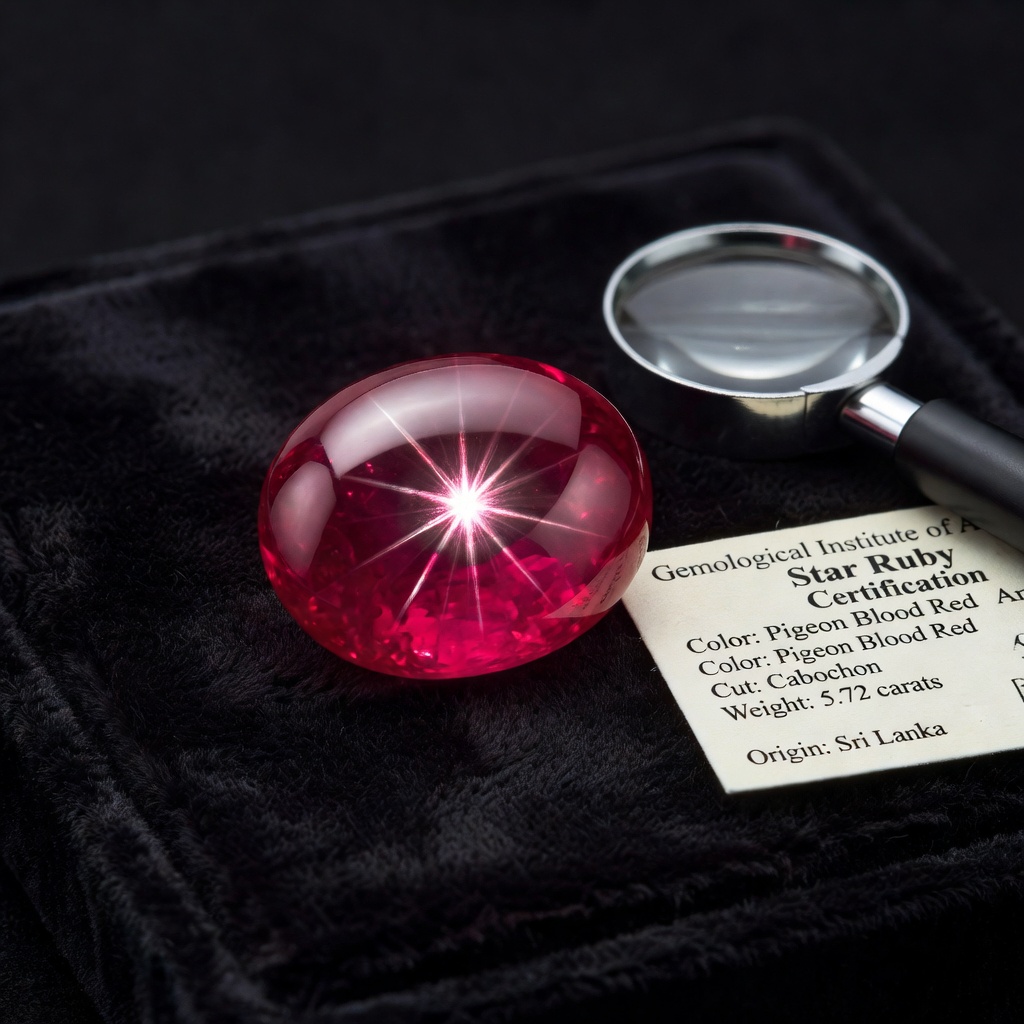
What Makes Star Rubies Unique: Understanding Asterism
The mesmerizing six-rayed star that dances across the surface of a star ruby gemstone represents one of nature's most captivating optical phenomena. Unlike their faceted counterparts that sparkle through light refraction, star rubies exhibit asterism in rubies—a phenomenon created by microscopic rutile needle inclusions aligned at precise angles of 60 and 120 degrees within the corundum crystal structure. These titanium dioxide needles, often called "silk," reflect light in a way that creates the illusion of a floating star that moves gracefully as the stone is tilted under a single light source.
The fundamental distinction between regular rubies and star varieties lies in their cutting style and internal architecture. While faceted rubies are cut with multiple angled faces to maximize brilliance and fire, star rubies must be cut as cabochons—smooth, domed shapes without facets—to properly display the star effect. This cabochon requirement means that star rubies sacrifice some of the fiery sparkle associated with faceted gems in exchange for the mysterious, velvety glow of asterism. Collectors and connoisseurs often prize star rubies precisely because they represent a rarer subset of corundum; only a small percentage of ruby rough contains the proper density and alignment of rutile needles necessary to create a sharp, well-defined star.
Star rubies command significant collector interest due to their relative scarcity compared to standard faceted rubies. The geological conditions required to form proper asterism occur infrequently, making fine specimens with sharp, centered stars genuine rarities. Historical examples like the Rosser Reeves Star Ruby—a 138.72-carat masterpiece housed in the Smithsonian Institution—demonstrate how exceptional star rubies achieve legendary status among gemstone enthusiasts. When evaluating a star ruby gemstone for purchase, understanding that you are acquiring not just a colored stone but a mineralogical curiosity adds significant depth to the acquisition beyond mere aesthetic appreciation.
Essential Quality Factors: The Three Cs of Star Rubies
Evaluating a star ruby requires shifting your assessment criteria from traditional faceted gem grading to specialized parameters that emphasize the interplay between body color and optical effect. The most crucial star ruby value factors diverge significantly from standard diamond or colored stone grading, demanding careful examination under controlled lighting conditions. When following any comprehensive Star Ruby Buying Guide, understanding these unique quality metrics prevents costly mistakes and ensures you select a stone that will retain both its beauty and value over time.
Body color evaluation remains paramount, with the most desirable hues resembling the legendary "pigeon's blood" red associated with premium Burmese rubies. However, star rubies often display slightly purplish or pinkish undertones due to the rutile inclusions that create the star effect. Avoid stones with excessive brownish or grayish overtones, as these secondary hues significantly diminish both beauty and value. The ideal star ruby exhibits a rich, saturated red base color that remains consistent across the dome while still allowing the star to appear clearly against the background. In practical terms, examine the stone under both incandescent and daylight-equivalent lighting to ensure the color remains appealing across different environments.
The star itself demands rigorous scrutiny regarding sharpness, positioning, and movement. Premium specimens display six distinct, straight rays that intersect precisely at the center of the dome, creating a symmetrical pattern resembling a snowflake or Star of David. The star should be centered—not skewed toward one edge—and each ray should extend approximately 60-70% of the way from the center to the edge without fading or breaking. Test the star's "roll" by moving the stone under a single penlight; high-quality asterism appears crisp and follows the light source smoothly, while inferior stars may appear fuzzy, broken, or stationary. Clarity considerations present unique challenges in star rubies because the silk inclusions necessary for asterism naturally reduce transparency. The key is finding the balance: enough silk to create a sharp star without making the stone appear overly milky or opaque.
Practical Tip: The Flashlight Test
When examining potential purchases, bring a small penlight to the viewing rather than relying on overhead store lighting. Direct the beam perpendicular to the dome's apex and slowly tilt the stone. A fine star ruby will display a sharp, luminous star that appears to glide across the surface, while commercial-grade stones may show wavy, incomplete, or diffused rays that diminish the magical effect.
Geographic Origins: Burma vs. Sri Lanka vs. Other Sources
The provenance of a star ruby significantly influences its value, appearance, and collectibility, with star ruby origins Burma Sri Lanka representing the two most prestigious sources in the gemological world. Burmese (Myanmar) star rubies historically set the standard for excellence, particularly those from the Mogok Stone Tract. These stones typically exhibit the most intense red body colors—often approaching the coveted pigeon's blood hue—combined with exceptionally sharp asterism. The geological conditions in Myanmar produce rubies with rutile inclusions that align perfectly to create stars with pronounced contrast against deep red backgrounds. However, political complexities and trade restrictions have made fine Burmese star rubies increasingly scarce, driving prices upward for verified origin specimens.
Sri Lankan (Ceylon) star rubies offer a different but equally compelling value proposition. Generally lighter in tone than their Burmese counterparts—often displaying pinkish-red to raspberry hues—Sri Lankan stones frequently occur in larger sizes and with greater clarity. The alluvial deposits of Ratnapura and Elahera yield star rubies with excellent transparency and well-defined stars, though the body color rarely achieves the intense saturation of top Burmese material. For buyers seeking substantial carat weights without the astronomical prices of Burmese gems, Sri Lankan origins provide an excellent entry point into serious collecting. Many connoisseurs specifically seek Ceylon star rubies for their softer, more feminine coloration and typically cleaner appearance.
Beyond these classic sources, Madagascar has emerged as a significant producer of star rubies, often offering stones that bridge the gap between Burmese intensity and Sri Lankan clarity. Vietnamese star rubies from the Luc Yen district occasionally produce fine specimens with purplish-red hues, while Thai star rubies tend toward darker, more garnet-like tones with distinct stars. When considering origin, remember that while Burmese stones command premium prices, excellent asterism and pleasing color matter more than geographic labels alone. A sharp-starred Sri Lankan stone often surpasses a poorly cut Burmese specimen in both beauty and value retention.
Case Study: The DeLong Star Ruby
The famous 100.32-carat DeLong Star Ruby, stolen in 1964 and subsequently recovered, exemplifies the desirability of Burmese origin. Its intense red color and exceptionally sharp star set the benchmark for what collectors seek. While few buyers will acquire museum-quality pieces, understanding that such specimens originated in Myanmar reinforces why Burmese provenance adds significant premiums to pricing structures.
Treatments and Enhancements: What Buyers Must Know
Navigating the complex landscape of star ruby treatments requires diligence, as enhancement methods vary widely in their acceptance within the trade and their impact on long-term value. Heat treatment represents the most common and generally accepted enhancement for star rubies, often improving body color by reducing purplish or bluish overtones while potentially intensifying the red hue. Moderate heating can actually improve star sharpness by partially dissolving excess silk that might otherwise cloud the stone, though excessive heat risks destroying the rutile needles entirely, eliminating the asterism. When properly disclosed, heated star rubies maintain strong market positions, though untreated specimens command premiums of 30-50% or more depending on quality.
Buyers must exercise extreme caution regarding diffusion treatment, particularly lattice diffusion where elements like beryllium are infused into the stone at high temperatures. This process artificially creates or enhances asterism in stones that originally lacked proper rutile alignment, or intensifies color in pale material. Diffused star rubies represent a fraction of the value of naturally asteriated stones and should be priced accordingly. Warning signs include unnaturally sharp stars that appear painted on rather than three-dimensional, stars that remain visible under diffuse lighting (natural stars require a single point light source), and unusually low prices for seemingly high-quality material. Always examine the stone under various lighting conditions; diffused stars often appear too perfect and lack the fluid movement characteristic of natural asterism.
Glass filling and fracture filling present serious red flags that dramatically reduce both value and durability. These treatments involve injecting lead glass or polymers into surface-reaching fissures to improve apparent clarity and sometimes color. While occasionally encountered in faceted rubies, filled star rubies are particularly problematic because the filling material can alter how light interacts with the stone, potentially affecting the star's appearance. Furthermore, these treatments are unstable; heat from jewelry repair, ultrasonic cleaning, or even prolonged sun exposure can damage the fillers, causing the stone to become cloudy or the star to disappear. Reputable dealers will disclose any filling, but certification from independent laboratories remains essential for verification.
Red Flag Detection
When examining a star ruby, look for surface-reaching fractures filled with glass under magnification; these appear as flattened, reflective planes within the stone. Additionally, if a dealer cannot provide treatment disclosure or seems evasive about enhancement history, treat the transaction with extreme skepticism. Professional gemological certification should explicitly state "no indications of heating" or disclose any treatments present.
Certification and Authentication: Protecting Your Investment
Acquiring a certified star ruby represents non-negotiable due diligence for any significant purchase, as the documentation provides essential verification of authenticity, origin, and treatment status. Reputable gemological laboratories employ advanced spectroscopic and microscopic analysis to distinguish natural from synthetic stones, identify geographic origins through inclusion patterns and trace elements, and detect treatments that might otherwise remain invisible to the unaided eye. The Gemological Institute of America (GIA), American Gemological Laboratories (AGL), and GemResearch Swisslab (GRS) maintain the highest standards for star ruby certification, providing detailed reports that protect consumers from misrepresentation and fraud.
When reviewing laboratory documentation, specific elements warrant careful attention. Origin reports indicating "Burma (Myanmar)" or "Sri Lanka (Ceylon)" significantly impact value and should be verified against the stone's characteristics. Treatment disclosure sections must explicitly state whether the stone shows indications of heating, and if so, whether the heating was traditional or involved diffusion processes. Crucially, look for specific mention of asterism quality; some advanced reports comment on star sharpness and visibility, though this remains somewhat subjective. The report should include a high-resolution photograph of the actual stone, allowing you to match certification numbers laser-inscribed on the girdle (when present) to the documentation.
Suspiciously low prices for seemingly high-quality star rubies often indicate undocumented treatments, synthetic origin, or simple misrepresentation. If a 5-carat Burmese star ruby with apparent perfect asterism and pigeon's blood color appears for $500 rather than the expected $10,000+, either the documentation is fraudulent or the stone has serious undisclosed issues. Always verify certification numbers directly with the issuing laboratory through their online verification systems rather than relying solely on printed documents that could be counterfeited. For investment-grade purchases exceeding $5,000, consider obtaining a second opinion from an independent gemologist who can verify that the stone matches its accompanying paperwork.
Pricing Guide: Budget Expectations and Value Tiers
Understanding realistic star ruby price per carat expectations prevents disappointment and helps allocate budget appropriately across quality tiers. The market for star rubies spans an enormous range—from affordable fashion jewelry pieces to six-figure collector specimens—making clear quality distinctions essential for informed purchasing decisions. Unlike faceted diamonds with standardized grading, star ruby pricing incorporates subjective elements like star aesthetics and origin prestige alongside objective factors like carat weight and color saturation.
Entry-level star rubies typically range from $100 to $500 per carat, representing commercial quality material often sourced from Madagascar, Thailand, or lower-grade Sri Lankan deposits. At this tier, expect faint or slightly off-center stars, lighter pinkish-red body colors, and potential minor treatments. These stones suit fashion jewelry and provide accessible entry points for those drawn to asterism without requiring significant investment. While not suitable for serious collecting, well-selected commercial star rubies offer genuine corundum beauty at accessible price points, particularly in sizes under three carats.
Mid-range investment-grade star rubies command $1,000 to $5,000 per carat, representing fine-quality specimens with sharp, centered stars and attractive red hues. Stones in this category typically originate from Sri Lanka or represent heated Burmese material with excellent asterism. They display consistent color saturation, good transparency, and stars that remain visible under normal indoor lighting. For most buyers seeking a balance between quality and cost, this tier offers the best value proposition, providing stones suitable for heirloom jewelry pieces that will retain value over time.
Collector and museum-quality star rubies start at $10,000 per carat and can exceed $25,000 per carat for exceptional Burmese specimens exceeding five carats with perfect asterism and pigeon's blood color. These ultra-rare stones feature razor-sharp stars that glide smoothly across perfectly domed surfaces, set against intensely saturated red backgrounds with minimal secondary hues. Large untreated Burmese star rubies with documented provenance occasionally appear at major auction houses, where competitive bidding can drive prices significantly higher. At this level, stones become alternative investments and historical artifacts, requiring specialized insurance and security considerations beyond standard jewelry coverage.
Budget Allocation Strategy
For buyers with $2,000 to spend, consider a 2-carat mid-range Sri Lankan stone rather than a 5-carat commercial-quality piece. The superior asterism and color intensity of the smaller, finer stone will provide greater long-term satisfaction and value retention than a larger but inferior specimen. When budget constraints force size versus quality decisions, always prioritize star sharpness and centering over carat weight.
Cut and Shape Considerations for Maximum Star Effect
The cabochon cut star ruby represents the only viable cutting style for displaying asterism, making understanding cabochon geometry crucial for evaluating quality. Unlike faceted gems where precision angles maximize brilliance, cabochon cutting for star rubies requires calculating dome height relative to the stone's diameter to position the star properly on the surface. The optimal dome rises gently to a rounded apex, typically with a height-to-width ratio between 60-70%, allowing light to reflect off the internal rutile needles at angles that create a centered, symmetrical star visible from directly above.
Shape selection significantly impacts both star appearance and value retention. Oval cabochons remain the most common and often most desirable shape for star rubies, as the elongated outline frequently aligns with the crystal structure to produce straight, evenly spaced rays. Round cabochons offer classic appeal and often command slight premiums due to material loss during cutting, but they require precise orientation to ensure the star centers perfectly within the circular outline. Cushion shapes—rectangular with rounded corners—provide substantial face-up appearance for the carat weight but risk truncated ray tips if the cutter does not properly account for the star's spread across the dome.
Common cutting flaws severely diminish value and beauty in star rubies. Off-center stars occur when the cutter fails to orient the cabochon dome perpendicular to the rutile needle alignment, resulting in a star positioned toward one edge of the stone. Wavy or crooked rays indicate improper crystal orientation or uneven dome polishing, creating stars that look distorted rather than geometrically perfect. Shallow domes fail to provide the proper reflective angles for strong asterism, while overly high domes make the stone difficult to set securely and may cause the star to appear small and weak. When evaluating a cabochon cut star ruby, always examine the stone from the side to assess dome symmetry; lopsided cutting indicates poor craftsmanship that compromises both aesthetics and durability.
Setting Selection and Daily Care Recommendations
Protecting a star ruby requires thoughtful setting design that accommodates the vulnerable domed surface while maximizing light exposure for optimal star display. Bezel settings and semi-bezels provide the ideal protection for cabochon cut star ruby jewelry, wrapping the stone's girdle and lower pavilion in metal that shields against direct impacts. Unlike faceted stones where prongs grip the crown and pavilion junction, cabochons lack sharp angles for secure prong placement, making partial or full bezels more secure for daily wear. Channel settings work well for smaller star rubies in bands or bracelets, though they may limit viewing angles for the star effect.
Cleaning protocols for star rubies differ significantly from those for faceted diamonds or sapphires due to potential fracture filling and the cabochon's exposed surface. Avoid ultrasonic cleaners entirely, as the vibrations can loosen stones in their settings and potentially damage fracture-filled material. Similarly, steam cleaning risks thermal shock and can damage certain treatments. Instead, clean your star ruby using warm water with mild dish soap and a soft-bristled brush, gently scrubbing the dome to remove oils and debris that might dull the star's appearance. Rinse thoroughly and pat dry with a lint-free cloth.
Storage practices prevent scratches and maintain the stone's aesthetic appeal over decades. Store star ruby jewelry separately from harder gemstones like diamonds, moissanite, or even other rubies and sapphires, as these can scratch the relatively soft dome surface (corundum rates 9 on the Mohs scale, but diamond rates 10). Individual soft pouches or compartmentalized jewelry boxes prevent contact damage. Remove star ruby rings before heavy physical activity, gardening, or household chores, as the protruding dome is more vulnerable to chipping or scratching than flat-faceted stones. With proper care, a fine star ruby will maintain its mesmerizing asterism for generations, serving as both wearable art and family heirloom.
Trusted Sources: Where to Purchase Quality Star Rubies
Finding reputable vendors for certified star ruby purchases requires balancing convenience, expertise, and security across various market channels. Established online dealers specializing in colored gemstones often provide extensive inventory with detailed photography and laboratory certification, offering competitive pricing due to lower overhead costs compared to brick-and-mortar boutiques. However, the inability to physically examine the stone before purchase necessitates strict return policies—ideally 30 days or longer—and high-resolution videos showing the star effect under single-point lighting. Reputable online sellers like those affiliated with the American Gem Trade Association (AGTA) or National Association of Jewelry Appraisers maintain ethical standards regarding disclosure and certification.
Brick-and-mortar boutiques offer the advantage of immediate visual inspection under controlled lighting conditions, allowing you to verify star movement and body color before committing to purchase. High-end jewelry districts in New York, Los Angeles, and Bangkok host dealers with decades of star ruby specialization who can source specific origins or sizes upon request. The premium paid for in-person service often proves worthwhile for investment-grade purchases exceeding $10,000, where personal relationships with dealers provide access to unlisted inventory and future trade-up opportunities.
For museum-quality specimens, major auction houses including Christie's, Sotheby's, and Heritage Auctions regularly feature exceptional star rubies in their jewelry sales. These venues provide rigorous pre-sale authentication, condition reports, and competitive bidding environments that establish fair market value. When purchasing through any channel, essential questions include: Does the price include independent laboratory certification? What is the return policy if the star appears different under home lighting? Can the stone be recertified at the seller's expense if treatment is discovered that was not disclosed? Reputable sellers welcome these inquiries and provide documentation supporting their representations.
Final Checklist: Before You Buy
Completing a comprehensive evaluation ensures your star ruby gemstone purchase aligns with both aesthetic desires and financial expectations. Begin with visual inspection under a single light source—use a penlight or direct sunlight—to confirm the star moves fluidly across the dome as you tilt the stone. The star should appear sharp and distinct, not diffused or fuzzy, with all six rays visible and symmetrical. Examine the body color under various lighting conditions to ensure the red hue remains pleasing without dominant brown or gray overtones that indicate lower quality.
Documentation verification provides essential protection against fraud or misrepresentation. Match any laser-inscribed certification numbers on the stone's girdle to the accompanying laboratory report, then verify the report's authenticity directly through the lab's online database. Ensure the certificate specifically addresses asterism and includes origin determination if Burmese or Sri Lankan provenance was promised. For stones over one carat, insist on full grading reports rather than simple identification cards.
Conduct thorough price comparison research using recent auction results and dealer pricing guides to ensure fair market value. Remember that star ruby price per carat varies dramatically based on origin, treatment status, and star quality—factors not always apparent in online listings. If a deal appears too good to be true, investigate potential undisclosed treatments or synthetic origin. Finally, confirm setting feasibility with a qualified jeweler before purchase, ensuring the stone's dimensions and dome height suit your intended jewelry design. Following this systematic approach transforms the complex Star Ruby Buying Guide into actionable steps toward acquiring a gemstone that will provide decades of visual delight and value retention.
Frequently Asked Questions
What causes the star effect in star rubies?
The star effect, called asterism, occurs when tiny rutile needle inclusions align in specific angles (at 60 and 120 degrees) within the corundum crystal structure. When cut as a cabochon and viewed under a single light source, these needles reflect light to create a six-rayed star that appears to float on the gem's surface.
Are star rubies more valuable than regular faceted rubies?
Generally, high-quality faceted rubies command higher per-carat prices than star rubies due to greater demand in the jewelry market. However, exceptional star rubies with sharp, centered stars and vivid red color—particularly from Burma—can be extremely valuable and highly collectible, sometimes exceeding the value of lower-grade faceted stones.
How much should I expect to pay for a quality star ruby?
Commercial quality star rubies typically range from $100-$500 per carat, while fine-quality specimens with sharp stars and good color cost $1,000-$5,000 per carat. Exceptional Burmese star rubies with perfect asterism and pigeon's blood color can command $10,000-$25,000+ per carat, with large museum-quality stones fetching significantly more.
What is the best origin for purchasing a star ruby?
Myanmar (Burma) historically produces the finest star rubies with intense 'pigeon's blood' red color and sharp asterism. Sri Lanka (Ceylon) offers excellent alternatives with lighter but often cleaner stones. Both origins are prestigious, though Burmese material typically commands higher prices due to rarity and historical significance.
How can I tell if a star ruby is natural or synthetic?
Natural star rubies show imperfections like uneven color zoning, natural inclusions, and slight irregularities in the star's rays. Synthetic star rubies often display perfect stars that remain stationary when rotated (natural stars move), overly uniform color, and curved growth lines visible under magnification. Always insist on certification from reputable labs like GIA or AGL.
Is heat treatment acceptable in star rubies?
Moderate heat treatment is generally acceptable in star rubies and can improve color without destroying the asterism, though it should always be disclosed. However, avoid diffused or lattice-diffused stones where the star is artificially created. Untreated star rubies command significant premiums (30-50% higher) over heated specimens.
What settings work best for star ruby jewelry?
Protective settings like bezels, semi-bezels, or channel settings work best because star rubies are cut as cabochons with domed surfaces that are prone to scratching. These settings shield the dome while allowing light to enter from above to display the star effect. Avoid prong settings that leave the dome exposed to daily wear.
How do I care for and clean my star ruby jewelry?
Clean star rubies using warm soapy water and a soft brush, avoiding ultrasonic cleaners and steam cleaning which can damage fracture-filled stones. Store separately from harder gems like diamonds to prevent scratching. Remove before heavy physical activity, as cabochon cuts are more vulnerable to impact damage than faceted gems.