Introduction to Sphene (Titanite)
Sphene, scientifically recognized as titanite, represents one of the most optically captivating minerals in the gemological world, distinguished by its remarkable brilliance and intense dispersion that rivals even the finest diamonds. The dual nomenclature surrounding this calcium titanium nesosilicate has created lasting confusion among collectors and jewelers alike, with both terms appearing interchangeably in mineralogical literature and commercial markets. Originally named "sphene" from the Greek word sphenos meaning wedge—a reference to its characteristic crystal formations—the mineralogist community officially adopted "titanite" in 1982 to emphasize its significant titanium content and align with modern chemical-based naming conventions established by the International Mineralogical Association.
Historical records indicate that sphene was first identified in significant deposits during the late 18th century, with early notable discoveries occurring in the Alps and subsequent finds in the Ural Mountains of Russia. The mineral gained considerable attention during the Victorian era when lapidaries began experimenting with faceting techniques to maximize its extraordinary optical properties. Today, while mineralogists prefer the designation titanite when discussing the mineral species scientifically, the gem trade continues to embrace "sphene" for marketing purposes, creating a unique dual identity that persists in contemporary Sphene (Titanite) Properties and Information resources. Understanding both terms remains essential for anyone seeking to acquire or study this exceptional titanite gemstone, as dealers and collectors may use either name depending on their regional preferences and professional backgrounds.
Physical and Chemical Properties
The chemical composition of sphene follows the precise formula CaTiSiO5, classifying it chemically as a calcium titanium nesosilicate that incorporates various trace elements affecting its coloration and optical characteristics. This complex chemistry allows for significant variation in physical appearance while maintaining consistent fundamental properties that distinguish it from other silicate minerals. When examining Titanite mineral properties, gemologists note that the stone crystallizes in the monoclinic system, typically forming distinct prismatic crystals with wedge-shaped terminations that contribute to its historical name and identification characteristics.
Sphene hardness presents a significant consideration for both lapidaries and jewelry designers, as the mineral ranks between 5 and 5.5 on the Mohs hardness scale, making it comparable to turquoise or apatite but considerably softer than popular jewelry stones like sapphire or diamond. This relatively low hardness combines with distinct cleavage planes to create challenges during cutting and wearing, requiring specialized handling techniques throughout the gemstone's journey from rough crystal to finished jewelry piece. The specific gravity of sphene ranges from 3.45 to 3.55, indicating a substantially denser stone than quartz, which helps gemologists distinguish it from visually similar materials during identification procedures. Additionally, the mineral exhibits perfect cleavage in one direction and distinct cleavage in another, characteristics that demand careful orientation during the cutting process to prevent accidental breakage.
Optical Properties and Exceptional Fire
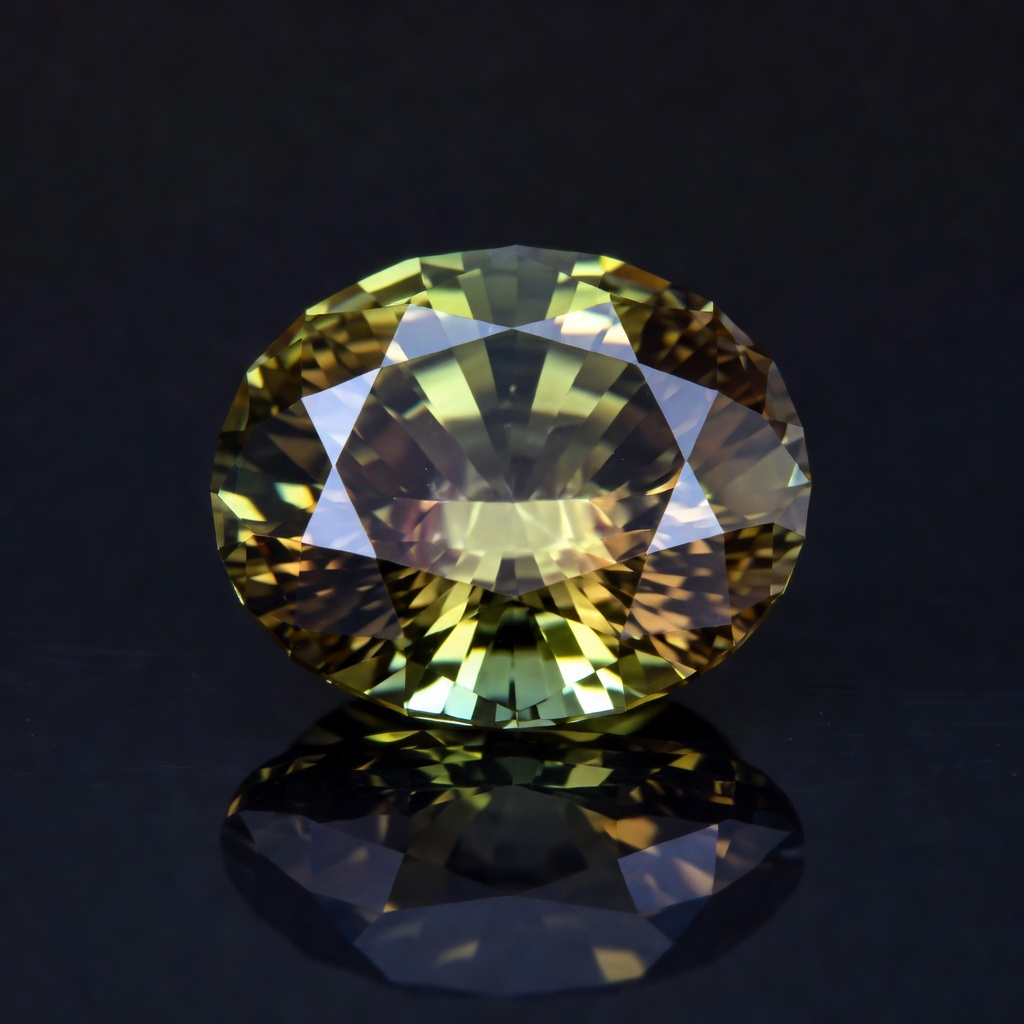
Perhaps no other characteristic defines sphene's desirability quite like its extraordinary optical performance, specifically its dispersion value of 0.051, which significantly exceeds diamond's renowned 0.044 dispersion rating. This exceptional sphene fire dispersion creates spectacular rainbow flashes when white light enters a properly faceted stone, separating into vivid spectral colors that dance across the table and crown facets with every movement. The phenomenon results from the mineral's high refractive index, which ranges from 1.843 to 2.110 depending on the crystallographic direction, combined with strong birefringence that produces a doubling effect when viewing objects through the stone.
The luster of quality sphene varies between adamantine (diamond-like) and resinous, with the finest specimens displaying a brilliant vitreous shine that enhances their apparent clarity and color saturation. When cutters orient sphene crystals correctly, they can maximize this fire while minimizing the effects of trichroism, where the stone displays different colors—typically shades of green, yellow, and reddish-brown—when viewed from different angles. Practical gemological testing reveals that sphene's birefringence measures approximately 0.100 to 0.192, creating visible doubling of back facets when observed through the crown with a loupe, a diagnostic feature that helps distinguish genuine sphene from simulants or look-alike stones such as demantoid garnet.
Color Varieties and Geographic Sources
Titanite color varieties span an impressive spectrum, though the gemstone most commonly occurs in yellow-green, honey-brown, olive, and greenish-gray hues that reflect its geological formation environment and trace element content. The most commercially desirable specimens display intense lime-green to yellowish-green colors reminiscent of fine demantoid garnet or chrysoberyl, while darker brownish-green stones, though more common, typically command lower prices in the collector market. Rare and highly prized varieties include chrome-green specimens from specific localities and unusual pink to reddish-orange stones discovered in Pakistan and Russia, which owe their distinctive coloration to rare earth element substitutions within the crystal lattice.
Geographic provenance significantly influences both the quality and color characteristics of sphene crystals available in today's market. Madagascar consistently produces some of the finest gem-quality material, particularly from the Antsirabe and Ihosy regions, where crystals yield intense green to yellow-green stones with exceptional clarity. Pakistan's Skardu district yields remarkable transparent crystals ranging from golden-yellow to rare pink varieties, while Sri Lanka (Ceylon) provides traditional honey-colored to greenish-yellow stones that have populated the gem trade for centuries. Russian deposits, particularly those in the Ural Mountains and the Kola Peninsula, produce distinctive yellowish-green to brown specimens often containing unique inclusion patterns that assist in origin determination. Other notable sources include Brazil, Canada (Quebec and Ontario), and select localities in the United States, including New York and California, each contributing distinct characteristics to the global supply of this fascinating mineral.
Crystal Structure and Formation
Understanding the sphene crystal system requires examining its monoclinic structure, characterized by three unequal axes with one oblique intersection that creates the mineral's distinctive wedge-shaped or lozenge-like crystal habits. These crystals typically form as simple to multiple prisms with steep pyramidal terminations, often displaying striations parallel to the prism length that serve as identifying features for field collectors and geologists. The monoclinic system allows for specific atomic arrangements that accommodate the calcium, titanium, and silicon composition while incorporating various trace elements that influence color and optical properties.
Geological formation environments for sphene include high-grade metamorphic rocks such as gneiss and schist, calcium-rich skarns formed through contact metamorphism between igneous intrusions and carbonate rocks, and coarse-grained granite pegmatites where large crystals have space to develop. Common twinning patterns, particularly contact twins on the {100} plane, create distinctive heart-shaped or arrowhead formations that collectors particularly treasure as mineral specimens. Within these environments, sphene often associates with minerals such as diopside, epidote, calcite, and various feldspars, providing field indicators for prospectors seeking new deposits. The formation process requires specific temperature and pressure conditions that allow for the incorporation of titanium into the silicate structure, typically occurring during the late stages of magmatic crystallization or during regional metamorphism of titanium-bearing sedimentary rocks.
Cutting Challenges and Faceting Techniques
Transforming rough sphene into finished gemstones presents significant challenges for lapidaries due to the combination of moderate sphene hardness and distinct cleavage planes that require expert handling to prevent catastrophic breakage. The cutting process demands slow, careful grinding with fine grits to avoid creating thermal shock or mechanical stress that could activate cleavage planes, particularly when working with included material or crystals containing internal fractures. Master cutters must orient the rough crystal with precision, aligning the table perpendicular to the optic axis to minimize the visible doubling effect while maximizing the stone's inherent brilliance and dispersion characteristics.
Optimal cutting styles for maximizing Sphene (Titanite) Properties and Information visibility include round brilliants and cushion cuts, which provide numerous facets to showcase the stone's fire while maintaining structural integrity through symmetrical design. Step cuts generally prove less suitable for sphene as they do not adequately display the dispersion that makes this gemstone desirable, though emerald cuts may be employed for cleaner material where clarity rather than fire represents the primary attraction. Protective girdle designs with slightly thicker faceting meet points help prevent chipping during setting and wear, while shallow crown angles reduce the risk of breakage during polishing. Experienced lapidaries often create custom designs specifically for individual rough crystals, taking into account inclusion locations, color zoning, and natural crystal faces that might be preserved as unique features in the final gemstone.
Jewelry Applications and Wearability
When considering sphene jewelry care and practical applications, designers and consumers must acknowledge that this titanite gemstone functions best in protective settings designed for pendants, earrings, brooches, and occasional-wear rings rather than daily-wear engagement pieces. The combination of 5-5.5 Mohs hardness and distinct cleavage makes sphene vulnerable to scratching, chipping, and breaking when subjected to the impacts and abrasions common in everyday activities. Jewelry designers typically recommend bezel settings, halo designs, or protective prong arrangements that shield the girdle and crown edges from direct contact with hard surfaces, significantly extending the wearable lifespan of these beautiful but delicate stones.
Comparative durability analysis reveals that sphene requires more careful handling than popular jewelry stones such as sapphire (9), ruby (9), or even amethyst (7), positioning it closer to opal or pearl in terms of wearability precautions. For collectors seeking to display sphene's spectacular fire, earrings represent an ideal application, as they face minimal impact risk while positioning the stones to catch light effectively. Pendants worn on shorter chains or protected beneath clothing similarly offer safe environments for showcasing larger specimens. When set in rings, sphene should be reserved for dress rings worn on special occasions rather than daily wear, and owners should remove such jewelry before engaging in household cleaning, sports activities, or manual labor that might expose the stone to chemical cleaners or physical shocks.
Identification and Distinguishing Features
Professional gemologists rely on several diagnostic characteristics to confirm Sphene (Titanite) Properties and Information and distinguish genuine specimens from simulants such as demantoid garnet, zircon, or various synthetic materials. Diagnostic inclusions frequently observed in sphene include wedge-shaped cavities, healing fractures, and parallel growth tubes that create distinctive fingerprint patterns under magnification, features that differ significantly from the horsetail inclusions typical of Russian demantoid or the doubling patterns seen in zircon. The combination of high relief, strong doubling of back facets due to high birefringence, and specific inclusion suites provides reliable identification markers for experienced practitioners.
Distinguishing sphene from visually similar demantoid garnet requires careful examination of dispersion patterns, as sphene typically displays more intense fire with broader spectral color separation, while demantoid exhibits characteristic "horsetail" inclusions composed of byssolite fibers. Zircon, another high-dispersion gemstone, can be differentiated through specific gravity testing (zircon is notably heavier at 4.6-4.8) and differences in absorption spectra. Advanced identification techniques include refractive index measurement using a refractometer, where sphene's readings between 1.843 and 2.110 fall within a distinctive range, and spectroscopic analysis revealing characteristic absorption lines related to titanium and rare earth element content. Chelsea color filters and UV fluorescence testing provide additional confirmatory data, though fluorescence reactions vary widely depending on trace element content and geographic origin.
Proper Care and Maintenance
Maintaining the beauty of sphene jewelry requires adherence to specific protocols that acknowledge the stone's relatively soft sphene hardness and sensitivity to thermal shock and chemical exposure. The recommended cleaning method involves using only warm soapy water—mild dish soap works effectively—applied with a soft brush such as a baby toothbrush or makeup brush with natural bristles to gently remove accumulated oils and debris from the surface and beneath the setting. Owners must strictly avoid ultrasonic cleaners and steam cleaning devices, as the vibrations and rapid temperature changes can cause existing fractures to propagate or activate cleavage planes, potentially shattering an otherwise beautiful gemstone.
Storage practices play a crucial role in preserving sphene jewelry, with individual soft pouches or separate compartment boxes preventing contact with harder gemstones such as diamonds, sapphires, or even quartz that could scratch the sphene's surface. When traveling, wrap sphene pieces in acid-free tissue or soft cloth before placing them in jewelry rolls to prevent movement and abrasion against metal settings or other stones. Practical lifestyle recommendations include removing sphene rings before washing hands with harsh soaps, applying cosmetics or perfumes, engaging in household cleaning with chemical agents, or participating in sports and manual activities. Annual professional inspections by qualified jewelers can identify loose settings or developing damage before serious loss occurs, ensuring that these exceptional gemstones remain secure and brilliant for generations of appreciation.
Market Value and Collectibility
The commercial value of high-quality titanite gemstone specimens depends on several interrelated factors, with color intensity representing the primary price determinant, particularly for stones displaying vivid chrome-green to yellowish-green hues without brownish modifying tones. Clarity significantly impacts valuation, as eye-clean stones over one carat command substantial premiums, while included material suitable primarily for mineral specimens or cabochons trades at considerably lower price points. Carat weight dramatically affects availability and pricing, as clean faceted stones exceeding five carats remain exceptionally rare in the market, often achieving prices comparable to fine tourmaline or spinel on a per-carat basis.
Current market trends indicate growing collector interest in sphene driven by increased awareness of its extraordinary sphene fire dispersion and the declining availability of fine material from traditional sources such as Madagascar and Sri Lanka. Investment potential remains moderate to strong for exceptional specimens, particularly untreated stones with documented provenance from specific renowned localities like Pakistan's Skardu region or particular Madagascar mines. Collectors seeking to acquire significant sphene should prioritize stones with independent laboratory certification verifying natural origin and absence of treatments, as heating or diffusion treatment, while uncommon, can affect long-term value stability. The market distinguishes between collector-grade mineral specimens showing classic crystal habits and cutting rough intended for faceting, with the former sometimes commanding higher prices from mineral enthusiasts than cut stones of equivalent weight due to crystallographic perfection and aesthetic presentation.
Frequently Asked Questions
Why is sphene also called titanite?
Sphene derives its alternative name 'titanite' from its titanium content (chemical formula CaTiSiO5). While 'sphene' refers to the Greek word for 'wedge' describing its crystal shape, mineralogists officially adopted 'titanite' in 1982 to emphasize its chemical composition, though both terms remain in common use today.
What makes sphene's fire greater than diamond?
Sphene possesses a dispersion value of 0.051, which exceeds diamond's 0.044. This higher dispersion means sphene splits white light into spectral colors more intensely, creating exceptional 'fire' or rainbow flashes, especially visible in faceted stones with proper cutting.
Is sphene suitable for engagement rings?
Due to its relatively soft hardness of 5-5.5 on the Mohs scale and distinct cleavage, sphene is generally not recommended for daily-wear engagement rings. It is better suited for pendants, earrings, or occasional-wear rings with protective settings like bezels.
What colors does sphene come in?
Sphene typically occurs in yellow-green, honey-brown, greenish-gray, and olive colors. Rare specimens display pink, red, or orange hues depending on trace element content. Chrome-rich sphene shows intense green colors, while rare earth elements can produce unusual color variations.
How can I tell if my sphene is real?
Authentic sphene exhibits high birefringence (double refraction visible as doubling of back facets), adamantine luster, and a dispersion higher than diamond. It typically shows specific inclusions like wedge-shaped cavities. Professional gemological testing including refractive index measurement (1.843-2.110) confirms identity.
What is the hardness of sphene on the Mohs scale?
Sphene ranks 5 to 5.5 on the Mohs hardness scale, making it softer than quartz (7) and significantly softer than sapphire (9) or diamond (10). This relatively low hardness requires careful handling to prevent scratches and damage during wear.
Where are the best sphene specimens found?
The finest gem-quality sphene originates from Madagascar, Pakistan (particularly the Skardu region), and Sri Lanka. Other notable sources include Russia, Brazil, Canada, and the United States (New York and California), with each locality producing distinct color characteristics.
How should I clean sphene jewelry?
Clean sphene using only warm soapy water and a soft brush. Avoid ultrasonic cleaners, steam cleaners, and harsh chemicals including acids and alkalis, as these can damage the stone. Always rinse thoroughly and dry with a soft cloth, storing separately from harder gemstones.