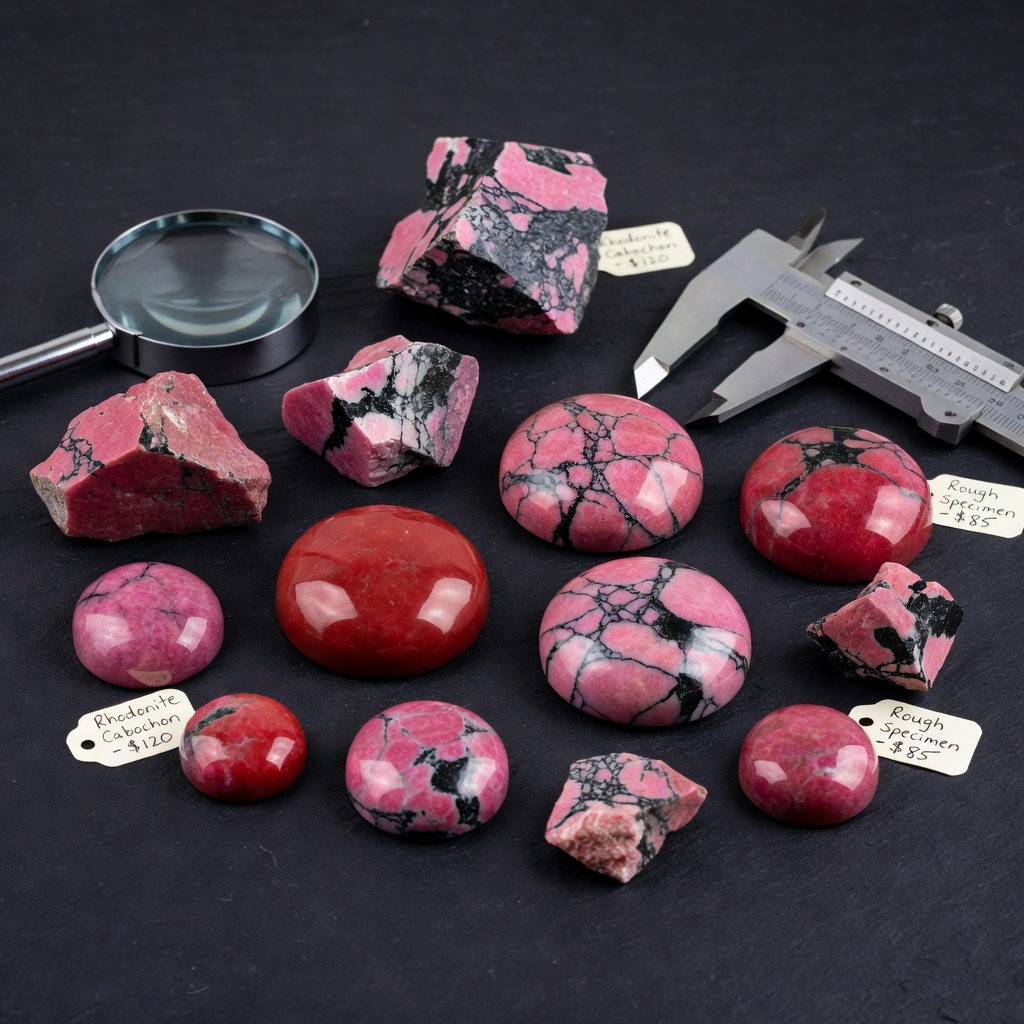
Introduction to Rhodonite Market Values
Rhodonite has emerged as one of the most sought-after colored gemstones in the contemporary jewelry market, captivating collectors and designers alike with its distinctive raspberry-pink to rose-red hues accented by dramatic black manganese oxide veining. As a manganese silicate mineral with the chemical composition (Mn,Fe,Mg,Ca)SiO₃, this striking stone offers an accessible entry point for those drawn to pink gemstones without the premium price tags associated with precious varieties like pink sapphire or morganite. Understanding the current Rhodonite Price Guide requires examining the full spectrum of quality grades available, from commercial material suitable for beaded jewelry and carving to museum-grade specimens that command prices rivaling semi-precious alternatives.
The market for rhodonite spans multiple tiers, with commercial-grade rough material typically entering the market at budget-friendly price points between $0.50 and $3 per gram, making it ideal for lapidary hobbyists and bulk jewelry manufacturers. Mid-range jewelry-grade cabochons generally retail between $5 and $30 per carat depending on pattern quality and size, while exceptional collector specimens featuring intense color saturation and minimal matrix can exceed $100 per carat. When comparing rhodonite value per carat against similar pink stones, rhodonite typically falls between rose quartz (which remains extremely affordable at $1-$5 per carat) and rhodochrosite (which can range from $20-$200+ per carat for high-grade Argentine material), positioning it as a mid-range option with excellent visual impact for the investment.
Key Factors Influencing Rhodonite Prices
Several critical characteristics determine where a specific rhodonite specimen falls within the pricing spectrum, with color quality serving as the primary value determinant. The most desirable rhodonite displays an intense, uniform rose-red to raspberry-pink coloration without brownish or grayish secondary tones, as deeper saturation directly correlates with higher rhodonite gemstone pricing across all market segments. Stones exhibiting a pure, vivid pink reminiscent of high-quality rhodochrosite command significant premiums, while material showing pale, washed-out coloration or uneven color distribution typically sells at substantial discounts regardless of size or clarity.
The distinctive patterning created by manganese oxide inclusions significantly impacts valuation, with collectors and jewelry makers specifically seeking specimens that display a harmonious balance between the pink host material and black veining or dendritic formations. Ideal matrix patterns feature bold, artistic black lines that contrast sharply against the pink background without overwhelming the stone's color, creating the signature appearance that distinguishes fine rhodonite from inferior material. Clarity considerations differ markedly between cabochon and faceted applications; while opaque to translucent material works beautifully for cabochons that showcase surface patterns, rare transparent rhodonite suitable for faceting requires exceptional clarity and commands prices ten to twenty times higher than typical opaque specimens due to the difficulty in finding clean, facet-grade rough.
Rhodonite Price Per Carat Breakdown
Understanding the granular details of rhodonite value per carat requires segmenting the market by material form and intended application, as pricing structures vary dramatically between rough mineral specimens, finished cabochons, and faceted gemstones. Commercial-grade rough rhodonite, often sold by gram rather than carat weight to lapidary artists and bulk buyers, typically ranges from $0.50 to $3 per gram for material suitable for tumbling, bead production, or carving, with price variations depending on color intensity and the presence of usable solid sections versus heavily fractured material.
Finished cabochons represent the largest segment of the jewelry market, with standard-quality stones measuring between 10x8mm and 20x15mm generally retailing between $5 and $15 per carat when sourced from common localities like Brazil or Australia. Premium cabochons featuring exceptional pattern contrast, intense color, and large sizes (25x18mm and above) can reach $20 to $30 per carat, particularly when cut to maximize the display of characteristic black manganese veining against the pink background. At the apex of the market, rare translucent rhodonite suitable for precision faceting—material that must be free of the inclusions and fractures that characterize most deposits—commands pink rhodonite cost premiums of $50 to $100+ per carat, with exceptional large clean stones occasionally exceeding these ranges at specialty auctions.
Origin-Based Pricing: Russian vs. Other Sources
Geographic provenance plays a decisive role in rhodonite valuation, with material sourced from the Ural Mountains of Russia standing at the pinnacle of the market due to its superior quality characteristics and historical significance in decorative arts. Russian rhodonite value stems from the region's production of fine-grained, intensely colored material that accepts an exceptional polish and displays the ideal contrast between deep rose-red stone and jet-black manganese matrix that has adorned imperial palaces and elite jewelry since the 18th century. This Ural Mountain material, particularly from the classic Sidelnikovo and Uspenskaya deposits, routinely commands 30% to 100% price premiums over comparable material from other localities, with large solid blocks suitable for ornamental carving reaching thousands of dollars per kilogram.
In contrast, Australian rhodonite from New South Wales and Queensland, while often displaying excellent color, typically enters the market at more accessible price points ranging from 40% to 60% below Russian material, making it popular for commercial jewelry production and beginning collectors. Brazilian deposits produce significant quantities of rhodonite with good color but often heavier matrix inclusions, positioning this material in the budget to mid-range pricing tier, while American material from Massachusetts and New Jersey—particularly the historically significant Franklin locality—carries modest premiums among specialist collectors due to its association with classic mineral specimens. Mining restrictions in Russia and the depletion of historically rich deposits have further tightened supply of top-tier material, creating a two-tier market where manganese silicate stone prices for Russian goods continue appreciating while abundant Brazilian and Australian material maintains stable, affordable pricing.
Quality Grades and Corresponding Price Ranges
The rhodonite market utilizes a tiered grading system that helps buyers understand value propositions across different quality levels, with Grade A (Collector) material representing the finest available specimens suitable for high-end jewelry or investment collecting. This premium tier features intense, saturated rose-red to raspberry coloration with minimal visible fractures, distinct and attractive black matrix patterning that enhances rather than detracts from the stone's appearance, and excellent polish quality that reveals the mineral's characteristic vitreous to pearly luster. Grade A specimens typically start at $25 per carat for smaller cabochons and can exceed $100 per carat for exceptional large pieces with museum-quality pattern display, representing the upper echelon of pink rhodonite cost structures.
Grade B (Jewelry) material comprises the workhorse segment of the market, offering good pink to rose coloration with acceptable matrix distribution that may include more extensive black veining or minor inclusions that do not significantly impact durability. This mid-range category, priced between $8 and $20 per carat depending on size and specific pattern quality, provides excellent value for silver and gold jewelry settings where the stone's natural beauty remains apparent without requiring the perfection demanded by high-end collectors. Grade C (Commercial) material includes pale pink to brownish-pink stones with heavy, distracting matrix patterns, surface-reaching fractures, or structural flaws that limit durability; while unsuitable for fine jewelry, this budget-friendly category at $2 to $7 per carat serves well for beaded jewelry, educational collections, and beginner lapidary projects where rhodonite jewelry worth considerations prioritize quantity and affordability over individual specimen perfection.
Form and Cut Impact on Valuation
The physical presentation of rhodonite significantly influences its market value, with rough mineral specimens and crystals appealing to a distinct collector base that evaluates aesthetic appeal, size, and crystalline form rather than cutting potential. Mineral specimens featuring well-formed crystals or massive blocks with exceptional pattern contrast sell by weight based on visual impact, with display-quality pieces from classic localities ranging from $10 for small matrix samples to $500+ for large cabinet specimens exceeding several pounds, particularly when they showcase the characteristic pink-and-black banding that makes this manganese silicate stone instantly recognizable.
Cabochon cutting represents the standard preparation method for rhodonite, as the opaque to translucent nature of most material makes it unsuitable for brilliant faceting, while the domed surface beautifully displays the stone's signature matrix patterns and color zoning. High-domed cabochons that maximize the three-dimensional display of black manganese veins against pink backgrounds command higher prices than flat-bottomed or low-domed cuts, with calibrated sizes for standard ring and pendant settings typically carrying 20% to 30% premiums over freeform shapes due to the material waste involved in cutting uniform dimensions. Rare faceted rhodonite, requiring exceptional transparency and freedom from inclusions found in less than 1% of mined material, represents the valuation extreme; these scarce gems require specialized cutting expertise to minimize breakage risks due to rhodonite's perfect cleavage, resulting in pricing of $75 to $150 per carat for well-executed stones that successfully navigate the challenges of cutting this beautiful but temperamental gemstone.
Retail vs. Wholesale Rhodonite Pricing
Understanding the dichotomy between wholesale and retail markets proves essential for anyone seeking to optimize their Rhodonite Price Guide expectations, as price differentials can range from 100% to 400% depending on supply chain positioning. Wholesale rough material markets cater primarily to lapidary artists, bead manufacturers, and jewelry production houses, offering bulk rhodonite by the kilogram or pound at significantly reduced per-gram rates; at major gem shows like Tucson or Denver, wholesale buyers might acquire commercial-grade rough for $0.30 to $1.50 per gram when purchasing 500-gram lots or larger, while high-grade cutting rough for cabochons ranges from $3 to $8 per gram depending on color intensity and locality documentation.
Retail markup structures vary dramatically by venue, with brick-and-mortar jewelry stores typically applying keystone (100%) to triple-keystone (200%) markups on finished rhodonite jewelry to cover overhead costs, resulting in $40 to $120 retail prices for pieces containing $20 worth of gemstone material. Online marketplaces offer more competitive pricing due to reduced overhead, though buyer vigilance remains necessary regarding color-accurate photography and disclosure of treatments. Direct-from-miner purchasing opportunities, increasingly available through social media platforms and specialized mineral websites, often provide the best value proposition for knowledgeable buyers, offering prices 30% to 50% below retail while ensuring provenance authenticity, particularly important when investing in Russian rhodonite value specimens where origin documentation significantly impacts resale potential.
Investment Potential and Resale Value
While rhodonite does not function as a liquid investment vehicle comparable to diamonds, rubies, or blue-chip stocks, the market demonstrates steady appreciation for exceptional material, particularly fine Russian specimens and large, flawless cabochons from depleted classic localities. Current trends indicate annual value increases of 5% to 10% for top-tier collector-grade rhodonite, driven by increasing restrictions on Russian mineral exports, growing awareness of the stone's metaphysical associations with emotional healing, and renewed interest in pink gemstones across fashion markets. However, potential investors should recognize that rhodonite jewelry worth on the secondary market depends heavily on documentation of origin, quality of craftsmanship in any settings, and the presence of unique characteristics such as exceptional size or unusual matrix patterns that distinguish ordinary material from investment-grade specimens.
The resale market for rhodonite operates primarily through specialized mineral auctions, estate sales, and collector-to-collector transactions rather than mainstream jewelry resale channels, creating liquidity challenges for those seeking quick returns. Museum-quality specimens exceeding 100 carats with exceptional patterning or historical provenance occasionally achieve remarkable prices at specialty auctions, with rare 19th-century Russian ornamental objects or jewelry pieces commanding five to six-figure sums among decorative arts collectors. For most buyers, rhodonite represents a "wearable investment" best appreciated for its aesthetic and personal value rather than speculative financial returns, though building a curated collection of fine specimens from diverse localities can yield modest appreciation over decades while providing ongoing enjoyment of these beautiful pink gemstones.
Where to Buy Rhodonite: Price Comparisons
Navigating the diverse purchasing channels for rhodonite requires understanding how venue selection impacts both pricing and quality assurance, with online gemstone marketplaces like Etsy, eBay, and specialized mineral retail websites offering the broadest selection and competitive pricing for individual buyers. These platforms typically feature cabochons ranging from $5 to $40 per carat depending on seller reputation and quality grading accuracy, though buyers must scrutinize photographs for color accuracy—rhodonite's pink tones vary widely under different lighting conditions—and verify seller return policies before committing to purchases. Established online mineral dealers often provide superior value compared to general jewelry retailers, as they possess the expertise to accurately grade rhodonite gemstone pricing tiers and typically offer detailed locality information essential for informed buying decisions.
Brick-and-mortar rock shops and metaphysical stores provide the advantage of physical inspection, allowing buyers to evaluate color saturation, matrix patterns, and surface polish quality in person, though these venues often carry 20% to 40% price premiums over online sources due to limited inventory turnover and specialized retail overhead. For vintage and antique rhodonite jewelry worth assessments, auction houses and estate sales occasionally feature exceptional pieces from the Victorian era through mid-century periods when rhodonite enjoyed particular popularity in carved cameos and beaded necklaces, with prices varying dramatically based on metal content, craftsmanship, and provenance. Regardless of purchasing venue, acquiring rhodonite from sellers who provide detailed provenance information, particularly for high-value Russian material, ensures both fair current pricing and stronger resale potential should market conditions or personal collecting interests change over time.
Frequently Asked Questions
How much does rhodonite cost per carat?
Rhodonite typically ranges from $5 to $30 per carat for cabochon-quality material, while rare translucent specimens suitable for faceting can command $50 to $100+ per carat. Rough material is often sold by gram at $0.50-$3 for commercial grade. The specific price depends heavily on color intensity, with deep rose-red stones commanding premiums over pale pink material, and origin, with Russian specimens generally doubling the price of comparable Brazilian or Australian stones.
Is rhodonite expensive compared to other pink gemstones?
Rhodonite is generally affordable compared to precious pink gemstones like pink sapphire or morganite. It offers excellent value for jewelry makers and collectors, though fine Russian material with exceptional patterning commands higher prices than common Brazilian or Australian rough. While a high-quality pink sapphire might cost $500 to $5,000+ per carat, and morganite typically ranges $100 to $300 per carat, rhodonite provides striking pink coloration with unique black matrix patterns at a fraction of these prices, making it accessible for statement jewelry pieces without significant investment.
What makes Russian rhodonite more valuable?
Russian rhodonite from the Ural Mountains is prized for its intense rose-red color, fine texture, and striking contrast between the pink stone and black manganese matrix. Historical significance, superior polishability, and limited availability due to mining restrictions contribute to its premium pricing. The material from classic localities like Sidelnikovo accepts a higher polish than most other sources and displays the ideal color saturation that has made it the standard against which all other rhodonite is measured since the 18th century when it was used for imperial decorative objects.
Does the size of rhodonite affect its price significantly?
While larger stones generally cost more total, price per carat often increases with size for high-quality material because finding large pieces without fractures or inclusions is rare. However, extremely large specimens may appeal more to mineral collectors than jewelry makers, affecting pricing dynamics. Cabochons exceeding 25 carats of clean, intensely colored material can command 50% to 100% higher per-carat prices than smaller stones, whereas very large rough specimens (over 1 kilogram) might actually decrease in per-gram value if they are too massive for standard jewelry applications and appeal only to specialized collectors or carvers.
How can I tell if I'm paying a fair price for rhodonite?
Evaluate color intensity (deeper pinks cost more), examine the pattern contrast between pink and black minerals, check for surface-reaching fractures that weaken the stone, and verify origin if premium pricing is claimed. Compare prices across multiple reputable dealers before purchasing. Additionally, examine the quality of the cut—well-polished cabochons with symmetrical domes and no flat spots indicate skilled lapidary work that justifies higher prices, while poorly executed cuts with scratchy surfaces or uneven domes should command lower prices regardless of material quality.
Is treated or enhanced rhodonite worth less than natural?
Rhodonite is rarely treated or enhanced, which helps maintain stable pricing. Any dyed or stabilized material should be significantly cheaper and clearly disclosed. Natural, untreated rhodonite with good color saturation represents the standard market value. Unlike many other gemstones, rhodonite's value derives primarily from its natural color and patterning, which cannot be easily replicated through treatment; therefore, treated material is generally considered undesirable and should sell at 50% to 70% discounts compared to untreated natural specimens of similar appearance.
Where is the best place to buy affordable rhodonite?
For affordable options, consider rock and mineral shows, direct purchases from lapidary artists, or online marketplaces specializing in rough gemstones. Avoid high-end jewelry stores for raw material, but ensure sellers provide clear photos showing true color and any matrix patterns. Building relationships with lapidary clubs or attending local gem and mineral society meetings can provide access to rough material at near-wholesale prices, while purchasing cull material (pieces with minor flaws unsuitable for fine jewelry but perfect for practice or bead making) from commercial cutters can yield beautiful rhodonite at 60% to 80% below standard retail pricing.