
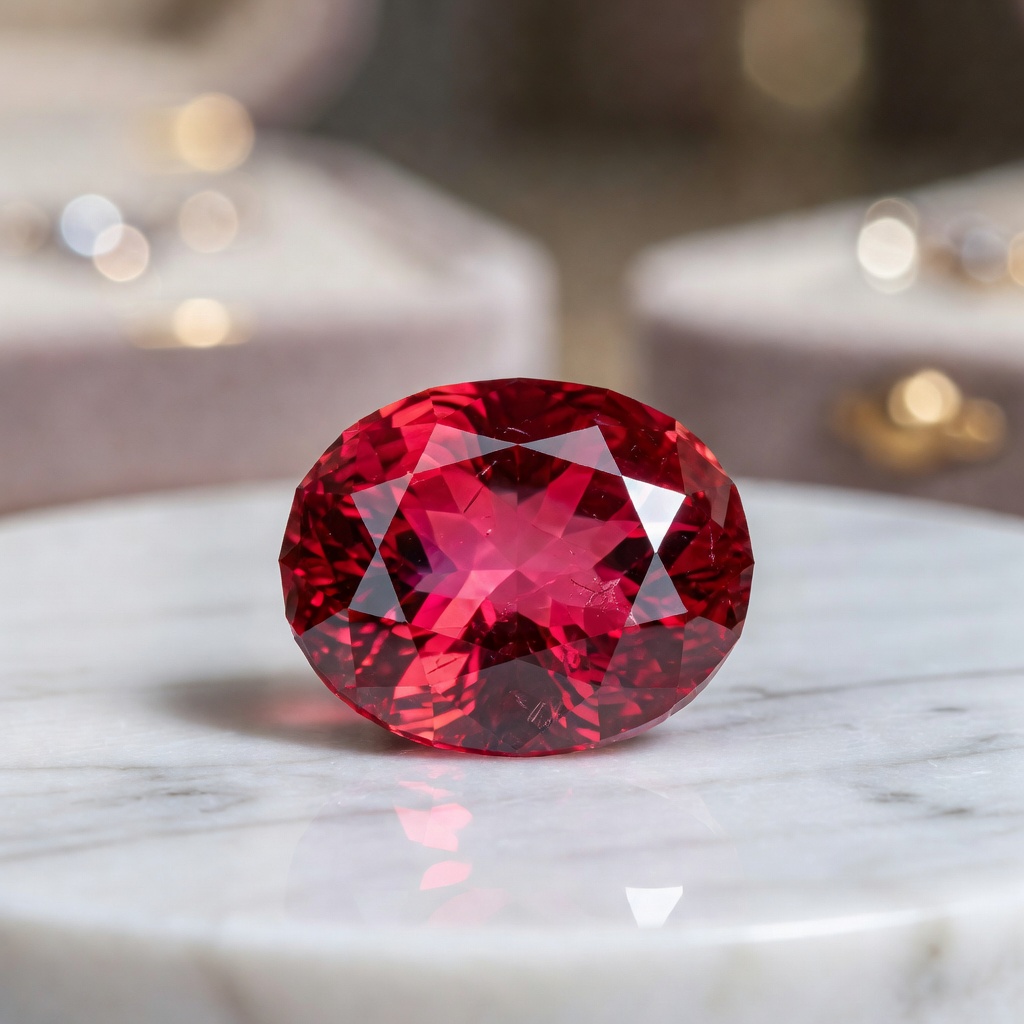
What Makes Red Beryl the Rarest Gemstone on Earth?
Red beryl stands as perhaps the most statistically improbable gemstone discovery in modern mineralogy, with mining operations extracting approximately one gem-quality crystal for every 150 tons of rock excavated from the Wah Wah Mountains. This extraordinary scarcity ratio surpasses even that of diamonds, where roughly one carat of diamond is recovered per ton of kimberlite ore, making red beryl approximately 150 times rarer than its carbon counterpart. When compared to emeralds, which already command premium prices due to limited deposits, red beryl remains exponentially scarcer, with annual global production measured in mere carats rather than kilograms.
The geological formation of this remarkable bixbite gemstone requires a perfect convergence of specific elements that seldom occur together in nature's laboratory. Unlike other beryl varieties such as emerald or aquamarine that form in diverse geological environments worldwide, natural red beryl demands simultaneous presence of beryllium-rich rhyolitic volcanic flows and manganese-bearing solutions at precise temperature and pressure conditions. This unique chemical marriage occurred only during the Tertiary period in specific localized pockets of western Utah, creating deposits that geologists estimate represent less than 0.0001% of the earth's accessible gem-bearing formations.
Geographic limitations further cement red beryl's status among rare red gemstones, as gem-quality material has been authenticated from merely three localities worldwide, with only the Utah deposits producing stones suitable for faceting and jewelry use. While trace occurrences exist in Mexico's San Luis Potosí region and New Mexico's Black Range, these deposits typically yield microscopic crystals unsuitable for cutting, rendering the Wah Wah Mountains effectively the sole source for collectors and jewelers. This absolute geographic constraint means that red beryl rarity grade assessments consistently place the gemstone above paraíba tourmaline, alexandrite, and even high-quality rubies in terms of availability per capita.
Geographic Origins: Why Utah Red Beryl Commands Premium Prices
The Wah Wah Mountains in Beaver County, Utah, represent the epicenter of red beryl production, specifically within a narrow geological zone spanning approximately 1.5 miles of altered topaz rhyolite. Mining operations here, conducted primarily by private claims holders since the 1950s, have yielded the vast majority of faceted material available on the collector market today. The specific geological formation known as the Topaz Dome complex created the unique hydrothermal environment necessary for bixbite crystallization, with mineral-rich fluids penetrating fractures in volcanic rock approximately 20 million years ago to form these precious hexagonal crystals.
Within the Utah red beryl mines, distinct claim groups produce material with notably different characteristics that directly impact valuation. The original Violet Claims, discovered by Lamar Hodges in 1958, historically provided the deepest raspberry-red crystals with exceptional transparency, while the adjacent Ruby Violet Claims, developed later, tend to produce slightly lighter material with more frequent inclusions. Sophisticated collectors often specify provenance when acquiring specimens, as stones from the original Violet Claims command 20-30% premiums over similar-quality material from secondary deposits due to their historical significance and superior color saturation.
While Mexican deposits in the Sierra de la Paila range and New Mexico occurrences in the Black Range technically produce red beryl, gemologists distinguish these as separate varieties due to their microscopic crystal size and inferior gemological properties. Mexican material rarely exceeds 5 millimeters in length and typically displays orange-red coloration rather than the pure raspberry hue associated with Utah specimens. Mining challenges including the remote 50-mile dirt road access to the Wah Wah Mountains, seasonal weather restrictions limiting operations to summer months, and the labor-intensive hand-sorting of volcanic rock contribute to the constrained supply that drives red beryl price per carat valuations into the thousands.
The Four Cs of Red Beryl Quality Assessment
Evaluating bixbite gemstone quality requires understanding how traditional grading standards adapt to this unique material's inherent limitations and exceptional rarity. Unlike diamonds or sapphires where strict clarity expectations prevail, red beryl quality factors prioritize color intensity and provenance over flawless transparency. Professional appraisers employ modified criteria that acknowledge the stone's Type III clarity classification while maintaining rigorous standards for hue saturation and crystal integrity.
Color assessment distinguishes between the coveted deep raspberry red that characterizes premium material and the less valuable salmon-pink or orange-red tones found in lower-grade specimens. The most desirable stones display a vivid red with subtle purple undertones reminiscent of ripe raspberries under daylight-equivalent lighting, avoiding the brownish modifiers that indicate iron contamination during formation. Pleochroism presents significant challenges during evaluation, as red beryl crystals display different colors when viewed from different crystallographic directions—typically orange-red parallel to the c-axis and purple-red perpendicular to it—requiring cutters to orient the table facet carefully to maximize the preferred purple-red face-up appearance.
Carat weight rarity factors create exponential valuation curves unique to this gemstone, with stones exceeding one carat considered museum-grade specimens worthy of institutional collections. The majority of faceted red beryls weigh between 0.10 and 0.40 carats, making even half-carat stones significant acquisitions for serious collectors. Cut optimization techniques must balance the pursuit of maximum weight retention against the management of pleochroism and the stone's inherent brittleness, with step cuts and modified brilliant cuts proving most successful for showcasing color while protecting vulnerable crystal edges.
Decoding Red Beryl Color: From Raspberry to Deep Red
The valuation hierarchy for red beryl color grade centers on achieving the elusive "stop-light red" or deep raspberry saturation that separates extraordinary specimens from merely acceptable material. Gemological laboratories assess hue using specialized colorimeters under controlled lighting, with the most valuable stones displaying a dominant red wavelength of approximately 700 nanometers with minimal orange or brown secondary tones. Collectors should examine potential acquisitions under multiple lighting conditions, as incandescent lighting may mask brown undertones that become visible under natural daylight, potentially affecting the stone's apparent value by thousands of dollars per carat.
Raspberry red beryl commands the highest premiums when the color maintains saturation across the entire crown of the stone without windowing or extinction. Stones cut too deeply may display a "bow-tie" effect or dead zones where light leaks through the pavilion, while overly shallow cuts sacrifice the rich color depth that defines premium material. The impact of pleochroism requires careful consideration during purchase, as a stone oriented to display its orange-red axis will appear significantly less valuable than one properly cut to emphasize the purple-red direction, even if both derive from the same rough crystal.
Tonal value preferences favor medium-dark tones that allow the red hue to develop fully without approaching the overly dark "black-out" effect seen in some African rubies. Light-toned material, sometimes described as "pink beryl" by unscrupulous sellers, lacks the saturation necessary for investment-grade classification and typically sells for 60-70% less than equivalent-weight dark raspberry specimens. When evaluating loose stones, place the gem against a white background under north daylight or equivalent LED lighting to accurately assess both saturation and tone without the interference of colored mountings or warm jewelry store lighting.
Understanding Inclusions and Clarity Expectations
Natural red beryl identification relies heavily on recognizing the distinctive internal characteristics that authenticate genuine material while distinguishing it from synthetics and simulants. As a Type III gemstone according to the Gemological Institute of America's clarity classification system, red beryl virtually always contains inclusions, making "eye-clean" specimens exceeding one carat essentially nonexistent and immediately suspect. Typical internal features include fingerprint patterns composed of trapped healing fluids, two-phase inclusions containing both liquid and gas bubbles, and growth zoning that appears as parallel lines following the crystal's hexagonal structure.
Surface-reaching fractures present particular challenges for red beryl inclusions assessment, as the mining process and inherent geological stresses frequently create partial fractures that extend from the surface into the crystal body. While these features may appear problematic to novice collectors, experienced gemologists accept minor surface-reaching inclusions as natural birthmarks provided they do not compromise structural integrity or create entry points for chemical damage during jewelry cleaning. However, heavily included stones with dense clusters of fractures may prove unsuitable for standard prong settings, requiring protective bezel mounts that obscure portions of the pavilion.
Eye-clean standards for red beryl differ significantly from those applied to diamonds or aquamarines, with collectors often appreciating visible inclusions as proof of natural origin rather than viewing them as value detractors. When examining stones under 10x magnification, look for the "feather" patterns and tube-like inclusions characteristic of Wah Wah Mountains material rather than the curved growth striations or seed plates indicative of hydrothermal synthetics. Stones with inclusions positioned near the girdle or under the table facet require careful setting considerations, as pressure applied during mounting could potentially expand existing fractures into visible cracks that diminish both beauty and durability.
Red Beryl Pricing Guide: Investment Expectations
Current red beryl price per carat ranges reflect the gemstone's absolute scarcity, with commercial-quality material starting at approximately $1,000 per carat for small, included stones with lighter saturation, while exceptional specimens exceeding one carat with deep raspberry color and minimal inclusions command $10,000 or more per carat. These valuations place red beryl among the most expensive colored gemstones by weight, surpassing fine sapphires and approaching the lower ranges of unheated Burmese rubies. The exponential premium multipliers for stones exceeding one carat create a bifurcated market where 0.50-carat stones might retail for $2,500 per carat, while 1.50-carat equivalents exceed $15,000 per carat due to their museum-grade rarity.
Color and clarity adjustment factors significantly impact red beryl value calculations, with stones displaying the coveted raspberry hue commanding 40-50% premiums over salmon-pink material of equivalent clarity and weight. Similarly, stones with surface-reaching inclusions may trade at 30-40% discounts compared to internally fractured specimens, as surface breaks pose greater risks for durability and setting complications. The liquidity considerations for red beryl investments differ from traditional precious metals or diamonds, as the ultra-niche collector market requires specialized auction houses such as Heritage Auctions or Bonhams for resale, with typical holding periods ranging from 5-10 years for optimal appreciation.
Investment-grade acquisitions should prioritize documentation from prestigious laboratories including GIA, AGL (American Gemological Laboratories), or Gübelin, as these reports verify both natural origin and geographic provenance—critical factors for future resale. Recent auction market performance trends indicate steady 8-12% annual appreciation for top-tier material, outpacing inflation and many traditional investment vehicles, though investors must account for the gemstone's illiquidity and the limited pool of potential buyers compared to blue-chip stocks or gold bullion. When building a collection, diversify across size categories, acquiring several stones in the 0.25-0.75 carat range for liquidity while securing one exceptional specimen over one carat as a cornerstone asset.
Natural vs Synthetic: Authentication Essentials
The distinction between red beryl vs synthetic material represents perhaps the most critical verification challenge facing prospective buyers, as hydrothermal growth techniques have produced convincing laboratory-created stones since the 1990s. Natural red beryl identification relies on microscopic examination of inclusion patterns, with authentic material displaying irregular, angular growth zoning and natural fingerprint inclusions that follow crystal structural weaknesses. Conversely, synthetic red beryl typically exhibits curved growth striations resembling chevrons or V-patterns, along with nail-head spicules and seed plates that indicate artificial growth conditions impossible to replicate in nature's geological timeframes.
Required laboratory certifications from GIA, AGL, or Gübelin provide essential authentication, as these institutions possess the advanced spectroscopic equipment necessary to detect subtle chemical differences between natural and synthetic material. Natural red beryl contains trace amounts of zinc, tin, and titanium in specific ratios distinct from laboratory-grown counterparts, detectable through laser ablation inductively coupled plasma mass spectrometry (LA-ICP-MS) or advanced EDXRF analysis. When reviewing certification documents, verify that the report specifically states "Natural Red Beryl" rather than merely "Red Beryl," as the omission of the natural qualifier may indicate synthetic or treated material.
Common simulants including red spinel, rubellite tourmaline, and even lead glass require careful differentiation, as unscrupulous sellers may offer these alternatives at suspiciously low prices while implying red beryl rarity. Red spinel, while valuable in its own right, lacks the dichroism and specific refractive index (1.566-1.574) of bixbite, while glass imitations feel noticeably warm to the touch and display gas bubbles under magnification. When evaluating potential purchases, insist on refractive index testing and specific gravity measurements (2.66-2.70 for natural red beryl), and be particularly wary of stones offered without documentation at prices significantly below the $1,000 per carat threshold that represents the current market floor for even modest natural material.
Settings and Care: Protecting Your Investment
Proper red beryl jewelry settings require balancing aesthetic display with protective engineering, as the gemstone's 7.5-8 Mohs hardness rating belies its inherent brittleness and susceptibility to cleavage fractures. Protective bezel settings that encircle the entire girdle with metal offer superior security compared to exposed prong settings, particularly for rings that face daily impact risks. When bezel mounting proves aesthetically unacceptable, consider V-prong configurations that protect the vulnerable points of the hexagonal crystal while maximizing light entry, avoiding standard four-prong settings that leave edges exposed to chipping hazards.
Hardness limitations combined with typical inclusions necessitate specific bixbite care protocols that exclude ultrasonic and steam cleaning methods commonly used for diamonds and sapphires. The thermal shock from steam cleaning can expand liquid-filled inclusions, creating new fractures or extending existing ones, while ultrasonic vibrations may loosen stones with surface-reaching feathers. Instead, clean red beryl jewelry using lukewarm water, mild dish soap, and a soft bristle brush, gently removing accumulated oils and debris without subjecting the stone to mechanical stress or temperature extremes.
Storage requirements demand separation from harder gemstones like diamonds, rubies, and sapphires that could scratch the beryl's surface during contact, ideally utilizing individual soft cloth pouches or compartmentalized jewelry boxes with padded dividers. Remove red beryl rings before engaging in physical activities including gardening, sports, or household cleaning, as sharp impacts against hard surfaces can cause irreparable cleavage breaks even with protective settings. For long-term storage, maintain stable humidity levels to prevent potential destabilization of hydration-sensitive inclusions, and consider periodic professional inspections every 12-18 months to ensure setting integrity remains intact.
Where to Buy: Finding Reputable Red Beryl Dealers
Acquiring authentic material requires bypassing general jewelry retailers in favor of specialized gem and mineral shows such as the Tucson Gem and Mineral Show or Denver Mineral Show, where dealers specializing in rare species offer verified inventory with proper documentation. Certified red beryl dealers typically maintain relationships with mining claim holders in the Wah Wah Mountains, providing chain-of-custody documentation that traces specific stones from extraction through cutting. When evaluating dealers, inquire about their membership in professional organizations such as the American Gem Trade Association (AGTA) or the International Colored Gemstone Association (ICA), as these memberships require ethical sourcing commitments and accurate disclosure practices.
Required documentation for any purchase should include country of origin verification, specific mining claim identification (Violet Claims vs. Ruby Violet Claims), and laboratory certification confirming natural origin. Red flags for treated material include stones with unusually high clarity for their size, prices below $800 per carat for any faceted material (indicating probable glass or synthetic), and sellers unwilling to provide independent laboratory reports. Be particularly vigilant regarding diffusion-treated stones where color has been artificially enhanced through surface-level chemical penetration, or composite doublets consisting of red beryl crowns cemented to colorless beryl or quartz pavilions.
Online purchasing verification strategies necessitate examining high-resolution photography under multiple lighting conditions, requesting video documentation showing the stone from various angles to assess pleochroism, and confirming return policies allowing independent verification within at least 72 hours of receipt. Reputable online dealers of rare red gemstones provide magnified inclusion photographs and spectroscopic data alongside standard certification, recognizing that remote buyers cannot physically examine material before purchase. When buy red beryl opportunities arise through auction platforms, verify the seller's rating history specifically regarding gemstone sales, and never participate in transactions requesting wire transfers or cryptocurrency payments without escrow protection, as these payment methods offer no recourse if material proves misrepresented or fraudulent.
Frequently Asked Questions About Red Beryl Buying Guide
Why is red beryl so expensive compared to other gemstones?
Red beryl commands premium prices due to extreme rarity—it's found in only one location in Utah for gem-quality material, with a ratio of 1 crystal per 150 tons of rock mined. Combined with limited production, high demand from collectors, and stones rarely exceeding 1 carat, prices range from $1,000 to over $10,000 per carat.
How can I tell if red beryl is real or synthetic?
Authentic red beryl typically shows natural fingerprint inclusions, two-phase inclusions, and growth zoning visible under magnification. Synthetic versions often appear too clean with curved growth patterns. Always require certification from reputable labs like GIA or AGL, and be wary of prices significantly below market value.
What is the difference between red beryl and bixbite?
Red beryl and bixbite refer to the same mineral species (beryl colored by manganese). 'Bixbite' was the original name honoring Maynard Bixby, but gemological organizations now prefer 'red beryl' to avoid confusion with bixbyite, a different black mineral found in the same locality.
Is red beryl a good investment for collectors?
Red beryl represents a strong alternative investment due to absolute scarcity and closed or limited mining operations. However, it's illiquid compared to diamonds or gold. Investment-grade stones should exceed 0.50 carats, display saturated raspberry color, and possess documentation from top-tier laboratories.
Can red beryl be worn daily in jewelry?
Daily wear is not recommended despite 7.5-8 Mohs hardness. Red beryl's brittleness and typical inclusions make it susceptible to chipping and breaking. If set in rings, protective bezel settings are essential, but earrings and pendants offer safer wearing options for this ultra-rare gem.
Where does the best quality red beryl come from?
The Wah Wah Mountains in Beaver County, Utah produce the finest gem-quality red beryl, specifically from the Violet Claims. This locality yields the deep raspberry-red color prized by collectors. While Mexico produces red beryl, Utah material consistently achieves higher color saturation and transparency.
What size red beryl should I buy for the best value?
For wearable jewelry, target 0.25 to 0.75 carats where prices remain accessible ($1,000-$3,000 per carat). Stones exceeding 1 carat are exponentially rarer and primarily collector specimens costing $10,000+ per carat. Focus on color saturation over size, as vivid raspberry red under 1 carat outperforms larger pale specimens.
Are there any treatments applied to red beryl I should know about?
Red beryl is rarely treated due to its rarity and value, but some stones may undergo fracture filling to improve apparent clarity. Heat treatment is uncommon and generally ineffective. Always request disclosure statements from sellers, as untreated natural red beryl commands the highest premiums in the collector market.


