Poudretteite Price Guide: Understanding Value in the World's Rarest Gemstone
The ultra-rare pink gemstone poudretteite represents the pinnacle of mineralogical scarcity, captivating collectors and investors who seek tangible assets beyond traditional markets. This comprehensive Poudretteite Price Guide examines current valuation metrics, sourcing strategies, and investment potential for what many experts consider the holy grail of gem collecting. With fewer than twenty-five faceted specimens known to exist worldwide, understanding the nuanced factors that drive poudretteite value per carat becomes essential for anyone considering entry into this exclusive market. Whether you are a seasoned gemstone investor or a passionate mineralogist, this guide provides the actionable intelligence needed to navigate the complexities of acquiring and authenticating nature's rarest treasure.
What Is Poudretteite? Understanding Nature's Rarest Gemstone
Poudretteite stands as one of the most extraordinary discoveries in modern mineralogy, representing a borosilicate mineral of such extreme scarcity that entire years pass without a single new specimen entering the market. The gemstone received its name following its discovery in 1987 at the Poudrette quarry within the Mont Saint-Hilaire alkaline complex in Quebec, Canada, where it initially appeared as minute, poorly formed crystals embedded in surrounding matrix. However, the true gemological significance of poudretteite emerged decades later when translucent, gem-quality crystals were unearthed in the Mogok Stone Tract of Myanmar (formerly Burma), transforming this mineralogical curiosity into one of the world's most coveted colored gemstones.
The chemical composition of poudretteite consists of potassium sodium boron silicate hydroxide, creating a unique crystal structure that crystallizes in the hexagonal system with distinctive physical properties. Gem-quality specimens typically present in delicate shades ranging from colorless to pale pink, with the most prized examples displaying intense magenta or raspberry coloration rarely seen in nature. Unlike diamonds or sapphires that benefit from extensive mining operations yielding thousands of carats annually, the total global supply of faceted poudretteite remains shockingly limited, with mineralogists estimating fewer than twenty-five cut stones exist in private collections and museums combined. This extraordinary poudretteite rarity creates a market dynamic where supply remains essentially static while global demand among ultra-high-net-worth collectors continues to escalate.
Critical Factors That Determine Poudretteite Market Value
Evaluating poudretteite value per carat requires understanding a complex matrix of quality factors that differ significantly from those applied to more common gemstones like diamonds or rubies. The interplay between color saturation, clarity characteristics, carat weight thresholds, and geographic origin creates a valuation hierarchy where seemingly minor differences can result in exponential price variations. Collectors must approach poudretteite acquisition with specialized knowledge, as the standard grading systems used for commercial gems prove inadequate for assessing these museum-quality specimens.
Color Grading and Chromatic Impact on Pricing
Color serves as the primary value determinant in poudretteite quality factors, with subtle variations in hue and saturation creating dramatic pricing tiers within the marketplace. The most valuable specimens display deep, saturated pink to magenta tones that remain consistent under various lighting conditions, while pale or washed-out pink stones command significantly lower premiums. Unlike pink diamonds that derive their color from plastic deformation of the crystal lattice, poudretteite's coloration stems from trace mineral inclusions and natural irradiation processes, resulting in a distinctive "glow" that discerning collectors prize above all other characteristics. Stones exhibiting the rare raspberry-red coloration found exclusively in Myanmar material can achieve prices triple those of lighter Canadian specimens, establishing color as the dominant pricing variable.
Clarity Standards and Inclusion Analysis
Clarity assessment for poudretteite requires modified expectations compared to standard colored gemstone grading, as even the finest specimens typically contain characteristic inclusions visible under magnification. Rather than demanding flawless clarity, experts evaluate whether inclusions interfere with the stone's brilliance or structural integrity, with eye-clean specimens representing the pinnacle of availability. Common inclusions include fine needle-like crystals, two-phase inclusions, and growth zoning patterns that actually assist in authentication when analyzed by qualified gemologists. Buyers should expect to pay substantial premiums for stones achieving "slightly included" status or better, though complete absence of inclusions may actually raise suspicion regarding synthetic origin or misidentification.
Carat Weight Exponential Pricing Dynamics
The relationship between size and price in the poudretteite market follows an aggressive exponential curve rather than the linear progression seen in more abundant gemstones, reflecting the mathematical impossibility of finding large, clean crystals. Specimens exceeding one carat represent extraordinary discoveries, as the original Canadian material rarely produced crystals suitable for cutting, and even Myanmar sources yield predominantly sub-carat rough. This scarcity creates a market where a two-carat stone might command not double but ten times the price per carat of a half-carat specimen, reflecting the rarity of larger crystals. Serious collectors should prepare for minimum investment thresholds that escalate dramatically once stones cross the one-carat barrier, where availability transitions from "extremely limited" to "virtually nonexistent."
Origin Distinction and Geographic Premiums
Provenance significantly influences valuation, with Burma poudretteite cost structures reflecting the superior gemological qualities found in Myanmar's Mogok region compared to the original Canadian discoveries. Myanmar specimens typically demonstrate superior transparency, deeper color saturation, and larger crystal sizes, commanding price premiums of 200-300% over comparable Canadian material. The Mont Saint-Hilaire specimens, while historically significant as the type locality, generally occur as smaller, more included crystals better suited for mineral collections than high-end jewelry. When evaluating acquisition opportunities, documented provenance from Myanmar immediately elevates a stone's investment potential and collector desirability, making origin verification a critical component of due diligence.
2024 Poudretteite Price Per Carat Breakdown
Current market dynamics for poudretteite price per carat 2024 reflect sustained demand from institutional collectors and private museums competing for the extremely limited supply entering the market. Unlike volatile cryptocurrency markets or fluctuating precious metals, poudretteite maintains remarkably stable valuation due to its absolute scarcity and the non-replicable nature of geological formation. The following pricing tiers represent verified transaction data from specialized dealers, auction houses, and private treaty sales occurring within the past eighteen months, providing realistic benchmarks for prospective acquisitions.
Entry-Level Specimens and Small Stone Pricing
Small poudretteite crystals and faceted stones weighing between 0.1 and 0.5 carats currently trade in the range of $2,000 to $4,000 per carat, depending on color intensity and clarity characteristics. These specimens, while still extraordinarily rare compared to common gems, represent the most accessible entry point for serious collectors seeking to establish holdings in this mineral species. Stones at this price point typically display lighter pink coloration and may contain visible inclusions, though they remain suitable for specialized jewelry applications or educational collections. Buyers should note that even these smaller stones require immediate authentication, as their lower price point relative to larger specimens makes them targets for misrepresentation using simulants like morganite or kunzite.
Premium Collector-Grade Stones
Museum-quality poudretteite exceeding one carat in weight commands exceptional premiums, with current market ranges spanning $10,000 to $20,000 per carat for stones possessing intense color and good clarity. At this tier, each stone represents a unique geological artifact with documented provenance, often accompanied by extensive laboratory reports and historical ownership records. Recent private sales of two-carat specimens with Burmese origin have exceeded $35,000 per carat, illustrating the aggressive pricing that occurs when multiple collectors compete for trophy acquisitions. These stones rarely appear in public listings, instead trading through established networks of mineral dealers and auction houses specializing in rare gems.
Auction Records and High-Value Sales Analysis
Prestigious auction houses including Sotheby's and Christie's have begun featuring poudretteite in their "Magnificent Jewels" and "Important Minerals" sales, establishing public benchmarks for maximum market valuations. A notable 2023 sale at Christie's Geneva featured a 1.52-carat Burmese poudretteite ring that achieved $28,400 per carat, setting a contemporary record for the species at public auction. These high-profile transactions serve dual purposes: establishing liquidity for existing collectors while introducing the gemstone to new ultra-high-net-worth buyers seeking alternative tangible assets. However, the vast majority of significant poudretteite transactions occur privately, meaning published auction records likely represent conservative estimates of true market peaks.
Rough Mineral Specimens vs. Faceted Gemstones
The price differential between crystalline mineral specimens and faceted gemstones creates distinct collecting niches within the poudretteite market, with rough crystals sometimes commanding higher prices than cut stones depending on aesthetic qualities. Crystallographers and mineral museums often prioritize well-formed hexagonal crystals with visible terminations, even if heavily included, over poorly shaped rough suitable only for cutting. High-quality rough specimens from Mont Saint-Hilaire can achieve $5,000 to $15,000 per gram depending on crystal size and association minerals, while Burmese rough commands even higher premiums when transparency permits cutting potential. Collectors must decide between the mineralogical significance of crystalline form versus the gemological beauty of faceted brilliance when allocating acquisition budgets.
Poudretteite vs. Other Rare Pink Gemstones: Investment Comparison
When evaluating rare pink gemstone prices within the context of tangible asset investment, poudretteite occupies a unique position combining extreme scarcity with emerging market recognition. While pink diamonds have dominated headlines with record-breaking sales exceeding $100,000 per carat for fancy vivid stones, poudretteite offers a distinct value proposition rooted in absolute rarity rather than marketed desirability. Understanding the relative investment characteristics of these ultra-rare species enables collectors to construct diversified portfolios balancing liquidity concerns with appreciation potential.
Poudretteite vs Diamond Price Analysis
The comparison between poudretteite vs diamond price reveals fascinating market dynamics where scarcity metrics override traditional gemological hierarchies. While top-grade pink diamonds from the Argyle mine command $100,000 to $500,000 per carat, these stones remain commercially available through established dealers, whereas comparable poudretteite simply cannot be purchased regardless of budget. This availability gap creates a "blue ocean" opportunity for poudretteite investors, as the gemstone remains undervalued relative to its true scarcity when compared to diamonds with millions of carats in annual production. However, diamonds benefit from established resale markets and standardized grading, whereas poudretteite sales require specialized networks and longer holding periods to achieve optimal returns.
Rarity Metrics Against Taaffeite and Musgravite
Within the pantheon of ultra-rare gemstones, poudretteite joins taaffeite and musgravite as the "holy trinity" of mineralogical scarcity, though each possesses distinct market characteristics affecting investment viability. Taaffeite, historically rarer than diamond but now benefiting from new Madagascar discoveries, trades between $1,500 and $2,500 per carat for smaller stones, representing lower entry costs but reduced exclusivity compared to poudretteite. Musgravite, another borate mineral with slightly greater availability than poudretteite, commands $8,000 to $15,000 per carat for fine specimens, establishing a pricing ceiling that poudretteite has begun to challenge. Poudretteite maintains the most extreme scarcity metrics of the three, with total known faceted weight likely under fifty carats globally, suggesting the greatest long-term appreciation potential despite current lower market recognition.
Liquidity Considerations and Market Depth
Investment liquidity presents the primary challenge for rare gemstone investment in poudretteite, as the absence of a standardized retail market necessitates patience and specialized networking to execute profitable exits. Unlike gold, silver, or even high-quality diamonds that can be liquidated within days through pawnbrokers or dealers, selling poudretteite requires identifying collectors with specific interest in the species and available acquisition capital. This illiquidity premium demands that investors maintain diversified portfolios where poudretteite represents a "crown jewel" holding rather than a liquid asset, with holding periods ideally spanning five to ten years or longer. However, the flip side of limited liquidity involves reduced price volatility, as poudretteite values remain insulated from the speculative trading that affects more common investment gemstones.
Historical Price Appreciation Trends
Analysis of price data from 2000 to 2024 reveals consistent double-digit annual appreciation for high-quality poudretteite, outpacing traditional investments like equities or real estate over comparable timeframes. In 2000, fine Burmese poudretteite traded at approximately $2,000 per carat, whereas current values exceed $15,000 per carat for comparable material, representing a 750% increase over twenty-four years. This trajectory reflects not merely inflation or speculative bubbles, but the fundamental market reality of static supply confronting exponentially growing demand from Asian collectors and mineral museums. Projecting forward, similar appreciation rates appear sustainable given the absence of new mining sources and increasing global wealth concentration among collectors capable of acquiring seven-figure mineral specimens.
Where to Source Authentic Poudretteite Safely
Acquiring genuine poudretteite requires navigating a specialized marketplace where mainstream jewelry retailers lack inventory and online marketplaces teem with misidentified or fraudulent listings. Prospective buyers must develop relationships with vetted poudretteite dealers who maintain direct connections to mining districts or estate collections, ensuring provenance documentation accompanies every transaction. The high value-to-weight ratio of these gems necessitates extreme caution regarding payment security, shipping insurance, and legal compliance when transferring assets across international borders.
Vetted International Dealers and Specialists
Reputable sources for authentic poudretteite include established mineral dealers such as The Arkenstone, iRocks, and select members of the Mineralogical Society of America who specialize in museum-grade specimens. These dealers provide essential services including spectroscopic verification, provenance research, and secure escrow arrangements for high-value transactions exceeding $50,000. When engaging with dealers, request detailed photographs under various lighting conditions, comprehensive laboratory reports from GIA or AGL, and documented chain of custody from the mining source to present ownership. Established dealers will welcome these due diligence requests, whereas hesitant sellers may indicate problematic authenticity or legal issues surrounding the specimen's export from Myanmar.
Prestigious Auction House Channels
Christie's, Sotheby's, and Bonhams periodically feature poudretteite in their natural history auctions and important jewels sales, providing the most secure acquisition environment for seven-figure specimens. Auction houses employ rigorous authentication protocols, guarantee title clearance, and provide buyer protection policies that eliminate many risks associated with private treaty sales. However, auction purchases incur buyer's premiums typically ranging from 20% to 25%, significantly increasing the total acquisition cost compared to direct dealer negotiations. Registering as a bidder requires financial qualification and advance notice, as auction houses restrict participation in high-value lots to verified collectors with established creditworthiness.
Recognizing Red Flags in Online Marketplaces
The proliferation of synthetic and misrepresented material on platforms like eBay, Etsy, and Instagram poses serious risks to unwary buyers seeking to buy poudretteite at "discounted" prices. Common scams include offering morganite or kunzite (both significantly softer and more common pink minerals) as poudretteite, or selling synthetic corundum with fabricated laboratory reports. Warning signs include prices significantly below market rates (genuine poudretteite never sells for "bargain" prices), sellers offering unlimited quantities (impossible given scarcity), and reluctance to provide independent certification from recognized laboratories. Always insist on payment methods offering buyer protection, and never wire funds or use cryptocurrency for gemstone purchases from unverified sellers.
Import Regulations and Legal Compliance
Purchasing Burmese poudretteite requires careful navigation of international sanctions and export regulations, particularly regarding the Myanmar government's involvement in gemstone mining. United States buyers must verify compliance with the Tom Lantos Block Burmese JADE (Junta's Anti-Democratic Efforts) Act and subsequent executive orders restricting imports from Myanmar's gem sector, though certain pre-sanction specimens remain legally tradable with proper documentation. European and Asian collectors face different regulatory frameworks, necessitating consultation with customs attorneys specializing in cultural property and gemstone imports before completing international transactions. Proper documentation including mining dates, export permits, and certificates of origin protects buyers from potential seizure or legal complications while establishing legitimate provenance for future resale.
Investment Potential: Is Poudretteite Worth Adding to Your Portfolio?
Evaluating poudretteite investment potential requires balancing the gemstone's extraordinary scarcity against the practical challenges of owning ultra-rare mineral assets. For sophisticated investors with established portfolios in stocks, bonds, and real estate, poudretteite offers genuine portfolio diversification through tangible assets with zero correlation to financial markets. However, the specialized nature of these investments demands educational commitment, secure storage infrastructure, and acceptance of illiquidity that distinguishes gemstone investing from conventional asset management.
Supply Constraints and Geological Reality
The investment thesis for poudretteite rests fundamentally on geological constraints that preclude new supply discovery, with no significant deposits identified since the early 2000s when Myanmar's Mogok tract yielded its limited production. Unlike commodities where new mining technologies or price increases stimulate additional supply, poudretteite requires specific borate-rich pegmatite environments that occur rarely in nature and have been extensively explored without additional discoveries. This supply inelasticity ensures that existing specimens represent a fixed population that decreases over time as stones enter permanent museum collections or suffer damage, creating a mathematical certainty of increasing scarcity. Investors essentially own a share of the world's finite poudretteite supply, an asset class guaranteed to become rarer with each passing year.
Demand Dynamics Among Ultra-High-Net-Worth Collectors
Demand growth for rare gemstone investment quality poudretteite derives primarily from three sources: Asian collectors seeking status symbols beyond traditional art, mineral museums expanding their gemological exhibits, and family offices allocating portions of wealth to tangible assets. Chinese and Middle Eastern collectors have demonstrated particular appetite for "trophy" minerals, with poudretteite offering the exclusivity that billionaires seek when competing for unique acquisitions. This demand remains price-inelastic among the target demographic, meaning that price increases do not significantly reduce buying interest among qualified collectors, supporting sustained appreciation trajectories.
Storage, Insurance, and Maintenance Protocols
Physical custody of high-value loose gemstones requires specialized infrastructure including UL-rated safes, environmental controls maintaining stable humidity, and comprehensive insurance riders specifically covering rare mineral specimens. Standard homeowner's policies exclude high-value gemstones, necessitating specialized collectibles insurance from providers like Lloyd's of London or Chubb, with premiums typically ranging from 0.5% to 1% of appraised value annually. Storage considerations must account for poudretteite's moderate hardness (5.5 on the Mohs scale), requiring separation from harder gemstones to prevent scratching and protection from household chemicals that might affect surface luster. Investors should budget approximately 1-2% of asset value annually for insurance, secure storage, and periodic re-appraisal to maintain proper documentation.
Portfolio Diversification Benefits
Within diversified investment portfolios, poudretteite serves as a "black swan" hedge against currency devaluation, inflation, and financial system instability, performing similarly to fine art or vintage automobiles but with superior portability and storage efficiency. The gemstone's value remains entirely independent of corporate earnings, interest rates, or geopolitical events affecting equity markets, providing genuine non-correlation during economic downturns. However, financial advisors typically recommend limiting rare gemstone investments to 5-10% of net worth maximum, ensuring that illiquidity does not jeopardize cash flow needs during emergencies. When properly sized within a portfolio context, poudretteite offers both aesthetic enjoyment and wealth preservation characteristics unmatched by paper assets.
Authentication and Certification Standards
The extreme value of genuine poudretteite necessitates rigorous authentication protocols to distinguish legitimate specimens from simulants, synthetics, and misidentified common minerals. Given that visual identification proves impossible without advanced gemological equipment, documented laboratory certification serves as the non-negotiable foundation of any legitimate transaction. Understanding the specific tests and characteristics that authenticate poudretteite protects buyers from sophisticated fraud while ensuring that acquired specimens retain value for future resale.
Required Laboratory Certification Documents
Legitimate poudretteite must accompany certificates from internationally recognized laboratories such as the Gemological Institute of America (GIA), American Gemological Laboratories (AGL), or Gübelin Gem Lab, verifying both identity and natural origin. These reports should include spectroscopic analysis confirming the unique absorption spectra of poudretteite, refractive index measurements (typically 1.511-1.532), and specific gravity determinations (2.53-2.58) that distinguish it from simulants. The certificate must explicitly state "Natural Poudretteite" rather than merely identifying the mineral species, as laboratory-grown synthetic versions have begun appearing in research contexts. Buyers should verify certificate authenticity directly with the issuing laboratory using report numbers, as fraudulent documentation accompanies many high-value mineral scams.
Spectroscopic Identification Methods
Advanced spectroscopic analysis provides definitive proof of identity when attempting to authenticate poudretteite and distinguish it from visually similar pink gemstones like morganite, kunzite, or pink sapphire. Poudretteite displays distinctive absorption bands in the violet and blue regions of the spectrum due to manganese content, creating a diagnostic "fingerprint" visible through spectroscopic examination. Energy-dispersive X-ray spectroscopy (EDX) or electron microprobe analysis can confirm the presence of boron, sodium, and potassium in specific ratios that define poudretteite's chemical composition. These tests prove essential because experienced cutters can fashion morganite or kunzite into forms resembling poudretteite, but cannot replicate the fundamental chemical signature that laboratory equipment detects.
Inclusion Patterns and Microscopic Features
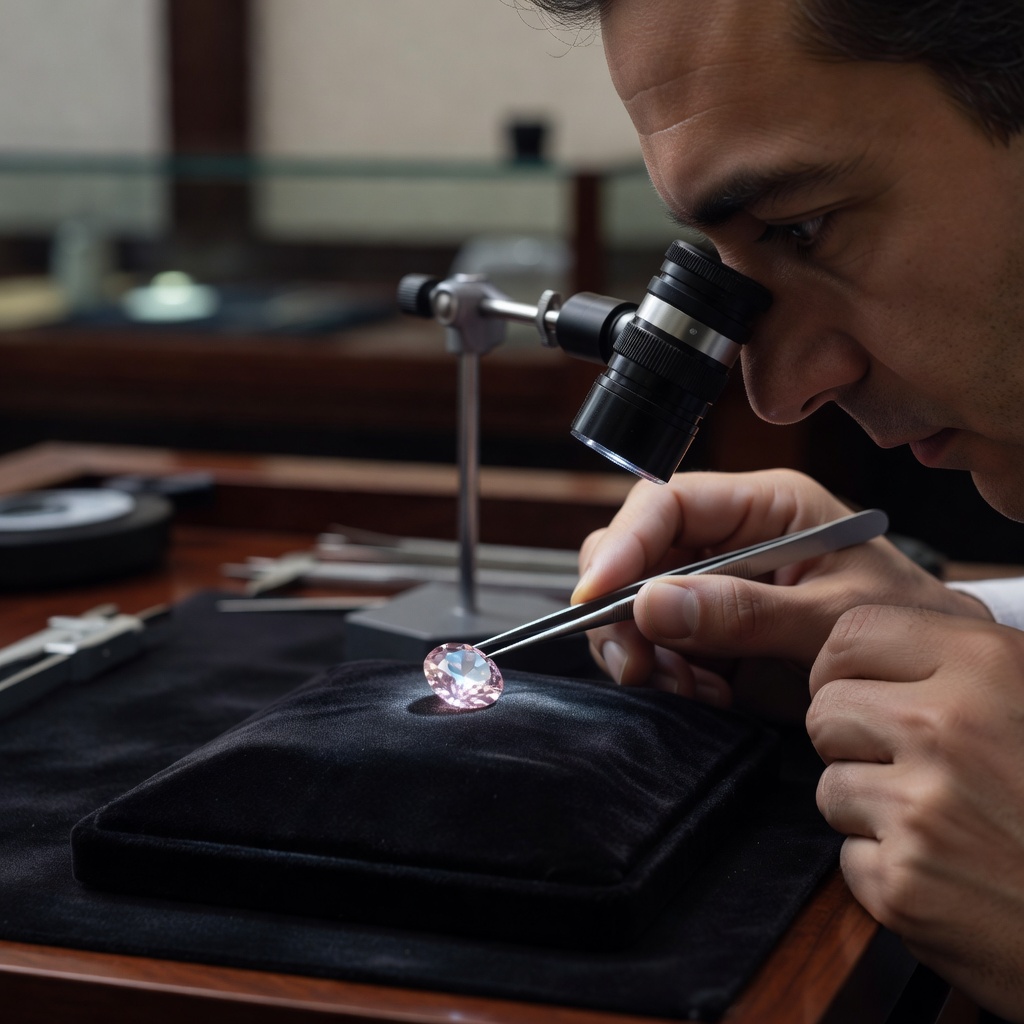
Examination under ten-power magnification reveals inclusion patterns unique to poudretteite that assist in authentication while providing insight into the stone's geological formation history. Common diagnostic inclusions include "fingerprint" patterns of partially healed fractures, fine needle-like crystals of associated minerals, and two-phase inclusions containing both liquid and gas bubbles. Burmese material typically displays different inclusion scenes than Canadian specimens, with Myanmar stones often showing tremolite needle inclusions and Canadian material displaying calcite or pyrite inclusions characteristic of Mont Saint-Hilaire geology. These microscopic characteristics not only confirm authenticity but also help determine geographic origin, significantly affecting valuation.
Chemical Testing and Borate Verification
Definitive chemical testing to verify borate composition distinguishes poudretteite from fakes and simulants, as no other pink gemstone shares its specific chemistry. Qualitative chemical tests using flame spectroscopy can detect the presence of boron, while quantitative analysis through mass spectrometry confirms the precise ratios of sodium, potassium, silicon, and boron that define the species. These destructive tests obviously cannot be performed on finished gemstones, making non-destructive methods like Raman spectroscopy or X-ray fluorescence the preferred authentication tools for valuable specimens. Reputable laboratories maintain comprehensive databases of known poudretteite chemical signatures, allowing them to identify even sophisticated synthetic attempts to replicate the mineral's composition.
Future Market Trends and Price Predictions
Forecasting future poudretteite prices requires analyzing geopolitical factors affecting supply, demographic shifts in collector markets, and technological developments that might impact natural stone values. Current indicators suggest continued bullish trends for the foreseeable future, though potential disruptions from laboratory-grown alternatives or changes in Myanmar's mining policies could alter trajectory predictions. Investors should monitor these variables closely while recognizing that the fundamental scarcity underpinning poudretteite's value remains immutable regardless of short-term market fluctuations.
Impact of Myanmar Mining Restrictions
Political instability and international sanctions affecting Myanmar's gemstone sector have effectively halted new poudretteite production from the world's only significant gem-quality source, ensuring supply constraints will intensify throughout the 2020s. The Myanmar military's control of mining regions has prompted many Western nations to ban imports of Burmese gemstones, creating a bifurcated market where Asian collectors access remaining supply while Western buyers compete for legacy specimens already outside Myanmar. These restrictions likely mean that any poudretteite entering the market in coming years will derive from estate sales or old collections rather than new mining, essentially guaranteeing price appreciation as existing specimens transfer between collectors. However, relaxation of sanctions or discovery of alternative deposits could moderate price growth, making ongoing geopolitical monitoring essential for investors.
Emerging Collector Markets in Asia and the Middle East
The center of gravity for rare gemstone collecting continues shifting eastward, with poudretteite market trends increasingly driven by Chinese, Japanese, and Gulf State collectors seeking alternative stores of wealth beyond traditional art markets. These emerging markets demonstrate particular appreciation for "trophy" minerals with documented rarity, viewing poudretteite acquisition as both investment and status symbol reflecting sophisticated connoisseurship. Auction houses have responded by establishing dedicated natural history sales in Hong Kong and Dubai, creating new liquidity venues that bypass traditional Western markets. This geographic diversification of demand creates price support even if Western collector interest wanes, establishing a global floor for valuations.
Technological Advances in Synthetic Production
Gemological laboratories have achieved limited success synthesizing poudretteite using hydrothermal growth methods, though current production remains experimental and economically unviable for commercial distribution. As synthesis technology improves, the market must develop sophisticated detection methods to distinguish laboratory-grown material from natural stones, potentially creating valuation spreads similar to those seen in the diamond market between natural and synthetic goods. However, given poudretteite's extreme rarity and the collector-driven nature of its market (as opposed to jewelry demand), synthetic alternatives likely will not significantly depress natural stone values, much as synthetic emeralds have not affected fine natural Colombian material. Still, investors should insist on updated laboratory reports using the latest detection technologies to ensure their holdings maintain premium valuations.
Expert Predictions for 2025-2030
Mineral market analysts project continued double-digit annual appreciation for fine poudretteite through 2030, with Burmese specimens over one carat potentially reaching $50,000 per carat as the supply of available stones diminishes further. This forecast assumes continued political instability in Myanmar preventing new mining, stable global economic conditions maintaining discretionary spending among ultra-wealthy collectors, and no major new discoveries that would increase supply. Conservative estimates suggest minimum price doubling over the next five years, while optimistic scenarios envision five-fold increases if Asian museum acquisition programs aggressively target poudretteite for permanent collections. As with all alternative investments, these predictions carry uncertainty, but the fundamental supply-demand imbalance supports bullish long-term outlooks for patient investors.
Frequently Asked Questions
How Much Does Poudretteite Cost Per Carat in 2024?
Quality poudretteite typically ranges from $2,000 to $6,000 per carat for smaller stones under 0.5 carats, while museum-grade specimens over 1 carat can command $10,000 to $20,000 per carat depending on color intensity and clarity. These figures represent significant increases from previous years, reflecting both inflation in the rare gem sector and diminishing availability of new material entering the market. Prices vary dramatically based on origin, with Burmese material commanding substantial premiums over Canadian specimens, and color saturation serving as the primary value differentiator within each size category. Prospective buyers should budget additional funds for certification, insurance, and secure storage, as these ancillary costs represent significant percentages of total investment when dealing with high-value gemstones.
Why Is Poudretteite More Expensive Than Diamonds?
Poudretteite commands higher prices than many diamonds due to extreme scarcity—fewer than 25 faceted specimens exist worldwide compared to millions of diamonds mined annually, creating a supply-demand imbalance that drives premium pricing. While commercial-grade diamonds trade at commodity prices due to massive global production, poudretteite represents a unique collectible asset where each stone constitutes a significant percentage of the world's known supply. The mathematical reality of poudretteite's rarity means that even billionaires cannot acquire large collections, whereas diamond accumulations of hundreds of carats remain readily available for purchase. This absolute scarcity premium explains why poudretteite achieves prices comparable to fancy vivid pink diamonds despite lacking the marketing infrastructure and consumer recognition that supports the diamond industry.
Is Poudretteite a Good Investment for Collectors?
Poudretteite can be an excellent long-term investment for sophisticated collectors due to its finite supply and increasing rarity, though it requires specialized knowledge, secure storage, and patience due to lower liquidity compared to traditional investments. The gemstone has demonstrated consistent price appreciation over the past two decades, outpacing inflation and many equity indices while providing portfolio diversification uncorrelated with financial markets. However, the lack of standardized resale markets means that realizing profits requires networking within specialized collector communities or waiting for appropriate auction opportunities, potentially extending holding periods to five years or longer. Investors should view poudretteite as a "passion investment" that provides aesthetic enjoyment alongside financial returns, rather than a liquid asset suitable for short-term speculation.
Where Does the Highest Quality Poudretteite Come From?
The finest gem-quality poudretteite originates from the Mogok Stone Tract in Myanmar (Burma), which produces crystals with superior transparency and deeper pink coloration compared to the original Canadian discoveries at Mont Saint-Hilaire. Myanmar's geological environment created the specific borate-rich pegmatite formations necessary for large, clean crystal growth, whereas the Canadian type locality produced predominantly small, heavily included specimens suitable primarily for mineral collections. Burmese material typically displays the intense magenta coloration most prized by collectors, along with crystal sizes exceeding one carat that remain virtually unknown from Canadian sources. However, ongoing political instability and mining restrictions in Myanmar mean that new production has ceased, making existing Burmese specimens increasingly valuable as irreplaceable geological artifacts.
How Can I Tell if Poudretteite Is Real or Synthetic?
Authentic poudretteite requires certification from recognized laboratories like GIA or AGL, shows specific inclusion patterns under magnification, and displays unique spectral properties; always insist on documented provenance and laboratory reports before purchasing. Visual identification proves impossible for amateurs, as skilled fraudsters can fashion simulants from morganite, kunzite, or synthetic corundum that mimic poudretteite's appearance to the unaided eye. Professional gemologists rely on refractive index testing, specific gravity measurements, and spectroscopic analysis to confirm the borosilicate chemistry that distinguishes genuine poudretteite from imitations. Buyers should be particularly wary of online sellers offering "bargain" priced poudretteite or stones without internationally recognized certification, as these represent the most common vectors for fraud in the rare gem market.
Can Poudretteite Be Used in Jewelry, or Is It Only for Collections?
While poudretteite can be set in jewelry, its extreme rarity and softness (5.5 Mohs hardness) make it primarily suitable for occasional-wear pieces like pendants or earrings rather than daily-wear rings; most specimens remain in mineral collections. The gemstone's moderate hardness renders it susceptible to scratching from everyday contact with harder materials like quartz dust, steel, or other gemstones, potentially damaging faceted surfaces during normal wear. Given that replacing a damaged poudretteite stone proves nearly impossible due to supply constraints, jewelers and insurance advisors typically recommend protective settings that minimize exposure to impact and abrasion. Most owners choose to display their poudretteite in mineral cabinets or safety deposit boxes, appreciating the stone as a geological treasure rather than an adornment, though custom-designed pendant settings allow occasional wearing for special events.
Will Poudretteite Prices Continue to Rise in the Future?
Market analysts predict continued price appreciation due to depleted mine sources in Myanmar, no new significant discoveries, and growing demand from wealthy collectors, though prices may stabilize if laboratory-grown alternatives gain market acceptance. The fundamental geological constraint of extreme scarcity suggests that existing specimens will continue appreciating as they transfer from dealers into permanent museum collections, effectively removing supply from the circulating market. However, technological breakthroughs in synthesis could potentially create acceptable alternatives for jewelry purposes, though these likely will not affect collector demand for natural specimens with documented provenance. Barring major new deposit discoveries—which appear geologically improbable given extensive exploration of potential borate localities—poudretteite appears positioned to maintain or exceed historical appreciation rates through the next decade.