Understanding the Moldavite Market: A Comprehensive Pricing Overview
Moldavite has emerged as one of the most sought-after gemstones in the metaphysical and collector communities, with prices surging dramatically over the past decade. This rare tektite, formed approximately 15 million years ago when a meteorite impacted the Ries crater in Germany and scattered molten debris across what is now the Czech Republic, represents a finite geological treasure that grows scarcer by the year. As government mining restrictions tighten and accessible deposits near depletion, understanding current market valuations has become essential for both first-time buyers and serious collectors. This Moldavite Price Guide will navigate you through quality tiers, authentication methods, and investment considerations to ensure you make informed purchasing decisions in this volatile marketplace.
Key Factors That Determine Moldavite Value
Evaluating Moldavite requires understanding specific aesthetic and geological characteristics that separate museum-grade specimens from commercial-quality material. Unlike many gemstones where clarity reigns supreme, Moldavite collectors prize distinctive surface features and color depth that tell the story of its violent cosmic origin. The interplay between hue, texture, and transparency creates a complex valuation matrix where two pieces of identical weight can differ dramatically in price.
Color Grading and Chromatic Depth
The most valuable Moldavite exhibits a deep forest green to blue-green coloration that appears almost opaque in thick sections but glows brilliantly when held to light. Pale olive or brownish tones indicate specimens found in secondary deposits where weathering and soil exposure have degraded the material over millions of years. When assessing Moldavite value per gram, color intensity serves as the primary differentiator, with deep green pieces from the Besednice locality commanding premiums of 40-60% over lighter material from Moravian sites.
Surface Texture and Natural Etching
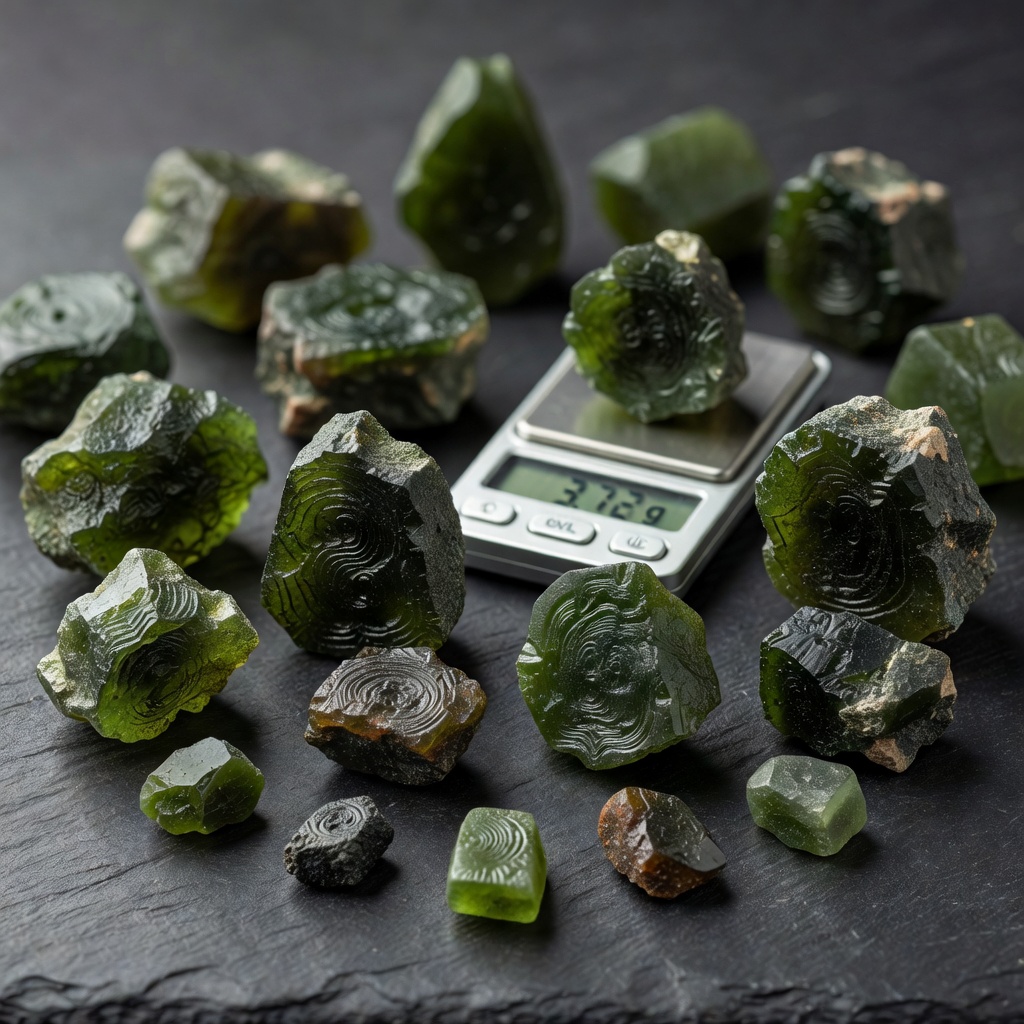
Authentic Moldavite displays intricate surface sculptures created by natural etching as the tektite cooled while flying through the atmosphere and lay buried in sediments for millennia. High-quality pieces feature deep grooves, pitting, and spiky projections that catch light dramatically, whereas smooth, glassy surfaces suggest either lower-grade material or artificial manipulation. The presence of lechatelierite inclusions—swirl-like silica glass formations visible under magnification—provides definitive proof of natural origin and significantly enhances collector value.
Transparency and Aesthetic Appeal
While opaque specimens hold value for their texture, translucent to semi-transparent Moldavite allows light penetration that reveals internal structures and bubble inclusions. Gem-grade material suitable for faceting requires exceptional clarity without cracks or inclusions that compromise structural integrity. Specimens exceeding 10 grams with combined deep color, dramatic surface features, and translucency represent the pinnacle of the market, often selling for premium multiples above standard pricing tiers.
Moldavite Price Per Gram: Complete Breakdown
Understanding the granular pricing structure helps buyers set realistic budgets while recognizing when a specimen represents genuine value versus overpriced inventory. The Czech Moldavite cost spectrum ranges widely based on quality gradients, with entry-level material suitable for jewelry making while investment-grade pieces require substantial capital commitment. Current market conditions reflect both the depletion of easily accessible deposits and increasing international demand from crystal healing practitioners and gemstone investors.
Entry-Level Specimens ($8-$25 Per Gram)
Beginning collectors can acquire authentic Moldavite in the $8-$25 per gram range, typically featuring smaller fragments under two grams with lighter olive-green coloration. These pieces often originate from alluvial deposits where tumbling in rivers has rounded sharp edges and reduced surface detail. While suitable for wire-wrapping or inclusion in resin crafts, entry-level material generally lacks the dramatic aesthetic presence that drives premium valuations. When purchasing in this tier, prioritize pieces with visible surface texture over completely smooth fragments, as the latter may indicate weathered or lower-grade stock.
Mid-Range Quality ($25-$45 Per Gram)
The sweet spot for most collectors falls between $25-$45 per gram, offering specimens between 2-5 grams with good color saturation and visible surface sculpting. Material in this bracket typically displays the characteristic forest green hue with moderate translucency and distinct natural etching that identifies genuine tektite formation. These pieces work well for pendants and display collections, providing the visual impact associated with high-quality Moldavite without the exponential price increases seen in larger specimens. Reputable dealers often photograph this tier individually rather than selling bulk lots, allowing buyers to select specific pieces based on personal aesthetic preferences.
Premium and Museum-Grade ($45-$100+ Per Gram)
Exceptional specimens exceeding $45 per gram represent the investment tier of the Moldavite market, featuring deep green coloration, high translucency, and dramatic surface features like spikes or deep grooves. Large pieces over 10 grams with perfect preservation command prices exceeding $100 per gram, particularly if they exhibit the coveted hedgehog texture associated with Besednice localities. Museum-grade material often requires direct relationships with Czech miners or participation in specialized mineral auctions, as dealers rarely list these pieces on standard e-commerce platforms. When considering purchases above $50 per gram, insist on detailed provenance documentation and third-party certification to verify authenticity and justify the premium investment.
Raw Specimens vs. Faceted Stones: Price Comparison
The decision between acquiring natural rough Moldavite versus processed gemstones involves significant cost considerations and value retention implications. While faceted stones offer jewelry-ready brilliance, the cutting process removes the very surface features that make Moldavite geologically unique. Understanding these distinctions helps collectors allocate budgets effectively between raw mineral specimens and wearable art pieces.
Natural Rough Moldavite Pricing Dynamics
Raw, unprocessed Moldavite retains the highest value per gram among serious collectors because the natural etched surface provides irrefutable evidence of authenticity while displaying the tektite's characteristic sculptural beauty. Collector preferences heavily favor raw specimens over 5 grams with intact surface features, as these pieces demonstrate the violent atmospheric ablation that occurred during the stone's formation. When evaluating raw Moldavite value, consider that damaged or chipped material sells for 30-50% less than pristine specimens, even when the damage occurred during natural geological processes.
Cut Stones and Bead Manufacturing Costs
Faceted Moldavite commands higher absolute prices due to labor-intensive cutting processes and significant material loss—roughly 60-70% of the original weight disappears during faceting. Cabochons typically retail for 2-3 times the rough material cost per carat, while precision faceted stones suitable for fine jewelry may cost 4-5 times rough prices. Tektite jewelry prices vary dramatically based on cut quality; poorly executed faceting that leaves windowing or asymmetric facets actually reduces value below that of equivalent-weight rough material. Bead strands represent the most affordable entry point for jewelry makers, though individual beads rarely exceed 0.5 grams and often feature drill holes that compromise structural integrity.
Setting Considerations and Total Investment
When calculating total expenditure for wearable Moldavite, setting materials significantly impact final costs. Sterling silver settings add $50-$150 to base stone prices, while 14k or 18k gold mountings can increase total investment by $300-$800 depending on design complexity. Custom settings for large raw specimens (5+ grams) require specialized prong or bezel designs that accommodate irregular shapes, often costing more than the stone itself. Investment-minded collectors should prioritize purchasing unset stones from reputable dealers, then commission custom settings locally to maintain clear provenance documentation and avoid premiums charged by jewelry retailers.
Spotting Fake Moldavite: Protecting Your Investment
The dramatic price appreciation of genuine Moldavite has spawned a sophisticated counterfeit industry worth millions annually, making authentication knowledge essential before any purchase. Real Moldavite vs fake distinctions often require close inspection, as modern manufacturing techniques can produce convincing imitations from molded glass or composite resins. Developing a critical eye for authentic characteristics prevents costly mistakes and ensures your collection retains long-term value.
Common Imitation Methods and Materials
Counterfeiters primarily utilize green bottle glass melted and etched with acid to simulate natural surface texture, creating pieces that visually approximate genuine Moldavite at a fraction of the production cost. More sophisticated fakes incorporate resin composites mixed with green dye and actual Moldavite dust to create "reconstituted" material sold dishonestly as natural specimens. The most deceptive imitations come from China and India, where manufacturers have studied genuine pieces to replicate color gradients and surface patterns with alarming accuracy. These fakes often appear in online marketplaces at prices 50-70% below market rates, tempting unsuspecting buyers with seemingly excellent deals.
Physical Authentication Techniques
Authentic Moldavite contains lechatelierite inclusions—wire-like or swirl-shaped imperfections formed from pure silica glass under extreme heat—that appear under 10x magnification as twisted, thread-like structures. Natural pieces also exhibit irregular surface etching with varying depth and direction, whereas acid-treated fakes display uniform pitting or overly perfect "sculpted" appearances. Real Moldavite feels naturally warm to the touch rather than cold like glass, and when held to strong light, shows color variations and internal bubbles rather than perfect clarity. The "fiduciary test" involves checking for mold marks or seam lines along edges, as genuine Moldavite never shows manufacturing artifacts.
Documentation and Certification Standards
Reputable dealers provide detailed provenance documentation specifying the exact locality within the Czech Republic where the specimen was extracted, along with authenticity certificates from recognized gemological laboratories. Be wary of generic certificates lacking specific details about weight, dimensions, and inclusion patterns, as these often represent meaningless printouts rather than professional authentication. High-value purchases should include laboratory reports from institutions like the Gemological Institute of America (GIA) or Czech Geological Survey, which can definitively distinguish natural tektite from manufactured glass through refractive index testing and chemical composition analysis.
Where to Buy Genuine Moldavite Safely
Navigating the Moldavite marketplace requires identifying trustworthy sources while recognizing red flags that signal potential fraud. Where to buy Moldavite safely involves balancing convenience against verification capabilities, with direct sourcing from Czech miners offering the best authenticity guarantees but requiring more logistical effort than domestic purchases. Establishing relationships with established dealers protects both your financial investment and the integrity of your collection.
Reputable Online Platforms and Auction Houses
Established mineral dealers with physical storefronts and long-standing eBay or Etsy reputations provide the safest entry point for new collectors, offering buyer protection policies and return windows for authentication verification. Specialized auction platforms like Heritage Auctions or iRocks occasionally feature certified Moldavite specimens with detailed geological provenance, though premiums of 20-30% above direct retail are common. When purchasing online, prioritize dealers who photograph individual specimens rather than using stock images, and who provide multiple angles including close-ups of surface texture and any damage. Reputable sellers willingly answer specific questions about mining localities and extraction dates, whereas evasive responses often indicate middlemen selling potentially questionable material.
Warning Signs of Fraudulent Sellers
Suspiciously low prices represent the primary red flag; authentic Moldavite cannot be profitably sold below $8 per gram at any quality level due to mining costs and Czech export restrictions. Perfectly symmetrical shapes with uniform coloration suggest manufactured glass rather than natural tektite, as genuine specimens exhibit irregular forms and color zoning. Sellers offering unlimited quantities of identical-looking pieces or claiming "new mine discoveries" likely distribute fakes, as legitimate Czech sources face strict extraction quotas and depleting reserves. Avoid vendors who refuse to provide specific locality information or who describe material vaguely as "from Europe" rather than specifying Bohemian or Moravian origins.
Direct Sourcing from Czech Miners
For serious collectors and retailers, establishing direct relationships with licensed miners in the Southern Bohemia region ensures access to fresh material before it passes through multiple markup layers. Annual mineral shows in Prague and Brno provide opportunities to meet extractors personally, examine rough material, and negotiate bulk purchases. While buying direct requires international wire transfers and export paperwork, prices typically run 30-40% below international retail, making this approach economically viable for purchases exceeding $1,000. However, verify that miners hold current extraction licenses, as illegal mining operations produce material that cannot be legally exported and may be confiscated at customs.
Investment Potential and Future Market Trends
Beyond aesthetic and metaphysical appeal, Moldavite represents a tangible asset class with documented appreciation trends driven by genuine supply constraints. Moldavite investment strategies focus on acquiring high-quality specimens during market dips, holding them as mining restrictions tighten, and liquidating when scarcity peaks. Understanding these Moldavite market trends helps investors distinguish between speculative bubbles and sustainable value appreciation based on geological reality.
Historical Price Appreciation Analysis
Over the past decade, quality Moldavite has appreciated between 200-300%, outpacing traditional inflation hedges like gold or silver during the same period. Entry-level material that sold for $3-$5 per gram in 2014 now commands $15-$25, while premium specimens have seen even steeper increases as wealthy collectors compete for finite supplies. This appreciation stems not from speculative trading but from the physical depletion of accessible deposits; the primary Besednice mine closed in 2017, and remaining extraction requires expensive deep drilling with diminishing returns. Historical data suggests that investment-grade pieces over 10 grams with exceptional color and texture have consistently outperformed smaller fragments in value retention.
Supply Constraints and Regulatory Impacts
The Czech government has increasingly restricted Moldavite mining through environmental protection laws and heritage preservation acts, treating the material as a national geological treasure rather than a commercial mineral resource. Current legal extraction occurs at roughly 10% of 2005 levels, with most active mines expected to cease operations within the next decade due to economic unviability. As surface deposits deplete, future supply will depend on alluvial finds in riverbeds and agricultural fields, creating an irregular and unpredictable supply chain. These constraints suggest continued upward price pressure, particularly for specimen-grade material suitable for museum collections rather than commercial jewelry production.
Specimen Types with Strong Investment Prospects
Large specimens exceeding 20 grams with deep green color and minimal damage represent the blue-chip investments of the Moldavite market, as their scarcity increases exponentially with size. Rare shapes, particularly those exhibiting the "hedgehog" or "spiky" texture characteristic of Besednice material, command premiums that outpace standard appreciation rates. Unusual formations such as "drops" (teardrop-shaped specimens showing aerodynamic ablation) or "dumbbells" (connected twin formations) attract specialized collectors willing to pay significant premiums above weight-based valuations. Investors should avoid common small fragments under 1 gram, as these lack the rarity to appreciate significantly and face increasing competition from synthetic imitations.
Caring for Your Moldavite to Preserve Value
Proper maintenance ensures that your Moldavite retains both its aesthetic beauty and financial value over decades of ownership. Unlike durable gemstones such as diamonds or sapphires, tektite material possesses a Mohs hardness of only 5.5 and contains natural stress fractures that require careful handling. Implementing appropriate storage and cleaning protocols protects your investment while maintaining the stone's energetic and visual properties.
Environmental Storage Requirements
Store Moldavite away from direct sunlight and heat sources, as prolonged UV exposure can fade the characteristic green coloration to a pale olive or brownish hue over time. Extreme temperature fluctuations risk exacerbating internal fractures, particularly in specimens with visible inclusions or surface-reaching cracks. Keep pieces separated in soft cloth bags or padded mineral boxes to prevent scratching from harder gemstones; storing Moldavite loose with quartz or corundum will result in surface damage that significantly reduces value. For high-value specimens, maintain stable humidity levels between 40-60% to prevent the microscopic surface etching from accumulating dust particles that dull the natural luster.
Safe Cleaning and Maintenance Protocols
Clean Moldavite using lukewarm water and mild, phosphate-free soap applied with a soft-bristled brush, gently working around surface crevices to remove accumulated oils and debris. Avoid ultrasonic cleaners, steam cleaning, or chemical solvents, as these can exploit internal fractures or alter the surface etching that contributes to the stone's value. After cleaning, pat dry with microfiber cloth rather than rubbing, which can catch on sharp surface projections and cause chipping. For specimens set in jewelry, remove Moldavite pieces before swimming in chlorinated pools or applying lotions and perfumes, as chemical exposure can dull the surface luster over time.
Insurance and Documentation Strategies
High-value Moldavite collections require scheduled insurance riders on homeowner's policies or specialized collectibles insurance, as standard coverage typically excludes loose gemstones and mineral specimens. Maintain detailed documentation including purchase receipts, authenticity certificates, and high-resolution photographs showing specific identifying features and any damage present at acquisition. Professional appraisals every three to five years track appreciation for insurance purposes and establish baseline values for estate planning. When transporting valuable specimens for shows or sales, use registered mail with declared value coverage or hand-carry pieces in rigid, padded containers to prevent the crushing or scratching that destroys investment-grade material.
Frequently Asked Questions
How much should I expect to pay for real Moldavite?
Authentic Moldavite typically ranges from $8 to $100+ per gram depending on quality. Small, lighter-colored pieces start around $8-$15 per gram, while deep green, highly translucent specimens with exceptional surface texture can command $50-$100 or more per gram.
Why is Moldavite more expensive than other crystals?
Moldavite prices reflect its extreme rarity as a tektite formed from a meteorite impact 15 million years ago, found only in the Czech Republic. With mines nearly depleted and extraction becoming increasingly difficult, supply is limited while global demand continues to grow, driving prices upward.
Can I buy real Moldavite for under $20?
Yes, but expect very small pieces (under 1 gram) or lower quality specimens with paler coloration. Be extremely cautious of deals that seem too good to be true—quality Moldavite under $15 per gram often indicates fake glass imitations or heavily damaged material.
How do I know if my Moldavite is real or fake?
Real Moldavite contains lechatelierite inclusions (swirl-like imperfections visible under magnification), has a naturally etched surface, and is never perfectly symmetrical. Fakes often appear too glossy, have uniform color, or show mold marks. When in doubt, purchase from dealers providing authenticity certificates.
Does Moldavite increase in value over time?
Historically, Moldavite has appreciated significantly, with prices increasing 200-300% over the past decade due to supply constraints. As the Czech government restricts mining further and existing deposits deplete, investment-grade specimens (large, high-quality pieces) are expected to continue appreciating.
Is faceted Moldavite worth more than raw pieces?
Generally, no. While faceted Moldavite commands higher absolute prices due to labor costs, raw specimens typically retain better value per gram among collectors. The natural etched surface is highly prized, and cutting removes material. However, high-quality faceted stones over 5 carats are rare and valuable to jewelry makers.
Where does the highest quality Moldavite come from?
The finest Moldavite originates from the Southern Bohemia region of the Czech Republic, specifically the Besednice and Chlum localities. Besednice Moldavite is particularly prized for its distinctive spiky, hedgehog-like surface texture and deep green color, commanding premium prices.
What size Moldavite offers the best value for beginners?
Beginners should target specimens between 1-3 grams in the $20-$40 per gram range. This size offers visible surface features and color without the premium prices of large collector pieces. Avoid tiny fragments under 0.5 grams as they're harder to authenticate and appreciate aesthetically.