What Is Mandarin Garnet? Understanding This Rare Orange Gemstone
Mandarin garnet represents one of the most captivating discoveries in modern gemology, belonging to the spessartite (spessartine) garnet species distinguished by its extraordinary orange coloration. This rare gemstone first captured international attention during the 1990s when significant deposits were discovered in Namibia's remote Kunene region, where miners unearthed crystals displaying an unprecedented vivid orange hue that resembled the popular Fanta orange soft drink. Unlike the more common red pyrope or green tsavorite garnets, mandarin garnet derives its distinctive color from manganese content within its chemical composition, creating a pure orange that remains stable under various lighting conditions without the brownish modifiers that plague lesser spessartite specimens.
The term "mandarin garnet" specifically refers to spessartite garnets exhibiting a pure, vivid orange color without secondary brown or reddish undertones, distinguishing them from standard orange spessartites that often appear muddy or diluted. This strict color criterion renders true mandarin garnets exceptionally rare, with gem-quality crystals representing less than one percent of total spessartite production worldwide. When evaluating spessartite garnet prices, collectors and investors must understand that only stones meeting the stringent mandarin color standard command premium valuations, while paler or brown-tinted specimens fall into lower commercial tiers despite sharing the same mineralogical classification.
Rarity factors extend beyond color to include the gemstone's limited geographic distribution and the depletion of original deposits. The Namibian mines that produced the initial flood of high-quality material in the 1990s have largely exhausted their accessible reserves, creating a supply bottleneck that continues to drive mandarin garnet value per carat upward. Modern production relies heavily on Nigerian deposits discovered in the early 2000s, though these sources yield smaller average crystal sizes and greater variation in color quality compared to the legendary Namibian rough. This geological scarcity positions mandarin garnet among the rarest colored gemstones available in the current market, with fine specimens over five carats appearing at major auctions less frequently than high-quality sapphires or emeralds of equivalent size.
The 4 Cs of Mandarin Garnet Valuation
When navigating this garnet buying guide, understanding how gemologists evaluate mandarin garnet requires focusing on modified criteria compared to diamond grading, where color overwhelmingly dominates the valuation equation. While the traditional four Cs (color, clarity, cut, and carat weight) provide a framework for assessment, mandarin garnet valuation assigns approximately sixty percent of a stone's value to its color characteristics alone, with the remaining forty percent distributed among clarity, cut precision, and size. This weighting reflects the market's insatiable demand for that specific Fanta orange hue, meaning a smaller, vividly colored stone often commands higher spessartite garnet prices than a larger specimen with inferior color saturation.
Color assessment examines three distinct components: hue, tone, and saturation, with the ideal mandarin garnet displaying a pure orange hue without red or yellow modifiers, a medium-light to medium tone that avoids darkness, and vivid saturation that appears electric under natural daylight. Clarity standards for mandarin garnet remain somewhat forgiving compared to sapphires or emeralds, as the gemstone species typically contains characteristic needle-like inclusions or fingerprint patterns that confirm natural origin. Eye-clean specimens, where no inclusions are visible to the unaided eye from approximately six inches away, represent the benchmark for fine quality, though slightly included stones may still command strong prices if the color remains exceptional.
Cut quality significantly impacts how mandarin garnet displays its coveted orange color, with skilled lapidaries facing the challenge of maximizing color saturation while maintaining brilliance and light return. The optimal cutting angles for orange gemstones differ from those designed for red or blue stones, requiring cutters to adjust crown and pavilion facets to prevent the stone from appearing too dark or "closed" while still concentrating the orange hue. Carat weight creates exponential rather than linear price increases, with stones surpassing three carats entering rarefied territory where mandarin garnet value per carat can triple or quadruple compared to one-carat specimens of equivalent quality. This phenomenon occurs because the chemical conditions necessary to form large, clean, vividly colored spessartite crystals occur so rarely in nature that supply constraints create dramatic price escalations at specific weight thresholds.
Mandarin Garnet Price Per Carat: Complete 2024 Breakdown
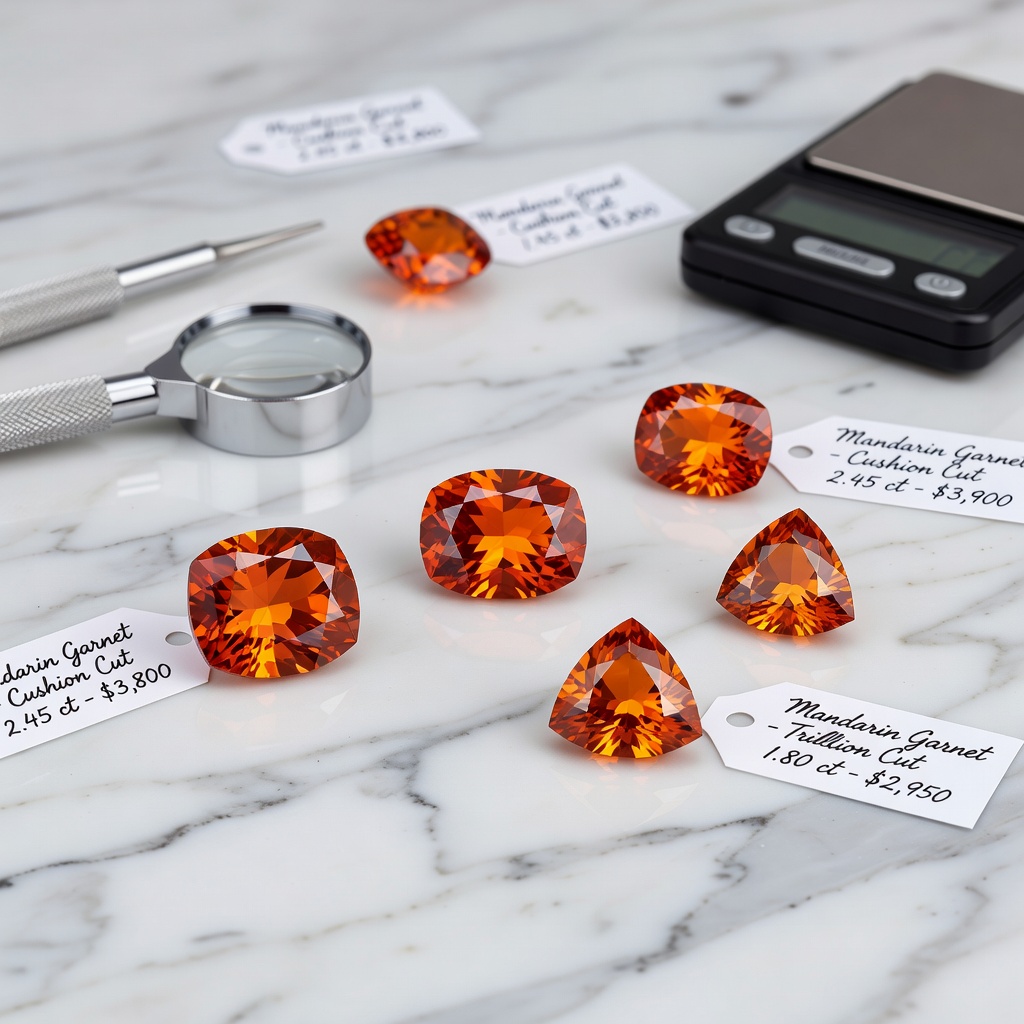
Current market conditions for 2024 reveal a stratified pricing structure that reflects the wide variation in quality available within the mandarin garnet category, requiring buyers to understand specific benchmarks when evaluating mandarin garnet price guide data. Commercial quality specimens, characterized by lighter orange color, visible inclusions, or slight brownish modifiers, currently trade between $200 and $500 per carat, making them accessible entry points for collectors seeking the gemstone's distinctive color without investment-grade premiums. These stones typically weigh under two carats and may show windows or extinction when viewed face-up, though they still provide the warm orange aesthetic that distinguishes spessartite from other garnet varieties.
Fine quality mandarin garnets exhibiting vivid Fanta orange color with eye-clean clarity and excellent cutting command substantially higher prices ranging from $800 to $2,000 per carat in the current market. Stones in this tier display the pure orange hue that defines the mandarin variety, showing strong fluorescence and color consistency under various lighting conditions from daylight to incandescent bulbs. When evaluating spessartite garnet prices at this level, buyers should expect properly proportioned cuts that maximize face-up appearance, with table percentages between fifty-five and sixty-five percent providing optimal balance between brilliance and color concentration.
Collector and investment-grade mandarin garnets representing the top one percent of production command premiums ranging from $3,000 to $8,000-plus per carat, with exceptional specimens occasionally exceeding $10,000 per carat at specialized auctions. These rare stones typically exceed three carats, display loupe-clean clarity, and exhibit the electric Fanta orange color that made the variety famous during the Namibian discoveries of the 1990s. Price escalation curves become particularly steep for stones above five carats, where supply constraints create auction-style competition among collectors; a five-carat fine mandarin garnet might command $15,000 per carat while a ten-carat equivalent could reach $25,000 to $30,000 per carat, illustrating the exponential rather than arithmetic relationship between size and value in this rare gemstone category.
Color Grading: From Fanta Orange to Deep Red-Orange
The premium "Fanta" color range represents the holy grail for mandarin garnet collectors, describing a specific visual territory where the gemstone displays pure vivid orange without dilution by brown, red, or yellow secondary hues. This color designation derives from the resemblance to the popular orange soda's artificial coloration—a pure, saturated orange that appears almost electric under natural daylight and maintains its intensity under incandescent lighting. Stones achieving this color grade represent less than five percent of total spessartite production, explaining why Fanta orange garnet commands multiples of the prices paid for stones with even slight color deviations.
Secondary hue modifiers significantly impact pricing hierarchies within the mandarin garnet market, with brownish tones representing the most detrimental modifier due to their tendency to "muddy" the orange appearance and reduce perceived vibrancy. Reddish undertones, while creating attractive stones sometimes marketed as "red-orange spessartite," generally reduce values by twenty to forty percent compared to pure orange specimens unless the red component remains subtle and actually enhances the stone's warmth. Yellowish modifiers create what dealers call "golden mandarin" or "honey spessartite," which appeals to some jewelry designers but typically trades at discounts of thirty to fifty percent below pure orange material. When considering orange gemstone investment potential, buyers should prioritize stones with color certificates specifically noting "orange" without secondary color designations, as these maintain liquidity and appreciation potential better than modified hues.
Lighting conditions dramatically affect how mandarin garnet displays its color, with the finest stones maintaining their orange saturation under incandescent, fluorescent, and natural daylight without shifting toward brown or appearing washed out. This color stability distinguishes high-quality mandarin garnet from hessonite garnet, another orange variety that typically shows significant color variation between lighting environments and often appears "whiskey-colored" rather than pure orange. When comparing mandarin garnet to other orange gemstones like fire opal or padparadscha sapphire, the garnet's superior hardness (7.25 on the Mohs scale) and refractive index provide additional durability and brilliance that support long-term investment values. Gemological laboratories use controlled lighting environments to grade color, with the most respected certificates including specific hue angle measurements on the GemDialogue or Munsell color systems to verify the absence of brown or yellow modifiers that might escape casual observation.
Clarity, Cut, and Carat Weight Impact on Value
Understanding typical inclusion patterns proves essential when evaluating mandarin garnet value per carat, as spessartite garnets commonly contain distinctive internal characteristics that help distinguish natural stones from synthetics while affecting transparency and brilliance. The most frequent inclusion types include needle-like rutile crystals arranged in parallel formations, fingerprint-patterned liquid inclusions, and small crystal guests such as zircon or apatite. These inclusions rarely impact durability when confined to the interior rather than surface-reaching fractures, but dense concentrations can create haziness that reduces the stone's ability to transmit light and display the coveted Fanta orange color.
Clarity grading for mandarin garnet follows a pragmatic standard where "eye-clean" specimens—those showing no visible inclusions at six inches under normal lighting—command significant premiums of fifty to one hundred percent over included material of equivalent color. Truly loupe-clean stones, showing no inclusions even under ten-power magnification, represent extreme rarities in sizes over two carats and justify the highest mandarin garnet price guide valuations for investment purposes. However, unlike diamonds where clarity dramatically affects brilliance, mandarin garnet can tolerate minor inclusions if they remain subtle and do not create obvious dark spots or reduce transparency, particularly in vintage or antique cuts where inclusion patterns might actually confirm natural origin and period cutting styles.
Optimal cutting styles for maximizing orange color include cushion, oval, and round brilliant cuts, though skilled lapidaries sometimes favor elongated shapes like marquise or pear to achieve better color distribution in shallow rough crystals. The cutting process for mandarin garnet involves delicate decisions regarding weight retention versus beauty, as spessartite rough often occurs in irregular shapes with color concentrated in specific zones. A cutter might sacrifice forty percent of the rough weight to orient the table perpendicular to the crystal's longest axis, thereby maximizing the face-up color saturation rather than preserving carat weight at the expense of visual impact. When consulting a garnet buying guide, look for stones with depth percentages between sixty and seventy percent, as shallower cuts may create "windowing" (see-through areas) while overly deep stones face up smaller than their carat weight suggests and may appear dark or "closed."
Origin Matters: Nigerian vs. Namibian Mandarin Garnets
The geographic provenance of mandarin garnet significantly influences market perception and valuation, with Namibian-origin stones commanding historical premiums due to their association with the original 1990s discoveries that established the variety's reputation. Namibian material from the Kunene region typically exhibits exceptional clarity and a specific orange hue that set the standard for mandarin garnet quality, though these mines now produce minimal quantities of facet-grade material. When available, Namibian specimens carry provenance premiums of twenty to thirty percent above equivalent Nigerian stones, particularly among collectors who value the historical significance of owning material from the original source that defined the Fanta orange garnet aesthetic.
Modern Nigerian mandarin garnet production dominates current market supply, with mines in the Ibadan and Jos Plateau regions yielding the majority of fine specimens available to collectors today. Nigerian material often displays slightly higher saturation than Namibian rough, though it typically occurs in smaller crystal sizes and may show more frequent inclusions requiring careful cutting decisions. Despite lacking the romantic provenance of Namibian stones, top-quality Nigerian mandarin garnets achieve equivalent color grades and increasingly command similar prices as supply constraints affect both sources equally. Tanzanian spessartite deposits, primarily around the Umba Valley, produce material that often trends toward reddish-orange or brownish-orange tones, offering more affordable entry points for collectors while rarely achieving the pure Fanta orange that defines true mandarin quality.
Geographic certification and documentation importance cannot be overstated when making significant purchases, as origin significantly affects both current valuation and future resale liquidity. Reputable laboratories such as GIA, AGL, and GRS now provide origin determination reports for mandarin garnet, using trace element analysis and spectroscopic data to distinguish between Namibian, Nigerian, and Tanzanian sources. When evaluating mandarin garnet value per carat, insist on certificates that specifically note origin for stones over two carats, as undocumented material may face skepticism from future buyers or require costly re-certification before resale. Some dealers attempt to market hessonite or color-shift garnets from other localities as mandarin garnet, making origin documentation crucial for verifying that the stone meets the strict color and composition criteria that justify premium pricing.
Treatments, Enhancements, and Their Effect on Pricing
Heat treatment represents the most common enhancement encountered in the mandarin garnet market, with low-temperature heating (typically below 600 degrees Celsius) sometimes employed to reduce brownish modifiers and intensify orange coloration in otherwise pale spessartite rough. Detection of heat treatment requires advanced spectroscopic analysis, as the process leaves few visible clues unlike the dramatic changes seen in heated sapphire or ruby. When properly disclosed, heat-treated mandarin garnets trade at discounts of twenty to forty percent compared to untreated material of equivalent appearance, making them suitable for jewelry applications where budget constraints outweigh investment considerations. However, for orange gemstone investment purposes, untreated stones retain liquidity and appreciation potential far better than treated material, which faces skepticism in the collector market.
Fracture filling and clarity enhancement using oils or resins represent serious red flags in mandarin garnet purchasing, as these treatments compromise the stone's durability and require special disclosure under international gem trade standards. While common in emerald and ruby markets, fracture filling remains relatively rare in garnets due to the mineral's typically better clarity, making its presence in mandarin garnet a warning sign of low-quality rough attempting to masquerade as fine material. Such treatments typically reduce values by sixty to eighty percent and should be avoided entirely unless the buyer specifically seeks inexpensive material for costume jewelry where durability concerns are secondary. A comprehensive garnet buying guide should always emphasize the importance of magnification inspection to detect filled fractures, which often show flash effects or iridescence when viewed under oblique lighting.
Laboratory certification from respected institutions provides essential protection against undisclosed treatments when evaluating spessartite garnet prices in the upper commercial or investment tiers. The Gemological Institute of America (GIA), American Gemological Laboratories (AGL), and Gübelin Gem Lab now routinely test for heat treatment in spessartite garnets using advanced techniques like laser ablation inductively coupled plasma mass spectrometry (LA-ICP-MS) to detect trace element redistribution patterns indicative of heating. For stones over one carat, or any piece costing over $1,000, purchase only those accompanied by reports specifically stating "no indications of heating" or equivalent language. Be wary of sellers offering "certificates" from unknown laboratories or vague statements about "natural color" without specific treatment disclaimers, as these often indicate attempts to obscure enhancement history and justify inflated pricing on treated material.
Where to Buy: Trusted Sources and Red Flags
Navigating the purchase of high-value mandarin garnet requires distinguishing between reputable auction houses, established retail jewelers, and the increasingly complex landscape of online marketplaces, each presenting distinct advantages and risks for the educated buyer. Established auction houses such as Christie's, Sotheby's, and Bonhams offer the highest level of provenance verification for investment-grade specimens, particularly for Namibian material from the original 1990s discoveries or exceptional Nigerian stones over five carats. While auction premiums (typically twenty-five percent buyer's fees) increase acquisition costs, the independent cataloging process and competitive bidding environment often result in fair market pricing for unique pieces with documented histories. Retail jewelry stores specializing in colored gemstones provide opportunities for physical inspection and immediate possession, though their mandarin garnet price guide valuations often include significant markups that reflect overhead costs rather than intrinsic material value.
Online marketplaces present the greatest risks for mandarin garnet purchases, where photographic manipulation, lighting tricks, and outright misrepresentation frequently obscure true color quality and clarity characteristics. When considering online vendors, verify their membership in professional organizations such as the American Gem Trade Association (AGTA) or International Colored Gemstone Association (ICA), which enforce ethical disclosure standards and provide recourse mechanisms for disputes. Request video footage of stones under various lighting conditions rather than relying solely on studio photography, as orange gemstones photograph differently under digital sensors than they appear to the human eye. For any garnet buying guide strategy, insist on a minimum ten-day inspection period with full return privileges for online purchases, allowing time for independent verification of the stone's color, clarity, and treatment status by a qualified gemologist.
Independent laboratory reports serve as non-negotiable documentation for purchases exceeding $500, providing verification of natural origin, color stability, and treatment status that protects the buyer's investment. Beyond basic identification, seek reports that include origin determination for stones over two carats, as this significantly impacts future resale values and collector interest. Red flags indicating potential problems include sellers who resist providing laboratory reports, offer "in-house certifications" rather than third-party documentation, or pressure buyers to complete transactions without inspection periods. When evaluating mandarin garnet value per carat against asking prices, compare the specific stone's characteristics—color grade, clarity, cut quality, and carat weight—against recent auction results rather than retail price lists, as the secondary market ultimately determines liquidity and appreciation potential for these rare gemstones.
Investment Potential and Future Market Trends
The investment thesis for mandarin garnet rests primarily on supply scarcity and geological constraints, as the specific combination of manganese-rich host rocks and geological conditions necessary to form vivid orange spessartite occurs in only a handful of localities worldwide. Original Namibian deposits have largely exhausted their commercial reserves, while Nigerian mining operations face increasing regulatory scrutiny and operational challenges that limit production volumes. This constrained supply pipeline contrasts sharply with growing demand from Asian collectors, particularly in China and Japan, where the orange color symbolizes prosperity and good fortune, driving mandarin garnet value per carat appreciation that has outpaced inflation by significant margins over the past decade.
Collector demand trends show increasing sophistication among Western buyers who previously focused on blue sapphires or rubies but now recognize mandarin garnet as an alternative orange gemstone with superior durability and rarity compared to fire opal or padparadscha sapphire. Auction results from 2020-2024 demonstrate consistent price appreciation for fine specimens over three carats, with annual increases ranging from eight to fifteen percent for investment-grade material. When comparing orange gemstone investment options, mandarin garnet offers advantages over sapphire in terms of absolute rarity—fine orange spessartites over five carats appear less frequently at auction than Kashmir sapphires—while trading at significantly lower price points that suggest room for continued appreciation as awareness spreads among collectors.
Liquidity factors represent the primary challenge when reselling mandarin garnet, as the market remains specialized compared to diamonds or Burmese rubies, requiring access to colored gemstone auction houses or private dealer networks to achieve fair market values. Unlike gold or blue-chip stocks, mandarin garnet does not offer immediate liquidity, making it suitable primarily for long-term collectors with five to ten-year holding periods rather than short-term speculators. However, for investors willing to hold high-quality specimens—specifically untreated stones over three carats with vivid Fanta orange color—the gemstone offers portfolio diversification benefits and tangible asset security during economic uncertainties. As global awareness of this rare gem continues growing while primary sources deplete, industry experts project continued strength in mandarin garnet price guide valuations, particularly for documented Namibian material and exceptional Nigerian specimens that represent the pinnacle of this vibrant orange gemstone category.
Frequently Asked Questions
How much is a 1-carat mandarin garnet worth?
A 1-carat mandarin garnet typically ranges from $200 to $2,000 depending on quality. Commercial-grade stones with lighter color or visible inclusions cost $200-$500, while fine-quality gems with vivid Fanta orange color and eye-clean clarity command $800-$2,000 per carat.
Why is mandarin garnet so expensive compared to other garnets?
Mandarin garnet commands premium prices due to its extreme rarity, limited geographic sources (primarily Nigeria and Namibia), and the specific vivid orange color that few other gemstones possess. Unlike common red garnets, high-quality mandarin garnets over 3 carats are exceptionally scarce, driving prices higher than demantoid garnet in some cases.
What is the difference between mandarin garnet and spessartite garnet?
Mandarin garnet is actually a specific variety of spessartite (spessartine) garnet characterized by its vivid orange color without brown modifiers. While all mandarin garnets are spessartites, not all spessartites qualify as mandarin garnet. The term 'mandarin' specifically refers to the premium Fanta-orange color range within the spessartite family.
Are heat-treated mandarin garnets worth buying?
Heat-treated mandarin garnets can be worth buying for jewelry purposes if properly disclosed and priced accordingly, typically 20-40% less than untreated material. However, untreated stones are preferred for investment and collection purposes. Always require laboratory certification to verify treatment status before purchasing.
Which origin produces the most valuable mandarin garnets?
Namibian mandarin garnets historically command the highest premiums due to their association with the original 1990s discovery and superior color saturation. However, modern Nigerian production now dominates the market and produces equally fine material. Tanzanian sources offer more affordable entry-level options with slightly different color characteristics.
How can I tell if a mandarin garnet is natural or synthetic?
Distinguishing natural from synthetic mandarin garnet requires professional gemological testing. Natural stones typically show specific inclusion patterns (needle-like, fingerprint, or crystal inclusions), while synthetics may appear too clean or show curved growth lines. Always purchase stones accompanied by reports from reputable labs like GIA, AGL, or GRS to verify natural origin.
Is mandarin garnet a good investment stone?
Mandarin garnet can be a solid investment for high-quality specimens over 3 carats with vivid color and good clarity. The gemstone has shown steady price appreciation due to limited supply and increasing collector demand. However, like all colored gemstones, liquidity can be challenging compared to diamonds or gold, making it better suited for long-term collectors than short-term investors.
What color grade commands the highest price in mandarin garnets?
The highest prices are paid for stones exhibiting pure vivid orange (often called 'Fanta orange') without brown, red, or yellow secondary hues. Stones should show strong saturation with medium tone—neither too dark nor too light. This specific color window represents less than 5% of production, explaining the significant price premiums for top-color material.