Understanding Legal Ivory Categories and Regulations
Navigating the complex landscape of ivory commerce requires a thorough understanding of international treaties and domestic legislation that govern these organic materials. The Convention on International Trade in Endangered Species of Wild Fauna and Flora (CITES) establishes the foundational framework distinguishing between pre-Convention ivory, antique specimens exceeding 100 years of age, and woolly mammoth derivatives. Under CITES ivory regulations, elephant ivory harvested before 1975 falls under different documentation requirements than post-Convention materials, creating distinct market categories that significantly impact valuation and legality. Additionally, mammoth ivory occupies a unique regulatory position since the species is extinct rather than endangered, exempting it from CITES Appendix I restrictions that govern African elephant ivory.
Within the United States, the Endangered Species Act provides specific exemptions for antique ivory, though these federal permissions coexist with increasingly restrictive state-level legislation. California, New York, and New Jersey have implemented total bans on ivory sales regardless of age, creating a patchwork of compliance requirements that collectors must navigate carefully. The federal de minimis exemption allows for limited quantities of pre-1976 ivory in musical instruments and certain antique items, but sellers must maintain rigorous documentation proving the item's age and chain of ownership to avoid severe penalties.
The United Kingdom's Ivory Act 2018 represents one of the world's strictest regulatory regimes, prohibiting the sale of ivory post-2018 with only narrow exemptions for pre-1947 items with minimal ivory content or rare museum-quality pieces. Similarly, European Union trade regulations require Annex A certificates for intra-community movement of antique ivory, while export prohibitions prevent the transfer of these materials outside member states. These evolving legal frameworks directly influence antique ivory value, as items with comprehensive provenance documentation command significant premiums over specimens with unclear ownership histories.
Factors Determining Ivory Market Value
Establishing accurate ivory market value requires a multidimensional assessment that extends far beyond raw material weight or basic visual appeal. Professional appraisers prioritize documented provenance and age verification as primary valuation determinants, as these elements establish legal compliance and authenticate the item's historical significance. A Victorian-era hair comb with verified estate documentation from the 1880s might command ten times the price of an identical undocumented piece, simply because the paperwork ensures legal transferability across jurisdictions. This documentation typically includes import permits, estate inventories, auction records, or carbon dating reports that definitively place the object's creation before critical regulatory cutoff dates.
Craftsmanship quality and artistic merit constitute secondary but crucial valuation factors, particularly for carved specimens and decorative objects. Master carvers from the Meiji period or renowned scrimshaw artists like Frederick Myrick create pieces that transcend material value, achieving prices comparable to fine art rather than organic commodities. The intricacy of relief carving, the precision of anatomical details in netsuke figures, and the compositional sophistication of multi-piece assemblies all contribute to premium pricing tiers. Historical significance further amplifies value, with ivory associated with notable historical figures, royal collections, or documented exhibitions attracting specialized collector interest and competitive bidding at major auction houses.
Condition grading standards provide objective metrics for assessing physical deterioration and previous restoration work. Professional conservators evaluate patina development—the natural yellowing and surface oxidation that occurs over decades—as positive aging indicators that authenticate genuine antique status. However, structural integrity issues such as hairline cracks, delamination, or previous repairs using modern adhesives significantly diminish value. Stable craquelure patterns consistent with age may add character, while active cracking or warping suggests poor storage conditions that threaten long-term preservation. Restoration impact varies by extent and methodology; invisible conservation stabilization might preserve value, while obvious filler materials or altered surfaces can reduce prices by fifty percent or more.
How to Identify Genuine vs. Synthetic Ivory
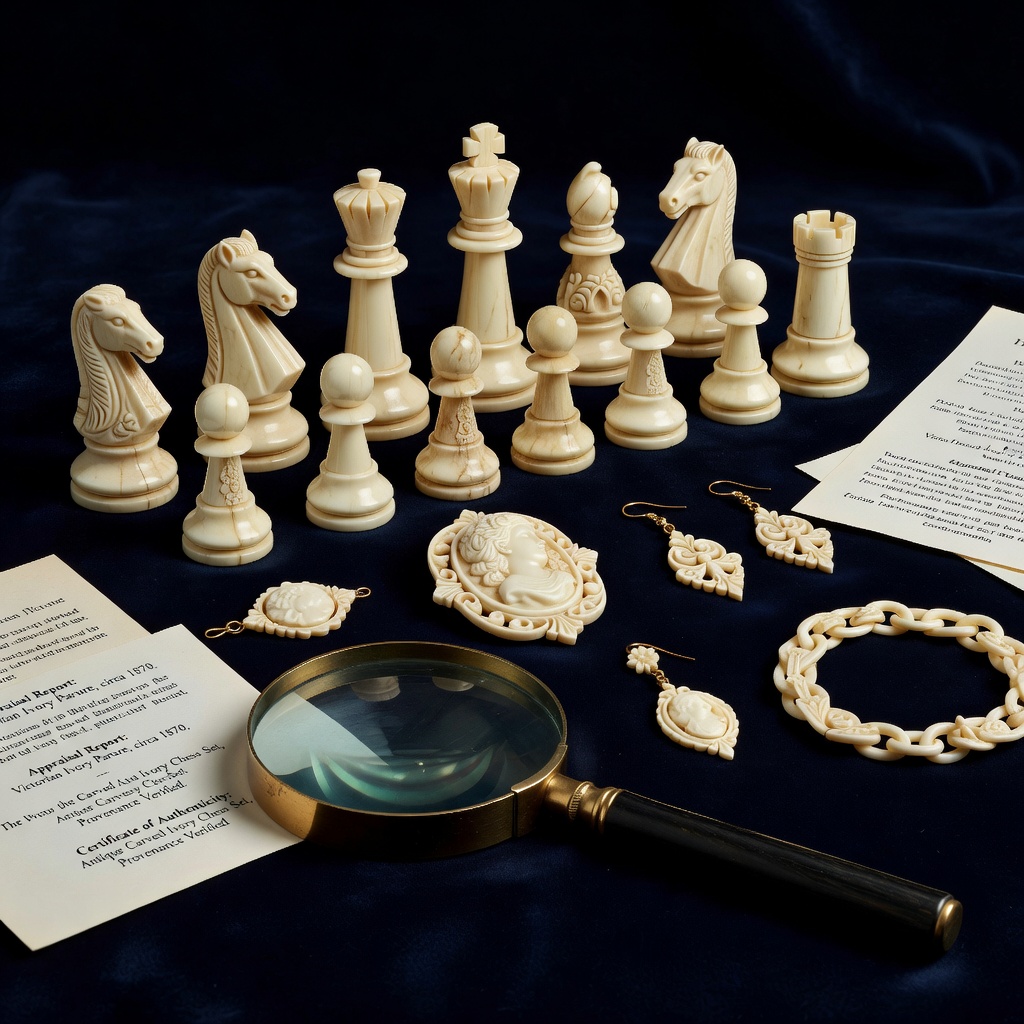
Accurate pre-ban ivory identification requires mastery of visual inspection techniques that distinguish genuine organic materials from sophisticated synthetic replicas and bone substitutes. The definitive characteristic of elephant ivory appears in the Schreger lines—intersecting cross-hatching patterns visible when examining cross-sections under magnification. These lines form angles greater than 115 degrees in elephant ivory, creating a distinctive engine-turned appearance that synthetic resins cannot perfectly replicate. Experienced collectors utilize 10x magnification loupes to examine these dentinal tubule structures, noting the consistent geometric patterns that differentiate authentic ivory from plastic imitations which typically show machine-made uniformity or complete absence of organic grain.
Differentiating between elephant ivory and mammoth ivory requires attention to specific Schreger line angles and coloration patterns. Mammoth ivory displays intersection angles of less than 90 degrees, appearing more acute and tightly packed than elephant counterparts. Additionally, mammoth specimens often exhibit characteristic blue-gray or brown mineral staining from permafrost burial, whereas elephant ivory tends toward creamy white or yellowed patination. Bone substitutes present different diagnostic features, including visible osteon structures (Haversian systems) that appear as tiny dots or dashes rather than intersecting lines, and a generally more porous texture that lacks the dense, enamel-like quality of true ivory.
Non-destructive testing methods provide scientific confirmation without damaging valuable specimens. Ultraviolet fluorescence analysis reveals distinct reactions under black light: genuine ivory typically fluoresces white or bluish-white, while bone appears brown or brownish-yellow, and synthetic resins often fluoresce brightly white or show artificial dye concentrations. Microscopic grain analysis using polarized light microscopy can identify the specific refractive properties of dentin versus synthetic polymers. For high-value authentication, Fourier-transform infrared spectroscopy (FTIR) identifies the apatite and collagen composition unique to genuine ivory, definitively distinguishing organic material from celluloid, casein, or modern polymer fakes that flood the decorative arts market.
Antique Ivory Price Ranges by Category
The antique ivory value spectrum spans several orders of magnitude depending on object category, craftsmanship level, and market demand dynamics. Victorian-era jewelry and personal accessories typically occupy the entry-level market segment, with simple hair combs, brooch mounts, and pendant settings ranging from $50 to $500. Intricate examples featuring engine-turned decoration, carved floral motifs, or inlaid precious metals command the upper end of this range, while plain utilitarian pieces with minimal artistic merit hover at lower valuations. Condition significantly impacts these categories, as jewelry items frequently exhibit wear patterns, missing teeth in combs, or damaged pins that necessitate restoration and corresponding price reductions.
Musical instrument components represent a specialized collecting niche with substantial price variation based on completeness and historical association. Complete sets of pre-ban piano keys, particularly those from renowned manufacturers like Steinway or Bechstein with original ivories intact, typically sell between $100 and $2,000 depending on the instrument's provenance and the key set's condition. Violin bows featuring genuine ivory frogs and button screws from celebrated archetiers command premium prices, sometimes exceeding $5,000 when attributed to makers like James Tubbs or François Xavier Tourte. However, isolated ivory components without their original instruments face diminished markets due to restrictions on fashioning new assemblies and challenges in proving antique status for individual parts.
Netsuke carvings and scrimshaw artwork occupy the apex of the antique ivory market, with museum-quality pieces achieving prices from $200 to over $10,000 based on artist attribution and detail complexity. Miniature Japanese toggle sculptures by recognized masters such as Tomotada or Masanao regularly exceed $50,000 at specialized auctions, while unsigned but finely detailed genre scenes typically range from $500 to $3,000. Maritime scrimshaw—engraved whale teeth and panbone plaques depicting naval scenes—commands strong prices among folk art collectors, with documented pieces from specific whaling vessels or bearing dated inscriptions achieving significant premiums over anonymous works. The presence of original polychrome staining and unfaded ink work further distinguishes high-value specimens from later reproductions or tourist-trade pieces.
Mammoth Ivory: The Legal Alternative Pricing
Woolly mammoth tusk value has emerged as the primary legal alternative for collectors and artisans seeking ivory materials without the regulatory complications surrounding elephant derivatives. Raw Siberian mammoth ivory pricing fluctuates between $300 and $1,500 per kilogram depending on coloration, preservation quality, and tusk curvature. Premium-grade white or cream-colored tusks with minimal exterior bark damage and solid internal structure command the highest raw material prices, suitable for high-end carving and jewelry applications. Conversely, excavated materials showing extensive mineral staining, root erosion, or internal cracking trade at significant discounts, often purchased for industrial applications or low-grade button manufacturing rather than artistic use.
Blue ivory represents the most prized category within mammoth ivory markets, characterized by vivianite mineral deposits that create distinctive blue-gray coloration within the dentin layers. These specimens, preserved in phosphorus-rich permafrost environments for millennia, achieve premiums of 200-400% over standard white mammoth ivory, with exceptional pieces reaching $3,000-$5,000 per kilogram. Bark ivory—the outermost layer retaining the original cementum and displaying natural textures—also commands specialized markets among sculptors who incorporate the rugged exterior into artistic designs, contrasting polished interior surfaces with raw organic exteriors. This material scarcity drives prices upward as Siberian deposits become increasingly difficult to access due to environmental regulations and remote extraction costs.
The carved mammoth ivory art market has developed distinct valuation standards separate from prehistoric elephant ivory comparisons. Contemporary master carvers working in mammoth ivory produce pieces that rival historical ivory sculptures in technical sophistication, with complex netsuke-style compositions or realistic wildlife sculptures selling for $5,000-$50,000 depending on the artist's reputation and carving complexity. Unlike elephant ivory antiques, these modern mammoth pieces face no resale restrictions in most jurisdictions, though they lack the historical patina and age verification that drives elephant ivory premiums. Investment collectors increasingly view high-grade mammoth ivory as the only viable option for new acquisitions, driving steady demand that compensates for the material's greater abundance compared to antique elephant ivory.
Professional Appraisal and Authentication Process
Securing accurate ivory appraisal services requires selecting certified professionals with specific expertise in prehistoric and antique organic materials rather than general personal property appraisers. The American Society of Appraisers and the International Society of Appraisers maintain directories of specialists qualified to evaluate ivory using standardized methodologies that comply with insurance and legal requirements. Qualified appraisers possess detailed knowledge of CITES documentation requirements, historical carving styles, and material science sufficient to distinguish between elephant, mammoth, and synthetic alternatives. They maintain current awareness of regulatory changes that affect valuation, ensuring that insurance documentation reflects both replacement cost realities and legal marketability constraints.
Comprehensive authentication requires extensive documentation including chain of ownership records, import papers, and scientific testing when applicable. Estate executors should gather death certificates, estate inventories, import permits from pre-1976 acquisitions, and any available family correspondence referencing the items' origins. For high-value pieces without documentary history, radiocarbon dating provides definitive age verification, with costs ranging from $300-$600 per sample but offering legal certainty regarding pre-ban status. Photographic documentation under various lighting conditions, including UV fluorescence shots and macro photography of Schreger lines, creates permanent records supporting both authentication and insurance claims.
Understanding the distinction between insurance valuation and market resale value proves crucial for estate planning and risk management. Insurance appraisals typically reflect replacement cost—the expense of acquiring a comparable item through legal channels—which often exceeds actual market liquidity, particularly in jurisdictions with strict sales restrictions. Market resale value considers current demand, legal transferability, and buyer accessibility, frequently resulting in lower figures than insurance schedules suggest. For example, a documented antique ivory netsuke might carry a $15,000 insurance replacement value while realizing only $8,000-$10,000 at auction due to limited buyer pools and compliance costs. Professional appraisers should provide both valuations when requested, enabling collectors to make informed decisions regarding retention, donation, or sale strategies.
Navigating Legal Sales and Marketplaces
Legal ivory sales require careful selection of venues that comply with both federal regulations and platform-specific policies regarding organic materials. Established auction houses including Sotheby's, Christie's, and Bonhams maintain specialized departments for Asian art and antiques where documented ivory pieces regularly appear, provided sellers submit comprehensive provenance documentation meeting strict due diligence standards. These institutions require pre-consignment vetting including professional condition reports, age verification, and legal opinion letters confirming the item's eligibility for sale under applicable jurisdictions. While commission rates range from 10-25%, the legitimacy and buyer access these venues provide justify the costs for high-value specimens, particularly given the legal protections afforded by auction house compliance procedures.
Online marketplace restrictions have severely limited digital sales channels, with eBay, Etsy, and Amazon maintaining blanket prohibitions on all ivory sales regardless of age or species. These platform bans reflect corporate risk management strategies rather than specific legal requirements, effectively pushing commerce toward specialized dealer networks and private treaty sales. Reputable antique dealers with physical gallery locations in states permitting ivory sales often maintain waiting lists for specific categories of ivory objects, facilitating transactions between willing buyers and sellers while ensuring proper documentation transfer. Gem and mineral shows provide alternative venues for mammoth ivory specifically, where vendors legally sell raw materials and carved art pieces under the same regulations governing fossil sales.
International travel considerations demand particular attention for collectors transporting ivory possessions across borders. Customs declaration requirements vary dramatically by destination, with many countries prohibiting ivory importation entirely regardless of the object's age or the traveler's ownership status. The United States requires CITES permits for temporary export of antique ivory for exhibition or repair purposes, while return importation demands proof that the specific item originated in the United States. Collectors should carry appraisal documentation, photographs, and acquisition receipts when traveling with ivory jewelry or accessories, and should verify destination country regulations through CITES management authorities before departure to avoid confiscation and potential criminal penalties.
Regional Market Variations and Compliance
Regional variations in ivory sales restrictions create complex geographic arbitrage opportunities and compliance challenges for international collectors. Within the United States, federal de minimis exemptions allow limited ivory content in antique musical instruments and certain decorative objects, but state-level total bans in California, Hawaii, Nevada, New Jersey, New York, Oregon, and Washington effectively nullify these exemptions for residents of those jurisdictions. New York's regulations specifically prohibit possessing ivory with intent to sell, creating liability risks for estate executors and family members inheriting collections. These state-level prohibitions significantly impact liquidity, as items legally saleable in Texas or Florida become legally inert assets in California, requiring owners to transport materials to compliant jurisdictions for disposition.
Asian markets have undergone dramatic transformations following China's 2017 domestic ivory ban and Hong Kong's subsequent prohibition implementation. These closures removed the world's largest consumer market from legal commerce, depressing global pricing structures for elephant ivory while paradoxically increasing values for documented museum-quality pieces among remaining Western collectors. The elimination of Chinese demand has shifted market dynamics toward smaller collector bases in Europe and North America, reducing price competition for common items while maintaining strong demand for exceptional rarities. Japanese markets maintain limited legal frameworks for registered pre-Convention ivory, though cultural shifts and aging traditional craftsmen have reduced domestic demand for new carvings.
European Union certificate requirements for intra-community trade create bureaucratic hurdles that affect valuation and market velocity. The EU requires Annex A certificates for movement of ivory between member states, with application processes taking 30-90 days and requiring detailed provenance documentation. Export prohibitions prevent EU residents from sending ivory to non-EU destinations, effectively trapping collections within the community unless owners can prove pre-1947 status qualifying for limited exemptions. The United Kingdom's departure from the EU has created additional complications, with the Ivory Act 2018 prohibiting sales of post-1947 ivory with few exceptions, making the UK market among the world's most restrictive and significantly reducing antique ivory values throughout the British Isles compared to continental Europe.
Investment Potential and Market Trends
Ivory investment strategies must account for a declining legal supply trajectory and increasing compliance costs that fundamentally alter traditional collectible markets. The finite nature of documented pre-ban elephant ivory creates scarcity value for pieces with impeccable provenance, yet simultaneously reduces liquidity as potential buyers face narrowing opportunities for legal resale. This dynamic favors long-term hold strategies for museum-quality pieces while punishing speculators seeking quick returns on common items like piano keys or cutlery handles. Compliance costs including appraisal fees, legal consultations, and potential carbon dating expenses can consume 10-20% of transaction values for mid-range items, effectively establishing price floors below which commerce becomes economically impractical.
The market has definitively shifted toward mammoth ivory as the only viable alternative for new carvings and contemporary artistic production. This transition reflects both regulatory necessity and evolving collector preferences, with many buyers specifically seeking mammoth materials to avoid the ethical complications and legal uncertainties surrounding elephant ivory. Investment-grade mammoth tusks showing exceptional preservation, substantial size, or rare blue coloration have appreciated steadily at 5-8% annually over the past decade, outperforming many traditional commodity investments while remaining legally transferable. However, this market remains vulnerable to potential future regulations if conservation groups successfully lobby for restrictions on mammoth ivory as a proxy for elephant ivory prohibitions.
Ethical collecting considerations increasingly influence market behavior, with many collectors choosing museum donation options for prohibited items rather than navigating complex sales restrictions. Major institutions including the Metropolitan Museum of Art and the British Museum accept donations of antique ivory when accompanied by proper documentation, providing tax benefits that may exceed potential sale proceeds while ensuring public access to cultural heritage objects. This trend toward institutional divestment from private hands further reduces market supply while potentially increasing values for pieces remaining in private collections. Forward-thinking collectors now prioritize comprehensive documentation and conservation-grade storage, treating ivory collections as legacy assets requiring generational management strategies rather than liquid investments.
Preservation, Care, and Insurance Considerations
Preserving antique ivory requires maintaining optimal environmental controls that prevent the dimensional instability causing cracks, warping, and delamination. Ideal storage conditions maintain relative humidity between 45-55% with minimal fluctuation, as ivory's organic composition absorbs and releases moisture causing expansion and contraction cycles that stress the material. Temperature stability proves equally important, with recommendations for 65-72°F (18-22°C) avoiding the thermal shock that occurs when moving items between significantly different environments. Display cases should include humidity monitoring devices and silica gel packets or specialized buffering materials that moderate atmospheric changes, while avoiding direct sunlight that accelerates surface oxidation and causes uneven yellowing or bleaching.
Proper cleaning protocols emphasize gentle maintenance using mineral oil or specialized conservation-grade solvents rather than household chemicals that damage organic materials. Conservators recommend applying small amounts of purified mineral oil using soft cotton cloths to replenish natural oils and prevent surface checking, performed annually or biannually depending on environmental dryness. Harsh chemical treatments including alcohol, acetone, or commercial cleaners strip protective patinas and dry the dentin structure, potentially causing irreversible damage. For heavily soiled pieces, professional conservation cleaning using controlled aqueous solutions and soft brushes removes accumulated grime without abrading the surface, though such interventions should be documented as they may affect future valuation if detected as restoration.
Documentation strategies for inheritance and estate valuation must establish legal ownership status to ensure smooth generational transfers and insurance coverage continuity. Collectors should maintain digital archives including high-resolution photographs, appraisal reports, acquisition receipts, and correspondence establishing provenance chains. Estate planning documents should specifically reference ivory collections and designate knowledgeable executors familiar with CITES ivory regulations and state-specific restrictions. Insurance policies require scheduled riders for high-value ivory items, with updates every 3-5 years reflecting market changes and condition assessments. For collections in banned jurisdictions, estate plans should include provisions for physical relocation to compliant states or countries prior to distribution to heirs, ensuring beneficiaries can legally possess or eventually sell inherited items without violating possession prohibitions.
Frequently Asked Questions
How much is ivory worth per gram in today's market?
Legal antique ivory typically ranges from $0.50 to $5.00 per gram depending on quality, while mammoth ivory averages $0.30 to $3.00 per gram. Pre-ban carved pieces command premiums based on artistic merit rather than raw material weight, with documented antique netsuke or scrimshaw reaching $50+ per gram at auction.
Can I legally sell my grandmother's ivory jewelry?
Legality depends on your location and documentation. In the US, you may sell antique ivory (100+ years old) with proper provenance under federal law, though states like California, New Jersey, and New York have stricter bans. The UK prohibits selling ivory post-2018 with very narrow exemptions. Always verify local regulations and obtain professional authentication before attempting sale.
What's the difference between elephant and mammoth ivory prices?
Elephant ivory typically commands higher prices ($2-$10/gram for antique pieces) due to scarcity and ban restrictions, while mammoth ivory is more abundant and legally tradable ($0.50-$3/gram raw). However, high-grade blue mammoth ivory with exceptional preservation can exceed common elephant ivory values. Mammoth ivory offers the only legal option for new carvings in most jurisdictions.
Do I need a certificate to sell antique ivory?
Requirements vary by jurisdiction. The US does not require federal certificates for pre-Act antique ivory, but some states mandate documentation. The EU requires an Annex A certificate for intra-community trade. UK sellers must register exempt items under the Ivory Act 2018. Professional appraisals and CITES documentation strengthen legal defensibility regardless of local requirements.
Why are ivory prices so variable and declining?
Prices fluctuate due to increasing legal restrictions, changing ethical attitudes, and enforcement actions against illegal trade. The closing of major markets (China 2017, UK 2018) reduced demand while compliance costs rose. However, rare documented museum-quality antiques maintain value, while common items like piano keys have plummeted due to difficulty proving legal status and selling restrictions.
Is it illegal to own ivory in the United States?
No, owning legally acquired ivory remains legal in the US under federal law. The Endangered Species Act prohibits importing, exporting, and selling most African elephant ivory, with exemptions for antique pieces (100+ years) imported pre-1976 or pre-1990 with documentation. State laws vary significantly, with total bans in California, Hawaii, Nevada, New Jersey, New York, Oregon, and Washington affecting possession rights.
How can I tell if ivory is pre-ban or antique?
Professional testing includes radiocarbon dating for definitive age verification (pre-1947 or pre-1975), visual analysis of patina and wear patterns, and documentation review. Pre-ban ivory typically shows natural yellowing, specific oxidation patterns, and age-consistent wear. However, visual identification alone is unreliable; laboratory testing provides the only legal certainty for high-value transactions.
Where can I sell ivory legally?
Legal sales channels include established auction houses (Sotheby's, Bonhams) for documented antiques, specialized dealers in states without total bans, and private sales within compliant jurisdictions. Online platforms like eBay and Etsy prohibit all ivory sales. Mammoth ivory can be sold through gem and mineral shows, specialty carving suppliers, and art galleries where state laws permit organic material sales.