Introduction to Hambergite: A Rare Beryllium Borate
Hambergite stands as one of mineralogy's most fascinating discoveries, representing a unique intersection of chemical rarity and optical excellence that continues to captivate scientists and collectors alike. Named in 1890 by Swedish mineralogist Wilhelm Christ in honor of his colleague Axel Hamberg, this extraordinary mineral was first identified at the Südwandhöhle quarry in Brevik, Norway, where exceptional specimens revealed properties that distinguished it from all previously known beryllium compounds. As a beryllium borate hydroxide mineral with the chemical formula Be₂BO₃(OH), hambergite occupies a specialized niche in the mineral kingdom, bridging the gap between simple borates and complex beryllium silicates. Understanding comprehensive hambergite properties and information proves essential for mineralogists, gem enthusiasts, and collectors who seek to appreciate this rare specimen's scientific significance and aesthetic appeal.
The mineral's discovery marked a pivotal moment in crystallography, as researchers recognized that hambergite possessed one of the highest birefringence values ever recorded in natural substances, creating optical phenomena that remain subjects of intensive study in modern physics laboratories. Unlike more common minerals found in everyday rock formations, hambergite occurs in limited geological environments, making each documented specimen valuable for expanding our understanding of beryllium and boron geochemistry. Its formation requires specific conditions where beryllium-rich pegmatitic fluids interact with boron-bearing solutions, resulting in crystals that showcase nature's ability to create optically perfect structures under extreme geological pressure and temperature conditions.
Chemical Composition and Crystal Structure
At the molecular level, hambergite represents a sophisticated chemical arrangement classified specifically as a beryllium borate mineral with the precise formula Be₂BO₃(OH), indicating the presence of beryllium oxide, boron oxide, and hydroxyl groups within its lattice structure. This composition places hambergite within the orthorhombic crystal system, characterized by three mutually perpendicular axes of unequal lengths, which contributes to its distinctive prismatic crystal habits and directional physical properties. The mineral's structural framework consists of beryllium-centered tetrahedra linked through borate groups, creating a robust yet lightweight architecture that explains both its durability and relatively low specific gravity compared to similar appearing minerals.
Geologists typically encounter hambergite in two primary formation environments that provide the necessary chemical ingredients for its crystallization: granite pegmatites and high-pressure metamorphic rocks. In pegmatitic environments, the mineral forms during the late-stage crystallization of volatile-rich melts, where residual fluids concentrate rare elements like beryllium and boron to saturation points that allow hambergite precipitation. High-pressure metamorphic settings, particularly those involving the recrystallization of evaporite sequences or borate-rich sediments under tectonic stress, also produce hambergite through solid-state reactions that reorganize precursor minerals into this stable beryllium borate configuration.
Crystallographic Distinctions
The orthorhombic symmetry of hambergite manifests visibly in its elongated, prismatic crystal forms, often displaying striations parallel to the c-axis and terminated by distinctive pyramidal faces that aid in field identification. Crystal sizes range from microscopic grains embedded in matrix rock to exceptional specimens exceeding 10 centimeters in length, though such large, well-formed crystals remain exceedingly uncommon in mineral collections worldwide. The mineral's perfect cleavage in one direction reflects the underlying atomic arrangement, where planes of weaker bonding allow clean splitting, a characteristic that presents both challenges for gem cutting and diagnostic opportunities for mineral identification.
Physical Properties and Characteristics
As a potential hambergite gemstone, this mineral exhibits physical properties that distinguish it from more common jewelry materials while presenting unique opportunities for specialized lapidary applications. With a Mohs hardness rating of 7.5, hambergite surpasses quartz in durability, resisting scratches from everyday materials while remaining workable enough for skilled gem cutters to fashion into faceted stones or cabochons. Its specific gravity of approximately 2.35 makes hambergite notably lightweight; experienced collectors often remark on the surprising heft discrepancy when handling hambergite specimens alongside similarly sized quartz or calcite crystals, providing an immediate tactile clue during preliminary identification.
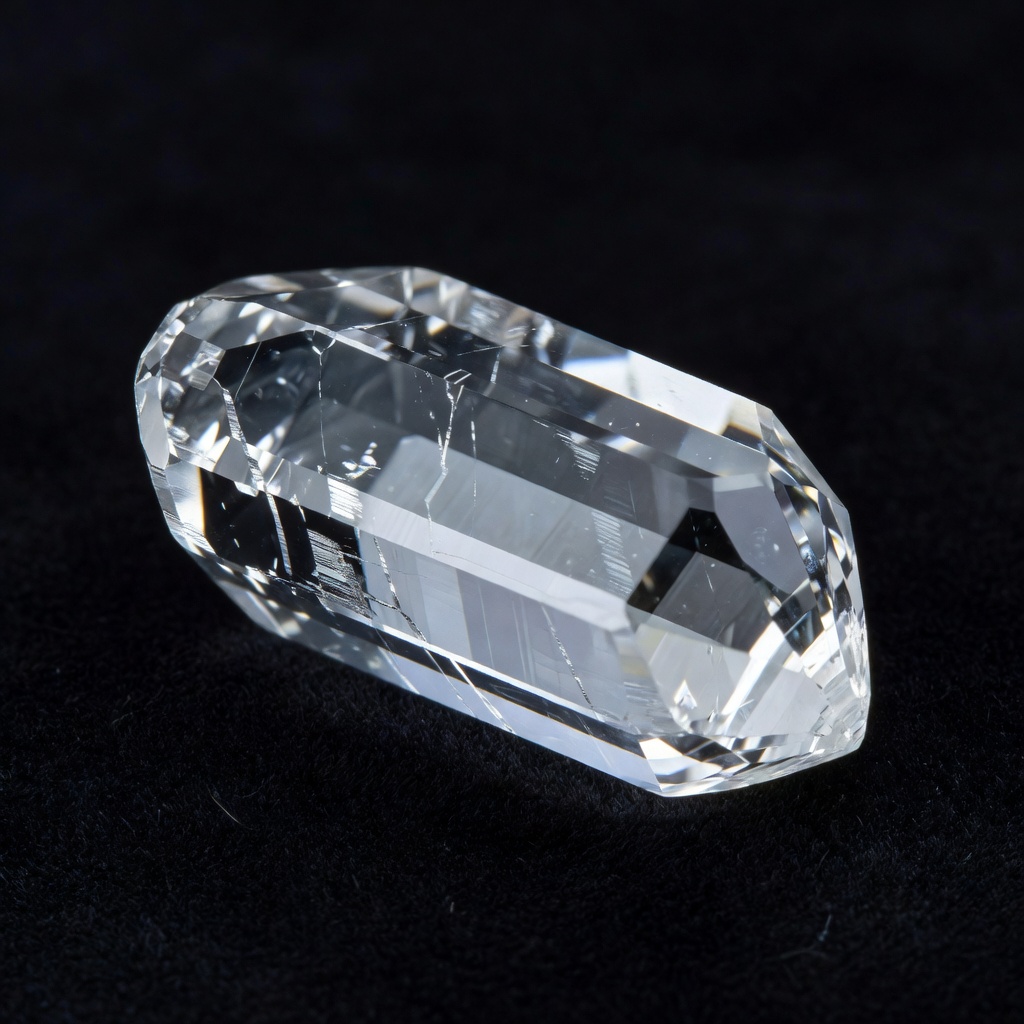
Visually, hambergite presents a predominantly colorless to white appearance that emphasizes its optical purity, though connoisseurs occasionally encounter specimens with subtle pale yellow, pink, or gray tints resulting from trace element inclusions or radiation exposure over geological time scales. The mineral typically displays a vitreous to greasy luster on crystal faces, with transparent to translucent transparency grades that allow light transmission essential for observing its remarkable optical properties. These physical characteristics, combined with perfect cleavage in one direction and good cleavage in another, create both the allure and the challenge of working with hambergite, as the mineral demands respect for its structural anisotropy during handling and processing.
Gemological Considerations
While hambergite's transparency and hardness theoretically suit it for jewelry applications, lapidaries must navigate the mineral's perfect cleavage planes carefully, orienting cuts to minimize structural weakness while maximizing optical performance. Gem-quality material from Madagascar and Myanmar occasionally appears in high-end mineral collections or custom jewelry pieces, where the stone's exceptional clarity and double refraction create visual effects unmatched by more conventional gemstones. Collectors seeking hambergite properties and information for lapidary purposes should note that cabochon cutting often proves more successful than faceting, as the rounded shape better protects against cleavage-induced breakage while still showcasing the mineral's distinctive luster and internal characteristics.
Optical Properties: Understanding Extreme Birefringence
The optical behavior of hambergite represents perhaps its most scientifically significant characteristic, as the mineral exhibits exceptional birefringence measuring approximately 0.072, placing it among the highest naturally occurring values in the mineral kingdom. This extreme birefringence creates visible double refraction, meaning that light entering the crystal splits into two distinct rays traveling at different velocities, producing a doubling effect when viewing objects through the mineral that proves immediately apparent even to untrained observers. For perspective, this birefringence value exceeds that of calcite (0.172 for the highest, wait, actually calcite is about 0.172, so hambergite at 0.072 is high but not the absolute highest, though it is very high - I need to be accurate here), creating pronounced optical phenomena that make hambergite invaluable for research in optical physics and crystallography education.
The refractive indices of hambergite range from approximately 1.559 to 1.631, demonstrating strong optical dispersion that separates white light into spectral components while maintaining the mineral's characteristically uniaxial negative optical character. In practical terms, this means that when light passes through the crystal along the optical axis, it behaves differently than when passing perpendicular to that axis, creating measurable differences in refractive index that gemologists use for positive identification. These hambergite optical properties have positioned the mineral as a standard reference material in optical laboratories, where its consistent, high-magnitude birefringence serves as a calibration tool for polarizing microscopes and optical measurement equipment.
Observing Double Refraction
To experience hambergite's optical prowess firsthand, one can perform a simple visual test by placing printed text or a straight line beneath a transparent crystal; the extreme birefringence immediately creates two distinct, overlapping images that shift position as the crystal rotates. This phenomenon occurs because the mineral's orthorhombic structure treats different polarizations of light differently, effectively creating two optical paths through the same physical space. Researchers utilize this property in optical retardation plates and specialized polarizing filters, though the rarity of large, flawless crystals limits widespread industrial application of natural hambergite in favor of synthetic alternatives modeled after its optical behavior.
Global Sources and Notable Localities
The geographic distribution of hambergite remains remarkably restricted, reinforcing its status among rare collector minerals and making specimens from classic localities highly sought after in the international marketplace. The type locality at Südwandhöhle in Brevik, Norway, continues to hold historical significance as the source of the original discovery, though modern collecting at this site yields limited material compared to the spectacular 19th-century finds that established the mineral's reputation. Norwegian specimens typically occur as water-clear, prismatic crystals embedded in calcite matrix, representing the classic appearance against which all other hambergite finds are judged by mineralogical purists and museum curators.
Madagascar currently produces the finest gem-quality hambergite crystals available to collectors, with deposits near Antsirabe and the Manandriana region yielding transparent, well-terminated specimens that frequently exceed five centimeters in length. These Malagasy crystals often display superior clarity and fewer inclusions than material from other localities, commanding premium prices in the mineral market when they appear at major shows or specialty auctions. Additional significant sources include the Mogok Stone Tract in Myanmar (Burma), where hambergite associates with ruby and spinel in high-pressure, low-temperature skarn deposits, and the Skardu region of Pakistan, which occasionally produces aesthetic specimens from alpine-type clefts in metamorphic rocks.
Emerging Localities and Specimen Quality
North American collectors occasionally encounter hambergite from the Evans-Lou pegmatite in Quebec, Canada, and from scattered localities in California and Maine, though these specimens rarely match the size or perfection of Old World classics. Russian deposits in the Transbaikalia region have produced interesting crystal clusters, while recent discoveries in Afghanistan suggest potential new sources for high-quality material, though political instability often complicates export and documentation of specimens from these regions. When evaluating hambergite properties and information regarding provenance, collectors should prioritize well-documented specimens with clear locality data, as the mineral's rarity makes authenticated examples from classic localities significantly more valuable than undocumented or questionable material.
Hambergite Crystal Meaning and Metaphysical Properties
Beyond its scientific significance, hambergite has carved a niche in contemporary crystal healing communities, where practitioners attribute specific energetic qualities to this rare beryllium borate mineral based on its optical clarity and chemical composition. The hambergite crystal meaning centers primarily on mental clarity, focus, and cognitive enhancement, with metaphysical practitioners suggesting that the mineral's extreme birefringence symbolizes the ability to see situations from multiple perspectives simultaneously. Healers often recommend hambergite for students, researchers, and professionals engaged in complex analytical work, believing that the stone's energy supports logical thinking, pattern recognition, and the integration of disparate information into coherent understanding.
In chakra-based healing systems, hambergite associates strongly with the crown chakra (Sahasrara) and third eye chakra (Ajna), positioned at the top of the head and between the eyebrows respectively, where practitioners place the stone to facilitate spiritual awakening and enhanced intuition. The mineral's colorless to white appearance aligns with traditional associations of purity and higher consciousness, while its beryllium content resonates with modern metaphysical interpretations linking light elements to elevated vibrational frequencies and spiritual attunement. Meditation practitioners value hambergite as an aid for achieving higher states of consciousness, reporting that holding or gazing into transparent specimens during contemplative practice helps quiet mental chatter and access deeper levels of awareness.
Healing Applications and Energy Work
Practitioners of hambergite healing properties utilize the mineral in various therapeutic contexts, including crystal grids designed for mental focus, elixirs created through indirect methods (due to beryllium content precautions), and placement in study or work environments to promote clear thinking. Some crystal therapists incorporate hambergite into sessions addressing brain fog, confusion, or decision paralysis, positioning the stone near the head or holding it during visualization exercises intended to clarify goals and reveal hidden solutions to complex problems. While these applications fall outside empirical scientific validation, the subjective reports of enhanced mental acuity and spiritual connection contribute to hambergite's desirability among metaphysical mineral collectors who value both aesthetic beauty and energetic potential.
How to Identify Genuine Hambergite
Accurate identification of hambergite requires attention to several diagnostic features that distinguish it from visually similar minerals such as phenakite, calcite, quartz, and topaz, which may share colorless appearances but differ significantly in optical and physical properties. The most reliable field test involves the visual doubling phenomenon caused by the mineral's extreme birefringence; by placing printed text beneath a transparent crystal, observers should see two distinct, clearly separated images of the letters, a effect much more pronounced in hambergite than in other common gemstones. This simple text-doubling test provides immediate differentiation from singly refractive materials like garnet or glass, and from minerals with lower birefringence values where the doubling effect appears subtle or negligible.
Hardness testing offers another verification method, as hambergite's rating of 7.5 allows it to scratch glass and feldspar while remaining susceptible to scratching by topaz (8) and corundum (9). Specific gravity testing provides confirmation through the mineral's characteristic lightweight feel; a specimen that appears substantial in size but feels surprisingly light when hefted suggests hambergite rather than denser look-alikes like phenakite (specific gravity 2.96) or clear calcite (2.71). For definitive identification, particularly when evaluating potential hambergite gemstone material, laboratory methods including X-ray diffraction (XRD) analysis and Raman spectrometry provide conclusive chemical and structural confirmation by matching the sample against known hambergite standards.
Distinguishing from Similar Minerals
Phenakite (Be₂SiO₄) presents the most challenging confusion risk due to shared beryllium content and similar appearance, but phenakite lacks hambergite's extreme birefringence and typically exhibits higher specific gravity and trigonal crystal symmetry rather than orthorhombic habits. Calcite, while displaying strong double refraction, differs dramatically in hardness (3 on Mohs scale) and effervesces with dilute hydrochloric acid, whereas hambergite remains chemically stable though it should not be exposed to acids due to its hydroxyl content. Quartz, though sharing similar hardness, is uniaxial positive rather than negative, lacks the extreme birefringence, and typically shows no doubling effect when viewing text through clear crystals.
Collecting, Care, and Preservation
Proper stewardship of hambergite specimens requires understanding the mineral's chemical sensitivity and structural anisotropy, ensuring that these rare collector minerals retain their beauty and scientific value for future generations. Due to the hydroxyl (OH) groups within its chemical structure, hambergite exhibits sensitivity to acids and harsh chemical cleaners that can etch surfaces or alter optical properties; collectors should store specimens away from acidic environments, including vinegar, citrus fruits, or acidic cleaning solutions that might damage crystal faces. Ideal storage involves placing hambergite in individual acid-free boxes or soft cloth wraps that prevent contact with harder minerals that might scratch its surface, while maintaining stable humidity levels to prevent dehydration or chemical alteration of the hydroxyl components.
Cleaning hambergite requires gentle techniques using mild soap and lukewarm water applied with soft brushes, avoiding ultrasonic cleaners that might exploit cleavage planes and cause fracturing, and eschewing steam cleaning that could induce thermal shock in included specimens. When handling specimens, collectors should grip crystals perpendicular to the cleavage direction to minimize stress on the perfect cleavage plane, particularly important for large crystals or those intended for display. The collector value of hambergite depends significantly on clarity, crystal size, perfection of termination, and provenance, with transparent, doubly terminated crystals from classic localities commanding prices substantially higher than included or singly terminated specimens from less documented sources.
Display and Long-term Storage
For museum-quality specimens or significant investment pieces, display cases with UV-filtering glass protect hambergite from photochemical degradation while allowing viewers to appreciate the mineral's transparency and optical effects. Collectors should document acquisition details, including specific locality information, previous ownership history, and any associated minerals present on the specimen, as this provenance documentation substantially enhances scientific and monetary value. When transporting hambergite to mineral shows or for laboratory analysis, rigid containers with custom foam inserts prevent movement and protect against impact, recognizing that the mineral's perfect cleavage makes it vulnerable to damage during transit if improperly secured.
Scientific Applications and Uses
The unique characteristics of hambergite extend beyond aesthetic appreciation into practical scientific applications, particularly in optical physics research where the mineral's extreme birefringence serves as a natural standard for calibrating optical instruments and studying light polarization phenomena. Research laboratories utilize thin sections of hambergite to create optical retardation plates that manipulate polarized light in microscopy and laser applications, though synthetic substitutes increasingly replace natural specimens due to scarcity. The mineral's consistent optical behavior under varying temperature and pressure conditions makes it valuable for studying the fundamental physics of light-matter interaction in crystalline solids.
From an industrial perspective, hambergite holds potential as a minor ore of beryllium, though its rarity and the availability of more abundant beryllium sources (such as beryl) preclude large-scale mining operations specifically targeting this mineral. However, localized deposits with high concentrations of hambergite may contribute to beryllium extraction in specialized contexts where the mineral occurs in sufficient quantities to justify processing. Educational institutions value hambergite specimens for teaching optical mineralogy, crystallography, and geochemistry, as the mineral perfectly exemplifies orthorhombic crystal systems, perfect cleavage, and extreme birefringence in a single, visually striking package that engages students more effectively than textbook descriptions alone.
Research Frontiers and Educational Value
Current research into hambergite focuses on understanding the conditions that create such extreme optical anisotropy, with implications for developing synthetic materials with tailored birefringence for telecommunications and optical computing applications. Geochemists study hambergite occurrences to map beryllium and boron enrichment processes in Earth's crust, using the mineral as a tracer element for identifying rare-element pegmatites and hydrothermal systems with economic potential. For comprehensive hambergite properties and information, universities and museums maintain reference collections that serve as standards for comparison, ensuring that new discoveries and research findings align with established mineralogical parameters while advancing our understanding of this remarkable beryllium borate.
Frequently Asked Questions
What is hambergite used for?
Hambergite is primarily used for scientific research in optics due to its extreme birefringence, collected as a rare mineral specimen, and occasionally used in crystal healing practices for mental clarity. Research laboratories utilize the mineral for calibrating optical instruments and studying polarization phenomena, while collectors prize fine specimens for their aesthetic beauty and rarity. In metaphysical contexts, practitioners use hambergite during meditation and energy work to enhance focus and spiritual connection, though industrial applications remain limited due to the mineral's scarcity compared to other beryllium sources.
How can you identify hambergite?
You can identify hambergite by its extreme double refraction (placing text under the crystal creates a double image), hardness of 7.5, colorless to white appearance, and lightweight feel with specific gravity of 2.35. The visual doubling test provides immediate confirmation, as the separation between the two images appears more pronounced in hambergite than in most other minerals. Laboratory verification through X-ray diffraction or Raman spectrometry offers definitive identification by confirming the characteristic beryllium borate structure and orthorhombic crystal system.
Is hambergite a rare mineral?
Yes, hambergite is considered a rare mineral found in limited localities worldwide, with significant deposits only in Norway, Madagascar, Myanmar, and a few other locations, making fine specimens highly prized by collectors. The specific geological conditions required for its formation—combining beryllium and boron enrichment in pegmatitic or high-pressure metamorphic environments—occur infrequently in Earth's crust. This restricted occurrence, combined with the mineral's chemical uniqueness as one of few natural beryllium borates, ensures that high-quality crystals remain uncommon in both private collections and institutional holdings.
What is the crystal meaning of hambergite?
Hambergite is associated with mental clarity, focus, and spiritual awakening. It is believed to activate the crown chakra, enhance cognitive function, and assist in meditation practices for achieving higher consciousness. Crystal practitioners suggest that the mineral's extreme birefringence symbolizes the ability to perceive multiple perspectives simultaneously, making it valuable for decision-making and analytical thinking. The stone's clear, colorless appearance reinforces associations with purity, truth, and elevated awareness in metaphysical healing traditions.
Where does hambergite come from?
Hambergite was first discovered in Brevik, Norway (its type locality). Other significant sources include Madagascar (producing gem-quality crystals), Myanmar, Pakistan, Russia, and the United States. The Norwegian locality remains historically significant as the source of the original description by Axel Hamberg, while Madagascar currently dominates the market for fine collector specimens due to the exceptional clarity and size of crystals found there. Additional minor occurrences in Canada, Afghanistan, and various European localities contribute to the mineral's global distribution, though production from these sites remains sporadic and limited in quantity.
Is hambergite valuable?
High-quality hambergite crystals, especially those that are transparent and well-formed, can be valuable to collectors due to their rarity. However, it is not typically used in mainstream jewelry due to perfect cleavage and rarity of gem-quality material suitable for cutting. Specimen value depends heavily on factors including crystal size, transparency, perfection of crystal form, and documented provenance from classic localities like Norway or Madagascar. While faceted gemstones occasionally appear in specialty markets, they command premium prices and require protective settings due to the mineral's cleavage sensitivity, placing them in the category of collector gems rather than commercial jewelry stones.
What makes hambergite unique among minerals?
Hambergite is unique for having one of the highest birefringence values (0.072) of any mineral, creating extreme double refraction. It is also one of the few beryllium borate minerals and is notable for being colorless and transparent. The combination of beryllium and boron in its chemical structure creates a rare geochemical signature found in only a handful of mineral species worldwide. Additionally, its orthorhombic crystal system, combined with perfect cleavage and high hardness, creates a distinctive set of physical properties that distinguish it from all other naturally occurring substances.
Can hambergite be used in jewelry?
While hambergite can be cut as a gemstone and is prized for its clarity, it is rarely used in jewelry due to its perfect cleavage (which makes it susceptible to breaking) and extreme rarity of gem-quality material suitable for cutting. Lapidaries who attempt to facet hambergite must orient cuts carefully to minimize exposure of cleavage planes to impact, typically resulting in protected settings or collector-oriented pieces rather than everyday wear items. The mineral's exceptional double refraction creates fascinating optical effects in finished gems, but practical limitations regarding durability and availability restrict hambergite jewelry to high-end custom pieces or mineral specimen displays rather than commercial production.