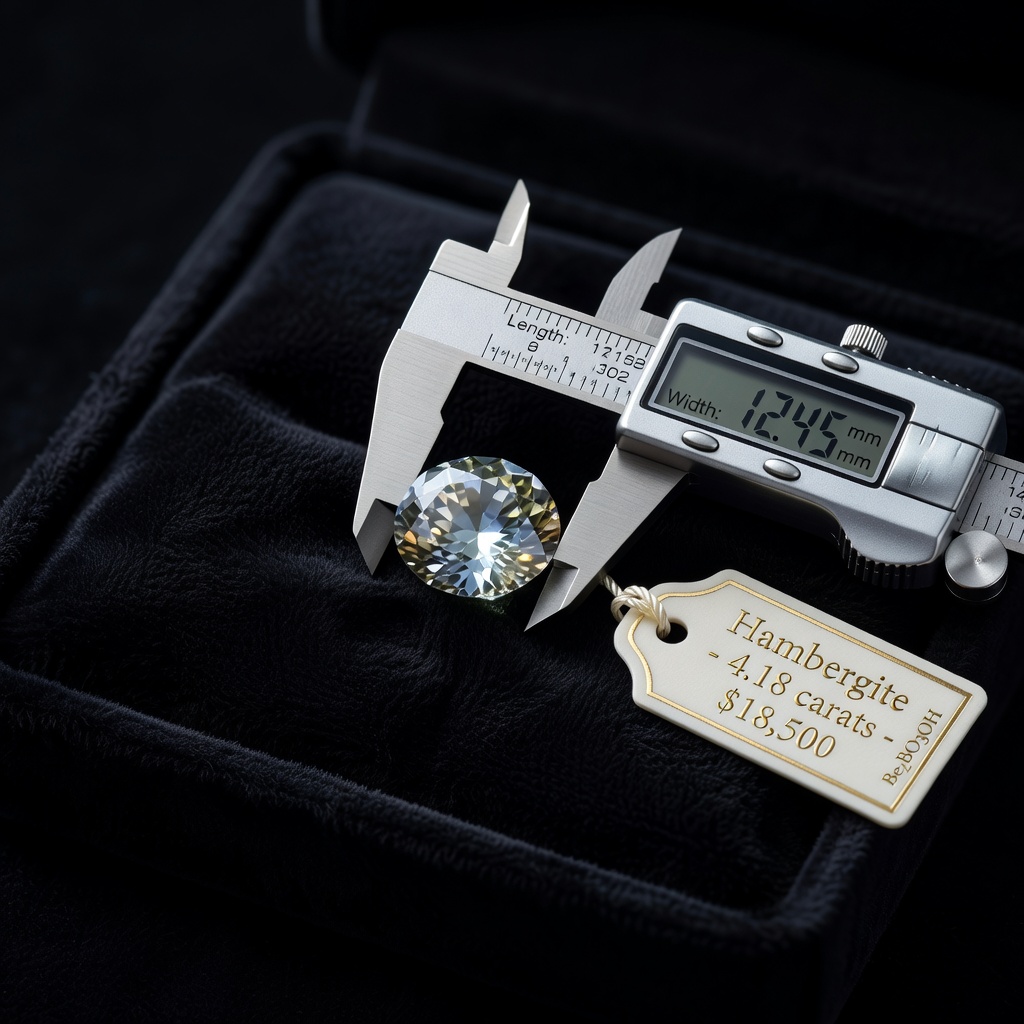
Introduction to Hambergite and Its Rarity
Hambergite stands as one of the mineral kingdom's most elusive treasures, a beryllium borate hydroxide mineral that captivates collectors with its exceptional optical properties and extreme scarcity. As a hambergite price guide for serious collectors and investors, understanding this gemstone begins with recognizing its chemical composition Be2BO3OH and its status as a high-birefringence borate mineral that rarely occurs in sizes suitable for faceting. Unlike commercially abundant gemstones such as quartz or amethyst, hambergite deposits are geographically restricted to specific pegmatite formations in Madagascar, Pakistan, and Myanmar, with each locality producing distinct characteristics that directly influence market valuation.
The collector market for this rare borate mineral operates within a specialized niche where supply constraints create natural price premiums that consistently outpace inflation. Entry-level hambergite specimens typically start around $50 to $200 for small, included crystals under two centimeters, while museum-quality crystals exceeding five centimeters can command prices ranging from $5,000 to $50,000 depending on transparency and crystal habit. Faceted stones present an entirely different pricing tier, with commercial quality gems starting at approximately $100 per carat and exceptional, eye-clean stones from premier localities reaching $1,000 or more per carat in today's competitive market.
Understanding Hambergite Quality Grading
Evaluating gem quality hambergite requires specialized knowledge of mineralogical standards that differ significantly from mainstream gemstone grading systems. Clarity represents the primary value determinant, as hambergite frequently contains liquid-filled inclusions, growth tubes, and internal fractures that compromise transparency. Stones achieving "eye-clean" status—meaning no visible inclusions at 15 centimeters without magnification—command substantial premiums, while included material suitable primarily for mineral specimens trades at 60-80% discounts compared to facet-grade crystals.
Color variations in hambergite range from absolutely colorless to pale yellow, straw-colored, or brownish tints, with the achromatic variety representing the pinnacle of desirability and value retention. For example, a 3-carat, internally flawless colorless hambergite from Madagascar's Sakavalana mine might retail for $2,400, whereas a similarly sized pale yellow stone with slight cloudiness from Pakistani deposits might fetch only $450. Cut quality presents unique challenges due to hambergite's extreme birefringence of 0.072, requiring master cutters to orient the table perpendicular to the optic axis to minimize double-image effects that can render poorly cut stones visually unappealing despite excellent rough material.
Clarity Standards and Transparency Requirements
Professional dealers assess hambergite clarity using modified diamond grading terminology, though the standards are necessarily less stringent given the mineral's natural formation constraints. Type I hambergite, containing minimal inclusions visible only under 10x magnification, represents less than 5% of production and drives the highest price points in the hambergite gemstone value spectrum. Type II stones, featuring minor inclusions visible to the naked eye but not detracting from overall beauty, comprise the commercial market segment, while Type III heavily included material remains the domain of mineral collectors seeking crystal specimens rather than jewelry applications.
Current Hambergite Price Per Carat (2024)
The hambergite gemstone value landscape in 2024 reflects a bifurcated market where specimen-grade crystals and faceted gems follow distinctly different pricing trajectories. Wholesale dealer networks currently list small crystal clusters (1-2 cm) at $75-$150 per gram, while individual crystals exceeding 4 centimeters with euhedral terminations range from $800 to $3,000 depending on luster and associated minerals. Retail markup typically ranges from 40% to 100% above wholesale acquisition costs, though established relationships with direct mine sources can reduce this spread for serious collectors.
Faceted stone pricing demonstrates even greater stratification based on size parameters that create exponential rather than linear pricing curves. Stones under one carat generally trade between $100 and $300 per carat, while the rare specimens exceeding five carats can command $800 to $1,200 per carat when exhibiting superior clarity. Geographic origin significantly influences these figures, with material from Madagascar's Ampasindava peninsula commanding 25-35% premiums over Pakistani material due to historical association with the finest crystallized examples, while Myanmar (Burmese) hambergite remains scarce enough that individual lots often sell through private treaty arrangements rather than public listings.
Wholesale Versus Retail Market Dynamics
Navigating the wholesale market requires established dealer credentials and minimum purchase commitments typically starting at $5,000, whereas retail acquisition through specialized mineral galleries offers greater consumer protection and authentication guarantees. Auction platforms present intermediate pricing opportunities, though buyer's premiums of 15-25% must be factored into investment calculations. For instance, a 5-carat faceted hambergite purchased wholesale at $400 per carat ($2,000 total) might retail for $3,200 through a Tucson gem show dealer, while the same stone at Heritage Auctions could realize $2,800 before premiums.
Factors Influencing Hambergite Market Value
Comprehending rare borate mineral pricing necessitates analyzing multiple interdependent variables that collectively determine fair market value. Crystal size represents the most critical constraint, as hambergite rarely forms crystals exceeding 10 centimeters in length, with specimens over 5 centimeters considered museum-grade rarities. A documented 8-centimeter crystal from Pakistan's Shigar Valley recently sold for $18,500, illustrating how geometric progression in pricing occurs with size increases, while a 2-centimeter crystal of similar quality might trade for merely $200.
Provenance documentation significantly impacts valuation, with specific localities carrying distinct market premiums based on geological significance and historical production quality. Madagascar remains the premier source for transparent, gem-quality crystals, particularly from the Sakavalana and Antsongombato mines, while Pakistan's Gilgit-Baltistan region produces larger but typically more included specimens. The presence of associated minerals such as tourmaline, beryl, or feldspar on matrix specimens can enhance value by 30-50% for aesthetic display pieces, provided the hambergite crystal remains the dominant visual element.
Treatment Status and Natural Material Distinctions
Unlike mainstream gemstones where heating and irradiation are commonplace, hambergite rarely undergoes enhancement due to its sensitivity to thermal shock and the rarity of treatable rough. However, astute collectors must verify natural status through laboratory certification, as some dealers have attempted to oil or resin-fill surface-reaching fractures to improve apparent clarity. Natural, untreated material commands full market value, while disclosed treated specimens typically trade at 40-60% discounts, making authentication documentation essential for investment-grade acquisitions.
Where to Buy Hambergite: Dealers and Marketplaces
Successfully buying hambergite online requires navigating a specialized marketplace where general e-commerce platforms present significant authentication risks. Established mineral dealers such as The Arkenstone, Rob Lavinsky's iRocks.com, and Heritage Auctions' Natural History division maintain rigorous provenance documentation and return policies essential for high-value acquisitions. These specialized venues typically photograph specimens under standardized lighting conditions and provide specific gravity measurements, ensuring buyers receive accurately represented material rather than misidentified phenakite or danburite simulants.
Online marketplaces like eBay and Etsy offer occasional hambergite listings at attractive price points, though these transactions demand advanced gemological knowledge to avoid costly misidentifications. Red flags include sellers offering "wholesale lots" of faceted hambergite at prices below $50 per carat, vague locality descriptions such as "Africa" rather than specific mines, and reluctance to provide independent laboratory certification. Reputable dealers will always welcome requests for additional photographs, videos demonstrating pleochroism, and third-party verification through institutions like the Gemological Institute of America (GIA) or American Gemological Laboratories (AGL).
Navigating Mineral Shows and Private Sales
For serious collectors, attending major mineral shows such as the Tucson Gem and Mineral Show in February or the Munich Mineral Show in October provides opportunities to examine specimens personally and establish relationships with direct mine operators. Private treaty sales through collector networks often yield the finest specimens before they reach public markets, though these transactions require extensive industry connections and immediate payment capabilities. When purchasing at shows, request written documentation specifying dimensions, weight, locality, and any known treatments, as verbal representations become difficult to enforce after transactions conclude.
Investment Potential and ROI Analysis
Evaluating hambergite investment potential requires understanding the mineral's position within the alternative asset class and its historical price appreciation patterns. Over the past decade, high-quality hambergite specimens have demonstrated compound annual growth rates (CAGR) of 5-8% for commercial grades and 10-15% for exceptional museum-quality pieces, outperforming many traditional inflation hedges. However, liquidity constraints present significant considerations, as converting hambergite holdings to cash typically requires 6-18 months through specialized auction houses or dealer consignment arrangements, compared to the immediate liquidity of gold or publicly traded securities.
Portfolio diversification benefits emerge from hambergite's low correlation with stock market indices and its appeal to an international collector base that remains relatively insulated from regional economic fluctuations. A case study involving a 4-carat, eye-clean Madagascar hambergite purchased in 2014 for $1,200 demonstrated remarkable value retention, selling in 2023 for $2,800—representing a 133% total return despite intermediate market volatility. Novice investors should begin with lower-value specimens ($500-$2,000) to learn market dynamics before committing to five-figure acquisitions, while experienced mineral investors might target specific locality variations known for consistent appreciation, such as the now-depleted Antsongombato mine material.
Liquidity Considerations and Market Timing
The secondary market for hambergite operates through specialized channels including Heritage Auctions' Nature & Science sales, Bonhams' Lapidary Works of Art auctions, and private sales brokered through the Mineralogical Record's classified sections. Unlike diamonds or colored stones with established Rapaport pricing lists, hambergite valuation remains subjective, requiring patience to match specific specimens with appropriate buyers. Economic downturns paradoxically often benefit rare mineral markets as investors seek tangible assets, though discretionary spending contractions can temporarily depress commercial-grade material prices by 15-20%.
Authentication and Certification Standards
Accurately assessing hambergite crystal cost necessitates rigorous authentication protocols to prevent costly acquisition of simulants or misidentified specimens. Professional gemological laboratories including GIA, AGL, and Gubelin provide identification reports confirming refractive indices (1.553-1.590), specific gravity (2.35-2.45), and birefringence measurements that definitively distinguish hambergite from visually similar phenakite, danburite, or white beryl. These certifications typically cost $75-$200 per specimen but represent essential insurance for purchases exceeding $1,000, providing documented proof of authenticity that enhances resale value and insurance coverage.
Physical property testing provides immediate field identification capabilities for experienced collectors. Hambergite exhibits perfect cleavage in one direction, a hardness of 7.5 on the Mohs scale, and a distinctive white streak when tested on unglazed porcelain. Advanced collectors utilize refractometers to measure the characteristic birefringence of 0.072, among the highest of colorless gemstones, which creates obvious doubling of back facets when viewed through the table of a faceted stone. Common simulants include glass imitations, which lack natural inclusions and show conchoidal fracture patterns rather than hambergite's cleavage, and synthetic quartz, which possesses lower specific gravity and different optical characteristics.
Identifying Enhanced and Synthetic Material
While synthetic hambergite remains extremely rare due to limited commercial demand, treatments such as fracture-filling with colorless oils or resins occasionally appear in the market. These enhancements can be detected through microscopic examination showing flash effects in filled fractures or through Fourier-transform infrared spectroscopy (FTIR) analysis available at major gemological laboratories. Investment-grade specimens should always be accompanied by reports explicitly stating "no indications of enhancement" or "natural, untreated" to ensure maximum value retention and future marketability.
Record-Breaking Sales and Famous Specimens
The upper echelons of hambergite crystal cost are defined by extraordinary specimens that transcend typical market valuations through exceptional size, provenance, or historical significance. The "Sakavalana Giant," a 12-centimeter doubly terminated crystal discovered in Madagascar during the 1980s, represents perhaps the finest hambergite ever recovered, with insurance appraisals exceeding $150,000 despite never appearing at public auction. Such specimens rarely trade on open markets, instead moving through private collections via discrete brokered transactions that establish precedent pricing for lesser but still significant crystals.
Public auction records provide concrete benchmarks for high-value hambergite, with Heritage Auctions' November 2019 Natural History sale featuring a 6.5-centimeter crystal on feldspar matrix from Pakistan that realized $22,500 including buyer's premium. Faceted stones achieving record prices include a 12.34-carat, internally flawless example sold through Christie's online jewels platform in 2021 for $14,800, establishing a per-carat record of approximately $1,200 for cut material. Museum-quality pieces housed in institutions such as the Smithsonian National Museum of Natural History or the Natural History Museum in London, while not for sale, influence market perception by establishing aesthetic standards that private collectors attempt to emulate.
Private Collection Sales and Market Influence
The dispersal of major private collections periodically injects exceptional hambergite specimens into the market, temporarily depressing prices through increased supply before scarcity reasserts upward pricing pressure. The 2017 dissolution of the William Larson Collection through The Arkenstone gallery introduced several world-class Madagascar hambergites to the market, with a 9-centimeter crystal selling for $35,000—establishing new price ceilings that benefited subsequent sellers of similar material. Collectors monitoring these collection sales can acquire investment-grade pieces at slight discounts to retail while benefiting from the impeccable provenance documentation that accompanies such dispersals.
Care, Storage, and Insurance Considerations
Proper stewardship of hambergite collections directly impacts long-term value retention and aligns with broader hambergite market trends favoring well-preserved specimens over damaged or poorly maintained examples. Despite its respectable 7.5 hardness, hambergite possesses perfect cleavage parallel to the prism faces, making it susceptible to damage from impact or pressure against harder materials. Cleaning requires only warm water and mild soap with a soft brush; ultrasonic cleaners and steam devices are strictly contraindicated due to the risk of thermal shock exacerbating existing fractures or causing cleavage plane separation.
Storage environments should maintain stable humidity levels between 40-60% to prevent dehydroxylation of the crystal structure, particularly for specimens from localities known for water-sensitive inclusions. Individual compartmentalization in acid-free boxes or display cases prevents contact with harder minerals like corundum or diamond that could scratch hambergite's surfaces. For specimens valued over $5,000, maintaining climate-controlled storage between 65-75°F (18-24°C) prevents thermal cycling that could propagate internal fractures, while archival-quality labels documenting locality, acquisition date, and previous ownership enhance provenance value for future sales.
Insurance Documentation and Appraisal Protocols
Standard homeowner's insurance policies typically exclude high-value mineral collections, necessitating specialized riders or standalone collectibles insurance through providers like Huntington T. Block or AXA Art Insurance. Professional appraisals should be updated every 3-5 years to reflect market appreciation, with documentation including high-resolution photography, laboratory certification copies, and detailed descriptions of any matrix or associated minerals. For faceted stones, maintaining original cutting documents noting weight retention percentages and cutter identities adds value, as hambergite's difficulty in cutting makes master-cut stones particularly desirable to knowledgeable collectors.
Conclusion: Is Hambergite Worth the Investment?
This comprehensive hambergite price guide reveals a market characterized by genuine scarcity, steady demand from sophisticated collectors, and pricing structures that reward knowledge and patience. For investors seeking portfolio diversification through tangible assets, hambergite offers compelling appreciation potential, particularly for specimens exceeding 5 centimeters or faceted stones over 3 carats with documented Madagascar or Pakistani origins. However, the market's illiquidity and specialized nature make it unsuitable for investors requiring quick capital access or those unwilling to develop gemological expertise.
Novice collectors should initiate their hambergite acquisitions through reputable dealers offering modestly priced specimens ($200-$800) that provide educational value while minimizing financial risk. Experienced mineral investors and high-net-worth collectors might focus on acquiring "trophy" specimens from depleted localities, accepting the premium pricing in exchange for assets that historically demonstrate superior appreciation rates and museum-quality aesthetic appeal. As global mining operations increasingly struggle to produce new hambergite finds of significance, existing specimens should continue appreciating, making strategic acquisition during the current market cycle a potentially lucrative long-term position for patient collectors who prioritize quality and authenticity over immediate liquidity.
Frequently Asked Questions
How much does hambergite cost per carat?
Hambergite typically ranges from $100 to $500 per carat for commercial quality, while exceptional, large crystals can command $1,000+ per carat. Prices vary significantly based on clarity, size, and origin, with clean faceted stones from Madagascar commanding premium rates.
Is hambergite a good investment for collectors?
Hambergite can be a solid long-term investment due to its extreme rarity and limited new deposits. However, it requires specialized knowledge and patience, as the market is smaller than mainstream gemstones, affecting liquidity.
What makes hambergite so expensive compared to other minerals?
Hambergite's high price stems from its rarity as a collectible borate mineral, difficulty in finding gem-quality crystals large enough to facet, and its limited geographic occurrence in only a few global locations.
Where is the best place to buy authentic hambergite?
Purchase from established mineral dealers who provide laboratory certification, reputable auction houses specializing in fine minerals, or directly from specialized gem shows like Tucson or Munich where authenticity can be verified in person.
How can I tell if my hambergite is real and not a simulant?
Authentic hambergite has a specific gravity of 2.35-2.45, a hardness of 7.5, and distinctive birefringence. Professional gemological testing is recommended, as glass imitations and other borate minerals can appear similar to the untrained eye.
Does hambergite increase in value over time?
Historically, high-quality hambergite has appreciated steadily as mines deplete and collector demand grows. However, appreciation rates vary by quality grade, with exceptional specimens showing stronger value retention than commercial material.
What is the largest hambergite crystal ever found?
The largest documented hambergite crystals reach up to 10-12 cm in length, primarily from Madagascar and Pakistan. Such large crystals are extraordinarily rare and command significant premiums when they appear on the market.
Are treated or enhanced hambergite stones worth less?
Yes, untreated natural hambergite commands significantly higher prices than treated material. Heat treatment or clarity enhancement is uncommon but possible; always request certification confirming natural status when purchasing investment-grade pieces.