Understanding Goshenite and Its Market Position
Goshenite represents the purest form of the beryl mineral family, distinguished by its complete absence of color that allows light to pass through with exceptional clarity. Unlike its more famous siblings emerald and aquamarine, which derive their value from rich saturation and hue, goshenite gemstone specimens captivate collectors and jewelry enthusiasts through crystalline transparency and diamond-like brilliance. This colorless beryl introduction to the fine jewelry market has accelerated significantly over the past decade as consumers seek ethical, affordable alternatives to traditional precious stones without sacrificing aesthetic appeal or durability.
The rising popularity of goshenite stems from its unique position as a natural, untreated gemstone that offers remarkable optical performance at a fraction of the cost of diamonds. Historical records indicate that goshenite was first discovered in Goshen, Massachusetts during the early nineteenth century, lending the stone its distinctive name. Today, major mining operations span across Brazil's Minas Gerais region, Madagascar's alpine deposits, and Nigeria's pegmatite fields, ensuring steady supply for the growing demand in both bridal jewelry and high-fashion cocktail pieces. Modern cutters have perfected techniques to maximize the stone's inherent brilliance, positioning goshenite as a sophisticated choice for discerning buyers who prioritize both budget consciousness and natural beauty.
Current Goshenite Price Per Carat (2024 Market Analysis)
The goshenite price per carat varies dramatically based on quality grades, with the market stratifying into distinct tiers that reflect clarity, size, and origin factors. Commercial grade material, typically featuring slight inclusions or less precise cutting, currently trades between $30 and $100 per carat, making it accessible for fashion jewelry and entry-level fine pieces. Fine quality specimens exhibiting exceptional transparency, precision cutting, and sizes exceeding two carats command significantly higher premiums, ranging from $200 to $800 per carat, with museum-quality stones over five carats occasionally exceeding $1,000 per carat at specialized auctions.
Current white beryl cost analysis reveals interesting fluctuations across major trading centers, with Bangkok and Jaipur reporting stable wholesale prices while Western retail markets show 15-20% markups due to increased consumer awareness. The 2024 market has seen modest price appreciation for untreated natural material, particularly from historic Brazilian deposits, as supply chain constraints affect rough material availability. Factors influencing these trends include the closure of several small-scale African mines, increased demand from Asian bridal markets seeking diamond alternatives, and the growing preference for untreated gemstones among millennial and Gen-Z consumers who prioritize natural provenance over processed appearance.
Price Thresholds and Market Segments
Understanding the specific breakpoints in goshenite pricing helps buyers navigate the market effectively. Stones under one carat typically fall into the commercial category unless they exhibit exceptional clarity and cut, while the jump to the premium tier becomes pronounced at the two to three carat mark where large clean crystals become statistically rare. The current white beryl cost structure rewards patience and knowledge, as stones with slight yellow or gray tints trade at 40-60% discounts compared to truly colorless examples, offering opportunities for budget-conscious buyers who prioritize size over absolute color purity.
The 4Cs of Goshenite Valuation
Evaluating goshenite requires adapting the traditional diamond grading system to account for the unique properties of colorless beryl. Unlike diamonds where color grading focuses on the absence of yellow, goshenite clarity grades emphasize the complete transparency that allows the stone's crystalline structure to showcase itself without distraction. Premium specimens must achieve at least eye-clean status, meaning no visible inclusions to the unaided eye at a distance of six inches, with the finest examples reaching loupe-clean standards where microscopic examination reveals no internal features under 10x magnification.
Cut quality significantly impacts both the beauty and value of goshenite, as the stone's lower refractive index compared to diamond requires precise angles to maximize light return. Master cutters often employ modified brilliant cuts or step cuts that emphasize clarity over fire, with pavilion angles between 40-43 degrees proving optimal for this material. Stones exhibiting excellent symmetry and polish grades command 30-50% premiums over commercial cutting, as these precision facets create the mirror-like reflections that distinguish fine goshenite from inferior material. When examining goshenite cut quality, look for consistent facet junctions and avoid stones with overly deep pavilions that create "fish-eye" effects or windowing that allows light to leak through the bottom.
Carat Weight and Color Considerations
Carat weight thresholds create exponential pricing jumps in the goshenite market, particularly at the one, three, and five carat marks where supply constraints become acute. Clean crystals over five carats represent less than 2% of total production, explaining why these specimens command premiums of 200-300% per carat compared to smaller stones. Color evaluation focuses strictly on the absence of tint, with the most valuable stones displaying pure water-like transparency without hints of yellow, gray, or green that might suggest iron contamination or heating treatments. When assessing larger stones, examine them against a white background in natural daylight to detect subtle color variations that laboratory lighting might mask.
Goshenite vs. Other White Gemstones: Price Comparison
The goshenite vs diamond price differential represents one of the most compelling value propositions in the gemstone market, with high-quality goshenite costing approximately 1/100th to 1/50th the price of equivalent diamonds. A one-carat eye-clean goshenite with excellent cut typically retails between $100 and $300, while a comparable SI1 clarity diamond of similar size commands $4,000 to $6,000. This dramatic price separation allows consumers to purchase significantly larger stones for engagement rings or statement pieces without compromising on visual impact or natural origin, establishing goshenite as the premier affordable diamond alternative for budget-conscious luxury buyers.
When compared to other diamond simulants and alternatives, goshenite occupies a unique position between white sapphire and moissanite in terms of both cost and optical properties. White sapphires, while harder at 9 on the Mohs scale, typically lack the brilliance of well-cut goshenite and command slightly higher prices due to their corundum pedigree. Moissanite offers superior fire and hardness (9.25 Mohs) but suffers from an overly disco-ball effect that some consumers find artificial, whereas goshenite provides a more subtle, refined brilliance that closely mimics diamond's light performance. The 7.5-8 Mohs hardness of goshenite provides adequate durability for daily wear when set properly, though it requires more protective settings than harder alternatives.
Optical Performance and Durability Analysis
Understanding the optical differences between these materials helps buyers make informed decisions based on lifestyle and aesthetic preferences. Goshenite exhibits a refractive index of 1.577-1.583, lower than diamond's 2.42 but sufficient to create impressive brilliance when cut to proper specifications. Unlike cubic zirconia or moissanite, goshenite does not display double refraction, maintaining crisp facet edges that enhance its diamond-like appearance. While softer than sapphire or diamond, goshenite's durability exceeds that of tanzanite, opal, or pearl, making it suitable for earrings, pendants, and occasional-wear rings when protected by bezels or halo settings that shield the girdle from impact.
Treatment Types and Their Impact on Value
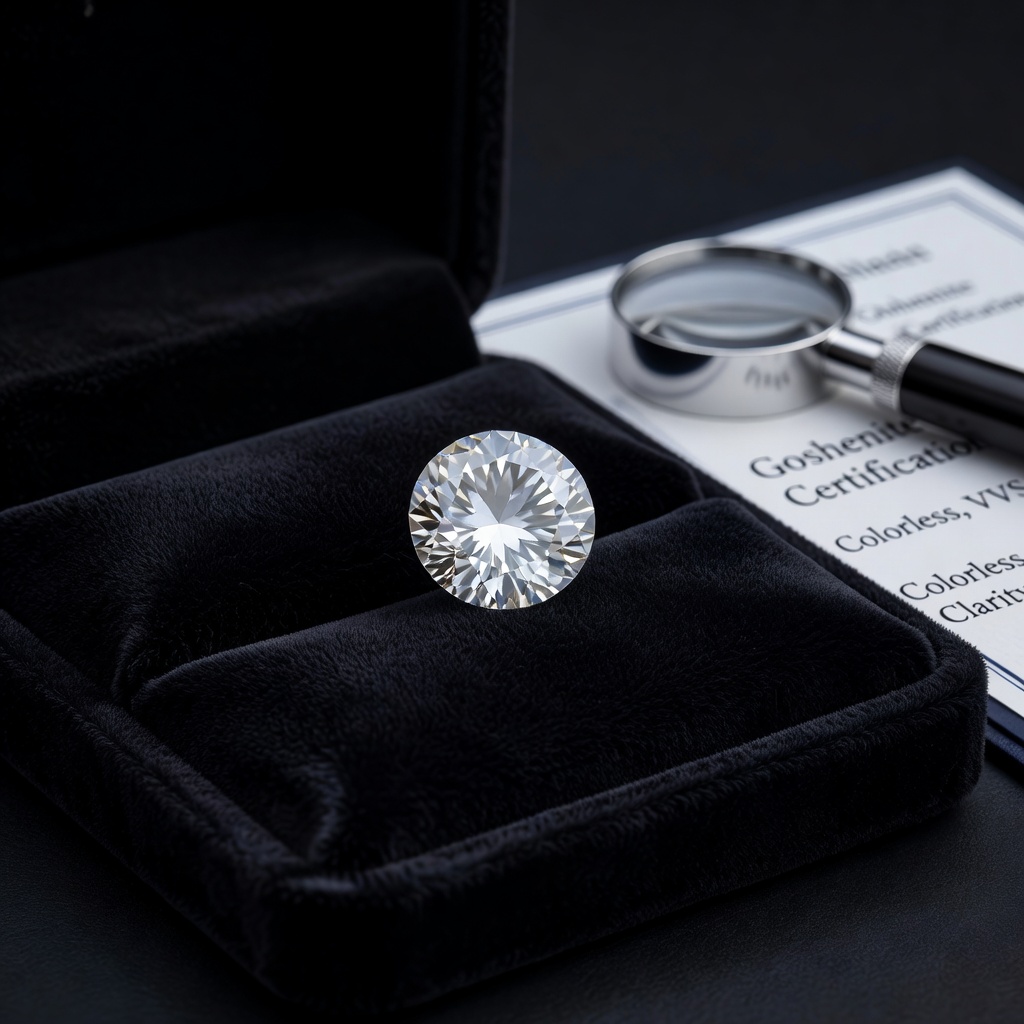
The distinction between natural and treated material creates significant price differentials in the goshenite market, with untreated stones commanding premiums of 20-40% over heat-treated equivalents. Heat treatment, commonly applied at temperatures between 400-600 degrees Celsius, dissolves natural tension cracks and improves clarity by reducing the visibility of fluid inclusions, but simultaneously diminishes the stone's status as a completely natural product. Laboratory certification from respected institutions like GIA or AGL becomes essential when purchasing premium material, as these reports definitively establish whether a stone has undergone thermal enhancement or remains in its natural state.
Clarity enhancement techniques extend beyond simple heating to include oiling and fracture filling, though these treatments are less common in goshenite than in emerald due to the stone's typically superior native clarity. Buyers should insist on full disclosure of any treatments, as untreated goshenite value appreciates more steadily over time and maintains stronger resale markets among collectors who prioritize natural provenance. When examining laboratory reports, look for specific language indicating "no indications of heating" or "natural, untreated" status, as vague terminology might obscure enhancement history. Ethical dealers will always disclose treatment status upfront, with treated stones representing excellent value for jewelry purposes while untreated specimens suit investment or collection-oriented purchases.
Detection and Certification Standards
Advanced spectroscopic analysis can detect heat treatment by identifying changes in the stone's absorption patterns, particularly in the infrared region where structural water alterations become apparent. Reputable laboratories employ microscopic examination to identify heat-altered inclusions that appear "melted" or rounded compared to their natural angular forms. For buyers seeking natural goshenite value retention, purchasing only certified stones from vendors who specialize in untreated material minimizes the risk of undisclosed enhancements. The price gap between treated and untreated material has widened in recent years as collector markets increasingly prize natural provenance, making proper documentation more critical than ever for maintaining investment value.
Geographic Origins and Source-Based Pricing
Provenance significantly influences goshenite pricing, with Brazilian material from the historic Minas Gerais deposits commanding the highest premiums due to exceptional clarity and deep cultural significance in the gemstone world. These Brazilian crystals, often extracted from pegmatite formations in the Jequitinhonha Valley, frequently exhibit superior transparency compared to African material, with collectors paying 25-35% premiums for documented Brazilian origin in larger sizes. The goshenite sources in Madagascar have emerged as significant suppliers of commercial-grade material, offering attractive price points for calibrated sizes under two carats while occasionally producing exceptional collector specimens from the Sahatany Valley.
African beryl mining locations including Nigeria's Kaduna and Plateau States contribute substantial quantities of material that typically trades at 15-20% discounts compared to Brazilian equivalents, though exceptional crystals from these regions command respect in specialist markets. Quality variations between mining locations often reflect geological differences in formation conditions, with Brazilian stones frequently displaying more uniform crystal structure while African material sometimes shows interesting growth zoning that affects cutting yields. Rarity factors escalate dramatically for large clean crystals regardless of origin, with stones over ten carats representing significant geological anomalies that transcend source-based pricing to achieve "important stone" status at international auctions.
Collector Interest in Historic Provenance
Specimens from depleted or historic mines carry additional premiums based on scarcity and romantic appeal, particularly material from the original Goshen, Massachusetts locality or classic Brazilian mines now exhausted or converted to other uses. These provenance premiums can double or triple base prices for museum-quality specimens, though such stones rarely enter the commercial jewelry market. Modern buyers should balance origin premiums against actual quality metrics, as a superb Nigerian stone typically outperforms a mediocre Brazilian crystal despite source-based pricing hierarchies. Documentation establishing specific mine locality adds value for collector-grade purchases, while commercial jewelry-grade material benefits less from provenance premiums unless the stones exhibit exceptional size or clarity characteristics.
Smart Buying Strategies for Maximum Value
Successfully buying goshenite requires navigating between online dealers and traditional brick-and-mortar establishments, with specialized online colored stone vendors typically offering superior selection and 20-40% better pricing than general retail jewelers. Reputable internet dealers provide high-resolution photography, detailed videos, and generous return policies that allow inspection before final commitment, essential for evaluating clarity characteristics invisible in static images. When considering buying goshenite online, prioritize vendors who specialize in beryl varieties rather than generalist sites, as these specialists possess the expertise to accurately grade clarity and detect treatments that untrained sellers might miss.
Essential documentation for any significant purchase includes laboratory reports from GIA, AGL, or Gübelin verifying natural origin and treatment status, alongside origin certificates for premium Brazilian material. Red flags demanding immediate avoidance include sellers describing synthetic white spinel or cubic zirconia as "goshenite," misleading terms like "created goshenite" implying lab-grown material, or prices significantly below market rates suggesting undisclosed treatments or simulants. Negotiation tactics differ between loose stones and mounted jewelry, with loose stones offering more flexibility for price discussion while custom settings typically involve fixed labor costs with potential discounts on the center stone itself.
Vendor Verification and Quality Assessment
Before purchasing, verify vendor credentials through industry organizations like the American Gem Trade Association (AGTA) or International Colored Gemstone Association (ICA), membership in which indicates commitment to ethical standards and disclosure requirements. Request specific clarity grades rather than general descriptions, insisting on eye-clean standards for stones over one carat and loupe-clean for investment pieces. When possible, arrange for independent appraisal within the return period to verify that the stone matches the seller's description regarding weight, dimensions, and treatment status. Building relationships with established dealers who offer upgrade policies or buy-back guarantees provides long-term security for significant purchases, particularly for engagement rings or heirloom-quality pieces where future service and valuation support prove invaluable.
Investment Potential and Resale Value Outlook
The goshenite investment landscape presents a nuanced picture for potential collectors, with the stone offering reasonable value retention compared to consumable fashion items but lacking the liquidity and appreciation potential of precious colored stones like ruby, sapphire, or emerald. Market liquidity remains relatively thin, meaning that selling goshenite quickly typically requires accepting 40-60% discounts from retail replacement values, though patience and proper marketing through specialty dealers can recover 70-80% of initial investment for exceptional pieces. Collector interest trends increasingly favor high-quality natural specimens over three carats with documented provenance from historic mines, with these stones showing modest annual appreciation of 3-5% compared to flat or declining values for commercial-grade treated material.
Long-term value retention depends heavily on purchasing quality at fair prices initially, as overpaying at retail eliminates potential for future appreciation. Untreated stones from recognized localities with superior clarity grades represent the safest store of value, while treated or commercial-grade material should be viewed as wearable art rather than financial instruments. Insurance appraisal considerations require separating sentimental value from actual replacement cost, with appraisers typically valuing fine goshenite at current wholesale replacement rates rather than inflated retail prices. Maintaining original laboratory certificates and purchase documentation proves essential for future resale or insurance claims, as provenance and treatment verification significantly impact secondary market interest.
Market Trends and Future Outlook
Emerging collector interest in "alternative" bridal stones has strengthened the investment case for exceptional goshenite, particularly large, clean stones suitable for significant engagement rings. Auction results from specialized colored stone sales indicate growing recognition of fine goshenite as a legitimate collector category, with record prices achieved for exceptional Brazilian specimens over ten carats. However, the market remains susceptible to fluctuations in diamond pricing, as significant drops in diamond values can reduce the perceived value proposition of diamond alternatives. Investors should focus on acquiring stones with unique characteristics—unusual size, exceptional clarity, or historic provenance—that distinguish them from commodity material, creating scarcity value that transcends general market movements.
Maintenance Costs and Setting Considerations
The moderate hardness of goshenite necessitates thoughtful consideration of goshenite durability factors when designing jewelry intended for daily wear. With a rating of 7.5-8 on the Mohs hardness scale, goshenite resists scratching from household dust and normal contact but remains vulnerable to hard knocks and abrasive materials that harder gemstones like diamond or sapphire would withstand. This durability profile influences long-term gemstone maintenance costs, as rings require more frequent inspection and potential tightening of settings compared to harder center stones. Professional cleaning services typically charge $25-$50 per visit for ultrasonic cleaning and prong inspection, with annual maintenance budgets of $100-$150 reasonable for heavily worn pieces.
Setting selection dramatically impacts the security and longevity of goshenite jewelry, with protective bezels offering superior security compared to delicate prong settings for active wearers. Full or partial bezels shield the girdle—the stone's most vulnerable area—from impact while preventing the accumulation of debris that can loosen settings over time. Prong settings, while maximizing light exposure and brilliance, require more frequent inspection and retipping every 5-10 years at costs ranging from $75-$200 depending on metal type and complexity. Repair costs for goshenite generally run lower than for diamond jewelry due to the stone's lower replacement value, though chipping or abrasion of the girdle may necessitate recutting, which typically costs $100-$300 per carat depending on the extent of damage.
Protective Measures and Wear Guidelines
For engagement rings or daily-wear pieces, consider halo settings where smaller hard stones surround the goshenite center, providing physical protection while enhancing visual size. Avoid wearing goshenite jewelry during activities involving harsh chemicals, extreme temperature changes, or physical impact, as thermal shock can fracture beryl and household cleaners may damage certain setting materials. Store pieces separately from harder gemstones to prevent scratching, preferably in individual soft cloth pouches or compartmentalized jewelry boxes. While goshenite requires more careful handling than diamond or sapphire, proper setting selection and mindful wear habits allow these beautiful stones to maintain their brilliance for generations with reasonable maintenance investment.
Conclusion: Making an Informed Purchase Decision
This comprehensive goshenite value guide demonstrates that informed purchasing requires balancing quality aspirations with realistic budget constraints while understanding the specific factors that drive pricing in the colorless beryl market. Key pricing factors include the exponential value increase at carat weight thresholds of one, three, and five carats; the critical importance of eye-clean to loupe-clean clarity standards; the significant premiums commanded by untreated natural material with laboratory certification; and the source-based pricing variations between Brazilian and African origins. For different budget tiers, commercial-grade material under $100 per carat offers accessible entry points for fashion jewelry, the $200-$500 range provides fine quality suitable for bridal applications, while $800+ per carat investments target collector-grade specimens with documented provenance and exceptional characteristics.
The future market outlook for colorless beryl remains positive as consumer education increases and ethical sourcing concerns drive interest in natural, untreated alternatives to laboratory-created diamonds. When preparing your buying checklist, verify laboratory certification for stones over one carat, confirm treatment status through reputable grading reports, examine stones under natural light for color purity, and ensure vendor return policies allow for independent appraisal. By prioritizing clarity and cut over absolute carat weight, insisting on proper documentation, and selecting protective settings appropriate to the stone's hardness, buyers can acquire beautiful goshenite jewelry that offers exceptional aesthetic value and reasonable long-term satisfaction at a fraction of diamond costs.
Frequently Asked Questions About Goshenite Pricing and Value
What is the average price per carat for goshenite?
Commercial quality goshenite typically ranges from $30 to $100 per carat, while fine quality stones with exceptional clarity and cut command $200 to $800 per carat. Large specimens over 5 carats with premium characteristics can exceed $1,000 per carat.
Is goshenite significantly cheaper than diamond?
Yes, goshenite costs approximately 1/100th to 1/50th the price of a comparable diamond. A 1-carat eye-clean goshenite might cost $100-$300, while a similar-sized SI1 diamond typically ranges from $4,000-$6,000, making it an extremely affordable alternative.
What clarity grade should I look for when buying goshenite?
Unlike emeralds, goshenite should be eye-clean (no visible inclusions to the naked eye). Look for VS (Very Slightly Included) or better clarity grades. Because it's colorless, inclusions are more visible than in colored beryls, significantly impacting both beauty and value.
Does goshenite hold its value over time?
While not considered a strong investment gemstone like ruby or sapphire, high-quality natural goshenite retains reasonable resale value. Untreated stones over 3 carats with excellent clarity are becoming more sought after by collectors, though liquidity remains lower than precious gems.
Can goshenite be used as a diamond substitute in engagement rings?
Absolutely. With a hardness of 7.5-8 on the Mohs scale, goshenite is durable enough for daily wear. When well-cut, it exhibits excellent brilliance and fire similar to diamond at a fraction of the cost, though it requires protective settings for long-term security.
Are treated goshenites worth less than natural stones?
Yes, untreated natural goshenite commands a 20-40% premium over heat-treated or clarity-enhanced specimens. Heat treatment is common to improve clarity, so always request a laboratory certificate verifying natural status if paying premium prices for untreated material.
Where is the best place to buy goshenite gemstones?
Reputable online gemstone dealers specializing in colored stones offer the best selection and competitive pricing. Look for vendors providing detailed photos, return policies, and laboratory certification from GIA, AGL, or GIA. Avoid general retail jewelry stores which typically markup significantly.
What factors make some goshenite stones more expensive than others?
Premium pricing correlates with size (stones over 5 carats are rare), exceptional clarity (loupe-clean), precision cutting (excellent symmetry and polish), natural untreated origin, and provenance from historically significant mines like those in Minas Gerais, Brazil.