
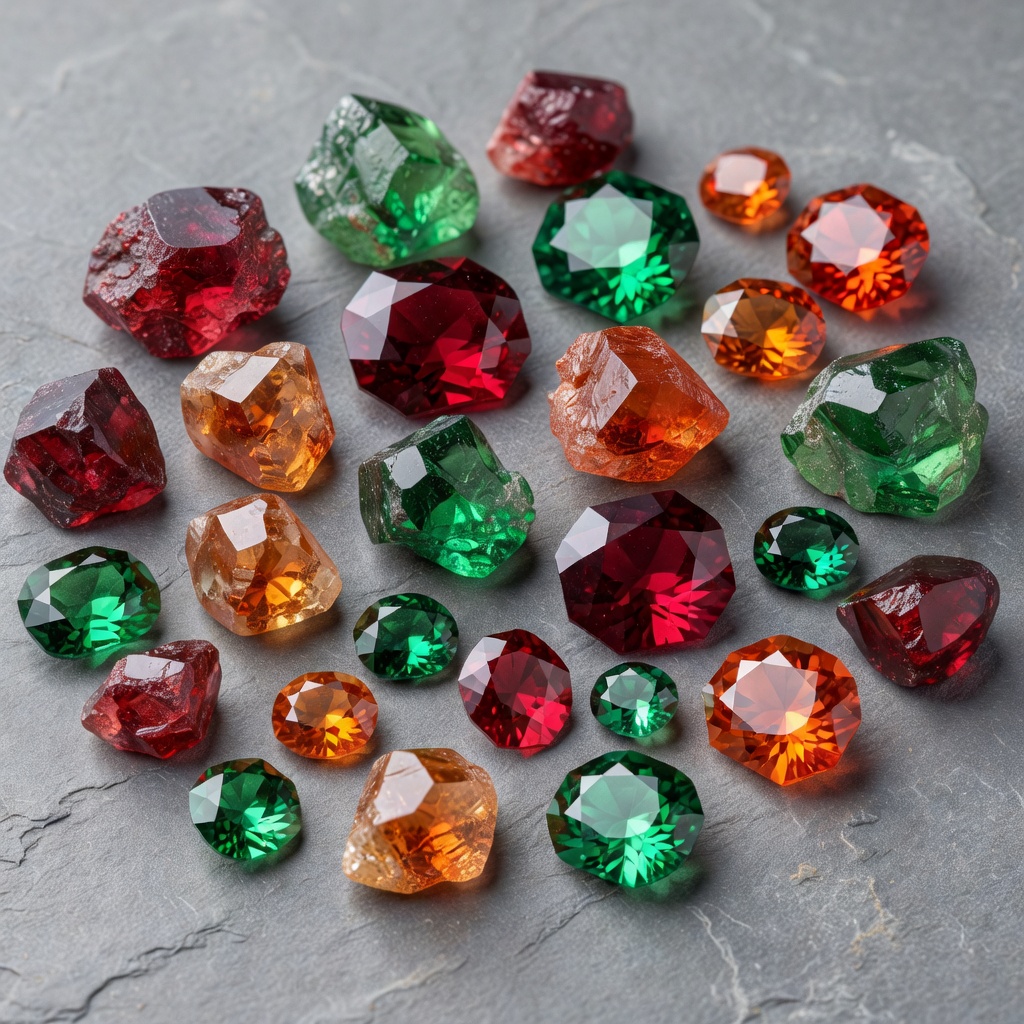
Introduction to Garnet: A Timeless Gemstone
Garnet represents one of the most fascinating and diverse mineral groups in the gemological world, consisting of a complex family of silicate minerals that share similar crystal structures yet display remarkable chemical variations. Unlike single-mineral gemstones such as diamond or quartz, garnet encompasses over twenty different varieties, each possessing unique optical and physical characteristics that distinguish it within the broader spectrum of precious stones. When exploring Garnet Properties and Information, it becomes immediately apparent that this gemstone family defies the common misconception of being merely a red birthstone, instead presenting a kaleidoscope of colors ranging from forest green to burnt orange and even rare blue hues.
The historical significance of garnet stretches across millennia, with archaeological evidence revealing its use in Egyptian pharaoh tombs, Roman signet rings, and Victorian mourning jewelry. Ancient warriors fashioned garnet amulets believing the stone would protect them from wounds during battle, while medieval clergy used it to symbolize Christ's sacrifice due to its blood-red varieties. Today, collectors and jewelry enthusiasts recognize garnet for its exceptional brilliance, often exceeding that of ruby, and its remarkable durability that makes it suitable for everyday wear in various jewelry settings.
Understanding what distinguishes garnet from other gemstones requires examining its unique combination of high refractive index, which creates exceptional fire and brilliance, coupled with a hardness range that provides practical durability. Unlike many colored stones that undergo heat treatment or radiation to enhance their appearance, most garnets on the market remain entirely natural, presenting authentic color straight from the earth. This untreated authenticity, combined with the gem's ability to occur in virtually every color of the rainbow, positions garnet as a versatile and valuable addition to any fine jewelry collection.
Physical and Chemical Properties of Garnet
The fundamental garnet mineral properties stem from its complex silicate structure characterized by the general chemical formula X₃Y₂(SiO₄)₃, where X and Y represent different metallic elements that determine the specific variety. This isometric crystal system creates perfectly symmetrical formations, typically developing as dodecahedrons or trapezohedrons with twelve or twenty-four faces respectively. The robust atomic bonding within garnet's crystal lattice contributes to its impressive durability, making it resistant to scratching and chipping under normal wearing conditions while maintaining exceptional polish and luster over decades of use.
On the Mohs hardness scale, garnet specimens typically register between 6.5 and 7.5, placing them in the same durability category as quartz and tourmaline, though specific varieties demonstrate different toughness levels. Almandine and pyrope varieties tend toward the higher end of this spectrum, exhibiting excellent resistance to abrasion suitable for rings and bracelets worn daily, while more brittle varieties like demantoid require protective settings due to natural inclusions. The specific gravity of garnet ranges from 3.4 to 4.3, significantly denser than many common gemstones, which creates a satisfying heft when handling high-quality specimens.
Optically, garnet possesses a high refractive index ranging from 1.72 to 1.94, depending on the chemical composition, which exceeds that of spinel and approaches sapphire in its ability to bend light and create brilliance. This optical density, combined with a vitreous to resinous luster, allows well-cut garnets to display exceptional fire and scintillation that rivals more expensive precious stones. The mineral's single refractive nature—meaning it does not split light into two rays like beryl or tourmaline—contributes to its sharp, clear appearance and makes it relatively straightforward to identify under gemological testing.
Major Types of Garnet Species
Understanding the types of garnet requires familiarity with six primary mineral species that form the foundation of this diverse gemstone family. Almandine, the most common variety found in commercial jewelry, derives its deep red to reddish-brown color from iron and aluminum within its chemical structure, frequently sourced from India, Brazil, and the United States. This variety often forms the classic "garnet red" that consumers recognize, though fine specimens exhibit a rich, velvety crimson that distinguishes high-quality almandine from lower-grade material.
Pyrope, whose name derives from the Greek words for "fire" and "eye," represents the magnesium-rich member of the garnet family, displaying vibrant red hues that can rival fine ruby when found in exceptional quality. This variety frequently occurs in ultramafic rocks and alluvial deposits, with significant sources located in the Czech Republic, South Africa, and Arizona. Pyrope often blends with almandine to create rhodolite garnet, a highly prized hybrid variety displaying delicate raspberry to purplish-red tones that command premium prices in the fine jewelry market.
Grossular garnet presents perhaps the most diverse color palette within the family, ranging from colorless specimens to vibrant greens and warm cinnamon browns, depending on trace elements present during formation. The green variety known as tsavorite, discovered in Tanzania and Kenya during the 1960s, stands as one of the most valuable garnet gemstone types due to its vivid emerald-like color and exceptional clarity. Andradite, the calcium-iron species, includes the rare and brilliant demantoid garnet, prized for its diamond-like adamantine luster and distinctive horsetail inclusions that actually increase value among collectors.
Color Variations and Rare Characteristics
While traditional perceptions limit garnet to red varieties, modern gemology recognizes these stones across the complete color spectrum, including spectacular greens, oranges, purples, and the exceptionally rare blue garnets discovered in Madagascar during the 1990s. The blue variety, scientifically classified as a color-change pyrope-spessartine hybrid, displays dramatic phenotypic shifts from teal-blue in daylight to purplish-red under incandescent lighting, making it one of the most valuable and sought-after types of garnet among serious collectors. Mandarin spessartine, displaying intense orange hues reminiscent of Fanta soda, represents another rare variety that has seen exponential price increases due to limited supply from Namibian and Nigerian mines.
Unique optical phenomena further distinguish certain garnet specimens from their counterparts, including asterism or the "star" effect seen in Idaho star garnets, where aligned rutile needles create four or six-rayed stars when cut en cabochon. Chatoyancy, or the cat's-eye effect, occasionally appears in grossular and andradite varieties, creating a single band of light that moves across the stone's surface when rotated. Color-change garnets, beyond the rare blue variety, also occur in other chemical compositions, displaying shifts between brownish-green and reddish-purple depending on lighting conditions.
The factors influencing garnet color primarily involve chemical composition and trace element substitution during crystal formation. Chromium and vanadium produce the intense greens seen in tsavorite and demantoid, while manganese creates the electric orange of spessartine varieties. Iron content generally yields the red, brown, and black tones associated with traditional garnets, with higher concentrations creating darker, more saturated hues. Understanding these chemical indicators helps gemologists identify specific varieties and predict potential color stability in different lighting environments.
Metaphysical and Healing Properties
Practitioners of crystal healing attribute powerful garnet metaphysical properties to this ancient stone, particularly regarding energy revitalization and the balancing of vital life force throughout the body's chakra system. Believed to stimulate the flow of chi or ki, garnet is often employed during meditation practices to cleanse and reenergize the aura, removing stagnant energy blocks that may cause physical or emotional lethargy. Many crystal therapists recommend placing garnet at the base of the spine or wearing it as a pendant near the heart to facilitate the upward movement of grounded earth energy through the central channel.
The strong association between garnet and the root chakra (Muladhara) establishes this gemstone as a premier grounding stone, helping individuals feel secure, stable, and connected to the physical world during times of stress or transition. By anchoring scattered energies and promoting a sense of safety, garnet supports those experiencing anxiety, depression, or disconnection from their physical bodies. This grounding influence extends to practical applications, where business professionals carry garnet to maintain focus during high-pressure negotiations or creative individuals use it to transform inspiration into tangible manifestations.
Emotionally, garnet healing properties center on igniting passion, enhancing creativity, and building confidence in those who work with the stone regularly. Ancient traditions suggest that garnet can intensify romantic love and devotion, making it a popular anniversary gift meant to revitalize long-term relationships. Physically, traditional healing systems associate garnet with supporting healthy circulation, boosting metabolism, and aiding in detoxification processes, though these applications should complement rather than replace conventional medical treatment. Some practitioners also use garnet to address issues related to the spine, cellular regeneration, and blood disorders based on its deep red color correspondence.
Birthstone Significance and Cultural Symbolism
As the official garnet birthstone for January, this gemstone carries profound significance for those born under the zodiac signs of Capricorn and Aquarius, symbolizing new beginnings, enduring friendship, and the inner fire necessary to persevere through winter's challenges. The tradition of garnet as January's stone dates back to biblical times, with some interpretations suggesting that Noah used a garnet lantern to navigate the Ark during the great flood, while ancient Hebrew texts associated it with the tribe of Judah. Modern gift-givers often select garnet jewelry for second wedding anniversaries, continuing the stone's association with commitment and lasting partnership.
Ancient civilizations imbued garnet with protective qualities, particularly for travelers and warriors venturing into dangerous territories. Crusaders set garnets into their armor and shields believing the stones would prevent injury and ensure victory in battle, while Southeast Asian cultures buried garnets with their dead to provide illumination and protection in the afterlife. The stone's blood-red varieties led to associations with vitality and life force, prompting Egyptian pharaohs to wear garnet necklaces as symbols of their divine right to rule and connection to the gods.
Contemporary symbolism emphasizes garnet's representation of love, commitment, and friendship across diverse cultural contexts. In Victorian England, garnet jewelry conveyed secret messages of affection, with different settings and accompanying stones creating elaborate codes of sentiment. Modern metaphysical communities view garnet as a stone of prosperity and business success, particularly in Asian markets where red stones traditionally attract wealth and good fortune. Whether worn as a protective talisman or a fashion statement, garnet continues to carry millennia of human meaning and spiritual significance.
Industrial and Modern Applications
Beyond its aesthetic value in jewelry, garnet mineral properties make it an indispensable industrial material, particularly in abrasive applications where its hardness and fracture characteristics outperform synthetic alternatives. The angular fracture pattern of crushed garnet creates sharp cutting edges ideal for sandblasting operations, where it effectively removes rust, paint, and scale from metal surfaces without generating excessive dust or embedding contaminants into the substrate. Waterjet cutting technologies rely heavily on 80-mesh garnet abrasive to slice through steel, stone, and composite materials with precision, utilizing the mineral's density and hardness to accelerate cutting speeds while maintaining clean edges.
Environmental applications leverage garnet's high specific gravity and chemical inertness for water filtration systems, where it serves as a dense filtration media capable of removing contaminants down to 10-20 microns. Multi-media filtration beds often use garnet as the bottom layer, capitalizing on its 4.0 specific gravity to remain beneath lighter anthracite and sand layers during backwashing cycles. This natural filtration capability extends to wastewater treatment facilities and industrial process water purification, where garnet's durability allows for years of service without significant degradation.
Scientific communities utilize garnet for geochronology and metamorphic petrology, as the mineral incorporates trace elements like uranium and rare earth elements that enable precise dating of rock formations. Researchers study garnet inclusions within diamonds and other minerals to understand deep earth processes, as these crystals form under specific temperature and pressure conditions that record geological history. Contemporary jewelry designers increasingly favor garnet for its untreated natural colors and ethical sourcing potential, creating modern collections that showcase the stone's versatility from rough crystal specimens to precision-cut gems in avant-garde settings.
Expert Buying Guide: Quality Factors
When evaluating a garnet gemstone for purchase, color saturation serves as the primary value determinant, with vivid, pure hues commanding significant premiums over stones exhibiting brown or grey masking tones. For red varieties, seek specimens displaying a pure red or slightly purplish-red without orange or brown undertones, while green tsavorites should display intense forest green coloration rivaling fine emerald. Clarity standards vary significantly among garnet types; whereas almandine and pyrope often contain minor inclusions acceptable to the trade, demantoid and tsavorite should appear eye-clean to maximize their brilliance and value.
Cut quality dramatically impacts garnet's performance, with well-executed brilliant cuts maximizing the stone's high refractive index and natural fire. Due to garnet's density, cutters must optimize proportions to prevent windowing or extinction, particularly in darker almandine specimens that may require shallow cutting to lighten their appearance. Carat pricing follows non-linear patterns, with significant price jumps occurring at 2-carat, 5-carat, and 10-carat thresholds for rare varieties like demantoid and tsavorite, while common almandine remains relatively affordable even in larger sizes.
Authenticity verification requires vigilance regarding treatments and synthetics, as natural garnets rarely undergo enhancement but may occasionally receive heat treatment to improve clarity. Synthetic garnets such as Yttrium Aluminum Garnet (YAG) and Gadolinium Gallium Garnet (GGG) exist in the market but display different optical properties and lack natural inclusions. Always request certification from reputable laboratories like GIA or AGL for significant purchases, and examine stones under magnification for natural crystal inclusions, growth patterns, and the distinctive horsetail inclusions characteristic of Russian demantoid that actually authenticate rather than detract from value.
Care and Maintenance Best Practices
Maintaining the beauty of your garnet properties requires understanding proper cleaning techniques that preserve the stone's polish without risking damage to the crystal structure or setting. The safest method involves using warm water mixed with mild dish soap, gently scrubbing with a soft-bristled toothbrush to remove accumulated oils and debris from behind the stone and within the setting. Avoid steam cleaners and ultrasonic machines, particularly for demantoid varieties containing natural inclusions or stones with significant internal fractures that might expand under thermal or vibrational stress.
Storage practices play a crucial role in preserving garnet jewelry, as the stone's 6.5-7.5 hardness makes it susceptible to scratching from harder materials like diamond, sapphire, or ruby. Store garnet pieces separately in soft cloth pouches or individual compartments within a jewelry box to prevent contact with other gemstones. When traveling, utilize padded jewelry rolls or hard cases that prevent movement and impact, particularly for rings and bracelets that endure more physical stress than earrings or pendants.
Environmental precautions include avoiding exposure to harsh chemicals found in household cleaners, chlorine in swimming pools, and hydrofluoric acid which can etch garnet's surface. Remove garnet jewelry before engaging in high-impact activities, gardening, or heavy lifting that might chip the stone against hard surfaces. Professional maintenance should include annual inspections by a qualified jeweler who can check for loose settings, worn prongs, and surface abrasions that might benefit from professional re-polishing, restoring the stone's original luster and ensuring decades of wearable enjoyment.
Investment Value and Collecting Tips
The investment potential of high-quality garnet gemstone specimens has gained significant attention as collectors recognize the rarity factors driving prices for exceptional material, particularly in varieties like demantoid, tsavorite, and mandarin spessartine. Demantoid garnet from the original Russian Ural Mountain deposits, especially specimens displaying the diagnostic horsetail inclusions of byssolite asbestos, command prices rivaling fine emeralds due to their extreme scarcity and historical significance. Similarly, tsavorite garnets exceeding five carats with vivid green coloration represent genuine investment-grade material, as the geological conditions producing such crystals remain exceptionally rare.
Market trends indicate sustained appreciation for untreated, vividly colored garnets as consumers increasingly value natural gemstones over treated alternatives. Mandarin spessartine from Namibia has experienced particular price escalation, with fine specimens appreciating over 200% in the past decade as mine depletion reduces supply. When compared to ruby, emerald, or sapphire, rare garnet varieties often offer superior value propositions, providing comparable color and brilliance at lower price points while maintaining stronger rarity profiles than many commercially available precious stones.
Building a diverse garnet collection requires strategic acquisition across the color spectrum, targeting representative specimens from each major species while prioritizing exceptional examples within budget constraints. Focus on acquiring stones with outstanding color saturation and provenance documentation, particularly for rare varieties where origin significantly impacts value. Collectors should prioritize cut quality that maximizes each stone's optical potential, seeking out custom cuts from renowned lapidaries that transform rough material into museum-quality display pieces. Whether acquiring for aesthetic appreciation or financial investment, garnet offers collectors entry points across all price ranges while providing the potential for significant appreciation in fine specimens.
Frequently Asked Questions
What are the main properties that define garnet?
Garnet is defined by its silicate mineral composition, 6.5-7.5 Mohs hardness, high refractive index (1.72-1.94), and isometric crystal system. It's known for exceptional brilliance, durability, and occurs in every color except pure blue in rare cases.
How many different types of garnet exist?
There are six main mineral species: almandine, pyrope, spessartine, grossular, andradite, and uvarovite. However, these form numerous varieties and hybrid combinations, resulting in over 20 recognized types used in jewelry and industry.
What is the spiritual meaning of garnet metaphysical properties?
Garnet is believed to energize and regenerate, promoting passion, creativity, and courage. It's associated with the root chakra for grounding, enhances manifestation abilities, and is thought to protect against negative energy while inspiring love and devotion.
Is garnet durable enough for daily wear in jewelry?
Yes, with 6.5-7.5 hardness, garnet is suitable for daily wear in rings, earrings, and pendants. However, avoid harsh impacts and extreme temperatures. Almandine and pyrope are most durable, while demantoid requires more careful handling due to natural inclusions.
What is the rarest and most valuable garnet color?
Blue garnet is the rarest, discovered in Madagascar and exhibiting dramatic color-change from blue-green to purple-red. Other valuable varieties include vivid green demantoid, tsavorite, and mandarin spessartine, which command premium prices.
How can I tell if my garnet is real or synthetic?
Real garnets have natural inclusions, show double refraction when viewed through a loupe, and have specific gravity of 3.4-4.3. Professional gemological testing is recommended. Synthetic garnets like YAG exist but lack natural inclusions and have different optical properties.
What makes garnet the January birthstone special?
As January's birthstone, garnet symbolizes new beginnings, protection, and lasting friendship. Its deep red color represents heart and passion, while its durability signifies strength. Ancient warriors wore it for protection, making it historically significant for January-born individuals.
Does garnet have scientifically proven healing properties?
While garnet's healing properties are not scientifically proven, crystal healing practitioners believe it supports circulation, metabolism, and detoxification. These metaphysical claims stem from traditional beliefs rather than medical evidence. Always consult healthcare providers for medical issues.


