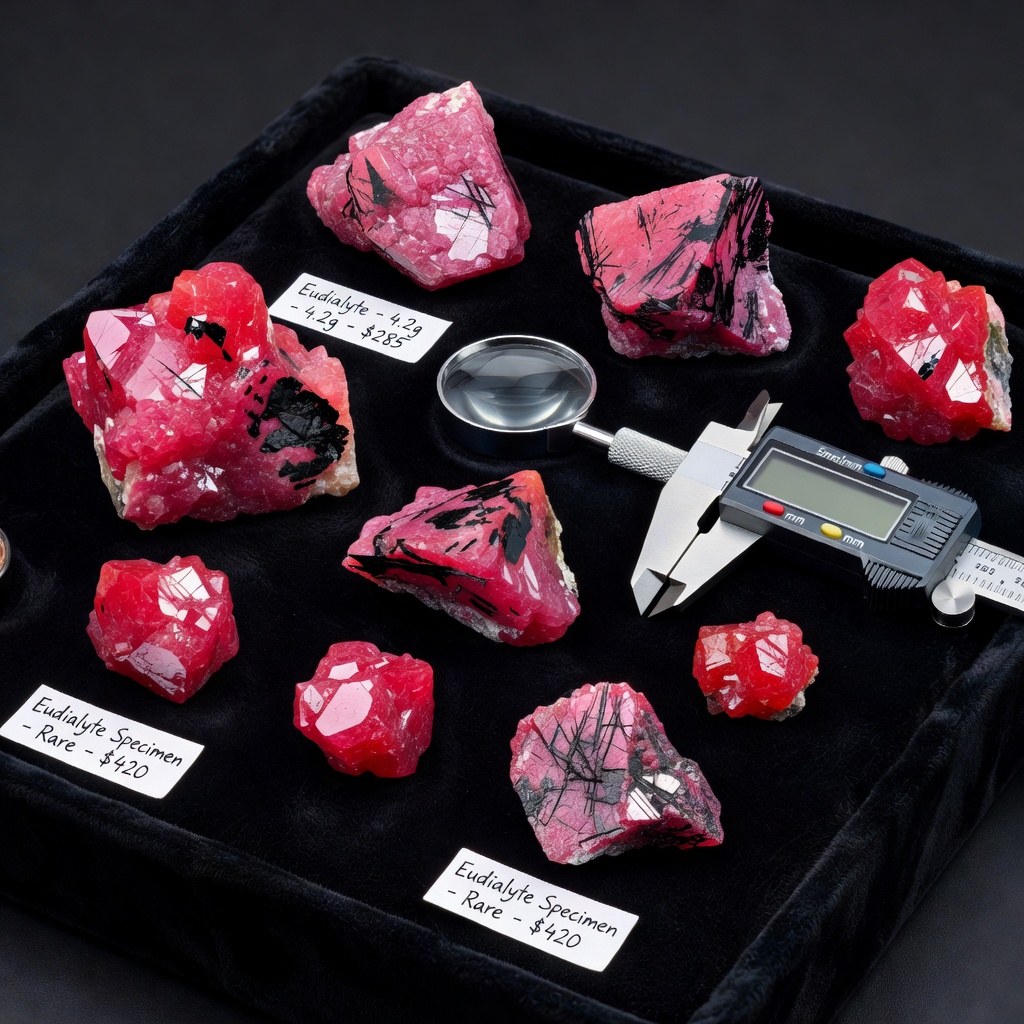
Understanding Eudialyte: Why Prices Vary in Today's Market
Eudialyte stands as one of the most captivating yet complex gemstones in the collector's market, distinguished by its vivid raspberry-red to cherry-pink hues that immediately distinguish it from other pink minerals. As a rare cyclosilicate mineral containing sodium, calcium, cerium, iron, manganese, and zirconium, this gemstone presents unique challenges for both miners and cutters that directly influence its market valuation. The Eudialyte Price Guide becomes essential for collectors because this material occupies a curious position between mineral specimen collecting and fine jewelry, with pricing structures that fluctuate dramatically based on form, quality, and origin. Unlike more common gemstones with standardized grading systems, eudialyte requires buyers to understand multiple market segments simultaneously, from rough matrix specimens prized by mineral enthusiasts to the rarely seen faceted stones that command premium prices in specialty jewelry markets.
The dual nature of eudialyte as both a collector's mineral and a potential jewelry stone creates distinct pricing tiers that confuse many first-time buyers. Mineral specimens featuring eudialyte crystals embedded in their natural matrix often sell for different price points than cut cabochons or faceted stones, even when weighing equivalent amounts. This disparity stems from the fact that eudialyte possesses perfect cleavage and a relatively soft hardness of 5 to 5.5 on the Mohs scale, making faceted stones risky investments for jewelers while enhancing the value of protected raw specimens. Additionally, the mineral's complex chemical composition makes it susceptible to acid alteration, meaning that specimens must be carefully preserved to maintain their vibrant colors and structural integrity over time.
Scarcity factors play a crucial role in current market dynamics, particularly as traditional Russian sources face depletion and export restrictions. The Kola Peninsula in Russia has historically produced the finest cherry-red specimens, but mining operations have slowed significantly due to resource exhaustion and geopolitical complications. This supply constriction has created a seller's market for high-grade Russian material, while Canadian deposits in Quebec and Ontario provide more accessible entry points for budget-conscious collectors. Understanding these scarcity-driven price escalations helps buyers recognize why certain specimens command ten times the price of seemingly similar material from different localities.
Current Eudialyte Market Values (2024)
The eudialyte value per carat varies dramatically depending on whether you are purchasing rough mineral material, cabochon-cut stones, or rare faceted gems. Current retail markets show commercial-grade cabochons ranging from $10 to $50 per carat, representing material with moderate translucency and lighter pink coloration that appeals to entry-level collectors and casual jewelry makers. Mid-grade specimens with better color saturation and fewer visible inclusions typically fall between $50 and $100 per carat, while fine transparent faceted stones with vivid cherry-red coloration can command $100 to $300 or more per carat. These prices reflect not only the material's inherent beauty but also the difficulty cutters face when working with eudialyte's brittle nature and perfect cleavage planes.
For mineral collectors interested in eudialyte mineral specimens, pricing typically shifts to per-gram calculations rather than carat weight, with matrix pieces ranging from $5 to $100 per gram depending on crystal size, color intensity, and association minerals. Exceptional cabinet specimens featuring large eudialyte crystals perched on contrasting black aegirine or white microcline matrix from classic Russian localities can exceed $500 per gram, particularly when documentation proves their origin from depleted mines. Wholesale markets operate on significantly different margins, with bulk rough material selling for 40-60% below retail prices, though such purchases typically require minimum orders of several hundred grams and knowledge of how to evaluate unprocessed material.
Seasonal fluctuations affect the eudialyte market predictably, with prices typically rising 10-15% in the months preceding major gem and mineral shows such as the Tucson Gem and Mineral Show in February and the Denver Gem and Mineral Show in September. Savvy buyers often purchase during summer months when demand slows, securing better negotiating positions with dealers eager to move inventory before show season. Additionally, the continued depletion of Russian sources has created a steady 8-12% annual appreciation in prices for documented Kola Peninsula material since 2020, making timely purchases particularly important for collectors viewing these specimens as long-term holdings.
Quality Grades and Their Impact on Cost
Understanding eudialyte gemstone quality requires familiarity with a grading system that differs significantly from traditional gemstones like diamonds or sapphires. AAA Grade eudialyte represents the pinnacle of the market, featuring transparent to semi-transparent material with vivid cherry-red coloration, minimal inclusions visible to the naked eye, and sufficient hardness to take a polish without crumbling. Such material commands premium pricing often exceeding $200 per carat when faceted, though it remains exceedingly rare due to the mineral's tendency toward internal fracturing and imperfect crystal formation. Collectors seeking AAA grade material should expect to work with specialized dealers who maintain relationships with Russian mining operations or Canadian lapidaries who carefully select rough from Mont Saint-Hilaire or the Kipawa alkaline complex.
AA Grade material comprises the workhorse of the eudialyte market, offering slightly included stones with good color saturation that may appear translucent rather than fully transparent. These specimens typically show some internal veining or minor fractures that prevent flawless faceting but still allow for attractive cabochon cutting or specimen display. Priced between $50 and $150 per carat depending on size and exact color intensity, AA grade eudialyte offers the best balance of visual impact and affordability for serious collectors. When evaluating AA grade stones, look for consistent color distribution throughout the material rather than patchy or zoned appearance, as uniform coloration significantly enhances value even when transparency is limited.
Commercial Grade eudialyte provides accessible entry points for new collectors, featuring opaque to translucent material with pale pink, salmon, or orange-red coloration. While these stones lack the dramatic impact of high-grade material, they allow collectors to acquire authentic eudialyte for $10 to $40 per carat, making them ideal for beadwork, inlay projects, or educational collections. Commercial grade specimens often originate from Canadian deposits where the eudialyte tends toward paler hues, or from secondary deposits where weathering has altered the mineral's surface chemistry. Despite their lower value, commercial grade pieces still display eudialyte's characteristic fluorescence under UV light and association with black aegirine, providing authentic examples of this rare mineral at modest price points.
Color Variations and Premium Pricing
Color serves as the primary value determinant in red eudialyte price calculations, with vivid cherry-red specimens commanding two to three times the value of paler salmon or orange-tinged material. The most desirable eudialyte displays a saturated raspberry-red color often described as "pigeon's blood red" in the trade, though this term technically applies to rubies. This premium coloration results from high manganese content combined with specific trace element ratios that create the mineral's characteristic absorption spectrum. Stones exhibiting this top color with minimal brown or orange secondary hues routinely achieve prices above $250 per carat when cut, while similar clarity stones in paler pink tones might sell for $75 per carat or less.
Bicolor specimens featuring stark contrasts between red eudialyte and black aegirine inclusions occupy a special niche in the collector market, with prices determined by the aesthetic balance between these contrasting minerals. Matrix specimens displaying sharp, well-formed black aegirine crystals emerging from cherry-red eudialyte groundmass can exceed $300 per gram, particularly when the composition creates visually striking patterns suitable for display. These pieces appeal specifically to mineral collectors rather than jewelry makers, as the included aegirine needles would fracture during cutting. The presence of white microcline or blue sodalite alongside the red eudialyte can further enhance value, creating tricolor specimens that showcase the mineralogical diversity of alkaline igneous complexes.
Color zoning significantly impacts faceting potential and final valuation, as uneven color distribution forces cutters to either accept significant weight loss to achieve uniform color or market stones with visible banding. Zoned eudialyte typically sells at 30-50% discounts compared to uniformly colored material, though some artistic cutters specifically seek zoned rough to create "watermelon" or banded cabochons that appeal to niche markets. When evaluating rough material, examine specimens under strong transmitted light to identify internal color distribution; solid red material without white or colorless zones offers the best cutting potential and corresponding investment security.
Eudialyte Cuts and Forms: Complete Price Breakdown
The form in which eudialyte reaches the market dramatically affects pricing, with faceted stones representing the rarest and most valuable presentation due to the mineral's challenging physical properties. Because eudialyte possesses perfect cleavage in one direction and brittle tenacity, cutters risk losing significant material to fracture during the faceting process. Consequently, faceted eudialyte mineral specimens command three to five times the price of equivalent weight rough material, with calibrated rounds or ovals over three carats exceeding $300 per carat when well-executed. Successful faceting requires expert orientation to avoid cleavage planes, meaning that only a handful of specialized lapidaries worldwide regularly produce quality faceted eudialyte, further limiting supply and supporting high prices.
Cabochons represent the most practical and commonly available form of eudialyte for jewelry applications, with prices ranging from $20 to $150 depending on size, color intensity, and dome height. High-domed cabochons with strong translucency and vivid coloration command premium prices near the top of this range, while flat-topped or pale-colored cabochons sell at entry-level prices around $25 to $40. When purchasing cabochons, examine the girdle edges carefully for signs of internal fractures that may worsen with wear; reputable dealers will disclose any stability issues, but microscopic cracks can expand over time due to eudialyte's sensitivity to temperature changes and physical impact. Protective bezel settings are recommended for all eudialyte cabochons intended for jewelry use.
Raw matrix specimens offer collectors the opportunity to own eudialyte in its natural geological context, with pricing determined by crystal size, matrix contrast, and overall aesthetic composition. Small thumbnail specimens under five grams might sell for $20 to $50, while cabinet-sized pieces featuring multiple well-formed crystals on contrasting matrix can exceed $1,000. Russian material from the Kola Peninsula consistently commands premiums of 200-300% over comparable Canadian specimens due to superior color intensity and historical significance. When evaluating raw specimens, consider the stability of the matrix itself; some eudialyte-bearing rocks are friable and require careful handling or consolidation treatments that should be disclosed by the seller.
Geographic Origin and Price Differentials
Provenance significantly influences eudialyte valuation, with specimens from the Kola Peninsula in Russia representing the gold standard for both collectors and gem enthusiasts. Russian eudialyte displays the most vivid cherry-red coloration found anywhere in the world, combined with characteristic associations of black aegirine and white microcline that create visually stunning contrast. As mining operations in the Lovozero and Khibiny massifs slow due to resource depletion and increased export restrictions, specimens with documented Russian origin appreciate steadily, often achieving prices two to three times higher than equivalent material from other localities. Serious collectors should insist on provenance documentation for Russian specimens over $200, including specific mine names and collection dates when possible.
Canadian deposits in Quebec and Ontario provide the market's primary source of affordable eudialyte, with the Mont Saint-Hilaire and Kipawa alkaline complexes producing abundant though generally paler material. Canadian eudialyte typically exhibits salmon-pink to orange-red hues rather than the deep cherry red of Russian stones, though exceptional pockets occasionally yield material rivaling Kola Peninsula quality. Prices for Canadian specimens run 40-60% below Russian material, making them excellent entry points for collectors building comprehensive eudialyte suites or jewelry makers seeking affordable rough for cabochon cutting. The accessibility of Canadian material also means that large, impressive cabinet specimens are more readily available and affordable than their Russian counterparts.
Greenland and Norway represent emerging sources of eudialyte that occupy middle pricing tiers between Russian premiums and Canadian affordability. The Ilímaussaq alkaline complex in Greenland produces eudialyte with distinctive deep red colors occasionally rivaling Russian material, while Norwegian deposits in the Langesundsfjord district offer historical specimens from classic 19th-century localities. These sources remain relatively underdeveloped commercially, providing opportunities for collectors to acquire fine material before potential market saturation. However, the limited scale of mining operations in these regions means that consistent supply remains uncertain, and prices can fluctuate significantly based on sporadic new discoveries.
Authentication: Avoiding Imitations and Dyed Stones
The scarcity and relatively high red eudialyte price points have incentivized unscrupulous sellers to market imitations and treated stones to unwary buyers. Common fakes include dyed calcite, which mimics eudialyte's color but lacks its specific gravity and fluorescence properties; thulite (pink zoisite), which is softer and shows different pleochroism; and low-grade rhodonite dyed to resemble cherry-red eudialyte. These imitations often appear at suspect online marketplaces or tourist trap mineral shops at prices that seem too good to be true. When evaluating potential purchases, remember that authentic eudialyte never appears in large, flawless masses suitable for bowling ball-sized spheres or massive carvings; such items are almost certainly dyed material or completely different minerals.
Visual identification of genuine eudialyte relies on recognizing its characteristic association with black aegirine prisms, a mineral rarely found in the same specimens as rhodonite or thulite. Authentic eudialyte exhibits a specific gravity between 2.8 and 3.0, noticeably heavier than calcite (2.71) but lighter than rhodonite (3.4-3.7). Under magnification, genuine eudialyte shows complex internal structures including minute inclusions and color zoning, while dyed imitations often display unnaturally uniform color that concentrates along fractures or surface cracks. The presence of weak fluorescence under short-wave UV light, typically showing orange or yellowish reactions, provides another diagnostic tool, though this test requires access to appropriate equipment.
For expensive specimens exceeding $500, laboratory testing provides essential verification through spectral analysis and refractive index determination. Eudialyte typically shows refractive indices between 1.606 and 1.611, distinct from rhodonite (1.733-1.744) and thulite (1.690-1.700). Raman spectroscopy or X-ray diffraction analysis can definitively identify eudialyte's unique crystal structure, though such testing costs $50-$150 per sample. When determining where to buy eudialyte, prioritize dealers who provide laboratory certification for high-value pieces or offer explicit return policies allowing independent verification. Reputable sources include established mineral dealers at major shows, specialized online retailers with extensive photography and provenance documentation, and auction houses with gemological expertise.
Eudialyte vs. Similar Gemstones: Value Comparison
Collectors often compare eudialyte vs rhodonite value when building pink mineral collections, as both stones offer reddish hues and black veining or inclusions. Generally, quality eudialyte commands 30-50% higher prices than equivalent rhodonite due to its greater rarity and superior transparency in fine grades. While rhodonite occurs in massive deposits across multiple continents, fine transparent eudialyte suitable for faceting remains genuinely scarce. However, top-grade rhodonite displaying distinct manganese oxide dendritic patterns or exceptional translucency can occasionally exceed the value of pale commercial-grade eudialyte, particularly when fashioned into large cabochons or ornamental objects.
Thulite (pink zoisite) and rhodochrosite represent other pink gemstones that occasionally compete with eudialyte for collector attention and jewelry applications. Thulite typically costs 20-30% less than equivalent eudialyte and offers superior durability with a hardness of 6.5 compared to eudialyte's 5-5.5, making it more suitable for jewelry wear. Rhodochrosite, particularly the translucent banded variety from Argentina, often overlaps with eudialyte in pricing but commands premiums when showing distinctive stalactitic formations or intense cherry-red coloration. Neither thulite nor rhodochrosite typically associates with black aegirine, providing a visual clue for identification when examining rough specimens.
Red tourmaline (rubellite) frequently serves as the luxury alternative to eudialyte, typically costing ten times more per carat for fine material. This significant price differential positions eudialyte as an affordable alternative for collectors seeking vivid red gemstones without the investment required for high-grade rubellite, which can exceed $1,000 per carat for clean, vivid stones. While rubellite offers superior hardness (7-7.5) and durability for jewelry, eudialyte provides unique color tones and mineral associations that rubellite cannot match. For display collections and occasional-wear jewelry, eudialyte offers exceptional value compared to these more expensive alternatives, providing vivid color at accessible price points.
Investment Potential and Collector Market Trends
While the eudialyte value per carat has shown steady appreciation in recent years, financial advisors generally classify this mineral as a collectible rather than a pure investment vehicle due to its physical limitations. The combination of 5-5.5 Mohs hardness and perfect cleavage makes eudialyte unsuitable for daily wear jewelry, limiting demand from the broader gem market and capping potential price appreciation compared to durable stones like sapphires or diamonds. However, within the specialized mineral collecting community, vintage Russian specimens have demonstrated consistent annual appreciation of 5-10% as mines deplete and classic specimens become concentrated in long-term collections. This appreciation trend particularly applies to documented specimens from historic Kola Peninsula localities with exceptional color and crystal form.
The collector market shows increasing sophistication regarding eudialyte, with buyers now demanding detailed provenance information and avoiding treated or stabilized material. Specimens from defunct localities or historic collections command premiums of 25-40% over newly mined material of equivalent quality, reflecting the hobby's emphasis on geological history and collecting heritage. Online marketplaces have democratized access to eudialyte specimens, but they have also increased the importance of buying from reputable dealers who guarantee authenticity and provide recourse if material proves misrepresented. The most successful "investments" in eudialyte typically involve purchasing exceptional specimens during market dips and holding them for five to ten years while supply constraints worsen.
Proper storage and documentation prove essential for maintaining resale value in eudialyte specimens. Store pieces away from direct sunlight, which can fade some eudialyte varieties over decades, and maintain stable humidity levels to prevent matrix deterioration. Documentation should include purchase receipts, provenance information tracing specimens back to specific mines or collectors, and any laboratory analysis certificates. Photograph specimens under consistent lighting conditions upon acquisition to document their original condition, as this record proves invaluable when selling to discerning collectors who worry about hidden damage or alterations. Insurance appraisals should account for replacement cost rather than purchase price, as finding equivalent specimens may cost significantly more than original acquisition prices in a rising market.
Smart Buying Strategies for Every Budget
This Eudialyte Price Guide would be incomplete without practical strategies for acquiring specimens across different budget ranges. Entry-level collectors with budgets under $100 should focus on small cabochons under 10 carats or thumbnail-sized mineral specimens from Canadian sources. These pieces provide authentic eudialyte material for study and appreciation without requiring significant financial commitment. Look for specimens from the Mont Saint-Hilaire locality, which offer genuine eudialyte at accessible prices despite generally paler colors than Russian material. Avoid the temptation to purchase "bargain" Russian specimens at suspiciously low prices, as these are frequently mislabeled Canadian material or dyed imitations.
Mid-range buyers with $100-$500 to spend should target 2-5 carat Russian cabochons or small matrix specimens with good color contrast between red eudialyte and black aegirine. At this price point, insist on specific locality information and examine pieces under magnification to verify natural color zoning and authentic mineral associations. Consider purchasing rough material from reputable dealers if you have access to a lapidary or know a skilled cutter; rough Russian eudialyte with good color typically sells for $20-$40 per gram, allowing significant savings if you can transform it into cabochons yourself. This budget range also allows acquisition of smaller faceted stones (under 2 carats), though such pieces remain rare and require careful setting to prevent damage.
High-end collectors with unlimited budgets should seek rare transparent crystals over 5 carats suitable for faceting, historic matrix specimens from depleted Russian mines, or exceptional bicolor pieces featuring dramatic mineral associations. At this level, work exclusively with dealers who specialize in alkaline complex minerals and can provide detailed geological context for specimens. Consider attending major mineral shows in Tucson, Denver, or Munich to examine pieces in person, as high-value eudialyte requires tactile and visual inspection that photography cannot fully capture. Building relationships with specific dealers who understand your collecting interests often provides first access to exceptional new finds before they reach public markets. Regardless of budget, always prioritize quality over size; a small, vividly colored, well-formed specimen generally appreciates better than a large, pale, or damaged piece.
Frequently Asked Questions About Eudialyte Pricing
How much does eudialyte cost per carat?
Commercial grade eudialyte typically sells for $10-$50 per carat, while high-quality transparent faceted stones range from $100-$300 per carat. Exceptional specimens with vivid cherry-red color and large clean facets can exceed $500 per carat.
Is eudialyte more expensive than rhodonite?
Generally yes. Quality eudialyte commands 30-50% higher prices than equivalent rhodonite due to greater rarity and more vivid transparency. However, top-grade rhodonite with distinct manganese oxide patterns can sometimes exceed pale commercial eudialyte in price.
Where is the best place to buy authentic eudialyte?
Reputable mineral dealers at Tucson or Denver gem shows offer the best selection. Online, trusted sources include The Arkenstone, iRocks, and verified sellers on Gem Rock Auctions. Always request provenance documentation for Russian specimens over $200.
Why are Russian eudialyte specimens so expensive?
The Kola Peninsula produces the world's finest cherry-red eudialyte with characteristic black aegirine inclusions. As these classic mines deplete and Russian export restrictions tighten, specimens from this locality command 2-3x premiums over Canadian or Greenland material.
What factors affect eudialyte value the most?
Color intensity (vivid red vs. pale pink), transparency level, size of clean material (large facetable pieces are rare), and provenance. Presence of associated minerals like aegirine or microcline can also increase value for collector specimens.
Can eudialyte be worn in jewelry daily?
Not recommended for rings or bracelets due to its 5-5.5 Mohs hardness and perfect cleavage making it prone to chipping. Pendants and earrings are safer options. Expect to pay $75-$250 for quality eudialyte jewelry set in protective bezel settings.
How can I tell if eudialyte is real or dyed?
Genuine eudialyte shows natural color zoning under magnification, contains characteristic black aegirine needles, has a specific gravity of 2.8-3.0, and may show weak fluorescence under UV light. Dyed imitations often have unnaturally uniform color that concentrates in fractures.
Do eudialyte prices fluctuate seasonally?
Yes, prices typically rise 10-15% before major gem shows (February and September) and drop during summer months. Russian material prices have steadily increased 8-12% annually since 2020 due to supply constraints, making early purchase advisable for collectors.