Introduction: Understanding Rare Euclase Gemstones
Euclase stands as one of the mineral kingdom's most coveted treasures, a rare beryllium silicate with the chemical formula BeAlSiO4(OH) that captivates collectors with its exceptional brilliance and scarcity. Unlike more common gemstones found in commercial jewelry stores, euclase occurs in limited quantities within pegmatite deposits, making each faceted stone a geological miracle. This comprehensive Euclase Buying Guide will navigate you through the complexities of acquiring these extraordinary gems, from understanding their unique crystal structure to identifying investment-grade specimens that appreciate over time.
First discovered in the Ouro Preto region of Minas Gerais, Brazil, in the late 18th century, euclase has since been found in only a handful of locations worldwide, including Colombia, Madagascar, Zimbabwe, and the Tanco Mine in Manitoba, Canada. The gem's name derives from the Greek words "eu" (well) and "klasis" (breaking), referring to its perfect cleavage—a characteristic that makes cutting these stones both challenging and risky for lapidaries. Mining operations face significant difficulties due to euclase's tendency to form as small prismatic crystals rarely exceeding a few centimeters in length, severely limiting the supply of facetable material.
The extreme rarity of gem-quality euclase cannot be overstated. While miners might extract kilograms of aquamarine or topaz from a single pocket, euclase discoveries typically yield only a few grams of clean crystals suitable for cutting. This scarcity has positioned euclase as a true connoisseur's stone, rarely appearing in mainstream jewelry markets but commanding intense interest among serious collectors and museums. As traditional mining districts become depleted and new discoveries remain elusive, the availability of fine specimens continues to diminish, driving increased competition among knowledgeable buyers.
Color Varieties and Quality Assessment
When evaluating a blue euclase stone, color stands as the paramount value factor, with premium specimens displaying a saturated deep blue to bluish-green hue reminiscent of fine aquamarine but with greater intensity. The most desirable stones exhibit a pure blue color without grayish or greenish modifiers, achieving vivid saturation levels that seem to glow from within the crystal. These top-tier color grades often command prices ten to twenty times higher than their pale counterparts, making precise color assessment crucial for both collectors and investors.
Beyond the coveted blue variety, euclase occurs in colorless, pale yellow, and occasionally pale green forms. While these alternative colors possess their own subtle beauty, they represent significantly lower price points in the market, typically ranging from $100 to $500 per carat compared to $2,000 or more for fine blue material. Some collectors specifically seek colorless euclase for its exceptional brilliance and diamond-like appearance, though these remain niche interests rather than mainstream investments. When examining any colored variety, be vigilant regarding color zoning—uneven color distribution that appears as bands or patches within the stone—which can dramatically reduce both beauty and value.
A distinctive optical phenomenon known as pleochroism adds complexity to euclase clarity characteristics and overall visual appeal. This property causes the stone to display different colors when viewed from different angles, typically showing deep blue along one crystal axis and pale blue or colorless perpendicular to it. Master cutters orient euclase to minimize this effect in the face-up position, but subtle pleochroism can actually enhance a stone's depth and vitality when properly managed. However, strong pleochroism that creates obvious color windows or dead spots when the stone is tilted should be avoided, as this indicates suboptimal cutting and will impact the gem's performance in jewelry settings.
Evaluating the 4Cs of Euclase Quality
Understanding the traditional diamond grading framework requires significant adaptation when applied to this rare beryllium silicate, particularly regarding color grading standards specific to euclase. Unlike diamonds where colorlessness reigns supreme, euclase value increases with color saturation, specifically seeking stones with medium to medium-dark tones and strong to vivid saturation. The ideal blue euclase should appear neither too dark (which obscures brilliance) nor too light (which appears washed out), with the sweet spot occurring in the 60-75% tone range on the Gemological Institute of America's color scale.
Euclase clarity characteristics demand careful examination under 10x magnification, as inclusions common to this mineral species include liquid feathers, two-phase inclusions (liquid and gas trapped within cavities), and occasionally rutile needles. While eye-clean stones command premium prices, collectors often accept minor inclusions that do not impact transparency or durability, particularly in specimens over two carats where clean material becomes exceptionally scarce. Avoid stones showing surface-reaching cleavage cracks or feathers, as these represent structural weaknesses that could lead to catastrophic failure during setting or wear. The euclase gemstone price escalates dramatically with clarity, with internally flawless stones over three carats potentially fetching $5,000 or more per carat.
Cutting euclase presents unique challenges due to its perfect cleavage in one direction, requiring lapidaries to orient the table facet perpendicular to the cleavage plane to minimize breakage risk. Brilliant cuts, particularly oval, cushion, and emerald shapes, maximize the stone's high refractive index (1.65-1.67) and excellent dispersion, creating that signature "icy" brilliance that distinguishes fine euclase from similar-looking aquamarine. Step cuts work well for showing off clean material but may emphasize any color zoning, while cabochon cuts occasionally appear for heavily included specimens or cat's-eye phenomena, though these represent a small fraction of the market.
Carat weight rarity significantly impacts pricing structures, with exponential rather than linear price increases as size increases. While one-carat fine blue euclase might retail for $1,500-$2,500 per carat, three-carat stones of equivalent quality could command $4,000-$6,000 per carat due to the extreme scarcity of larger crystals. Specimens exceeding five carats in fine quality appear so infrequently that they often sell at auction rather than through traditional retail channels, with final hammer prices determined by competitive bidding among serious collectors.
Authentication and Avoiding Synthetic Stones
Verifying the authenticity of a blue euclase stone requires understanding its distinct physical properties: a hardness of 7.5 on the Mohs scale, specific gravity ranging from 3.0 to 3.1, and a refractive index between 1.651 and 1.673. These measurements, particularly the specific gravity, help distinguish euclase from common simulants like aquamarine (lower specific gravity, 2.68-2.74), blue topaz (lower refractive index), or synthetic spinel (different optical characteristics). Advanced testing using a refractometer and hydrostatic weighing scale provides definitive identification when performed by qualified gemologists.
The market occasionally encounters imitations including cobalt-colored glass, synthetic quartz, or even assembled doublets featuring glass crowns and euclase pavilions. Glass imitations typically show conchoidal fracture patterns rather than euclase's perfect cleavage, while synthetics often appear too clean or show curved growth lines under magnification. Natural euclase almost always contains some form of inclusion—liquid feathers, healing fractures, or crystal inclusions—that serve as fingerprints of its geological formation. A complete absence of inclusions in a large blue stone should trigger immediate suspicion and prompt laboratory verification.
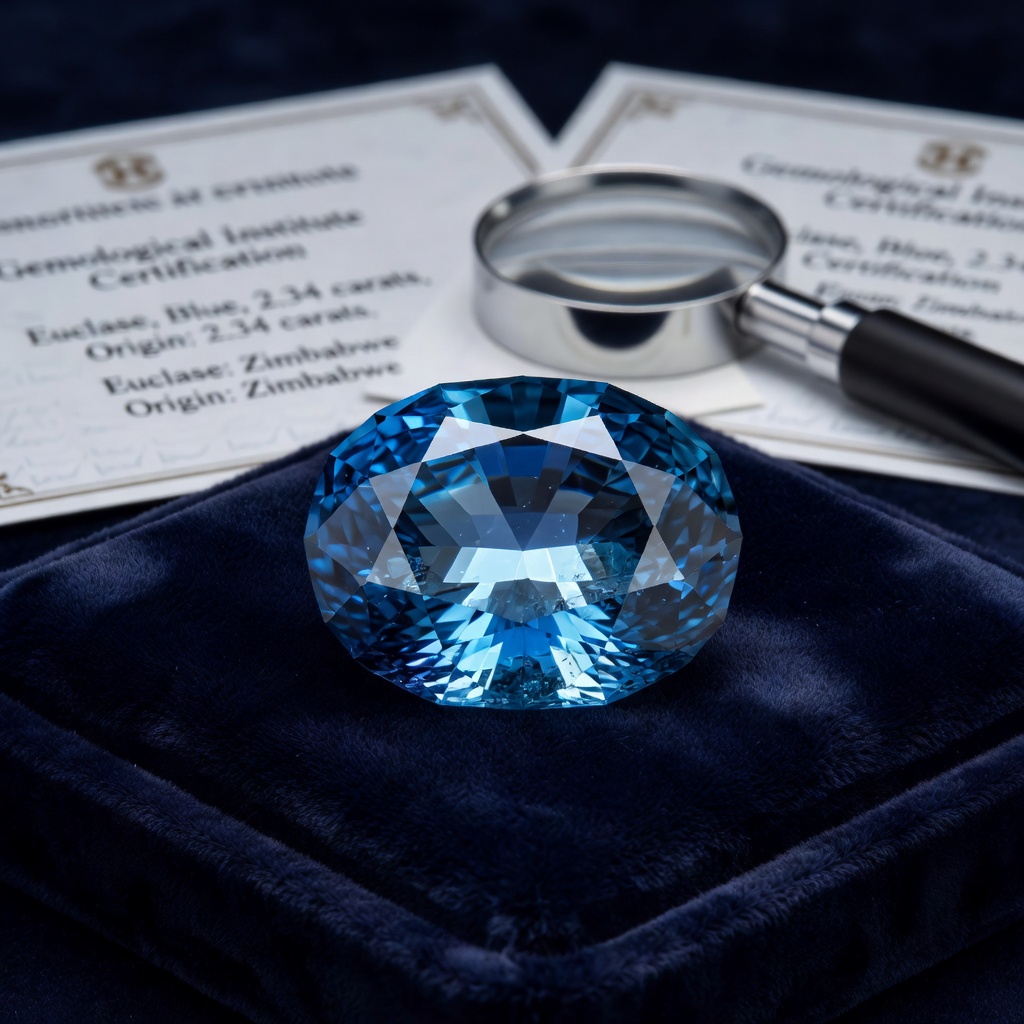
Gemstone certification GIA standards provide the gold standard for authentication, with reports from the Gemological Institute of America, American Gemological Laboratories (AGL), or the Swiss Gemmological Institute (SSEF) offering essential documentation of origin, treatment status, and natural provenance. These laboratories employ advanced spectroscopic analysis, including Raman spectroscopy and energy-dispersive X-ray fluorescence (EDXRF), to confirm chemical composition and detect any heat treatment or filling substances. For investment-grade purchases exceeding $5,000, never accept dealer-provided "certificates" or appraisals; insist on independent laboratory reports from internationally recognized institutions.
Visual inspection techniques for detecting treatments include examining the stone under diffused light for color concentrations along fractures (indicating dye) or flash effects suggesting oil or resin filling. While euclase rarely undergoes heat treatment due to its sensitivity to thermal shock, some pale material might be irradiated to enhance blue coloration. Laboratory reports specifically stating "no indications of heating" or "natural color" provide essential protection for buyers, particularly when building a collector gemstone investment portfolio where untreated stones retain value better than enhanced specimens.
Market Pricing and Investment Value
Current euclase gemstone price structures reflect the material's scarcity and quality parameters, with commercial-grade stones (light color, visible inclusions, small size) starting around $500 per carat, while museum-quality specimens (deep blue, eye-clean, over three carats) regularly exceed $5,000 per carat. Auction records demonstrate the investment potential, with a 5.23-carat Brazilian blue euclase selling for $28,000 in 2022, representing over $5,300 per carat. These prices position euclase significantly higher than aquamarine but below fine Kashmir sapphires or Paraíba tourmalines, suggesting room for continued appreciation as awareness grows among sophisticated collectors.
Several factors drive value appreciation in the collector market, including the depletion of historic Brazilian mines and increasing difficulty of extracting new material from existing deposits. Unlike diamonds or sapphires where new mines occasionally boost supply, euclase discoveries remain sporadic and unpredictable, creating a supply-constrained market ideal for long-term investment. Additionally, growing interest in rare beryllium minerals among Chinese and Middle Eastern collectors has expanded the buyer pool, creating competitive pressure at high-end auctions and specialty dealer shows.
When comparing euclase to other rare blue gemstones, it occupies a unique position between the accessibility of aquamarine and the stratospheric prices of fine sapphire. While a fine blue sapphire might cost $10,000-$50,000 per carat, comparable euclase offers similar color intensity and superior brilliance (due to higher refractive index) at roughly one-tenth the price. However, liquidity considerations require careful attention; unlike diamonds or gold, euclase cannot be liquidated quickly through standard pawn shops or jewelry stores. Successful resale requires access to specialized auction houses like Bonhams or Christie's, or established networks of rare gem dealers, with typical holding periods of 5-10 years for optimal returns.
Trusted Sources: Where to Purchase Euclase
Acquiring authentic euclase requires navigating a specialized marketplace dominated by high-end gemstone dealers, estate auctions, and mineral shows rather than traditional jewelry retailers. Esteemed dealers such as Pala International, The Arkenstone, or specialized European ateliers in Paris and Geneva maintain inventories of certified stones with documented provenance. Reputable auction houses including Sotheby's, Christie's, and Heritage Auctions occasionally feature euclase in their jewelry and rare gemstone sales, providing access to historically important specimens with impeccable documentation.
When purchasing online or from private sellers, several red flags should trigger immediate caution: prices significantly below market rates (suggesting synthetic or treated material), reluctance to provide independent laboratory certification, vague origin descriptions ("African" rather than specific mine locations), or pressure to complete transactions quickly without proper escrow services. Insist on high-resolution photographs taken under different lighting conditions, including daylight equivalent and incandescent lighting, as euclase color can shift significantly depending on the light source. Never wire money directly to sellers without verification of their business credentials and physical address.
Origin documentation significantly impacts value, with Brazilian material from the Ouro Preto region commanding premiums over African or Canadian specimens due to historical significance and typically superior color. Request specific mine information when available, as stones from the Tanco Mine (Canada) or Zimbabwe sometimes show distinctive inclusion patterns that specialists can identify. For transactions exceeding $10,000, engage escrow services that verify the stone matches documentation before releasing funds, protecting both buyer and seller in these high-value acquisitions.
Return policies deserve particular scrutiny given euclase's subtle color variations that may appear different under various lighting conditions than shown in vendor photographs. Reputable dealers offer 7-14 day inspection periods allowing buyers to examine the stone under their own lighting conditions and with their own gemologist. This Euclase Buying Guide strongly recommends utilizing this inspection period to verify the stone against its laboratory report and assess personal satisfaction with the color and clarity before finalizing the purchase.
Jewelry Applications and Setting Considerations
Designing jewelry around a blue euclase stone requires careful consideration of the gem's physical limitations, particularly its perfect cleavage plane that creates vulnerability to impact damage. Protective setting designs become essential, with bezel settings offering superior protection compared to prong settings that leave edges exposed. V-prongs can work for certain shapes but must be positioned away from the cleavage plane, while halo settings provide both protection and enhanced visual size. Pendant and earring designs generally suit euclase better than rings, as these applications subject the stone to less mechanical stress and impact risk.
Metal pairings significantly influence the perceived color of euclase, with 18k yellow gold and rose gold warming the appearance of slightly greenish-blue stones, while platinum and white gold enhance the cool, icy appearance of fine blue specimens. For investment pieces intended primarily as collector showcases rather than daily wear, consider custom designs featuring intricate gallery work visible from the pavilion side, allowing light to enter and exit the stone optimally while displaying the cutter's precision. Some collectors commission convertible designs allowing the stone to transfer between pendant and ring mountings, providing versatility while minimizing wear time in the more vulnerable ring position.
Durability concerns limit euclase jewelry care options and suitability for daily wear. While the 7.5 hardness rating resists scratching from household dust, the perfect cleavage means that a sharp blow against a hard surface can split the stone cleanly along its cleavage plane—a catastrophic failure mode unlike the chipping seen in tougher gems like sapphire or spinel. Reserve euclase rings for special occasions rather than daily wear, and remove them during activities involving hand impact, such as sports, gardening, or heavy lifting. For collectors building investment portfolios, maintaining stones in loose condition or minimally set pendants preserves optimal condition for future resale.
Long-term Care and Maintenance
Proper euclase jewelry care begins with appropriate cleaning methods that acknowledge the stone's sensitivity to thermal shock and mechanical vibration. Never subject euclase to ultrasonic cleaners or steam cleaning systems, as the vibrations can extend existing fractures along cleavage planes, and rapid temperature changes can cause thermal shock fractures. Instead, clean your euclase using only warm water with mild dish soap and a soft-bristled brush, gently removing accumulated oils and debris without risking structural damage. Rinse thoroughly with lukewarm water and pat dry with a soft, lint-free cloth.
Storage requirements demand segregation from harder gemstones like diamonds, rubies, and sapphires that could scratch euclase's surface. Store pieces individually in padded boxes or soft cloth pouches, preferably with compartments that prevent contact with other jewelry items. Avoid exposing euclase to extreme temperature fluctuations, such as leaving pieces in hot cars or wearing them while moving between freezing outdoor temperatures and heated interiors, as thermal expansion differentials can stress internal inclusions and cleavage planes. Prolonged exposure to direct sunlight may fade some treated colors, though natural euclase generally shows good color stability.
For collector gemstone investment purposes, maintaining comprehensive documentation includes obtaining updated insurance appraisals every 2-3 years as market prices appreciate. Photograph your euclase under standardized lighting conditions, including scale references, to document condition and aid in recovery if lost or stolen. Some collectors invest in specialized gemstone insurance policies through companies like Jewelers Mutual or Chubb, which provide coverage specifically tailored to rare gem collections including mysterious disappearance and market appreciation clauses. Keep laboratory certificates in secure storage separate from the stones themselves.
Periodic re-polishing may become necessary for worn stones, particularly those set in rings that show surface scratches or abraded facet junctions over decades of wear. However, re-polishing euclase requires master lapidaries familiar with the material's cleavage properties, as improper handling during polishing can cause catastrophic breakage. Before commissioning any re-polishing work, verify the cutter's experience with euclase specifically, and obtain written agreements regarding liability for breakage during the process. For valuable specimens, consider leaving minor wear marks as evidence of natural aging rather than risking the stone during cosmetic improvement.
Building a Investment-Grade Collection
Strategic collector gemstone investment in euclase requires diversification across color varieties, origins, and size categories to mitigate risk and maximize portfolio stability. While fine blue Brazilian specimens should form the core of any serious collection, consider adding exceptional examples of colorless or pale yellow material from Canadian or African sources, which may appreciate as alternative varieties gain collector recognition. Aim for a mix of sizes, including several smaller fine stones (1-2 carats) for liquidity, one or two significant specimens (3-5 carats) for appreciation potential, and perhaps one exceptional museum-quality piece (5+ carats) as the collection's centerpiece.
Documentation and provenance significantly impact resale value, with stones accompanied by historical documentation, previous ownership by notable collectors, or inclusion in mineralogical publications commanding substantial premiums. Maintain organized records including original purchase receipts, laboratory certificates, previous appraisal reports, and any exhibition history or publication mentions. Some collectors create detailed portfolios featuring high-resolution photography, chemical analysis reports, and geological context information, transforming their collection into a documented study set that appeals to institutions and serious collectors.
Market timing awareness helps optimize acquisition costs, with major auction houses typically scheduling important jewelry sales in April, June, October, and December—periods when tax considerations and holiday gifting drive increased competition and prices. Conversely, summer months often see reduced activity and potentially better negotiating positions with dealers eager to move inventory. Network actively with specialized rare gem dealers by attending shows like the Tucson Gem and Mineral Show or the Munich Mineral Show, where personal relationships can provide first access to new discoveries before stones reach public markets.
Final Checklist Before Purchase
Before finalizing any euclase acquisition, verify that the gemstone certification GIA or equivalent laboratory report matches the stone exactly, checking measurements, weight, and inclusion patterns against the documentation. Ensure the report specifically addresses treatment status, as "natural, no heat" stones command significant premiums over treated material. Review the treatment disclosure section carefully for mentions of oiling, filling, or irradiation, and confirm that the vendor has disclosed all known treatments in writing as part of the sales contract.
Conduct thorough visual inspection under multiple lighting conditions, including natural daylight, incandescent, and fluorescent lighting, as euclase color can shift noticeably between warm and cool light sources. Examine the stone under 10x magnification to verify inclusion patterns match the laboratory plot diagram, ensuring you have not received a substituted stone. Check for windowing (areas where light passes straight through without reflection) and extinction (dark areas indicating poor cutting), particularly in stones with step cuts or shallow pavilion angles.
Negotiation strategies for rare gemstones differ from standard retail haggling; focus on value-added terms rather than just price reduction. Request professional cleaning and polishing before delivery, upgraded insurance appraisal documentation, or inclusion of a protective setting at cost. For significant purchases, consider offering wire transfer rather than credit card payment in exchange for a 2-3% discount (saving the dealer processing fees). Always secure a written guarantee of authenticity and return privilege, even if purchasing from seemingly reputable sources.
Finally, establish long-term preservation planning by identifying qualified jewelers experienced with rare gems for future maintenance, securing appropriate insurance coverage before taking possession, and planning storage solutions that protect your investment from environmental hazards. Remember that this Euclase Buying Guide emphasizes buying for love of the material first, with investment potential as a secondary consideration—the finest collections are built by collectors passionate about the geological wonders they steward for future generations.
Frequently Asked Questions
What makes euclase so expensive compared to other blue gemstones?
Euclase commands premium prices due to its extreme rarity, limited geographic deposits, and mining difficulties. Unlike aquamarine or blue topaz, gem-quality euclase crystals are rarely found in large sizes, and the mineral's perfect cleavage makes cutting risky and labor-intensive. High-quality blue specimens over 2 carats are exceptionally scarce, driving prices to $2,000-$5,000+ per carat for fine material.
How can I verify that my euclase is natural and untreated?
Always request certification from reputable laboratories like GIA, AGL, or SSEF. Natural euclase typically shows specific inclusions like liquid feathers or two-phase inclusions under magnification. The stone should have a refractive index of 1.65-1.67 and specific gravity of 3.0-3.1. Be wary of unusually clean stones at low prices, as these may be synthetic spinel or glass imitations.
Is euclase suitable for engagement rings or daily-wear jewelry?
Euclase is generally not recommended for daily wear due to its perfect cleavage and 7.5 hardness rating, making it susceptible to chipping and breaking upon impact. It's best suited for collector specimens, pendants, or earrings that receive less physical stress. If set in a ring, choose protective bezel settings and reserve for occasional wear only.
What is the most valuable color for euclase?
Deep saturated blue to slightly greenish-blue euclase commands the highest prices, particularly those with vivid saturation similar to fine aquamarine but more intense. Stones with strong pleochroism showing different colors from different angles are also prized. Colorless and pale yellow varieties exist but are significantly less valuable, typically selling for 1/10th the price of fine blue material.
Where are the best euclase deposits located?
The finest gem-quality euclase historically comes from the Minas Gerais region of Brazil, particularly Ouro Preto. Other notable sources include the Tanco Mine in Manitoba (Canada), Colombia, Madagascar, and Zimbabwe. Brazilian material typically shows the most desirable blue colors, while African deposits often yield lighter or colorless specimens.
How should I clean and store my euclase gemstone?
Clean euclase using only warm soapy water and a soft brush; never use ultrasonic cleaners, steam cleaners, or harsh chemicals due to the stone's cleavage planes. Store separately from harder gemstones like diamonds or sapphires to prevent scratching, ideally in a padded box or soft pouch. Keep away from extreme temperature changes and direct sunlight for prolonged periods.
Can euclase be a good investment for gemstone collectors?
Yes, high-quality euclase can be an excellent investment due to increasing scarcity and growing collector demand. Unlike more common gems, euclase availability is actually decreasing as historical mines deplete. However, investment success requires purchasing top-color, certified stones from reputable dealers and holding them for 5-10 years. Always buy for love of the stone first, with appreciation as a secondary benefit.
What are the key differences between euclase and aquamarine?
While both are beryllium-containing minerals, euclase (BeAlSiO4(OH)) has a different chemical composition than aquamarine (Be3Al2Si6O18). Euclase is significantly rarer, has higher refractive index (more brilliance), and exhibits stronger pleochroism. Aquamarine is harder (7.5-8 vs 7.5) and more durable for jewelry. Euclase typically shows more intense blue saturation in smaller sizes compared to aquamarine, but costs 10-20 times more per carat.