What Is Enstatite? An Introduction to This Rare Pyroxene
Enstatite represents one of the most fascinating yet underappreciated minerals in the gemological world, belonging to the pyroxene group of rock-forming silicates. This magnesium pyroxene crystallizes with the chemical formula Mg2Si2O6, forming distinct prismatic crystals that range from transparent gem-quality specimens to opaque industrial materials. The name derives from the Greek word enstates, meaning opponent or adversary, which references the mineral's remarkable refractory nature and high resistance to melting even under extreme temperatures.
Unlike its more commonly encountered cousins diopside and augite, which dominate basaltic rocks worldwide, enstatite maintains distinct chemical and structural characteristics that set it apart within the pyroxene family. While diopside contains significant calcium content and augite represents a complex solid solution of multiple cations, pure enstatite gemstone material consists primarily of magnesium silicate with minimal calcium interference. This compositional purity contributes to its unique optical properties and explains why gemologists prize transparent crystals for collector's pieces despite their relative obscurity in mainstream jewelry markets.
Perhaps most intriguingly, enstatite occurs not only within Earth's crust but also extraterrestrially, playing a significant role in meteorite classification and planetary science. Aubrite meteorites, named after the Aubres meteorite that fell in France in 1836, consist almost entirely of this magnesium silicate mineral, offering scientists crucial insights into the early solar system's formation. Whether discovered in the ultramafic rocks of Sri Lanka or within the fragmented remains of ancient asteroids, enstatite continues to captivate mineralogists and Enstatite Properties and Information seekers alike with its dual terrestrial and cosmic significance.
Chemical Composition and Crystallography
The fundamental chemistry of enstatite centers on its status as a magnesium silicate mineral, specifically representing the magnesium end-member of the orthopyroxene solid solution series. Pure enstatite contains approximately 40% magnesium oxide (MgO) and 60% silicon dioxide (SiO2), though natural specimens rarely achieve perfect purity due to isomorphous substitution with iron. This substitution phenomenon occurs when ferrous iron (Fe2+) replaces magnesium ions within the crystal lattice, creating gradational varieties that range from iron-poor enstatite to iron-rich ferrosilite.
Crystallographically, enstatite belongs to the orthorhombic pyroxene subclass, crystallizing in the space group Pbca with distinctive prismatic habits and two directions of perfect cleavage intersecting at approximately 87° and 93°. The crystal structure consists of single chains of silica tetrahedra linked by magnesium ions in octahedral coordination, creating elongated prismatic crystals often striated parallel to their length. This structural arrangement produces the characteristic columnar or fibrous aggregates commonly observed in hand specimens, with crystals occasionally reaching impressive sizes of several centimeters in exceptional geological environments.
The solid solution relationship between enstatite and ferrosilite creates a continuous compositional spectrum rather than discrete mineral species, with intermediate compositions forming hypersthene and bronzite varieties. When iron content reaches approximately 10-30% of the total cation population, the material transitions from true enstatite into hypersthene territory, displaying distinct optical and physical changes. Understanding this chemical variability proves essential for gemologists attempting to classify specimens accurately, as the boundary between Bronzite vs enstatite represents a gradational zone rather than a sharp demarcation, requiring quantitative chemical analysis for definitive identification.
Structural Relationships Within the Pyroxene Group
Within the broader pyroxene group, enstatite maintains close structural affinities with other orthorhombic species while differing significantly from monoclinic clinopyroxenes like diopside and hedenbergite. The orthorhombic crystal system imposes specific symmetry constraints that result in straight extinction under polarized light microscopy, providing gemologists with a reliable diagnostic tool for distinguishing enstatite from its monoclinic counterparts. This structural distinction also influences cleavage angles, with orthorhombic pyroxenes displaying nearly right-angle cleavage intersections compared to the approximately 93° angles characteristic of clinopyroxenes.
Physical Properties and Durability
Understanding Enstatite hardness proves crucial for both gem cutters and jewelry designers, as this mineral registers 5.5 on the Mohs scale of mineral hardness. This moderate hardness places enstatite between apatite (5.0) and orthoclase feldspar (6.0), making it softer than quartz and significantly more susceptible to scratching than corundum or diamond. While this hardness level precludes enstatite from everyday ring wear without protective settings, it remains sufficiently durable for pendants, earrings, and occasional-wear jewelry pieces where abrasive contact remains minimal.
The specific gravity of enstatite typically ranges between 3.2 and 3.3 for pure magnesium-rich specimens, though this value increases proportionally with iron content substitution. Hypersthene varieties containing substantial iron may exhibit specific gravities approaching 3.5, providing gemologists with a useful diagnostic parameter when combined with refractive index measurements. This density places enstatite among the heavier silicate minerals, feeling noticeably substantial when held in the hand compared to lighter gems like quartz (specific gravity 2.65) or beryl (2.7).
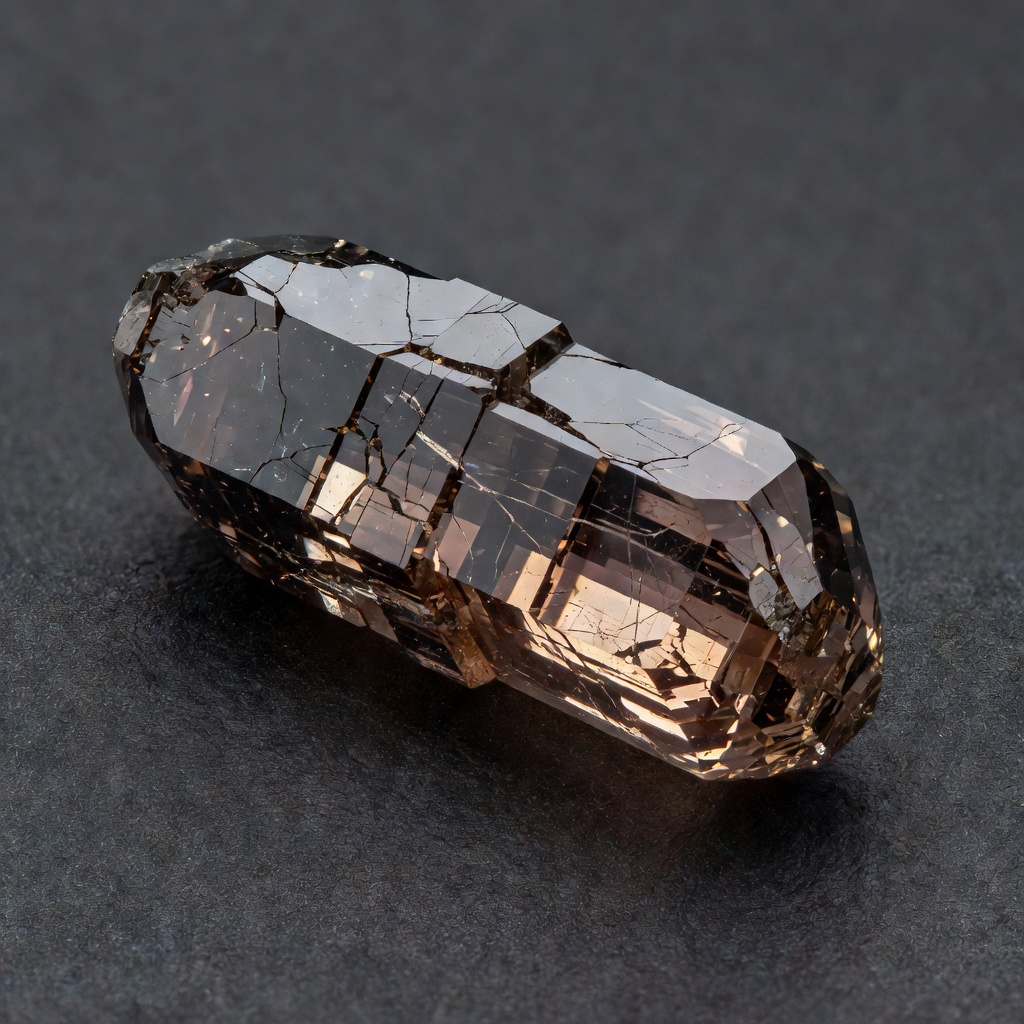
Color variations in enstatite span a spectrum from colorless and white through pale yellow, gray, brown, and pale green, with the most desirable gem-quality material typically displaying brownish-green to yellowish-brown hues. Iron content largely dictates color intensity, with pure magnesium enstatite appearing nearly colorless to white, while increasing iron produces the darker brown and green tones characteristic of bronzite and hypersthene varieties. The mineral exhibits distinct prismatic cleavage in two directions with an uneven to conchoidal fracture pattern, physical characteristics that present both opportunities and challenges during the cutting process.
Durability Considerations for Jewelry Applications
Despite its moderate hardness, enstatite possesses excellent tenacity and resistance to thermal shock, thanks to its refractory nature and strong internal bonding. However, the perfect cleavage planes present a vulnerability point, as sharp impacts directed along these planes can cause the stone to split cleanly. Jewelry designers must account for this characteristic by avoiding exposed table settings in rings and instead opting for bezel or protected settings that shield the gemstone from direct blows. When evaluating Enstatite Properties and Information for jewelry purposes, always consider the trade-off between the gem's aesthetic appeal and its requirement for protective mounting.
Optical Properties and Gemological Characteristics
The optical properties of enstatite reveal its biaxial positive optical character, meaning the mineral possesses two optic axes and exhibits positive birefringence when viewed under polarized light. The refractive indices typically range from 1.65 to 1.67, with precise values depending on iron content and crystallographic orientation. Alpha indices usually measure around 1.650-1.656, beta around 1.653-1.662, and gamma approximately 1.658-1.668, creating a birefringence of 0.008 to 0.012 that remains visible as doubling of facet edges when viewed through the stone with a loupe.
Enstatite pleochroism ranges from weak to distinct in colored varieties, displaying different absorption colors when viewed along different crystallographic axes. Typically, pleochroic colors include colorless to pale yellow or pale green to brownish-green combinations, though the effect remains subtle in pale specimens and more pronounced in iron-rich varieties. This optical phenomenon requires careful orientation during cutting to maximize color display or minimize undesirable tinting, with skilled lapidaries often positioning the table perpendicular to the c-axis to achieve optimal face-up color.
Transparency in enstatite varies dramatically based on quality grade, ranging from transparent gem-quality crystals suitable for faceting to translucent or opaque material used for cabochons or mineral specimens. Transparent varieties often contain microscopic inclusions of magnetite or talc that may create silk-like effects or, in rare cases, contribute to chatoyancy when aligned along specific crystallographic directions. Under shortwave ultraviolet light, most enstatite remains inert, though some specimens may display weak greenish fluorescence, providing additional diagnostic criteria for laboratory identification.
Varieties and Related Mineral Species
The enstatite-ferrosilite solid solution series encompasses several named varieties that differ primarily in iron content and resulting optical characteristics. Bronzite vs enstatite distinctions center on iron concentration, with bronzite containing approximately 10-30% FeSiO3 and displaying a distinctive bronze-like metallic luster or schiller effect caused by exsolved iron oxide lamellae. This variety typically appears opaque to translucent with a submetallic luster on cleavage surfaces, making it unsuitable for faceting but occasionally carved into decorative objects or fashioned into cabochons displaying a shimmering play of light.
Hypersthene represents the iron-rich intermediate member of the series, containing roughly 30-50% FeSiO3 and exhibiting colors ranging from brownish-black to grayish-green with a distinctive pearly or vitreous luster. Many Hypersthene properties overlap with enstatite, though hypersthene frequently displays chatoyancy (cat's-eye effect) or asterism (star effect) when cut en cabochon due to aligned needle-like inclusions of hematite or goethite. These optical phenomena create striking visual effects that command premium prices in the collector's market, particularly for specimens showing sharp, well-centered eyes or stars.
Ferrosilite represents the iron-dominant end member (Fe2Si2O6) of the series, though natural occurrences remain rare compared to the magnesium-rich varieties. This mineral typically appears in meteorites and specific high-temperature geological environments rather than as gem-quality material. Understanding these gradational relationships helps collectors and gemologists appreciate that "enstatite" in the gem trade often refers to the lighter-colored, more transparent magnesium-rich varieties, while darker, more opaque material may represent transitional compositions approaching hypersthene or bronzite.
Geological Sources and Global Distribution
Gem-quality Enstatite sources remain limited compared to more common gemstones, with primary deposits occurring in Sri Lanka (Ceylon), Myanmar (Burma), and Tanzania. Sri Lankan deposits, particularly those in the alluvial gravels of Ratnapura and Elahera, historically produced some of the finest transparent yellowish-brown and greenish-brown crystals suitable for faceting. Myanmar's Mogok Stone Tract yields enstatite associated with peridotite and serpentinite formations, often occurring alongside spinel and peridot in the same geological environments.
Tanzania's Umba Valley and Merelani Hills represent significant modern sources, where enstatite occurs in association with tsavorite garnet, tanzanite, and other gem minerals formed in high-pressure, low-temperature metasomatic environments. Additional Enstatite mining locations include India (particularly the states of Tamil Nadu and Andhra Pradesh), South Africa (Bushveld Complex), Brazil (Minas Gerais), and the United States (New York and Pennsylvania). These deposits typically form within ultramafic and mafic igneous rocks such as peridotites, norites, and pyroxenites, where magnesium-rich magmas slowly crystallized under deep crustal conditions.
Beyond terrestrial occurrences, enstatite constitutes the primary component of aubrite meteorites and enstatite chondrites, stony meteorite classes named specifically for their mineralogical composition. These extraterrestrial specimens provide pure magnesium-rich material that formed under highly reducing conditions in the early solar system, offering scientifically valuable material that occasionally yields small transparent crystals. While not gem-quality in the traditional sense, meteoritic enstatite holds immense value for research institutions and private collectors interested in planetary materials.
Enstatite in Jewelry: Cutting, Setting, and Value
Transforming rough enstatite into finished gemstones presents unique challenges due to the mineral's perfect cleavage and moderate hardness, requiring lapidaries with specialized expertise in handling delicate materials. Cutting enstatite demands careful orientation to avoid cleavage planes intersecting the table or girdle, as these orientations create vulnerability points where the stone might fracture during setting or wear. Experienced cutters typically employ low-angle facets and avoid extremely thin girdles, instead opting for slightly thicker proportions that provide structural integrity without excessive weight loss.
Popular cutting styles for transparent Enstatite gemstone material include step cuts (emerald cuts) that showcase the stone's clarity and pleochroism while minimizing cleavage risks, cushion cuts that maximize color display, and cabochons for chatoyant or translucent specimens. Step cuts prove particularly effective for displaying enstatite's vitreous luster and allowing observers to appreciate the subtle color shifts caused by pleochroism. Cabochon cuts, typically domed and polished without facets, best display chatoyant varieties such as star enstatite or hypersthene, concentrating reflected light into a distinct eye or star pattern.
Enstatite gemstone value depends primarily on clarity, size, color intensity, and quality of cut, with fine transparent specimens ranging from $50 to $500 per carat depending on these factors. Large crystals exceeding five carats with high transparency and strong pleochroism command premium prices due to their rarity, while smaller or heavily included material remains affordable for beginning collectors. When considering Enstatite jewelry settings, designers should select protective mountings such as bezels, half-bezels, or halo settings that shield the gem's edges from impact, reserving enstatite primarily for pendants, earrings, and brooches rather than rings subject to daily abrasion.
Metaphysical Properties and Crystal Healing Lore
Within crystal healing traditions, Enstatite crystal meaning centers on themes of grounding, stability, and practical manifestation, with practitioners associating this magnesium-rich mineral strongly with the Earth element. Crystal healers believe that enstatite creates a solid energetic foundation, helping individuals maintain equilibrium during periods of significant life transitions or emotional upheaval. The mineral's refractory nature—resisting melting even under extreme heat—translates symbolically into metaphysical properties of endurance and maintaining one's integrity under pressure.
Root chakra activation represents a primary application in energy work, with healers placing enstatite at the base of the spine or holding it in the receiving hand during meditation to strengthen connection to Earth energies. Practitioners report that working with this stone enhances mental clarity and supports decisive action, cutting through confusion to reveal practical solutions to complex problems. Enstatite healing properties also supposedly include protection from electromagnetic pollution and energetic boundary setting, creating a stabilizing field that prevents energy drain from external sources.
Meditation practices utilizing enstatite often involve placing the stone on the third eye to enhance mental focus or carrying it as a pocket stone during challenging negotiations or decisions. Some crystal healing systems associate enstatite with the astrological sign of Aries, suggesting it helps balance impulsive tendencies with practical deliberation. While these metaphysical associations lack scientific validation, they contribute to the stone's appeal among holistic practitioners and collectors interested in the intersection of mineralogy and spirituality.
Identification, Authentication, and Buying Guide
Identifying enstatite requires careful differentiation from similar-appearing minerals such as diopside, spodumene, and tremolite, which share comparable colors and crystal habits. Visual inspection provides initial clues: enstatite typically displays a vitreous to pearly luster, perfect prismatic cleavage, and often exhibits a grayish or brownish cast distinct from the brighter green of chrome diopside or the more intense coloration of spodumene varieties. The presence of two cleavage directions intersecting at nearly 90°, combined with a specific gravity noticeably higher than quartz, helps distinguish enstatite from look-alike specimens.
Laboratory testing confirms identification through refractive index measurements (typically 1.65-1.67), specific gravity determination (3.2-3.3), and optical character assessment using a polariscope to confirm biaxial positive optics. Advanced techniques such as Raman spectroscopy or X-ray diffraction provide definitive mineralogical confirmation, particularly for opaque varieties where optical tests prove inconclusive. When pursuing an Enstatite buying guide approach, insist on gemological certification from reputable laboratories such as GIA (Gemological Institute of America) or AGL (American Gemological Laboratories) for specimens valued over several hundred dollars.
Fortunately, enstatite rarely undergoes enhancement treatments, as heating typically destroys the stone's color rather than improving it, and fracture filling proves uncommon due to the mineral's moderate value and cleavage characteristics. However, buyers should remain vigilant for misidentification, as dealers occasionally label brownish diopside or color-change pyroxene as "enstatite" to capitalize on the latter's exotic appeal. Always examine stones under magnification to verify natural inclusion patterns consistent with enstatite's typical magnetite or talc inclusions, and be wary of prices that seem disproportionately low for claimed gem quality, as these may indicate synthetic simulants or misidentified material.
Care, Maintenance, and Storage Recommendations
Proper Enstatite care begins with understanding the stone's vulnerability to thermal shock and mechanical stress despite its refractory nature. Cleaning enstatite gemstone specimens requires only mild soap and lukewarm water applied with a soft brush, avoiding ultrasonic cleaners and steam cleaning equipment that can exploit cleavage planes and cause fracturing. The sudden vibrations from ultrasonic cleaners create stress waves that may split stones along their perfect cleavage directions, resulting in catastrophic damage to otherwise beautiful specimens.
Chemical exposure presents another hazard, as acids—including those found in household cleaners, cosmetics, and even perspiration—can etch the surface of enstatite over time, dulling its polish and luster. Remove enstatite jewelry before applying lotions, perfumes, or hairsprays, and avoid contact with chlorine bleach or hydrochloric acid solutions. Sudden temperature changes also pose risks; never expose enstatite to rapid heating or cooling, such as moving from a hot car to air conditioning or placing stones near heating vents, as differential thermal expansion can initiate fractures along cleavage planes.
Storage recommendations emphasize isolation from harder gemstones to prevent scratching, as enstatite's 5.5 Mohs hardness makes it susceptible to damage from quartz (7), topaz (8), corundum (9), and diamond (10). Store enstatite pieces in individual soft cloth pouches or compartmentalized jewelry boxes with fabric-lined dividers, ensuring they never contact harder stones that could abrade their surfaces. For jewelry containing enstatite, schedule professional inspections annually to check for loose settings or developing chips, particularly for pieces worn occasionally in protective pendant or earring mountings.
Frequently Asked Questions
What is enstatite used for?
Enstatite is primarily used as a collector's gemstone in jewelry, particularly in pendants and earrings due to its moderate hardness. Industrially, non-gem quality enstatite serves as a refractory material in ceramics and metallurgy. Metaphysical practitioners also use it for crystal healing and meditation practices.
Is enstatite a rare gemstone?
Yes, gem-quality transparent enstatite is considered quite rare in the jewelry market. While the mineral itself is relatively common in igneous rocks, transparent crystals large enough for faceting are uncommon, making fine specimens valuable to collectors and gem enthusiasts.
What is the difference between enstatite and hypersthene?
Hypersthene is actually a variety of enstatite containing higher iron content (10-30% FeSiO3), whereas pure enstatite contains magnesium only. Hypersthene typically displays a distinctive bronze-like metallic luster and chatoyancy, while pure enstatite appears more transparent and glassy.
What color is enstatite?
Enstatite occurs in colors ranging from colorless, white, and pale yellow to gray, brown, and pale green. The most valuable gem-quality specimens typically show brownish-green to yellowish-brown hues with strong pleochroism, displaying different colors when viewed from different angles.
How hard is enstatite on the Mohs scale?
Enstatite has a Mohs hardness of 5.5, making it softer than quartz but harder than opal. This moderate hardness means it requires protective settings in rings and careful handling to prevent scratching, though it's suitable for pendants and earrings where abrasion risk is lower.
Where is enstatite found?
Significant deposits occur in Sri Lanka, Myanmar, Tanzania, and India. It also forms in ultramafic igneous rocks worldwide, including South Africa, Brazil, and the United States. Notably, enstatite is found in certain meteorites called aubrites, which consist almost entirely of this mineral.
Is enstatite valuable?
Fine gem-quality enstatite can be moderately valuable, particularly large transparent specimens with strong pleochroism, typically ranging from $50 to $500 per carat depending on quality. However, opaque or heavily included material is inexpensive and used primarily for mineral collections rather than fine jewelry.
What does enstatite mean spiritually?
Spiritually, enstatite is associated with grounding, stability, and mental clarity. Crystal healing traditions suggest it helps create energetic boundaries, supports decision-making during transitions, and connects the user to Earth energies through the root chakra.