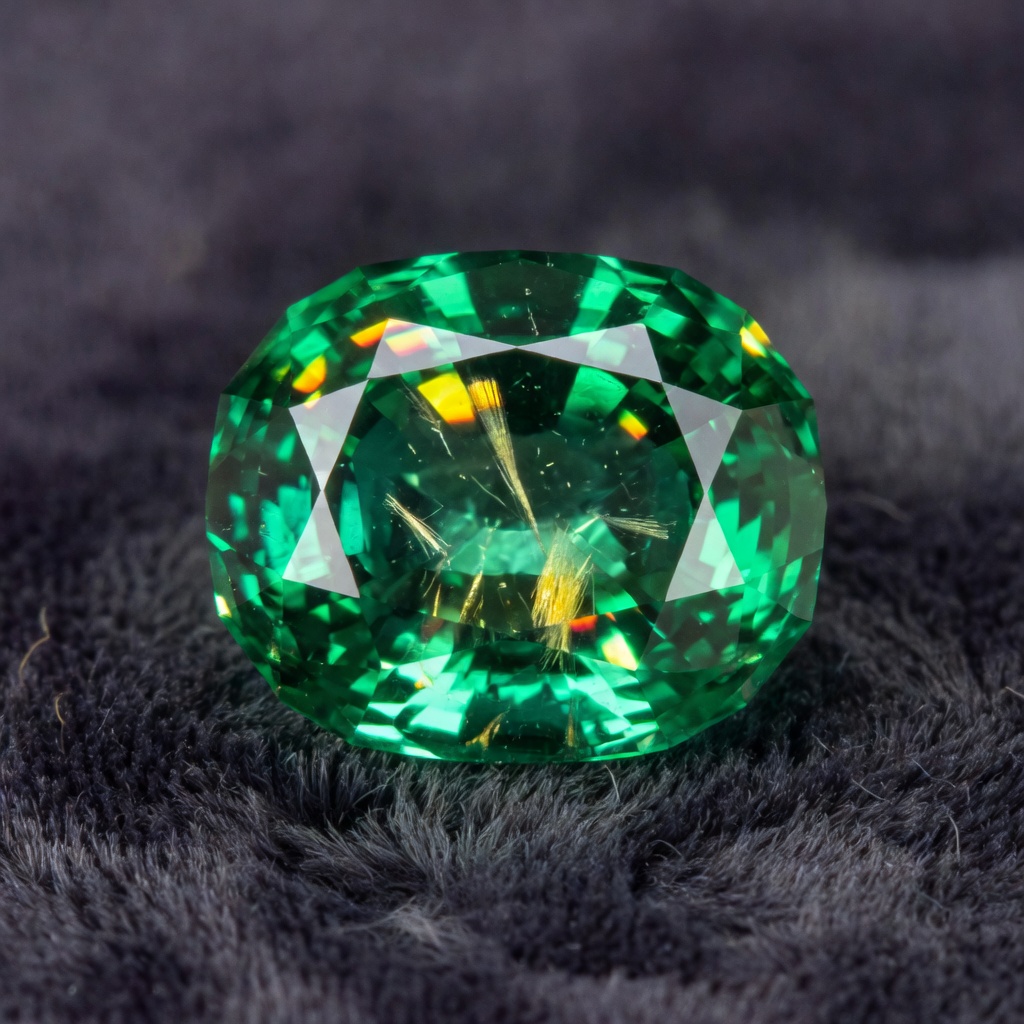
Introduction to Demantoid Garnet
Demantoid garnet stands as one of the most captivating discoveries in the world of precious gemstones, first unearthed in 1868 within the remote Ural Mountains of Russia. The very name derives from the Dutch word "demant," meaning diamond, a testament to the stone's remarkable ability to split light into spectral colors with greater intensity than even the hardest known natural substance. As the most valuable and rare variety of andradite garnet, this green garnet gemstone quickly captured the attention of European aristocracy during the Victorian and Edwardian eras, adorning the elaborate jewelry collections of royalty and social elites who prized its fire and rarity above emeralds.
Understanding the demantoid garnet meaning extends beyond its physical beauty to encompass its historical significance as a symbol of prosperity and discernment. Unlike the more common red varieties of garnet that dominated ancient markets, demantoid introduced the garnet family to the elite circle of high jewelry with its vivid green palette and diamond-like brilliance. The stone's association with luxury reached its zenith during the Belle Époque period, when master jewelers like Fabergé incorporated Russian demantoid into intricate objets d'art and platinum-set creations that remain museum pieces today.
Physical and Chemical Properties
At the molecular level, demantoid garnet belongs to the nesosilicate mineral group with a chemical composition of calcium iron silicate (Ca3Fe2Si3O12), distinguishing it within the broader andradite species. This specific arrangement of elements contributes to the andradite garnet properties that make demantoid unique, particularly its exceptional dispersion rate of 0.057, which exceeds diamond's 0.044 and creates the characteristic "fire" that seems to dance within the stone when moved under light sources.
The demantoid garnet properties include a refractive index ranging from 1.88 to 1.94, one of the highest among all gemstones, which contributes significantly to its brilliant luster and light return capabilities. However, collectors must note the Mohs hardness rating of 6.5 to 7.5, which while respectable, indicates variable toughness that requires careful handling compared to corundum or diamond. This moderate hardness, combined with a specific gravity of 3.82 to 3.88, gives demantoid a substantial feel in hand while demanding protective settings in jewelry applications to prevent chipping or abrasion during daily activities.
The Diagnostic Horsetail Inclusions
Perhaps no other gemstone feature inspires such fascination among gemologists as the horsetail inclusion demantoid displays, consisting of radiating chrysotile fibers that create patterns remarkably resembling equine tail hairs. These inclusions, composed of asbestos minerals that formed simultaneously with the host garnet crystals during the Proterozoic era, serve as nature's fingerprint confirming both the stone's natural origin and, crucially, its provenance from the historic Russian deposits of the Ural Mountains.
The paradox of horsetail inclusion demantoid specimens lies in their defiance of conventional gemological wisdom, where inclusions typically diminish value. In Russian demantoid garnet, these delicate golden threads can actually increase market value by twenty to thirty percent when they radiate symmetrically from a central chromite crystal, providing undeniable proof of Ural Mountain origin. However, discerning collectors must understand that Namibian demantoids occasionally display similar "horsetail-like" features composed of different mineral compositions, lacking the precise crystallographic structure and historical significance that make true Russian horsetails so coveted among connoisseurs.
Color Variations and Quality Grading
The ideal color for premium demantoid garnet spans the spectrum from vivid emerald green to slightly yellowish green, with the most valuable stones displaying a pure grass-green hue reminiscent of fresh spring foliage. This distinctive coloration results primarily from chromium content within the crystal structure, which produces the pure green tones most associated with high-end specimens, while iron substitutions tend to create slightly more yellowish or brownish secondary hues that, while attractive, command lower prices in the international market.
When evaluating green garnet quality, gemologists prefer stones with light to medium tone rather than dark saturation, as excessive depth can mask the spectacular dispersion that defines the variety. Pleochroism—the phenomenon where a crystal shows different colors when viewed from different angles—plays a subtle but important role in face-up appearance, with master cutters orienting rough material to minimize yellowish tones and maximize the desirable green flash that makes demantoid so distinctive among colored gemstones.
Global Sources and Mining Origins
The legendary Ural Mountains remain the spiritual home of Russian demantoid garnet, where alluvial deposits along the Bobrovka and Kladovka rivers have yielded the finest quality stones since the 19th century. These historic Russian deposits produce material characterized by the classic emerald-green coloration and diagnostic horsetail inclusions that define the benchmark for quality, though modern mining yields only sporadic production compared to the prolific output of the Imperial Russian era.
Since the discovery of significant deposits in Namibia's Green Dragon mine in 1996, the African nation has emerged as the current primary producer of demantoid sources, offering larger, cleaner stones that typically lack the distinctive horsetail inclusions but provide accessibility for jewelry designers seeking calibrated sizes. Secondary deposits in Madagascar, Italy's Val Malenco, Iran's Kerman province, and Afghanistan's Badakhshan region contribute smaller quantities to the market, each displaying subtle variations in chemistry and appearance based on their unique geological formations and the distinction between primary (hard rock) versus alluvial (river-worn) mining environments.
Demantoid vs Tsavorite: Key Differences
When examining demantoid vs tsavorite, the fundamental distinction begins with species classification: demantoid belongs to the andradite garnet group while tsavorite represents the green variety of grossular garnet. This chemical difference manifests physically in demantoid's superior dispersion and "fire" compared to tsavorite's typically greater clarity and transparency, creating a choice for collectors between explosive brilliance and crystalline purity depending on their aesthetic preferences and intended jewelry applications.
From a practical standpoint, the demantoid vs tsavorite comparison favors tsavorite for daily wear jewelry due to its superior toughness and slightly higher hardness range of 7 to 7.5 on the Mohs scale, compared to demantoid's more variable durability. Tsavorite also offers better availability in larger sizes exceeding two carats, whereas fine demantoid becomes exponentially rarer above one carat. However, demantoid commands higher per-carat prices among collectors who value its historical significance, unique optical properties, and the romantic association with Russian imperial treasures that tsavorite, discovered only in 1967, cannot yet claim.
Market Value and Investment Potential
Demantoid garnet value follows an exponential curve relative to size, with stones exceeding two carats in fine quality representing extreme rarities that command premium prices rivaling fine emeralds or rubies. Current market data indicates price ranges from approximately $500 per carat for commercial quality material between one and two carats, escalating to $3,000-$8,000 per carat for exceptional Russian specimens displaying vivid color and horsetail inclusions, with museum-quality stones over three carats potentially exceeding $10,000 per carat at auction.
Investment considerations for this rare green gemstone must account for the market's size limitations and liquidity constraints, as the finest material often disappears into private collections for decades. However, the combination of finite Russian source depletion, growing collector demand from Asian markets, and the stone's irreplaceable optical characteristics suggests strong long-term appreciation potential for authenticated, high-quality specimens. Serious investors should prioritize documented Russian origin, untreated status, and presence of diagnostic inclusions when building positions in demantoid as an alternative asset class.
Jewelry Applications and Setting Recommendations
Maximizing the beauty of demantoid garnet jewelry requires selecting cuts that accentuate the stone's phenomenal dispersion, with round brilliant, oval brilliant, and mixed cuts proving most effective at liberating rainbow flashes from the crystal. Master lapidaries often favor designs that combine brilliant-style crowns with step-cut pavilions, balancing maximum fire with weight retention, as the scarcity of fine rough material necessitates careful yield management while prioritizing optical performance over standardized calibrations.
Given the gemstone's moderate hardness, protective settings become essential for longevity, with bezel settings, half-bezels, or halo designs providing superior protection compared to exposed prong settings that leave vulnerable girdle edges susceptible to chipping. Demantoid garnet jewelry performs best in earrings, pendants, and brooches where impact risk remains minimal, though occasional wear rings can be safely executed with protective mountings in yellow gold, which enhances the stone's warm green tones, or platinum, which provides a cool contrast emphasizing the gem's vivid color saturation.
Care and Maintenance Guidelines
Proper demantoid garnet care begins with gentle cleaning using warm soapy water and a soft-bristled brush, avoiding ultrasonic cleaners and steam cleaning systems that could potentially damage the stone through vibration or thermal shock. The presence of horsetail inclusions, while valuable for identification purposes, creates internal stress planes that make the stone particularly susceptible to damage from sudden temperature changes, requiring owners to remove jewelry before engaging in activities involving extreme heat or cold exposure.
Storage protocols for gemstone maintenance demand keeping demantoid pieces separate from harder materials such as diamonds, sapphires, and rubies in individual soft pouches or compartmentalized boxes to prevent surface scratching. Regular professional inspections every six to twelve months allow jewelers to check prong integrity and setting security, particularly important for rings where daily wear might compromise the mounting, ensuring that these rare treasures remain secure and pristine for future generations.
Buying Guide: Authentication and Certification
When buying demantoid garnet, insist upon certificates from internationally recognized laboratories such as the Gemological Institute of America (GIA), American Gemological Laboratories (AGL), or the Swiss Gemmological Institute (SSEF), as these reports provide crucial origin determination and treatment disclosure that significantly impact value. Reputable labs can distinguish between Russian and Namibian material through advanced spectroscopic analysis and inclusion studies, providing the documentation necessary for insurance and resale purposes while verifying that the stone is natural rather than synthetic.
Understanding treatment acceptance helps buyers navigate the market effectively, as low-temperature heating to improve clarity represents an accepted practice that should be disclosed but does not dramatically impact value as would chemical treatments or fracture filling. Awareness of common simulants—including green glass, cubic zirconia, and manufactured yttrium aluminum garnet (YAG)—protects consumers from fraud, while budget allocation strategies should prioritize intense color and proven Russian origin over sheer carat weight, as a smaller, certified demantoid with horsetail inclusions typically outperforms larger, cleaner stones in both beauty and investment retention.
Frequently Asked Questions About Demantoid Garnet
What makes demantoid garnet different from other garnets?
Demantoid garnet belongs to the andradite species and is distinguished by its exceptional dispersion (fire) of 0.057, which exceeds that of diamond. It is the only garnet that frequently displays diagnostic horsetail inclusions—radiating chrysotile fibers that actually increase its value when confirming Russian origin. Unlike common red garnets, demantoid displays vivid green colors ranging from emerald to yellowish-green, making it the most valuable and rare variety of andradite.
Why are horsetail inclusions valuable in demantoid garnets?
Horsetail inclusions are unique to demantoid garnets and consist of radiating chrysotile (asbestos) fibers that resemble horse tails. These inclusions are paradoxically desirable because they serve as definitive proof of natural origin and typically indicate Russian provenance from the Ural Mountains. While inclusions usually reduce gemstone value, horsetails can increase a demantoid's worth by 20-30% when they are aesthetically pleasing and confirm the stone came from the historic Russian deposits rather than newer Namibian sources.
How much is demantoid garnet worth per carat?
Demantoid garnet prices range dramatically based on size, color, clarity, and origin. Commercial quality stones (1-2 carats) typically cost $500-$2,000 per carat, while fine quality Russian material with horsetail inclusions can command $3,000-$8,000 per carat. Exceptional stones over 2 carats are extremely rare and can exceed $10,000 per carat. Namibian demantoids, though cleaner and larger, generally sell for 30-50% less than comparable Russian material due to collector preference for classic sources.
Is demantoid garnet suitable for everyday wear?
Demantoid garnet is not recommended for everyday wear in rings due to its Mohs hardness of 6.5-7.5 and variable toughness. While harder than many gemstones, it lacks the durability of sapphires or rubies and can chip or abrade with daily impact. It is better suited for earrings, pendants, brooches, or occasional wear rings with protective bezel settings. If worn daily, the stone requires protective mounting and regular professional inspection to ensure prongs remain secure.
Where does the best demantoid garnet come from?
The finest demantoid garnets historically come from the Ural Mountains in Russia, specifically the Bobrovka and Kladovka rivers. Russian demantoids are prized for their vivid emerald-green color and characteristic horsetail inclusions. While Namibia now produces the majority of commercial demantoid (discovered in 1996), offering cleaner and larger stones, collectors still prefer Russian material for its superior color and historical significance. Italian and Madagascar deposits produce smaller quantities of varying quality.
How can I tell if a demantoid garnet is real?
Authentic demantoid garnet can be identified by its exceptional fire (dispersion), which creates rainbow flashes more pronounced than diamond. Under magnification, look for the diagnostic horsetail inclusions (in Russian material) or distinctive doubling due to high birefringence. Real demantoids possess a refractive index of 1.88-1.94 and specific gravity of 3.82-3.88. Professional gemological testing using refractometers, spectroscopes, and microscopic examination is essential, as glass imitations and synthetics exist. Always request certification from reputable labs like GIA or AGL.
What is the difference between demantoid and tsavorite garnet?
Demantoid and tsavorite are both green garnets but belong to different species with distinct properties. Demantoid is andradite, displaying higher dispersion (fire) and frequently containing horsetail inclusions, with hardness of 6.5-7.5. Tsavorite is grossular garnet, typically cleaner with higher clarity, greater toughness, and hardness of 7-7.5, making it more durable for jewelry. Tsavorite usually shows a pure green to bluish-green color, while demantoid ranges from yellowish-green to emerald green. Demantoid commands higher prices per carat due to greater rarity, while tsavorite offers better availability in larger sizes.
What is the best cut for demantoid garnet?
Demantoid garnet performs best in brilliant cuts, round cuts, or mixed cuts that maximize its exceptional dispersion (fire). The round brilliant cut is most popular as it maximizes light return and showcases the stone's diamond-like brilliance. Step cuts (emerald cuts) are less common as they minimize the dispersion that makes demantoid distinctive. Due to the rarity of rough material, cutters often choose shapes that preserve weight while optimizing optical performance. Custom cuts that protect vulnerable corners are recommended for rings, while earrings and pendants can accommodate more delicate cutting styles.