What Is Demantoid Garnet? Understanding Rarity and Value
Demantoid garnet stands as one of the most extraordinary discoveries in the history of gemology, first unearthed in 1868 within the rugged Ural Mountains of Russia by the renowned mineralogist Nils Gustaf Nordenskiöld. This remarkable gemstone belongs to the andradite species of the garnet family and derives its name from the Dutch word "demant," meaning diamond, a direct reference to its exceptional optical properties that rival even the most precious diamonds. Unlike its green garnet cousin tsavorite or the more common grossular varieties, demantoid possesses a dispersion rating of 0.057, which actually exceeds diamond's 0.044, creating spectacular rainbow flashes of fire that collectors and connoisseurs covet above all other green gemstones.
The rarity of demantoid garnet value extends far beyond its optical brilliance, as gem-quality specimens represent a minute fraction of all garnet discoveries worldwide. While tsavorite deposits in East Africa yield commercial quantities suitable for jewelry production, true demantoid remains geologically scarce, with viable mining operations limited to sporadic pockets in Russia's Ural Mountains, Namibia's alluvial deposits, and recent limited finds in Madagascar. This extreme scarcity, combined with the gem's unmatched dispersion and vivid green coloration ranging from yellowish-green to deep emerald tones, establishes demantoid as the undisputed aristocrat of the garnet family and justifies its position among the most expensive colored gemstones per carat in the contemporary market.
Current Demantoid Garnet Price Ranges by Quality
Understanding the Demantoid Garnet Price Guide requires careful analysis of quality tiers that reflect origin, clarity, and size parameters affecting market valuation. Entry-level collectors can expect to invest between $200 and $800 per carat for commercial-grade material, typically sourced from African deposits such as Namibia or Madagascar, featuring lighter yellowish-green colors and moderate inclusions visible to the naked eye. These specimens, often cut in standard calibrated sizes under one carat, provide an accessible introduction to green garnet pricing per carat while offering genuine demantoid characteristics including the species' signature dispersion.
Fine quality demantoid commands substantially higher premiums, with Russian specimens from the historic Ural Mountain deposits ranging from $2,000 to $10,000 per carat depending on color saturation and clarity grades. At the apex of the market, collector-grade stones featuring the coveted horsetail inclusions, vivid classic green coloration, and sizes exceeding two carats regularly achieve prices of $15,000 or more per carat at major auction houses. Current 2024 market trends indicate continued appreciation for Russian material, with prices increasing approximately 8-12% annually as supply constraints tighten and Asian collector demand intensifies, particularly in Hong Kong and Tokyo markets where rare green gemstone investment portfolios increasingly feature significant demantoid holdings.
Origin Impact: Russian vs African Demantoid Pricing
The provenance of a demantoid garnet dramatically influences its market valuation, with Russian demantoid garnet value consistently commanding premiums of three to five times over equivalent African material. This substantial price differential stems primarily from color characteristics, as Ural Mountain specimens exhibit what dealers term "classic green"—a vivid, saturated medium green with slight yellow undertones that historically defined the variety's desirability during the Victorian era and Russian Imperial periods. Conversely, Namibian and Madagascan demantoids typically display lighter, more yellowish-green hues that, while attractive, lack the depth and saturation that characterize the finest Ural demantoid market value specimens prized by museums and serious collectors.
Beyond aesthetic considerations, origin documentation significantly impacts resale value and insurance appraisals, with stones accompanied by GIA or AGL origin reports commanding substantial premiums in the secondary market. Russian mining operations have declined precipitously since the early 20th century, rendering new production essentially negligible and transforming existing Ural material into increasingly scarce collectible assets. When examining visual differences, experts note that African demantoids often appear slightly "sleepy" or milky compared to the crystalline brilliance of Russian stones, while Namibian material occasionally exhibits superior clarity but cannot replicate the distinctive color chemistry of the historic Ural deposits that formed under unique geological conditions approximately 400 million years ago.
Documentation and Market Positioning
Serious collectors should insist upon comprehensive laboratory reports verifying both species identification and geographic origin, as undocumented demantoids suffer significant liquidity penalties when offered for resale. Reputable dealers typically provide detailed provenance information tracing Russian material to specific mining districts such as the Kladovka or Kotschubei localities, while African stones should be accompanied by mining permits and export documentation ensuring ethical sourcing compliance. Insurance valuations for high-quality Russian demantoids often require updated appraisals every 18-24 months due to rapid market appreciation, whereas African material maintains more stable, gradual price growth trajectories suitable for conservative investment strategies.
The Horsetail Inclusion Phenomenon and Value
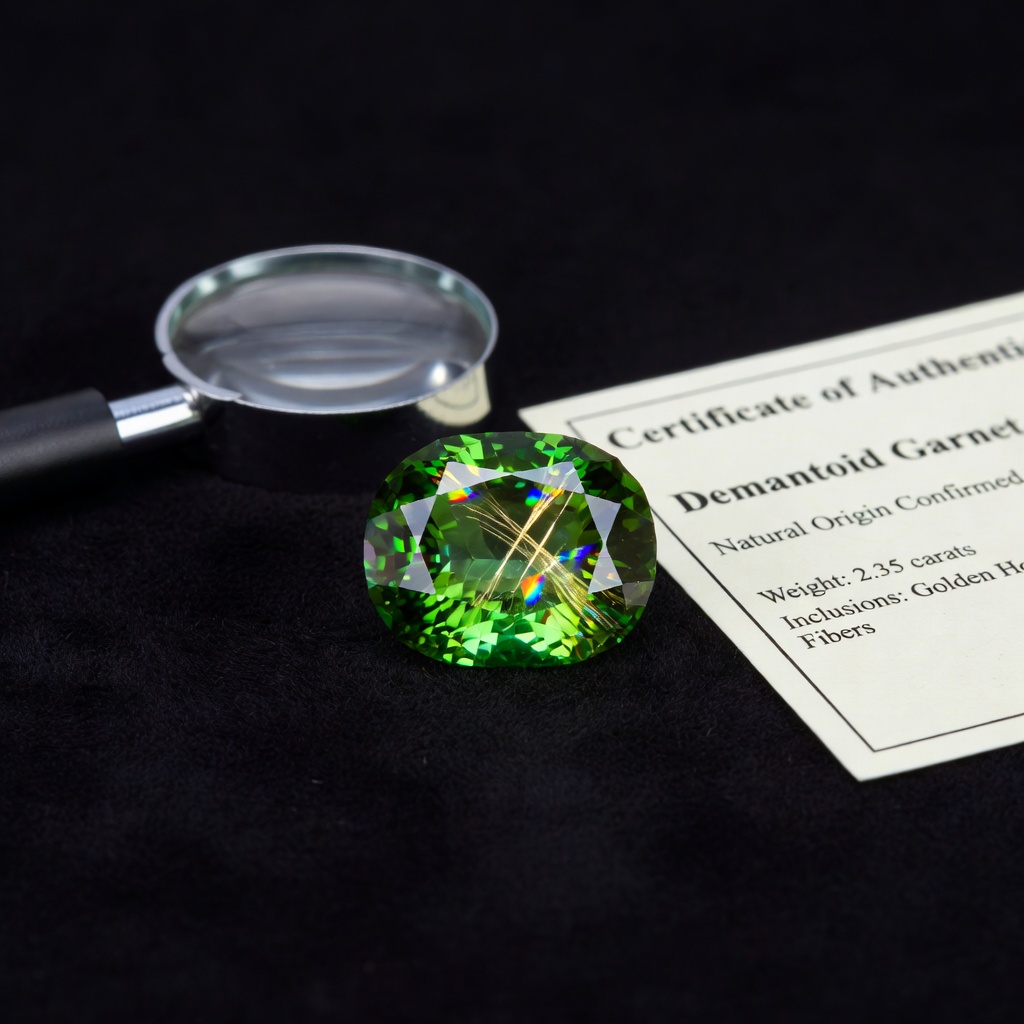
Unlike virtually every other gemstone variety where inclusions diminish value, horsetail inclusion demantoid specimens actually command significant premiums when these distinctive features are prominently visible and aesthetically arranged. These radiating inclusions consist of byssolite fibers—a member of the amphibole mineral group—that form feathery, spray-like patterns resembling horse tails emanating from a central chromite crystal nucleus. First documented in Russian Ural material, these inclusions serve as diagnostic proof of natural origin while simultaneously creating a unique optical phenomenon that collectors specifically seek, often paying 20-40% premiums over equivalent clean stones.
The value enhancement occurs because horsetail inclusions definitively indicate natural formation rather than laboratory synthesis, as current technological capabilities cannot replicate these complex fibrous structures in convincing detail. When evaluating demantoid quality factors, gemologists assess horsetail visibility, symmetry, and distribution pattern, with the most valuable specimens displaying well-defined, symmetrically radiating sprays visible through the table facet without requiring microscopic examination. Synthetic demantoids produced via hydrothermal or flux methods may attempt to simulate inclusions, but these artificial patterns typically appear too uniform or lack the organic, irregular branching characteristic of natural byssolite formations that developed over millions of years under specific temperature and pressure conditions unique to the Ural Mountain geological environment.
Identifying Authentic Horsetail Patterns
Authentication of genuine horsetail inclusions requires careful examination under 10x magnification, where natural specimens reveal delicate, thread-like fibers with slightly varying thicknesses and organic, irregular distribution patterns. Artificial inclusions in synthetic stones tend to appear thicker, more rigid, and geometrically perfect, lacking the soft, feathery terminations characteristic of natural byssolite. When purchasing investment-grade demantoid, request photomicrographs from reputable laboratories documenting inclusion patterns, as these images provide baseline documentation for future authentication and significantly enhance resale value among sophisticated collectors who specifically seek these diagnostic features.
Carat Weight and Size Premium Calculations
The relationship between size and value in demantoid garnet follows an exponential rather than linear progression, creating significant investment opportunities for those understanding demantoid price per carat scalability. Stones weighing less than one carat represent the most accessible entry point for collectors, with commercial-quality African material available in calibrated sizes suitable for jewelry mounting, though prices remain relatively modest compared to larger specimens. The one to two carat range marks the beginning of serious rarity, as clean crystals of this size occur in approximately one-tenth of one percent of all demantoid discoveries, triggering price jumps of 300-500% compared to sub-carat weights.
Specimens exceeding three carats achieve true investment-grade status, with large demantoid garnet value approaching that of fine Kashmir sapphires or Colombian emeralds due to extreme geological scarcity. Clean Russian demantoids over three carats essentially constitute museum pieces, with fewer than fifty significant specimens known to exist in private collections worldwide. When evaluating face-up appearance versus actual weight, demantoid's high specific gravity of 3.82-3.88 means that well-cut stones appear smaller than equivalent-weight sapphires or rubies, making precision cutting essential to maximize visual impact while minimizing weight loss during the lapidary process.
Cutting Considerations and Weight Retention
Master cutters face unique challenges with demantoid rough, as the mineral's brittle tenacity and characteristic inclusions require specialized techniques to preserve carat weight while optimizing optical performance. Round brilliant and cushion cuts typically yield the best dispersion display but sacrifice significant rough weight, often retaining only 15-25% of the original crystal mass. Step cuts and emerald cuts, while more conservative of weight, may compromise the stone's signature fire; therefore, investors should prioritize cut quality over sheer carat weight when evaluating potential acquisitions, as poorly cut large stones trade at significant discounts to optimally proportioned smaller gems.
Color, Cut, and Clarity Grading for Value
Evaluating demantoid quality factors requires specialized knowledge distinct from diamond or other colored gemstone grading systems, as demantoid possesses unique characteristics that demand adjusted assessment criteria. The ideal color range encompasses vivid medium green with slight yellowish undertones, often described as "chrome green" or "forest green," though subtle variations toward bluish-green remain acceptable if saturation remains strong. Stones displaying overly dark tones that suppress dispersion or excessively light "mint" colors trade at 40-60% discounts to optimally colored material, regardless of clarity or size parameters.
Cut optimization presents particular challenges given demantoid's high refractive index of 1.88-1.94 and exceptional dispersion, requiring precise facet angles to maximize fire without creating "windows" or dead spots where light leaks through the pavilion. Clarity standards differ significantly from diamonds, as demantoid collectors accept minor inclusions as evidence of natural origin, provided they do not severely impact brilliance or durability. Regarding treatments, unlike emeralds which commonly undergo oiling, high-quality demantoid rarely receives enhancement, though some African material may undergo gentle heating to improve color; such treatments require disclosure and typically reduce value by 15-30% compared to untreated specimens of equivalent appearance.
Practical Grading Guidelines
When assessing potential purchases, examine the stone under various lighting conditions, noting that fine demantoid should display vibrant fire even under diffuse natural light, not just intense point-source illumination. Look for " extinction" or dark areas in the face-up position that indicate poor cutting proportions, and verify that the girdle thickness remains sufficient to prevent chipping during setting. For investment purposes, prioritize stones with laboratories explicitly stating "no indications of heating" on their reports, as untreated Russian material demonstrates the strongest historical appreciation trends and maintains superior liquidity in the resale market compared to treated stones or material of uncertain enhancement status.
Demantoid vs Tsavorite: Investment Comparison
When evaluating demantoid vs tsavorite price dynamics, investors encounter two distinct market philosophies despite both stones belonging to the green garnet family. Tsavorite, discovered in Tanzania during the 1960s and subsequently mined in Kenya, offers superior availability in sizes exceeding three carats and typically trades at $500-$3,000 per carat for fine quality, making it approximately one-third the cost of equivalent demantoid. However, demantoid's extreme rarity, historical significance dating to the Russian Imperial court, and unmatched optical properties position it as the superior rare green gemstone investment vehicle for long-term appreciation, despite higher initial acquisition costs and reduced liquidity.
Durability factors slightly favor tsavorite for jewelry applications, as demantoid's lower hardness (6.5 on the Mohs scale versus tsavorite's 7-7.5) and distinct cleavage planes make it more susceptible to damage in rings or bracelets subjected to daily wear. However, for investment purposes held in secure storage or mounted in protective pendant settings, demantoid's scarcity premium outweighs these practical concerns. Market liquidity differs significantly between the varieties, with tsavorite offering faster liquidation through broader dealer networks, while demantoid requires specialized auction channels or high-end colored stone dealers but rewards patience with superior appreciation rates averaging 12-15% annually for fine Russian material versus 6-8% for comparable tsavorite.
Portfolio Allocation Strategies
Sophisticated collectors often maintain positions in both varieties, allocating tsavorite for jewelry pieces and immediate liquidity needs while reserving demantoid for generational wealth preservation. When comparing specific specimens, a 2-carat Russian demantoid with horsetail inclusions might cost $25,000-$35,000, while a comparable quality 5-carat tsavorite commands $8,000-$12,000, illustrating how demantoid concentrates value in smaller, more portable formats ideal for high-net-worth portfolio diversification. The investment thesis for demantoid strengthens further when considering that new tsavorite discoveries continue sporadically in East Africa, whereas Russian demantoid sources remain effectively exhausted, ensuring continued supply constraint for the more valuable variety.
Authentication and Certification Essentials
Acquiring significant demantoid specimens without proper documentation exposes collectors to substantial financial risk, making certification from recognized laboratories absolutely essential for purchases exceeding $1,000. The Gemological Institute of America (GIA), American Gemological Laboratories (AGL), and Swiss institutions SSEF and Gübelin provide comprehensive reports verifying species identification, geographic origin, and treatment status—documentation that typically adds 10-15% to acquisition costs but proves indispensable for resale and insurance purposes. These reports specifically identify natural versus synthetic demantoid, distinguishing genuine stones from yttrium aluminum garnet (YAG) or cubic zirconia simulants that unscrupulous dealers might offer at suspiciously attractive prices.
Red flags indicating potential fraud include prices significantly below market rates (typically 50% or more below comparable certified stones), vague or missing origin information, sellers unwilling to provide return privileges, and stones mounted in settings that obscure pavilion facets where synthetic characteristics often reveal themselves. When buying demantoid garnet, insist upon examination by an independent gemologist before finalizing transactions for stones over $5,000, and verify that any claimed Russian origin accompanies specific locality documentation, as generic "Russia" designations without Ural Mountain specificity may indicate material from less valuable secondary deposits or even African rough passed off as historic Russian material.
Dealer Selection and Due Diligence
Reputable acquisition channels include established colored stone dealers with gemological credentials (FGA, GG, or equivalent), major auction houses such as Christie's and Sotheby's specializing in important jewels, and specialized trade shows like the Tucson Gem and Mineral Show where direct comparison shopping becomes possible. Online purchases require enhanced caution; verify dealer membership in professional organizations such as the American Gem Trade Association (AGTA) or International Colored Gemstone Association (ICA), and request high-resolution video documentation showing the stone's dispersion and inclusion patterns before committing to remote transactions. For investment-grade specimens, consider escrow services that release funds only upon satisfactory independent verification of the stone's characteristics against seller descriptions.
Market Outlook and Investment Potential
The investment thesis for demantoid garnet rests upon compelling supply-demand fundamentals that suggest continued appreciation for high-quality specimens over the coming decades. Historical price data reveals that fine Russian demantoid has appreciated 300-400% over the past twenty years, outpacing traditional investments like gold and many equity indices while offering portfolio diversification benefits uncorrelated with financial markets. Current mining economics indicate no significant new Russian production, with remaining Ural operations focused on specimen-grade mineral samples rather than faceting rough, while Namibian deposits face depletion within an estimated 10-15 years at current extraction rates.
Collector demand continues expanding exponentially across Asian markets, particularly among Chinese and Japanese investors seeking tangible assets with cultural significance and portable wealth concentration. North American collectors increasingly recognize demantoid's investment potential, with major auction houses reporting 25-30% annual increases in demantoid consignments and corresponding hammer prices. As a rare green gemstone investment, demantoid offers particular advantages for estate planning and wealth preservation, as stones over two carats with documented Russian origin and horsetail inclusions function essentially as concentrated stores of value requiring minimal storage costs while providing aesthetic enjoyment unavailable from paper assets or precious metals.
Future Market Projections
Industry analysts project that demantoid will follow the appreciation trajectory established by alexandrite and Paraiba tourmaline, varieties that transitioned from niche collector interests to mainstream investment assets as supply constraints became widely recognized. The emergence of demantoid as a recognized alternative investment vehicle appears likely as institutional investors increasingly allocate capital to colored gemstones, with Russian material over 3 carats potentially achieving six-figure per-carat prices within the next decade as ultra-high-net-worth collectors compete for the diminishing supply of museum-quality specimens. For entry-level investors, acquiring smaller African stones with exceptional cutting and color now may provide significant upside as the overall demantoid market tier expands upward, carrying values for all quality levels in the category's wake.
Frequently Asked Questions
How much does demantoid garnet cost per carat?
Demantoid garnet prices range from $200 to $800 per carat for commercial-quality African material, while fine Russian specimens typically cost $2,000 to $10,000 per carat. Exceptional large stones with prominent horsetail inclusions can command $15,000 or more per carat.
Why is Russian demantoid more expensive than African demantoid?
Russian demantoid from the Ural Mountains commands a premium due to superior color—often described as 'classic' vivid green compared to the slightly yellowish tones of African material. Additionally, Russian mining has significantly declined, making historic material scarcer and more collectible.
Do horsetail inclusions increase or decrease demantoid value?
Unlike most gemstones where inclusions lower value, horsetail inclusions (radiating byssolite fibers) actually increase demantoid value when visible. These inclusions are diagnostic of natural origin and highly prized by collectors, often commanding 20-40% premiums over clean stones.
Is demantoid garnet a good investment?
Demantoid garnet has shown strong historical appreciation, particularly for Russian material over 2 carats with horsetail inclusions. As one of the rarest garnet varieties with limited new supply, high-quality specimens offer excellent portfolio diversification for colored gemstone investors.
How can I tell if my demantoid garnet is real?
Authentic demantoid exhibits high dispersion (fire), often shows horsetail inclusions under magnification, and has a specific gravity of 3.82-3.88. Professional gemological testing using refractive index measurements and inclusion analysis is recommended, accompanied by certificates from recognized labs like GIA or AGL.
What is the difference between demantoid and tsavorite garnet prices?
While both are green garnets, demantoid typically costs 2-3 times more than tsavorite per carat for equivalent quality. Demantoid's superior dispersion (higher than diamond) and extreme rarity drive prices higher, whereas tsavorite offers better availability in larger sizes over 3 carats.
Why are large demantoid garnets so expensive?
Demantoid crystals rarely form in sizes over 2 carats clean. Stones exceeding 3 carats are considered museum-grade or investment-quality. The exponential price increase reflects geological rarity—larger rough is extremely scarce, and cutting losses are significant due to the stone's properties.
Where is the best place to buy demantoid garnet?
Purchase from established colored gemstone dealers with gemological credentials, reputable auction houses (Christie's, Sotheby's), or specialized trade shows like Tucson. Always demand origin reports and certification for stones over $1,000, and avoid deals that seem significantly below market price.