Demantoid Garnet Buying Guide: Investing in the Emerald of the Urals
Navigating the world of rare colored gemstones requires both education and discernment, particularly when considering one of nature's most spectacular creations. This comprehensive Demantoid Garnet Buying Guide equips collectors and jewelry enthusiasts with the knowledge necessary to evaluate quality, understand market dynamics, and make informed purchasing decisions. Whether you are drawn to the stone's extraordinary brilliance or its rich historical significance from the Ural Mountains, understanding the nuances of this green andradite garnet variety ensures you select a specimen worthy of your investment.
What is Demantoid Garnet? Understanding the Basics
Demantoid garnet represents the most prestigious and valuable variety within the andradite garnet species, distinguished by its remarkable optical properties and intense green coloration. First discovered in Russia's Ural Mountains in 1868 by mineralogist Nils Gustaf Nordenskiöld, this gemstone quickly captivated European aristocracy and jewelry houses with its diamond-like brilliance. The name itself derives from the Dutch word "demant," meaning diamond, a direct reference to the stone's exceptional adamantine luster and fire that exceeds even that of diamond when properly cut.
What truly distinguishes demantoid from other green garnets is its dispersion rating of 0.057, which surpasses diamond's 0.044, creating spectacular rainbow flashes that dance across the facets when the stone moves. This phenomenon, combined with its typical color range of vivid yellowish-green to deep emerald green, produces a visual experience unique among gemstones. Historically prized by Russian royalty and featured in the collections of Carl Fabergé, demantoid earned the romantic moniker "emerald of the Urals," though connoisseurs argue its fiery brilliance actually surpasses that of emerald.
As a calcium iron silicate mineral, demantoid forms under specific geological conditions requiring contact between igneous rocks and calcium-rich host materials, explaining its extreme rarity compared to other garnet varieties. While most green andradite garnet varieties remain obscure to general consumers, demantoid has maintained consistent demand among serious collectors and investors who recognize its combination of beauty, rarity, and historical provenance. Modern deposits have expanded beyond Russia, yet the finest specimens continue to command attention at major auction houses and among private collectors seeking museum-quality pieces.
Russian vs African Demantoid: Origin Matters
The provenance of a demantoid garnet significantly impacts both its market value and collector desirability, creating distinct categories within the gemstone marketplace. Classic Ural Mountain stones, particularly those from the original Bobrovka and Kladovka river deposits, represent the gold standard for demantoid garnet value, commanding premium prices due to their historical significance and distinctive internal characteristics. These Russian specimens carry romantic associations with 19th-century imperial jewelry and the Art Nouveau period, when they enjoyed particular favor among leading designers.
Since the early 1990s, Namibia has emerged as the primary commercial source for demantoid, producing stones from the Green Dragon and other mines in the Namibian desert. Namibian demantoid origin deposits typically yield cleaner, larger crystals that allow cutters to produce substantial faceted stones exceeding one carat with relative consistency. While these African stones often display excellent color and clarity, they generally lack the distinctive internal features found in Russian material, creating a marketplace dichotomy between collectors seeking historical authenticity and those prioritizing size and cleanliness.
Beyond these primary sources, Madagascar and Iran produce minor quantities of demantoid with distinct characteristics that appeal to specialized collectors. Iranian material occasionally displays the horsetail inclusions associated with Russian stones, while Madagascar produces stones with slightly different trace element compositions affecting their color profile. When evaluating russian demantoid vs namibian options, consider whether you prioritize investment potential and collector prestige (Russian) or wearable size and eye-clean appearance (Namibian), as this decision will guide your purchasing strategy and budget allocation.
Case Study: The 5-Carat Russian Discovery
In 2018, a private collector purchased a 5.2-carat Russian demantoid with prominent horsetail inclusions for $45,000 at a Geneva auction, demonstrating the exponential value increase for large Russian material. Contrast this with a comparable 5-carat Namibian stone, which might command $8,000-$12,000 despite superior clarity. This disparity illustrates how origin documentation directly impacts demantoid garnet value, particularly for investment-grade specimens where provenance paperwork adds significant premiums.
The Horsetail Inclusion: Nature's Signature
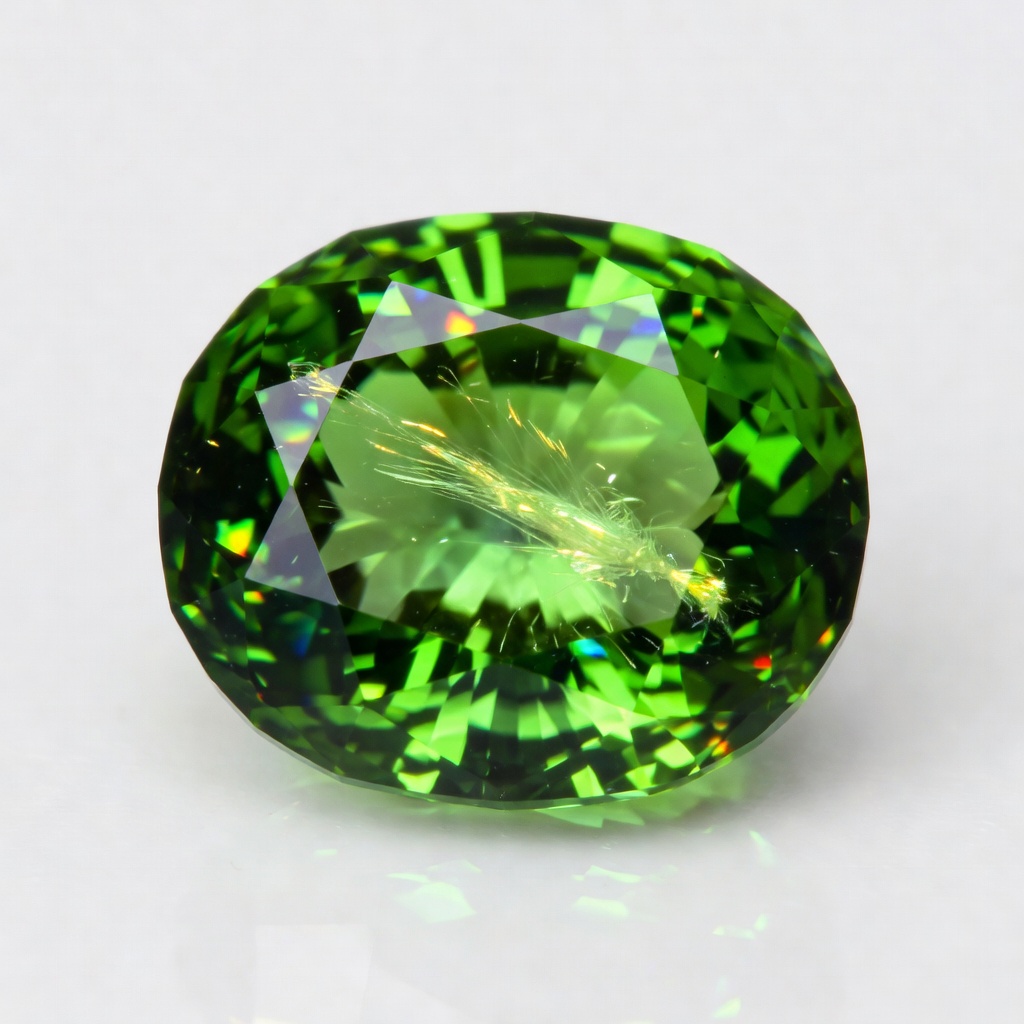
Among gemstone inclusions, few are as celebrated or diagnostically significant as the horsetail inclusion demantoid collectors covet. These unique internal features consist of radiating bundles of chrysotile asbestos fibers that spread outward from a central chromite crystal, creating patterns remarkably resembling a horse's flowing tail. Found predominantly in Russian demantoid from the Ural Mountains, these inclusions serve as positive identification markers, confirming both the stone's natural origin and its prestigious geographic provenance.
Unlike most gemstones where inclusions detract from value, horsetail inclusions actually enhance the desirability and market price of demantoid garnets when present in moderate, aesthetically pleasing distributions. Collectors and connoisseurs specifically seek these features as proof of authenticity and provenance, considering them nature's certification of Russian origin. The presence of delicate, golden-green horsetail sprays suspended within the vivid green host material creates a mesmerizing three-dimensional landscape that connoisseurs describe as looking into a mystical forest.
African stones, particularly those from Namibia, typically lack these diagnostic inclusions, appearing cleaner and more transparent but simultaneously less distinctive to experienced gemologists. This absence of horsetail patterns in Namibian material actually aids in russian demantoid identification, allowing experts to differentiate between origins even when other visual characteristics appear similar. When purchasing stones marketed as Russian, always inspect them under 10x magnification for these telltale fibers; their presence validates authenticity and justifies premium pricing, while their absence in supposedly Russian material should raise immediate concerns about misrepresentation.
Color Grading: What to Look For
Evaluating demantoid garnet color grade requires understanding the interplay between body color and dispersion, as this gemstone's optical performance creates unique viewing experiences under different lighting conditions. The ideal color ranges from vivid yellowish-green, sometimes described as "traffic light" green, to deep emerald green with high saturation that remains consistent across various lighting environments. Stones exhibiting pure green without excessive yellow or brown modifiers command the highest prices, particularly when the color depth allows the stone's high dispersion to create rainbow flashes without appearing too dark.
The relationship between body color and dispersion presents a fascinating balancing act for cutters and collectors alike. Stones with lighter tones maximize the visibility of dispersion fire, creating spectacular rainbow effects, but may appear slightly yellowish or washed out in certain lights. Conversely, deeply saturated stones resembling fine emeralds provide rich green coloration but may suppress the very dispersion phenomenon that makes demantoid unique. The most valuable specimens achieve equilibrium, displaying vivid green demantoid coloration while maintaining enough transparency to showcase spectacular internal fire.
When examining potential purchases, evaluate stones under multiple lighting conditions including natural daylight, incandescent, and LED lighting. Avoid stones that appear overly dark or "closed," as these will appear blackish in low-light settings and fail to display demantoid's characteristic brilliance. Similarly, reject stones with excessive yellow or brown modifiers that drift toward olive or muddy green tones. The finest demantoids maintain their green integrity while lighting up with spectral colors when moved, creating the living, breathing quality that distinguishes world-class specimens from commercial-grade material.
Clarity, Cut, and Carat Weight Considerations
The cutting style chosen for a demantoid dramatically affects its visual performance, with round brilliant and cushion cuts best showcasing the material's high dispersion and fire. These cuts maximize light return through precisely angled facets that separate white light into spectral colors, creating the rainbow flashes that define fine demantoid. Oval and pear shapes also perform well, though they require careful proportioning to avoid "bow-tie" dark areas that can appear across the center of elongated stones.
Unlike diamonds or sapphires where eye-clean clarity is expected, demantoid garnet cut stones often contain characteristic inclusions that specialists accept as part of the gem's natural identity. Completely eye-clean demantoids over one carat are exceptional rarities that command significant premiums, while stones with minor inclusions visible only under magnification offer excellent value for jewelry purposes. When evaluating clarity, distinguish between the desirable horsetail inclusions indicative of Russian origin and negative features such as large fractures, dark mineral inclusions, or clouds that significantly impede transparency.
Carat weight presents the most dramatic valuation factor in demantoid purchasing decisions, as stones over 2 carats are extremely rare and command exponential price premiums. Most faceted demantoids available on the market range from 0.25 to 0.75 carats, with stones approaching 1 carat already considered significant finds. For collectors seeking demantoid garnet value appreciation, acquiring larger stones with documented Russian origin represents the strongest investment potential, as these specimens appear at major auctions less frequently than rubies, sapphires, or emeralds of comparable size. When budget constraints limit options, prioritize superior cutting and color over sheer size, as a smaller, brilliantly cut stone outperforms a larger poorly proportioned specimen in beauty and long-term desirability.
Pricing Guide and Market Value
Understanding demantoid garnet price per carat requires recognizing the dramatic quality tiers that separate commercial material from investment-grade specimens. Current market data indicates that commercial quality stones, typically Namibian material under 0.5 carats with good color but noticeable inclusions, range from $200 to $800 per carat. Fine quality stones exhibiting vivid green color, good clarity, and excellent cutting command $1,000 to $3,000 per carat, while exceptional Russian stones with documented provenance and characteristic horsetail inclusions can exceed $5,000 per carat, with museum-quality specimens over 2 carats reaching $10,000 or more.
The price curve for demantoid escalates dramatically for stones over 1 carat due to extreme rarity in larger sizes. A 1.5-carat fine Russian demantoid might cost $8,000-$12,000 total, while the same quality in a 2.5-carat stone could command $25,000-$40,000, representing a per-carat price increase of nearly 100%. This exponential pricing structure reflects the geological reality that demantoid crystals rarely grow large enough to yield cut stones over 2 carats, particularly from Russian deposits. Investment potential remains particularly strong for high-quality Russian specimens with laboratory documentation confirming origin, as these stones continue appreciating faster than inflation and many traditional investment vehicles.
When budgeting for a demantoid purchase, allocate funds for proper certification and setting if creating jewelry. The investment in a GIA or AGL report typically costs $100-$300 but adds significant resale value and insurance documentation. For those entering the market, consider acquiring a fine 0.75-1 carat Namibian stone with excellent cutting as an accessible entry point, allowing appreciation for the material before committing to premium Russian specimens. Regardless of budget, avoid stones priced significantly below market rates, as these likely indicate undisclosed treatments, synthetic material, or misrepresented origin that will destroy long-term value.
Certification and Authentication Essentials
Acquiring certified demantoid stones represents a non-negotiable step in the purchasing process, as professional gemological verification protects against misrepresentation, synthetic substitution, and undisclosed treatments. Reputable laboratories such as GIA (Gemological Institute of America), AGL (American Gemological Laboratories), and SSEF (Swiss Gemmological Institute) provide reports confirming natural origin, identifying any treatments, and ideally determining geographic origin—a crucial factor for valuation. These documents serve as the stone's passport, providing insurance companies and future buyers with independent verification of quality claims.
While demantoid rarely undergoes the extensive treatments common to emeralds or rubies, heat treatment and oiling occasionally appear in the marketplace to improve apparent clarity. Heat treatment can lighten overly dark stones or improve color, while oiling temporarily masks surface-reaching fractures. Any treatment must be disclosed at the time of sale, and laboratory reports should specifically state "no indications of heating" or identify any treatments present. Synthetic demantoid exists but remains rare in the market; however, advanced laboratory equipment can distinguish natural from created material through inclusion analysis and spectroscopic testing.
When reviewing a demantoid garnet report, verify that the identification specifies "andradite garnet, variety demantoid" rather than generic "garnet" descriptions. For Russian material, seek reports that specifically confirm "Russian origin" based on inclusion patterns and trace element chemistry, as this documentation significantly affects resale value. Retain all original paperwork, including receipts and laboratory certificates, in a secure location, as complete documentation packages can increase resale values by 10-20% compared to loose stones without provenance records.
Smart Buying Strategies and Red Flags
Successfully navigating the demantoid marketplace requires strategic dealer selection and vigilant awareness of common pitfalls that trap unwary buyers. When looking to buy demantoid garnet online or in person, prioritize dealers specializing specifically in colored gemstones rather than general jewelry retailers, as specialists possess the expertise to evaluate quality accurately and price inventory according to current market conditions. Established dealers should offer detailed photographs and videos under different lighting conditions, magnified images of inclusions, and reasonable return policies allowing independent verification by your own gemologist.
When evaluating stones marketed as Russian demantoid, insist on inspecting them under 10x magnification for horsetail inclusions before purchase. The absence of these fibers in supposedly Russian material suggests either Namibian origin misrepresented to command higher prices or potentially synthetic material. Similarly, examine cutting quality carefully; poorly cut stones with windowed centers or asymmetrical facets indicate either inexperienced cutting of valuable material or attempts to maximize weight retention from heavily included rough at the expense of beauty.
Several red flags should immediately terminate negotiations: prices significantly below market value indicating potential synthetics or treatments, dealers unwilling to provide independent laboratory reports, vague or evasive answers regarding origin, and high-pressure sales tactics claiming imminent price increases or limited availability. Legitimate demantoid purchasing tips include requesting references from previous clients, verifying membership in professional organizations such as the American Gem Trade Association (AGTA), and comparing pricing across multiple specialist dealers before committing. Remember that true Russian demantoid in fine quality rarely appears at steep discounts; if a deal appears too good to be true, the stone likely lacks the represented origin or natural status.
Care and Maintenance for Demantoid Jewelry
Proper demantoid garnet care ensures your investment maintains its brilliance and structural integrity across generations, though the material's physical properties require specific handling protocols. With a Mohs hardness of 6.5-7, demantoid falls below the durability of sapphire, ruby, or diamond, making it susceptible to scratching and chipping under rough wear. This relative softness necessitates protective settings for rings, particularly bezel or halo designs that shield the girdle and corners from direct impact, though pendants and earrings represent safer choices for regular wear as they experience less mechanical stress.
Cleaning demantoid jewelry requires gentle methods that avoid thermal shock or mechanical vibration that could expand internal inclusions or fracture filled areas. Never use ultrasonic cleaners or steam cleaning devices, as these can cause existing fractures to propagate or loosen stones from their settings. Instead, clean your demantoid using warm water, mild dish soap, and a soft brush, followed by immediate drying with a lint-free cloth. Store demantoid pieces separately from harder gemstones like diamonds, sapphires, or rubies, as contact between materials can scratch the demantoid's surface.
For long-term demantoid jewelry maintenance, have settings inspected annually by a professional jeweler to ensure prongs remain tight and protective structures intact. Remove demantoid rings before engaging in household cleaning, gardening, or sports activities that could subject the stone to impact or exposure to harsh chemicals. When traveling, transport demantoid jewelry in individual padded compartments within a jewelry roll or case. With proper care, these rare green gems provide decades of wearing pleasure while maintaining their value as tangible assets, bridging the gap between wearable art and investment-grade collectibles.
Frequently Asked Questions
How much should I expect to pay for demantoid garnet per carat?
Demantoid garnet typically ranges from $200 to $5,000+ per carat depending on quality and origin. Namibian stones generally cost $200-$2,000 per carat, while fine Russian demantoids with horsetail inclusions can command $3,000-$10,000+ per carat for high-quality specimens.
Is Russian demantoid garnet better than Namibian demantoid?
Russian demantoid is considered more prestigious due to historical significance and characteristic horsetail inclusions, commanding higher prices. However, Namibian demantoid often exhibits better clarity and larger sizes. 'Better' depends on whether you prioritize investment value and rarity (Russian) or size and cleanliness (Namibian).
What are horsetail inclusions and do they affect value?
Horsetail inclusions are chrysotile asbestos fibers that radiate from a central point, resembling a horse's tail. Found primarily in Russian demantoid, they actually increase value when present in moderate amounts, as they confirm Russian origin and are considered desirable collector features rather than flaws.
How can I verify if a demantoid garnet is natural and untreated?
Always request a gemological report from GIA, AGL, or SSEF confirming natural origin. The report should specify any treatments (rarely heat or oiling) and ideally determine geographic origin. Under magnification, natural demantoids show distinct inclusion patterns unlike synthetic stones.
What color grade should I look for when buying demantoid?
Seek vivid yellowish-green to deep emerald green with strong saturation. The finest demantoids display a 'traffic light' green with high dispersion (rainbow flashes). Avoid overly yellow or overly dark stones that appear black in low light; the best stones maintain green color while showing exceptional brilliance.
Is demantoid garnet suitable for engagement rings?
While beautiful, demantoid's 6.5-7 Mohs hardness and brittle nature make it less ideal for daily-wear rings compared to sapphires or diamonds. If used in engagement rings, choose protective bezel settings and reserve for occasional wear. Pendants and earrings are safer, more practical choices for this rare gem.
Where is the best place to buy demantoid garnet?
Purchase from established colored gemstone dealers specializing in garnets, auction houses like Christie's or Sotheby's for investment-grade pieces, or reputable online vendors offering detailed photos, videos, and return policies. Avoid general jewelry stores lacking specific demantoid expertise.
What size demantoid garnet is considered rare?
Stones over 1 carat are considered rare, while specimens over 2 carats are extremely rare and museum-quality. Most faceted demantoids available on the market range from 0.25 to 0.75 carats. Large, clean Russian stones over 2 carats can command prices comparable to fine emeralds or rubies.