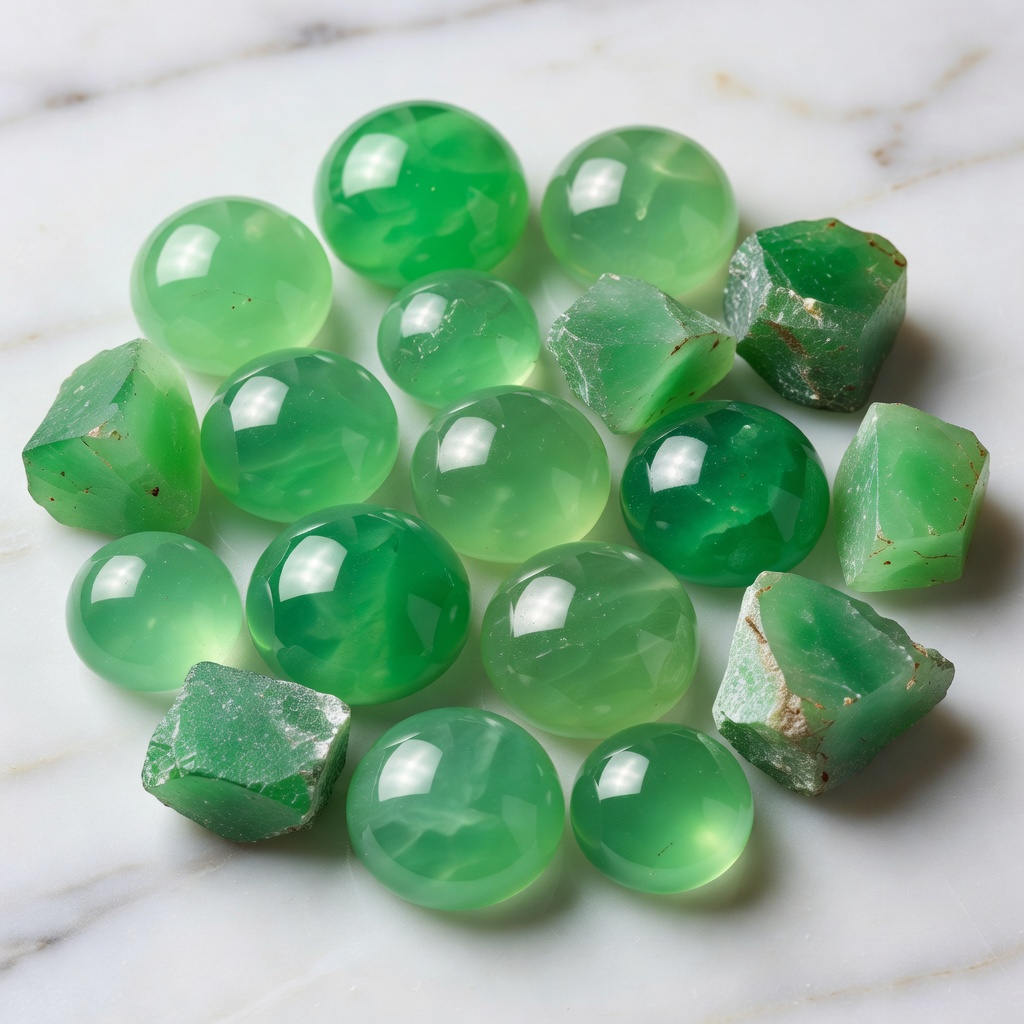
What Is Chrysoprase? Understanding the Apple-Green Chalcedony
Chrysoprase represents one of the most valuable and visually striking varieties within the chalcedony quartz family, distinguished by its captivating apple-green to emerald-green coloration. This chrysoprase gemstone derives its name from the Greek words "chrysos" meaning gold and "prason" meaning leek, though modern specimens more commonly exhibit the fresh green tones of young apples rather than golden leeks. Unlike emerald or other green gemstones that owe their color to chromium or vanadium, chrysoprase owes its distinctive hue to microscopic inclusions of nickel silicate minerals dispersed throughout the silica structure.
Historically, chrysoprase held significant importance in ancient jewelry and royal collections, with evidence of its use dating back to ancient Greece and Rome where it was prized for its rarity and perceived metaphysical properties. Alexander the Great reportedly wore a chrysoprase into battle believing it granted him invincibility, while during the Victorian era, the stone experienced a resurgence in popularity among European aristocracy who admired its subtle elegance compared to more ostentatious gems. Archaeological findings have uncovered chrysoprase artifacts in Egyptian tombs and Minoan burial sites, indicating its status as a luxury commodity throughout antiquity.
From a practical standpoint, understanding the physical properties of this apple chrysoprase proves essential for potential buyers. The gemstone ranks between 6.5 and 7 on the Mohs hardness scale, making it sufficiently durable for most jewelry applications while remaining softer than corundum or diamond. Its cryptocrystalline structure lacks cleavage planes, meaning it resists breaking along specific directions better than many crystalline gemstones, though it remains susceptible to scratching and chipping under impact. The stone typically exhibits a waxy to vitreous luster and ranges from translucent to nearly opaque, with the most valuable specimens displaying excellent light transmission through their depth.
Essential Quality Factors for Chrysoprase Evaluation
When evaluating chrysoprase quality factors, color consistency and saturation serve as the primary determinants of value, with premium specimens displaying uniform green tones throughout the entire stone without brownish or yellowish secondary hues. Unlike many colored gemstones where inclusions might be tolerated or even desired (as with emeralds), chrysoprase commands higher prices when it exhibits minimal surface-breaking fractures and internal clarity that allows for even color distribution. Professional gemstone grading for chrysoprase follows similar principles to other chalcedony varieties, emphasizing the absence of cloudiness, crack systems, or iron oxide staining that commonly affects lower-quality material.
Translucency levels significantly impact both aesthetic appeal and market value, with the finest chrysoprase allowing light to penetrate several millimeters into the stone while maintaining vivid color saturation. When examining potential purchases, hold the specimen against a strong light source to identify any opaque zones or "dead" areas where light fails to transmit, as these indicate lower quality material. Case studies from major auction houses reveal that chrysoprase cabochons with "glowing" translucency consistently achieve hammer prices 300-400% higher than opaque specimens of similar size and apparent color, demonstrating how crucial this factor remains in professional valuation.
Surface clarity assessment requires careful examination under 10x magnification to identify hairline cracks, pitting, or surface-reaching inclusions that could compromise structural integrity during setting or wear. Unlike diamonds or sapphires, chrysoprase rarely receives clarity grades on standardized reports, making visual inspection by the buyer or a trusted gemologist essential before significant investment. Practical tip: Request to view the stone both dry and wet (lightly misted with water), as moisture temporarily masks surface-reaching fractures; if the stone shows significant color improvement when wet, it likely contains surface cracks that will affect durability and value retention.
Decoding Color: From Apple Green to Deep Emerald Tones
The ideal chrysoprase color spectrum spans from bright apple-green to deep emerald-green tones, with the most commercially desirable specimens exhibiting the vivid green associated with Granny Smith apples rather than the bluish-green of emeralds or the yellowish-green of peridot. This coloration directly correlates with nickel content, typically ranging between 0.5% to 2% nickel oxide by weight, with higher concentrations producing deeper green saturation until the point where opacity increases and translucency diminishes. Gemologists note that the most valuable apple chrysoprase maintains consistent color saturation to a depth of at least 5-6 millimeters, indicating solid material rather than surface-stained chalcedony.
Color zoning presents a common challenge in chrysoprase evaluation, manifesting as irregular patches, bands, or spots of varying green intensity that disrupt visual uniformity. When examining rough or cut stones, rotate the specimen under natural daylight to identify any color zoning that might become more apparent in certain lighting conditions, as uneven color distribution significantly reduces both aesthetic appeal and resale value. Experienced cutters often orient cabochons to minimize visible zoning, but savvy buyers should inspect the stone from multiple angles to ensure consistent color presentation regardless of orientation.
Distinguishing chrysoprase from similar green chalcedony varieties requires careful attention to subtle color differences and chemical composition. Prase, another green chalcedony, typically exhibits a more leek-green or yellowish-green hue resulting from chlorite inclusions rather than nickel, while chrome chalcedony (mtorolite) displays a deeper, more saturated emerald-green color from chromium content. In practical buying scenarios, request specific identification from sellers, as prase commands lower prices than fine chrysoprase, and some unscrupulous dealers may mislabel the former as the latter to inflate prices.
Geographic Origins: Australian vs. Global Sources
Australian chrysoprase, particularly material extracted from the Marlborough deposits in Queensland, consistently sets the industry standard for quality and commands premium pricing in international markets. The Marlborough region produces chrysoprase with exceptional apple-green coloration and remarkable translucency, attributed to the unique geological conditions involving weathered nickel-rich ultramafic rocks that existed approximately 150 million years ago. Mining operations in this region typically yield material in veins and nodules ranging from pea-sized specimens to massive boulders weighing several hundred pounds, though gem-quality cutting material represents less than 15% of total extraction.
Polish and German sources, specifically the historic deposits near Szklary (Poland) and the former mines in Silesia (Germany), have produced chrysoprase since the 14th century and continue to yield material with characteristic deep green tones. While European chrysoprase often exhibits slightly more yellowish undertones compared to Australian material, it remains highly collectible among connoisseurs who appreciate its historical significance and distinctive color profile. Case study: A recent auction of antique Polish chrysoprase intaglios demonstrated that provenance from these historic mines can add 25-30% premiums over comparable Australian material of similar quality, particularly among European collectors.
Emerging sources from Tanzania, Brazil, and Madagascar increasingly influence the global market, offering alternatives to traditional suppliers though typically with variable quality. Tanzanian material often displays excellent color but may show more frequent fracturing, requiring stabilization treatments before cutting, while Brazilian deposits occasionally produce large clean specimens suitable for statement jewelry pieces. When purchasing chrysoprase sources outside of Australia, buyers should request specific locality documentation, as origin significantly impacts valuation and some treatments more commonly applied to African or South American material may not be disclosed without direct inquiry.
Authenticity Checks: Spotting Fakes and Treatments
The market for fake chrysoprase encompasses several common simulants including dyed quartz, green glass, and plastic resins, each requiring specific identification techniques to distinguish from natural material. Dyed chalcedony or quartz represents the most prevalent imitation, with unscrupulous sellers saturating white or pale green material with chromium or nickel-based dyes to mimic natural color; these fakes typically show concentrated color along fracture lines and surface cracks where dye accumulates, unlike natural chrysoprase where color remains uniform throughout the structure. Glass imitations often contain telltale bubbles visible under magnification and lack the waxy luster characteristic of chalcedony, while plastic substitutes feel warm to the touch immediately and weigh significantly less than genuine stone of comparable size.
Identifying heat treatment and dye penetration requires systematic examination using magnification and simple gemological tests. Heat-treated chrysoprase may show "burnt" appearances at surface fractures or display unnatural color gradients fading toward the center of thick cabochons, while dyed material often reacts to acetone testing (though this risks damage and should only be performed by professionals). Advanced chrysoprase identification techniques include spectroscopic analysis, where natural chrysoprase shows distinct nickel-related absorption bands between 550-590 nanometers that dyed imitations cannot replicate.
Laboratory certification provides essential protection for significant purchases, with reputable labs such as GIA (Gemological Institute of America), AGL (American Gemological Laboratories), or Gubelin issuing reports that confirm natural origin and disclose any treatments. When buying chrysoprase priced above $500 per carat, always demand a certificate specifically testing for dye treatment, as many standard gem identification reports do not explicitly test for color enhancement unless requested. Practical example: A collector in Tucson recently avoided a $3,200 loss when laboratory testing revealed that a "natural Australian chrysoprase" actually comprised dyed agate from India, demonstrating the critical importance of verification for investment-grade material.
Pricing Guide: Understanding Value Per Carat
Understanding chrysoprase price per carat requires familiarity with quality tiers that range from commercial-grade material at $10-$30 per carat to exceptional museum-quality specimens exceeding $200 per carat. Entry-level chrysoprase typically exhibits pale green color, significant opacity, and minor surface imperfections suitable for bead production or casual silver jewelry, while mid-tier material ($30-$80 per carat) offers consistent apple-green color with good translucency appropriate for fine jewelry settings. The premium tier ($80-$200+ per carat) demands intense emerald-green coloration, exceptional translucency allowing light transmission through 8mm+ depths, and flawless surfaces suitable for high-end designer pieces or collector specimens.
Size premiums significantly affect chrysoprase value, as clean material over 20 carats becomes exponentially rarer due to the nodule-forming nature of chrysoprase deposits that typically yield smaller cutting rough. While a 5-carat fine Australian cabochon might retail for $400 ($80 per carat), a comparable quality 50-carat specimen could command $8,000-$10,000 ($160-$200 per carat) due to collector demand for impressive display pieces. Market trends indicate increasing interest in large chrysoprase center stones as alternatives to expensive emeralds or jadeite, with prices for exceptional specimens appreciating 8-12% annually over the past decade according to gemstone investment indices.
Investment potential considerations should include origin documentation, as Australian material consistently outperforms other sources in value retention, and untreated natural color commands significant premiums over stabilized or treated material. When budgeting for chrysoprase jewelry, allocate approximately 60-70% of the total cost for the gemstone itself when working with custom designers, as the material often exceeds the cost of gold settings for fine specimens. Practical tip: Purchase loose stones during the Tucson Gem and Mineral Show or similar wholesale events where direct access to Australian rough cutters can reduce per-carat costs by 30-40% compared to retail jewelry stores.
Chrysoprase vs. Jade: Key Differences Buyers Should Know
The comparison of chrysoprase vs jade frequently arises in the marketplace due to their similar green coloration, though these materials differ fundamentally in mineral composition, physical properties, and value metrics. Chrysoprase belongs to the chalcedony quartz family (silicon dioxide), while jade refers to either jadeite (sodium aluminum silicate) or nephrite (calcium magnesium silicate), creating distinct visual and textural differences under close examination. While both materials can exhibit apple-green to emerald-green colors, chrysoprase typically displays more uniform translucency and a waxy, almost "glowing" appearance compared to the more granular or fibrous texture visible in high-quality jadeite.
Hardness and durability comparisons reveal that while chrysoprase ranks 6.5-7 on the Mohs scale, nephrite jade measures 6-6.5 and jadeite ranges 6.5-7, making them comparable for jewelry use though jadeite generally offers superior toughness due to its interlocking crystal structure. However, chrysoprase gemstone pieces typically require more protective settings than jade because chalcedony lacks the interlocking fibrous structure that gives nephrite its legendary resistance to breaking. For daily wear rings, jadeite remains the safer choice despite higher costs, while chrysoprase better suits pendants, earrings, or occasional-wear rings with protective bezels.
Price differences between these green gemstones remain substantial, with high-quality jadeite (imperial jade) commanding $1,000-$10,000+ per carat compared to chrysoprase's $20-$200 range, making chrysoprase an attractive alternative for designers seeking green center stones without jadeite's prohibitive costs. Value retention factors favor untreated chrysoprase from documented Australian sources, which has shown steady appreciation, while jadeite prices fluctuate dramatically based on Chinese market demand and political factors. Case study: A jewelry designer recently substituted a 15-carat fine Australian chrysoprase ($1,200) for a comparable appearance jadeite ($8,500+) in a custom pendant, delivering the client's desired "imperial green" aesthetic while saving 85% on material costs.
Jewelry Applications and Setting Recommendations
Selecting appropriate chrysoprase jewelry settings requires balancing aesthetic display with protective considerations due to the stone's moderate hardness and sensitivity to impact. Rings represent the most challenging application, requiring protective bezel settings or substantial basket designs that shield the girdle edges from direct blows, while pendants and earrings offer safer venues for showcasing larger specimens without daily wear risks. When designing statement pieces, consider that chrysoprase excels in cabochon cuts between 10x8mm to 20x15mm, sizes that maximize color impact while remaining practical for standard jewelry manufacturing.
The choice between protective bezel settings and exposed prong settings significantly impacts long-term durability, with bezel settings providing 360-degree protection for the stone's vulnerable edges while prong settings maximize light entry and perceived brilliance. For gemstone settings in engagement rings or daily wear bands, full bezels in 14k or 18k gold offer optimal protection, whereas half-bezels or heavy prong settings suit cocktail rings intended for occasional wear. Practical example: A vintage chrysoprase ring from the 1920s recently examined at auction maintained perfect condition specifically because its Art Deco bezel setting protected the stone from nearly a century of occasional wear, while a 1990s prong-set example showed significant chipping at the girdle.
Metal pairing options significantly influence the perceived color of apple chrysoprase, with yellow gold enhancing warm undertones and creating a classic, vintage aesthetic popular in Victorian revival pieces. White metals including platinum, white gold, and silver provide contemporary contrast that emphasizes the stone's green purity, while rose gold creates sophisticated, feminine designs that complement chrysoprase's natural warmth without overwhelming it. Design tip: For maximum color impact, choose bezel settings in high-polish yellow 18k gold for traditional looks, or brushed 14k white gold for modern minimalist designs that let the chrysoprase color dominate the visual field.
Care and Maintenance Best Practices
Proper chrysoprase care begins with appropriate cleaning methods that preserve the stone's surface polish and structural integrity without introducing thermal shock or chemical damage. Always avoid ultrasonic cleaners and steam cleaning devices, as the vibrations can exacerbate existing fractures while rapid temperature changes cause thermal shock that may crack the stone. Instead, clean chrysoprase using warm water with mild dish soap and a soft natural bristle brush, gently scrubbing to remove accumulated oils and dirt before rinsing thoroughly and patting dry with a lint-free microfiber cloth.
Storage recommendations emphasize isolation from harder gemstones to prevent scratching, as chrysoprase's 6.5-7 hardness means it readily scratches when stored loose with diamonds, sapphires, or even harder quartz varieties. Store individual pieces in soft cloth pouches or compartmentalized jewelry boxes with fabric-lined dividers, ensuring that pendants and earrings do not contact metal findings that might abrade the surface during drawer movement. For extensive collections, consider storing fine chrysoprase specimens with anti-tarnish strips in airtight containers to minimize oxidation of metal settings and prevent environmental pollutants from dulling the stone's surface luster.
Gemstone maintenance protocols must account for chrysoprase's heat sensitivity and vulnerability to chemical exposure, including household cleaners, chlorine, and even prolonged contact with body oils and acidic perspiration. Remove chrysoprase jewelry before swimming, cleaning with chemicals, or engaging in activities that cause heavy perspiration, as these factors can gradually etch the surface or cause color fading over time. Warning: Never expose chrysoprase to sudden temperature changes, such as moving from a hot tub to cold pool water or placing heated stones under cold taps, as thermal shock remains the leading cause of chrysoprase cracking in jewelry applications.
Where to Buy: Trusted Sources and Red Flags
Navigating the Chrysoprase Buying Guide marketplace requires distinguishing between reputable online dealers, established local gem shows, and high-risk venues where misrepresentation prevails. Established online dealers specializing in colored gemstones, such as those affiliated with the American Gem Trade Association (AGTA) or International Colored Gemstone Association (ICA), typically offer detailed photography, return policies, and certification options essential for confident purchasing. Local gem shows provide advantages for examining color and translucency in person, particularly the Tucson Gem and Mineral Show where Australian rough dealers offer direct access to Marlborough material without retail markups.
When preparing to buy chrysoprase, arm yourself with essential questions for sellers regarding treatment disclosure, specific locality documentation, and return examination periods. Ask explicitly: "Has this stone been dyed, heat-treated, or stabilized?" and "Can you provide documentation of Australian origin?" Reputable sellers welcome these inquiries and provide detailed responses, while evasive answers or vague statements like "natural color" without specific treatment denials should trigger immediate caution. Red flags include prices significantly below market rates (indicating dyed material), sellers who discourage independent appraisal, and stones offered without return privileges or inspection periods.
Return policies and verification guarantees protect buyers from misrepresented material, with standard terms allowing 7-10 day examination periods for full refunds if the stone fails to match descriptions or containsundisclosed treatments. For purchases exceeding $1,000, demand the right to independent gemological verification within 48 hours of receipt, ensuring the seller accepts returns if laboratory testing reveals treatments or synthetic origin not disclosed at sale. Practical safeguard: Never purchase chrysoprase from social media marketplaces or auction sites without escrow services or credit card protection, as these venues show increasing rates of dyed agate misrepresented as fine Australian chrysoprase, particularly from sellers based in Southeast Asia with no established gemological credentials.
Frequently Asked Questions About Chrysoprase
Is chrysoprase expensive compared to other gemstones?
Chrysoprase is considered a semi-precious gemstone with moderate pricing. High-quality Australian material can range from $20 to $200 per carat, making it more affordable than emerald or jadeite but pricier than common agates. The price depends heavily on color intensity, translucency, and origin.
How can I tell if my chrysoprase is real or dyed?
Real chrysoprase exhibits natural color variations and translucency with a waxy luster. Dyed imitations often show concentrated color in cracks, uneven saturation, or appear too uniformly vivid. Professional testing for dye penetration or consulting a certified gemologist is recommended for expensive purchases.
What is the best color for chrysoprase?
The most valued chrysoprase displays an intense, uniform apple-green to emerald-green color without brown or yellow undertones. Premium specimens offer excellent translucency allowing light to pass through while maintaining vivid saturation. Australian material typically commands higher prices for achieving this ideal color consistently.
Can chrysoprase be worn daily in rings?
While chrysoprase ranks 6.5-7 on the Mohs hardness scale, daily ring wear requires protective settings like bezels to prevent chipping and scratching. It's softer than sapphire or diamond, so reserve rings for occasional wear or choose pendants and earrings for daily use to preserve the stone's beauty.
How does chrysoprase compare to jade?
Though visually similar, chrysoprase is chalcedony quartz while jade refers to either jadeite or nephrite. Chrysoprase typically shows more translucency and uniform color, whereas jade often displays a more granular texture. Chrysoprase is generally more affordable and slightly softer than high-quality jadeite.
Does chrysoprase fade in sunlight?
Yes, chrysoprase can fade with prolonged exposure to direct sunlight or heat due to its nickel-based coloring agent. Store pieces away from windows and avoid wearing them during extended sun exposure. This sensitivity makes chrysoprase better suited for evening jewelry or protected storage when not worn.
What should I look for when buying chrysoprase online?
Request high-resolution photos showing the stone against white and black backgrounds to check translucency. Verify return policies, ask about treatments or dyeing, and demand certificates for expensive specimens. Compare color consistency across multiple images and read seller reviews regarding color accuracy.
Is Australian chrysoprase better than other sources?
Australian chrysoprase, particularly from Marlborough in Queensland, is highly prized for its superior apple-green color and excellent translucency. While Polish and German sources produce quality material, Australian deposits consistently yield the most commercially desirable specimens, often commanding premium prices in the market.