Charoite Buying Guide: Expert Tips for Selecting Premium Siberian Purple Gemstones
Navigating the world of rare gemstones requires specialized knowledge, particularly when seeking one of nature's most exclusive treasures. This comprehensive Charoite Buying Guide equips collectors and jewelry enthusiasts with essential expertise to evaluate quality, authenticate origins, and make informed purchasing decisions. Whether you are drawn to this striking purple gemstone for its metaphysical properties or its visual drama, understanding the nuances of Siberian charoite ensures you acquire genuine specimens worthy of investment. From identifying characteristic chatoyancy to recognizing ethical sourcing channels, mastering these evaluation criteria protects both your financial investment and aesthetic satisfaction.
Understanding Rare Siberian Charoite Origins
Charoite represents one of the most geographically restricted gemstones on Earth, sourced exclusively from the Murun Massif in the Sakha Republic of Yakutia, Russia. This extreme exclusivity stems from a unique geological formation process involving limestone intrusions into syenite rocks under specific temperature and pressure conditions that scientists believe occurred approximately 140 million years ago. The resulting mineral combination produces the stone's distinctive fibrous structure, creating mesmerizing swirling patterns that range from delicate lavender to intense deep violet, often accompanied by remarkable chatoyant effects that seem to move beneath the surface.
The increasing demand within crystal healing communities and high-end jewelry markets has intensified as collectors recognize charoite's finite nature. Unlike diamonds or sapphires that occur across multiple continents, charoite deposits remain confined to a single remote Siberian mountain range less than one square kilometer in size. This extreme scarcity, combined with harsh mining conditions and strict Russian export regulations, positions Siberian charoite among the most coveted purple gemstone buying opportunities available to serious collectors. When evaluating specimens, prioritize documentation confirming Murun Massif origin, as this provenance significantly impacts both value and authenticity.
Essential Quality Grading Criteria for Premium Selections
Evaluating charoite quality grades requires understanding three primary visual characteristics that separate museum-quality specimens from commercial-grade material. First, examine the stone for chatoyancy, commonly called the cat's eye effect, which manifests as a moving band of light across the surface when rotated under direct illumination. This optical phenomenon indicates high fibrous content within the crystal structure, serving as a reliable marker of premium charoite that commands significantly higher market prices than non-chatoyant varieties.
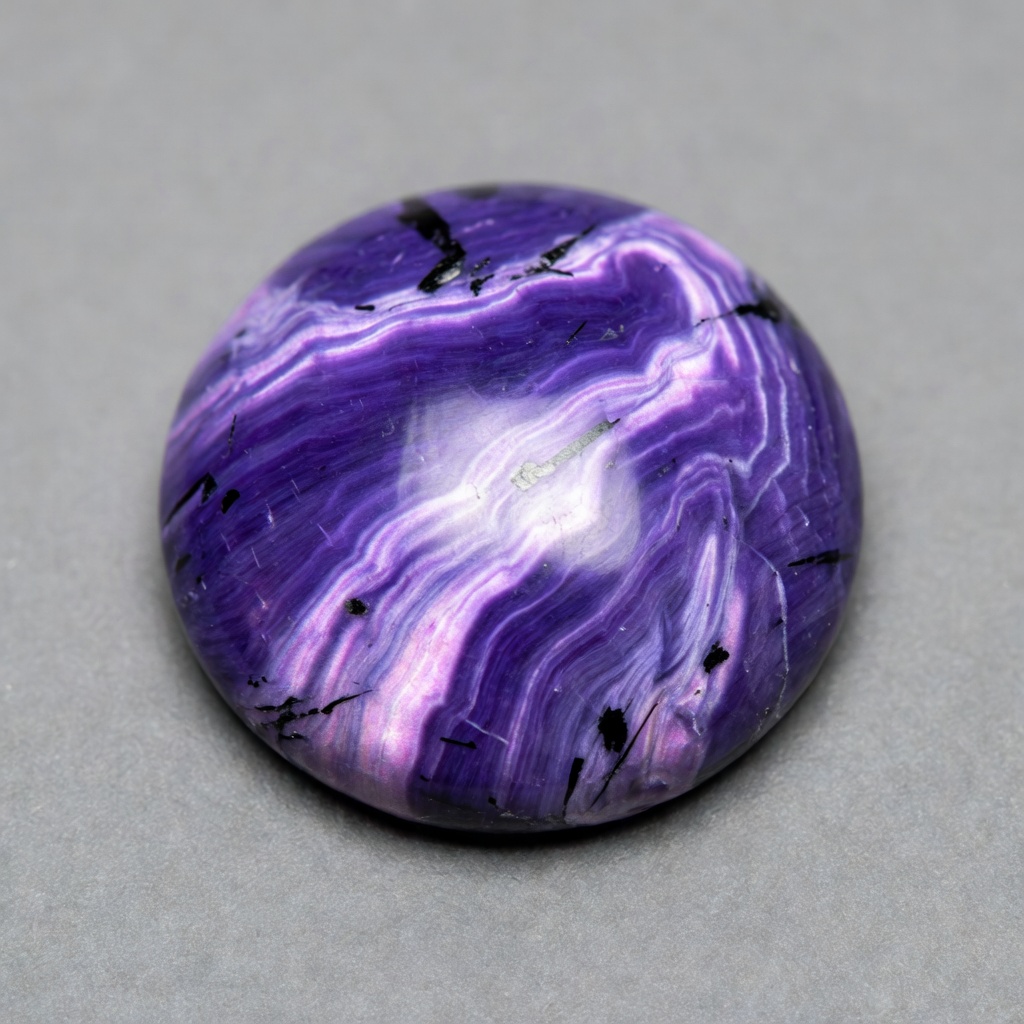
Pattern complexity represents the second critical grading factor, with top-tier stones displaying intricate, feather-like swirling formations rather than dull, uniform coloration. Premium specimens showcase complex intergrowths where purple fibers intertwine with white, black, and occasionally orange mineral inclusions, creating landscape-like scenes within the stone. Finally, assess translucency levels by holding the gem against a light source; high-grade charoite permits partial light transmission that enhances its depth and luminosity, whereas opaque specimens typically indicate lower quality or excessive matrix rock content. When examining cabochons, seek stones where these three elements—chatoyancy, complex patterning, and translucency—create a harmonious visual symphony that justifies premium pricing.
Color Variations and Visual Characteristics
The color spectrum of purple charoite stone specimens significantly influences both aesthetic appeal and market valuation, with specific hues commanding substantial premiums over others. Deep violet to royal purple represents the most desirable color range, particularly when saturated evenly throughout the fibrous structure without excessive brown or gray tinting that diminishes vibrancy. When evaluating potential purchases, rotate stones under various lighting conditions, as natural daylight reveals true color saturation while artificial lighting may mask undesirable undertones that only become apparent in different environments.
Natural black inclusions within charoite typically indicate the presence of aegirine or feldspar minerals, which serve as desirable authenticity markers rather than flaws requiring avoidance. These dark accentuations create striking contrast against the purple background, enhancing the stone's dimensional appearance and proving its natural formation rather than synthetic manufacture. Additionally, authentic specimens display distinctive feathered or swirling patterns created by interlocking crystal fibers, whereas imitations often present as solid blocks of uniform color lacking the organic flow characteristic of genuine material. Collectors should specifically seek specimens where these swirling formations create distinct zones or landscape patterns, as these visual elements define the unique personality of each individual charoite gemstone.
Detecting Fake Charoite and Common Imitations
The rarity and value of authentic charoite have unfortunately spawned numerous imitations that require careful scrutiny to identify, making natural charoite identification skills essential for prospective buyers. Dyed quartz or agate represents the most prevalent counterfeit, easily distinguishable through microscopic examination that reveals color pooling within surface cracks and fractures rather than the uniform fiber-optic effect of genuine material. These treated stones lack the natural chatoyancy and complex internal structure that defines authentic charoite, often feeling cooler to the touch and displaying artificial-looking color saturation that appears too uniform or garish compared to nature's subtle variations.
Sugilite frequently creates confusion among novice collectors due to its similar purple appearance, though discerning buyers recognize distinct differences between these minerals. While both display violet hues, sugilite lacks the characteristic swirling patterns and fibrous chatoyancy that define charoite, presenting instead as more uniformly colored massive material without the dimensional depth created by interlocking crystal structures. When uncertainty persists regarding fake charoite vs real specimens, request laboratory certification from recognized bodies such as the Gemological Institute of America (GIA) or American Gem Trade Association (AGTA), which can definitively confirm natural origin versus synthetic manufacture or chemical treatment through advanced spectroscopic analysis.
Charoite Pricing Guide and Market Value (2024)
Understanding current market valuations prevents overpayment while ensuring recognition of genuine bargains when they appear in the marketplace. Charoite price per carat varies dramatically based on quality tiers, with commercial grade material typically ranging from $1 to $5 per carat for stones showing moderate color saturation and minimal chatoyancy. AAA quality specimens featuring intense violet coloring, strong cat's eye effects, and complex patterning command $10 to $50 or more per carat, with exceptional museum-quality pieces exceeding $100 per carat depending on size and visual impact.
Cabochons exceeding twenty carats with exceptional chatoyancy represent particularly scarce inventory due to rough material limitations, often commanding premium prices significantly above standard per-carat rates. The mining process yields relatively small rough pieces, making large, clean specimens exponentially rarer and more valuable than smaller counterparts. Rough specimen pricing varies independently from cut stones, with values determined by matrix rock content, display potential, and the presence of distinct crystal formations suitable for mineral collections. When budgeting for charoite value appreciation, consider that prices have steadily increased approximately 8-12% annually over the past decade due to mining restrictions and depleting reserves, suggesting continued upward pressure on valuations for high-quality material.
Selecting Cuts and Settings for Maximum Durability
Proper cutting and jewelry design significantly impact both the visual presentation and longevity of charoite cabochon pieces, requiring strategic decisions based on the stone's physical properties. Cabochon cuts featuring smooth, domed tops represent the optimal choice for charoite jewelry quality, as this style protects the stone's moderate hardness of 5-6 on the Mohs scale while simultaneously displaying chatoyancy to maximum advantage. The domed surface allows light to interact with the fibrous internal structure, creating the mesmerizing movement that makes this gemstone distinctive, whereas faceted cuts risk chipping the relatively soft material and obscuring the natural patterns that collectors prize.
Setting selection requires equal consideration, as the stone's relative softness makes it vulnerable to scratching from daily wear encounters with harder materials. Avoid high-exposure ring settings intended for everyday use, particularly prong mountings that leave the stone vulnerable to impacts; instead, opt for protective bezel settings or choose pendants and earrings that experience less physical contact during wear. When purchasing charoite beads for stringing projects, inspect drilling holes carefully for cracks that may propagate under tension, and verify uniform color saturation throughout the strand, as bead quality varies dramatically between suppliers. For investment pieces, commission custom settings that cushion the stone while allowing light entry from multiple angles to maximize the chatoyant display.
Trusted Sources: Where to Buy Authentic Charoite
Establishing reliable procurement channels represents perhaps the most critical aspect of acquiring genuine material, requiring due diligence when selecting authentic charoite dealers. Prioritize vendors maintaining direct connections to Russian mining operations or established relationships with authorized export agents who can provide documented provenance from the Murun Massif. Reputable gem show vendors who offer comprehensive return policies and detailed geological information typically provide greater security than anonymous online marketplace listings, particularly when purchasing higher-value specimens.
Exercise extreme caution when encountering listings offering unusually large stones at prices that appear "too good to be true," as these frequently indicate dyed quartz or other imitations masquerading as genuine charoite. When you buy charoite online, verify seller expertise by requesting specific information regarding mining restrictions, geological formation details, or the specific region within the Murun Massif where rough material originated. Knowledgeable dealers willingly discuss the challenges of extracting charoite from Siberian permafrost and can explain recent changes in Russian export regulations that affect availability. Request multiple photographs showing the stone under different lighting conditions, and never hesitate to ask for independent laboratory certification before finalizing significant purchases.
Care and Maintenance for Longevity
Proper maintenance protocols ensure that charoite care practices preserve both the structural integrity and visual brilliance of your investment over decades of enjoyment. Clean specimens using only mild soap and lukewarm water applied with a soft microfiber cloth, gently removing accumulated oils and debris without subjecting the stone to harsh chemicals or ultrasonic cleaning devices that can damage the delicate fibrous structure. The intense vibrations created by ultrasonic cleaners may cause internal fracturing or separation of the mineral layers within charoite, leading to irreversible damage that diminishes both beauty and value.
Storage practices require equal attention, as the stone's 5-6 Mohs hardness leaves it vulnerable to scratching from harder gemstones such as diamonds, sapphires, or rubies. Maintain charoite jewelry in separate compartments of your jewelry box, or wrap individual pieces in soft cloth pouches that prevent contact with abrasive surfaces. Additionally, avoid prolonged exposure to direct sunlight or intense UV radiation, which may gradually fade the vibrant purple hues that make this gemstone distinctive. Remove charoite rings before engaging in household cleaning, gardening, or physical activities that might result in impact or chemical exposure, ensuring that this rare Siberian treasure remains pristine for future generations.
Frequently Asked Questions
How much does high-quality charoite cost per carat?
Quality charoite typically ranges from $10 to $50 per carat for premium specimens with strong chatoyancy and deep purple coloring. Commercial grade stones may cost $1-$5 per carat, while exceptional museum-quality pieces with intense patterning can exceed $100 per carat.
How can I tell if my charoite is real or dyed?
Authentic charoite displays a distinctive fibrous structure with chatoyancy (cat's eye effect) when rotated under light. Dyed imitations like quartz or agate show color concentrated in cracks, lack natural swirling patterns, and feel cooler to the touch. When in doubt, request a gemological certificate.
Is charoite durable enough for everyday rings?
With a hardness of 5-6 on the Mohs scale, charoite is softer than many gemstones and susceptible to scratching. While suitable for occasional wear rings, it's better suited for pendants, earrings, or protected bezel settings. Remove charoite rings before physical activities or housework.
Why is charoite only found in Russia?
Charoite forms under extremely specific geological conditions involving limestone intrusions and syenite rocks that occurred in the Murun Massif, Yakutia. This unique combination of temperature, pressure, and chemical elements exists nowhere else on Earth, making charoite truly exclusive to Siberia.
What causes the purple color in charoite?
Charoite's distinctive purple color comes from its complex mineral composition, primarily potassium, sodium, calcium, and silicate arranged in a specific crystal structure. The varying purple intensities result from trace elements and the density of the fibrous crystal alignment within the stone.
Is charoite the same as sugilite?
No, charoite and sugilite are distinct minerals. While both appear purple, sugilite is typically more uniform in color without charoite's characteristic swirling patterns and chatoyancy. Sugilite comes from Japan and South Africa, whereas charoite is exclusively Russian. Charoite also has a fibrous structure unlike sugilite's massive form.
What is the best cut for charoite gemstones?
Cabochon cuts (smooth, domed tops) are ideal for charoite as they protect the stone's moderate hardness and best display the chatoyancy and swirling patterns. Faceted cuts are rare and generally not recommended as they can chip easily and obscure the stone's natural beauty.
Can charoite fade in sunlight?
Yes, prolonged exposure to direct sunlight or intense UV light can cause charoite's vibrant purple colors to fade over time. Store charoite jewelry in a dark jewelry box or pouch, and avoid wearing it during extended sunbathing or leaving it on windowsills.