Introduction to Cat's Eye Chrysoberyl
Cat's eye chrysoberyl represents one of the most mesmerizing phenomena in the gemstone world, combining exceptional durability with a captivating optical display that has fascinated collectors for centuries. Known mineralogically as cymophane, this rare variety of chrysoberyl displays chatoyancy—a distinct band of light that moves across the surface resembling the slit pupil of a feline. Unlike the more commonly encountered tiger's eye quartz, genuine chrysoberyl cat's eye gemstone material belongs to an elite category of precious stones that commands respect among connoisseurs and gemologists alike. Understanding cat's eye chrysoberyl properties and information becomes essential for anyone seeking to invest in or appreciate this extraordinary mineral.
Historical records reveal that ancient civilizations treasured these stones as powerful protective talismans and symbols of wealth. Hindu mythology referred to chrysoberyl cat's eye as "lehsunia," believing it warded off evil spirits and brought financial prosperity to the wearer. Roman soldiers reportedly carried these gemstones into battle, convinced that the all-seeing eye would protect them from hidden dangers and unseen enemies. Throughout the Victorian era, cabochon-cut cat's eyes became fashionable in men's cufflinks and stickpins, representing sophistication and discernment among the educated classes.
When evaluating rarity, fine specimens of cat's eye chrysoberyl actually surpass many better-known gems in scarcity. While rubies and sapphires occur in multiple localities worldwide, gem-quality cymophane properties that display sharp, silvery eyes combined with honey-colored transparency remain exceptionally limited. This scarcity factor, combined with the stone's remarkable hardness and singular beauty, positions it as a sophisticated choice for investors seeking alternatives to traditional diamond or emerald portfolios.
The Science Behind the Chatoyancy Effect
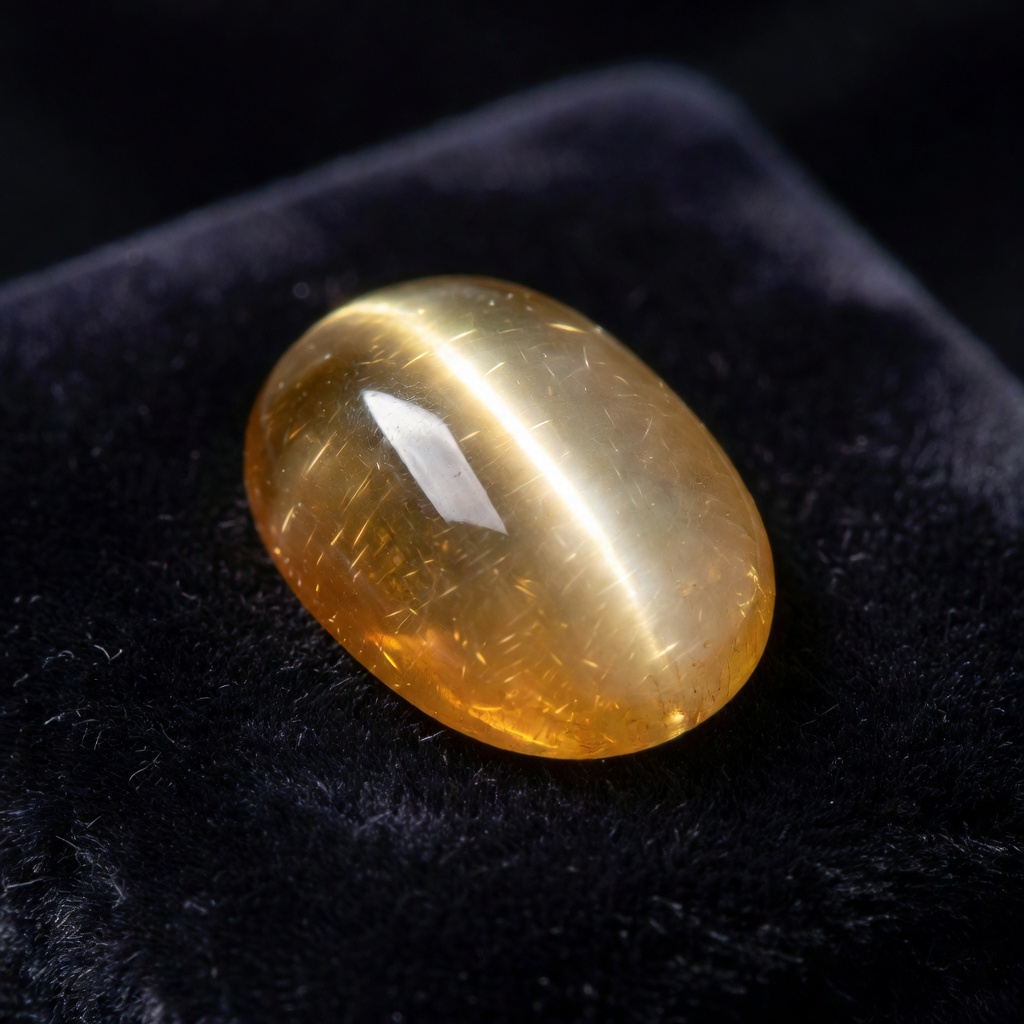
The mesmerizing chatoyancy effect that defines these gemstones results from a perfect alignment of microscopic inclusions within the crystal structure, creating an optical phenomenon that transforms light into a tangible line. Unlike asterism, which produces star patterns through intersecting needle inclusions, chatoyancy requires parallel alignment of hollow tubes or silk fibers oriented in a single direction. When light strikes these aligned inclusions, it reflects back as a concentrated band perpendicular to their orientation, creating the signature moving eye that seems to float across the stone's surface.
Examining cymophane properties under magnification reveals networks of extremely fine, hollow tubes or acicular cavities arranged in parallel arrays throughout the mineral structure. These inclusions typically form during the crystal's growth phase when rapid temperature changes create tiny gas bubbles that elongate along specific crystallographic directions. The density and uniformity of these inclusions directly correlate with the sharpness and visibility of the cat's eye line, with the finest specimens containing thousands of perfectly aligned microscopic channels per square millimeter.
Perhaps the most diagnostic characteristic for identifying premium material involves the "milk-and-honey" effect observed when rotating the stone under a single light source. As the cabochon turns, one hemisphere appears milky and diffused while the opposite side displays translucent honey-colored brilliance, with the chatoyant line marking the boundary between these zones. This phenomenon occurs because the aligned inclusions scatter light differently depending on viewing angle, creating distinct zones of opacity and transparency that shift as the stone moves. Gemologists utilize this milk-and-honey test to distinguish natural chrysoberyl cat's eye gemstone material from simulants or lower-quality substitutes.
Physical and Chemical Composition
Understanding the fundamental chemistry of this mineral reveals why it exhibits such exceptional durability and optical characteristics compared to other gemstones. The chemical formula BeAl2O4 identifies chrysoberyl as beryllium aluminum oxide, a composition that places it in the oxide mineral class alongside corundum (ruby and sapphire) and spinel. This specific arrangement of beryllium and aluminum atoms creates a crystal lattice of remarkable stability, contributing to the stone's resistance to chemical weathering, thermal shock, and mechanical abrasion that might damage softer gem materials.
Regarding cat's eye stone hardness, chrysoberyl ranks 8.5 on the Mohs hardness scale, surpassing topaz (8) and significantly exceeding quartz (7) and garnet (7.5). This exceptional hardness stems from strong covalent bonding between the beryllium, aluminum, and oxygen atoms, creating a rigid three-dimensional framework that resists scratching under normal wearing conditions. For jewelry applications, this hardness translates to practical durability, allowing cat's eye chrysoberyl to maintain its polish and surface integrity even in rings and bracelets subjected to daily wear and accidental impacts.
Crystallographically, chrysoberyl belongs to the orthorhombic crystal system, typically forming tabular or prismatic crystals with distinct striations and twinning patterns. Specific gravity measurements range between 3.70 and 3.72, noticeably higher than quartz but slightly lower than corundum, providing gemologists with a useful diagnostic parameter for identification. The mineral lacks cleavage planes, meaning it does not split along preferred directions when struck, further enhancing its suitability for jewelry settings where stones might experience accidental blows or pressure points.
Color Variations and Quality Grading
The body color of cymophane spans a surprisingly diverse spectrum, though connoisseurs particularly prize specific hues that enhance the chatoyant phenomenon. Honey-colored specimens displaying rich golden-yellow to greenish-yellow tones command the highest premiums, as these colors provide optimal contrast against the silvery-white eye line. Secondary brownish or grayish tones may occur depending on trace element content, particularly iron substitutions within the crystal lattice, though excessive darkness can obscure the chatoyancy and reduce the stone's commercial value significantly.
When evaluating chrysoberyl color grades, the critical factor involves the interplay between body color and the sharpness of the eye effect. The finest stones exhibit a distinct, silvery-white line that remains straight, narrow, and centered across the dome of the cabochon regardless of lighting angle. This eye should move smoothly across the surface as the stone rotates, maintaining consistent width and intensity without breaking, winking out, or appearing diffuse. Stones displaying double eyes or "split pupils" indicate improper cutting orientation and command substantially lower prices than those with singular, crisp lines.
Transparency levels significantly impact value determination, with semi-transparent to translucent specimens representing the most desirable category for fine jewelry. Completely opaque material may display chatoyancy but lacks the depth and luminosity that characterize investment-grade stones. Clarity standards for high-grade cat's eye chrysoberyl allow for the inclusions necessary to create the eye effect but reject surface-reaching fractures, internal cracks, or cloudy zones that detract from the stone's brilliance. Advanced grading systems consider the "opening and closing" of the eye—premium specimens maintain visibility across wider viewing angles than inferior material.
Geographic Origins and Mining Sources
Sri Lanka chrysoberyl deposits have supplied the world's finest cat's eye material for over two millennia, establishing the island nation as the premier source for honey-colored specimens with exceptional clarity. The gem gravels of Ratnapura and Elahera yield alluvial chrysoberyl crystals worn smooth by ancient river systems, often discovered alongside sapphires and spinels in traditional mining pits. Sri Lankan material typically exhibits the coveted golden-honey coloration with sharp, silver-white eyes, commanding premium prices in international markets due to both aesthetic superiority and historical prestige associated with Ceylon gems.
Brazilian deposits, particularly those in Minas Gerais and Espírito Santo, produce significant quantities of chrysoberyl cat's eye with distinct characteristics separating them from Asian material. Brazilian stones often display greenish-yellow to olive tones rather than pure honey colors, with some deposits yielding rare blue-green or teal specimens that appeal to collectors seeking unusual variations. The mining operations in Brazil frequently recover chrysoberyl as a byproduct of alexandrite extraction, given that both gem varieties occur in similar pegmatite and mica schist environments within the same geological formations.
Secondary sources including Madagascar, India, and Myanmar contribute smaller volumes to the global supply, each imparting distinct regional characteristics to their output. Madagascar produces lighter-colored material often described as "straw yellow," while Indian deposits in Orissa and Kerala yield stones with pronounced brownish components. Myanmar (Burma) occasionally produces fine specimens comparable to Sri Lankan quality, though political instability and mining restrictions have limited recent exports from this region. Understanding where cat's eye chrysoberyl is found helps collectors appreciate provenance factors that influence both value and appearance.
Cutting Techniques and Cabochon Preparation
The transformation of rough chrysoberyl into a finished gemstone requires specialized lapidary skills, as cabochon cutting represents the only effective method for displaying chatoyancy. Unlike faceted stones that maximize brilliance through light refraction, cabochon gemstone preparation involves shaping the material into a smooth, domed surface that allows light reflection from internal inclusions. This technique requires precise orientation of the rough crystal so that the base of the cabochon sits perpendicular to the aligned inclusions, ensuring the chatoyant band appears centered and straight across the dome.
Critical orientation decisions begin with examining the rough under strong directional lighting to identify the concentration and alignment of needle inclusions. Experienced cutters spend considerable time studying rough crystals before making the first cut, as improper alignment results in off-center eyes, crooked lines, or "open and shut" effects where the eye disappears at certain angles. The rough must be positioned so that the included tubes run parallel to the intended base plane, requiring spatial visualization skills and understanding of crystallography to predict how the finished stone will perform.
Optimal proportions for cat's eye chrysoberyl cuts balance dome height against base dimensions to maximize eye visibility while maintaining aesthetic appeal. Excessively high domes may create distorted eye lines or reduce the stone's stability in jewelry settings, while flat domes fail to concentrate the chatoyant effect sufficiently. The ideal dome height typically ranges between 60% to 70% of the stone's total thickness, creating sufficient curvature to focus reflected light into a sharp line without compromising structural integrity. Master cutters also consider the "milk-and-honey" balance, ensuring that both hemispheres display distinct optical characteristics when the finished piece rotates.
Market Value and Investment Considerations
The chrysoberyl value spectrum spans remarkably wide ranges, reflecting the dramatic quality differences between commercial-grade material and museum-quality specimens. Current market data indicates that cat's eye gemstone prices typically start around $500 to $1,000 per carat for smaller stones with moderate eye visibility and slightly off-color body tones. Fine specimens exceeding five carats with sharp, silver eyes and honey transparency command $5,000 to $15,000 per carat, while exceptional large stones with perfect optical phenomena and provenance documentation can exceed these figures significantly at auction.
Several key factors determine where individual stones fall within these pricing tiers. The sharpness and mobility of the eye line serve as primary value drivers, with lasersharp bands that remain visible across wide viewing angles warranting substantial premiums over stones with fuzzy or intermittent lines. Body color significantly impacts desirability, with the classic honey tone outperforming greenish or brownish alternatives by margins of 200% or more in equivalent qualities. Size constitutes another critical variable, as clean rough material large enough to yield finished stones over ten carats becomes exponentially rarer, creating scarcity premiums for substantial specimens.
Investors seeking cat's eye chrysoberyl for portfolio diversification should prioritize certification from recognized laboratories such as GIA (Gemological Institute of America), AGL (American Gemological Laboratories), or SSEF (Swiss Gemmological Institute). These reports verify natural origin, absence of treatments, and specific quality parameters including color description, transparency grade, and chatoyancy intensity. Documentation of Sri Lankan origin often adds provenance premiums, while untreated status remains essential for investment-grade material, as heating or oiling treatments significantly diminish long-term value retention in this species.
Distinguishing from Other Cat's Eye Gemstones
The gem market offers numerous materials displaying chatoyancy, making accurate identification crucial for both consumers and collectors seeking authentic chrysoberyl. Tiger's eye quartz represents the most common simulant or substitute, though distinguishing features become apparent upon examination. While both display chatoyant bands, tiger's eye ranks only 7 on the Mohs scale compared to cat's eye stone hardness of 8.5, showing surface scratches more readily. Additionally, tiger's eye exhibits a fibrous, somewhat waxy luster and belongs to the quartz family with different refractive indices and specific gravity than genuine chrysoberyl.
Apatite and beryl varieties also occasionally display cat's eye effects, requiring gemological testing for definitive separation. Apatite cat's eye typically shows lower hardness (5 on Mohs scale), different refractive index ranges (1.63-1.64 versus chrysoberyl's 1.74-1.75), and often displays bluish or violet body colors uncommon in chrysoberyl. Beryl cat's eye (including aquamarine or emerald varieties showing chatoyancy) possesses lower specific gravity and different optical characteristics, though the distinction may require laboratory instruments for absolute certainty.
Understanding alexandrite vs chrysoberyl relationships helps clarify the mineralogical family tree, as both represent distinct varieties of the same parent species. Alexandrite displays the rare color-change phenomenon (green in daylight to red under incandescent light) but typically does not show chatoyancy unless specifically designated as "alexandrite cat's eye," an extremely rare combination exhibiting both optical effects simultaneously. Standard identification tests include checking for the milk-and-honey effect, measuring specific gravity, and examining refractive indices, with chrysoberyl showing birefringence (double refraction) that separates it from isotropic simulants like glass or garnet.
Care, Cleaning and Maintenance
Maintaining the beauty of chrysoberyl cat's eye gemstone specimens requires understanding both the stone's durability and vulnerabilities. Despite impressive hardness, the microscopic inclusions creating the chatoyancy effect can present weak points if subjected to extreme thermal shock or mechanical vibration. Safe cleaning methods involve using warm soapy water—prepared with mild dish detergent—and soft natural bristle brushes to remove accumulated oils and debris from the stone's surface and setting. This gentle approach effectively restores luster without risking damage to the inclusions or the setting's integrity.
Ultrasonic cleaners and steam cleaning equipment should be strictly avoided despite chrysoberyl's general durability. The high-frequency vibrations of ultrasonic baths may loosen the stone in its setting or potentially affect the structural integrity of the included tubes creating the eye effect. Steam cleaning presents thermal shock risks, as rapid temperature changes can cause internal stress fractures around inclusion areas. Additionally, harsh chemical solvents including acetone, bleach, or ammonia-based cleaners may attack the metal settings or remove protective coatings sometimes applied to enhance the stone's appearance.
Storage recommendations emphasize separating chrysoberyl pieces from harder gemstones, particularly diamonds, which can scratch virtually any other material including this relatively hard species. Individual soft pouches or compartmentalized jewelry boxes prevent contact abrasion between pieces. When traveling, consider removing rings during activities involving potential impact, as while the stone resists scratching well, sharp blows concentrated at the dome's apex might chip the surface. Regular professional inspections every twelve to eighteen months ensure that prongs remain tight and the cabochon setting maintains proper security, preventing loss of these valuable specimens during wear.
Conclusion: Why Collectors Value This Gemstone
The enduring fascination with cat's eye chrysoberyl properties and information stems from the perfect convergence of rarity, durability, and optical magic that few other gemstones achieve simultaneously. Collectors recognize that beyond the immediate visual impact of the moving eye, these stones represent geological miracles where specific conditions aligned millions of years ago to create parallel inclusions within an already rare mineral species. This combination of exceptional hardness suitable for daily wear and the singular chatoyancy effect positions cymophane as a practical yet precious choice for discerning jewelry enthusiasts.
When purchasing authentic specimens, insist upon documentation from reputable gemological laboratories that verify natural origin and untreated status. Examine the stone under single-point lighting to confirm the milk-and-honey effect, ensuring the eye remains sharp and centered across the dome. Consider provenance carefully, recognizing that Sri Lankan material traditionally commands premiums for its color quality, though fine Brazilian specimens offer excellent alternatives for budget-conscious collectors. Work with established dealers who specialize in colored stones rather than general jewelry retailers, as expertise in chrysoberyl identification requires specific knowledge often lacking in mainstream commercial channels.
The enduring appeal of chrysoberyl cat's eye in jewelry design continues evolving as contemporary artisans rediscover its sophisticated, understated elegance. Unlike faceted stones that compete through brilliance and fire, cat's eye chrysoberyl offers a mysterious, organic beauty that shifts and changes with the wearer's movement. Whether set in classic platinum mountings for vintage-inspired pieces or contemporary gold designs emphasizing the stone's warm honey tones, this remarkable gemstone maintains its position as a connoisseur's choice—rare enough to satisfy the collector, durable enough for generations of wear, and beautiful enough to captivate at every glance.
Frequently Asked Questions
What is the difference between chrysoberyl and cat's eye chrysoberyl?
Chrysoberyl is the mineral species, while cat's eye chrysoberyl (also called cymophane) is a specific variety displaying chatoyancy—a moving line across the surface caused by aligned inclusions. All cat's eye chrysoberyls are chrysoberyl, but not all chrysoberyls show the cat's eye effect.
How hard is cat's eye chrysoberyl compared to other gemstones?
Cat's eye chrysoberyl ranks 8.5 on the Mohs hardness scale, making it harder than garnet (7.5), topaz (8), and significantly harder than quartz (7). This exceptional hardness makes it suitable for daily wear in rings and bracelets without scratching easily.
What causes the line effect in cat's eye chrysoberyl?
The chatoyant line results from microscopic hollow tubes or silk inclusions aligned parallel within the crystal structure. When cut en cabochon with the base perpendicular to these inclusions, light reflects off them creating a single sharp band resembling a cat's pupil.
Is cat's eye chrysoberyl the same as alexandrite?
No, though both are chrysoberyl varieties. Alexandrite displays color-change (green to red) under different lighting, while cat's eye chrysoberyl displays chatoyancy (the moving line). Some rare specimens called alexandrite cat's eye exhibit both phenomena simultaneously.
Where does the finest cat's eye chrysoberyl come from?
The most prized specimens traditionally come from Sri Lanka (Ceylon), known for honey-colored stones with sharp, silver-white eyes. Brazilian material tends toward greenish-yellow tones, while Madagascar produces lighter colored varieties.
How much does cat's eye chrysoberyl cost per carat?
Prices range from $500-$1,000 per carat for commercial quality to $5,000-$15,000+ for fine specimens over 5 carats with sharp eyes, honey color, and high transparency. Exceptional large stones with perfect eyes can command even higher premiums.
Can cat's eye chrysoberyl be worn daily?
Yes, due to its hardness of 8.5 and absence of cleavage planes, cat's eye chrysoberyl is excellent for daily wear in all jewelry types. However, avoid harsh blows and ultrasonic cleaning, as the inclusions creating the eye can be vulnerable to extreme heat or vibration.
How do I verify if my cat's eye chrysoberyl is natural?
Look for the 'milk-and-honey' effect when rotating the stone—natural specimens show one side milky and the other translucent honey-colored. Request certification from GIA or AGL laboratories, and check for natural inclusions under magnification, as synthetics often appear too perfect.