Understanding Cassiterite: Industrial Mineral vs. Collector's Specimen
Cassiterite serves as the primary ore of tin, chemically classified as tin dioxide (SnO2), and represents one of the few minerals commanding entirely different valuation metrics depending on its ultimate destination. This comprehensive Cassiterite Price Guide examines how industrial processors evaluate material based strictly on tin content percentages and extraction efficiency, while collectors determine cassiterite crystal value through aesthetic criteria including transparency, crystal habit, and matrix association. This fundamental divergence creates parallel markets where the same mineral might sell for $0.002 per gram as ore concentrate or $500 per gram as a display specimen, depending entirely on crystallographic development rather than chemical purity. The mineral's high specific gravity of 6.8-7.1 and hardness of 6-7 on the Mohs scale make it both economically viable for industrial mining and durable enough for long-term curation in museum collections.
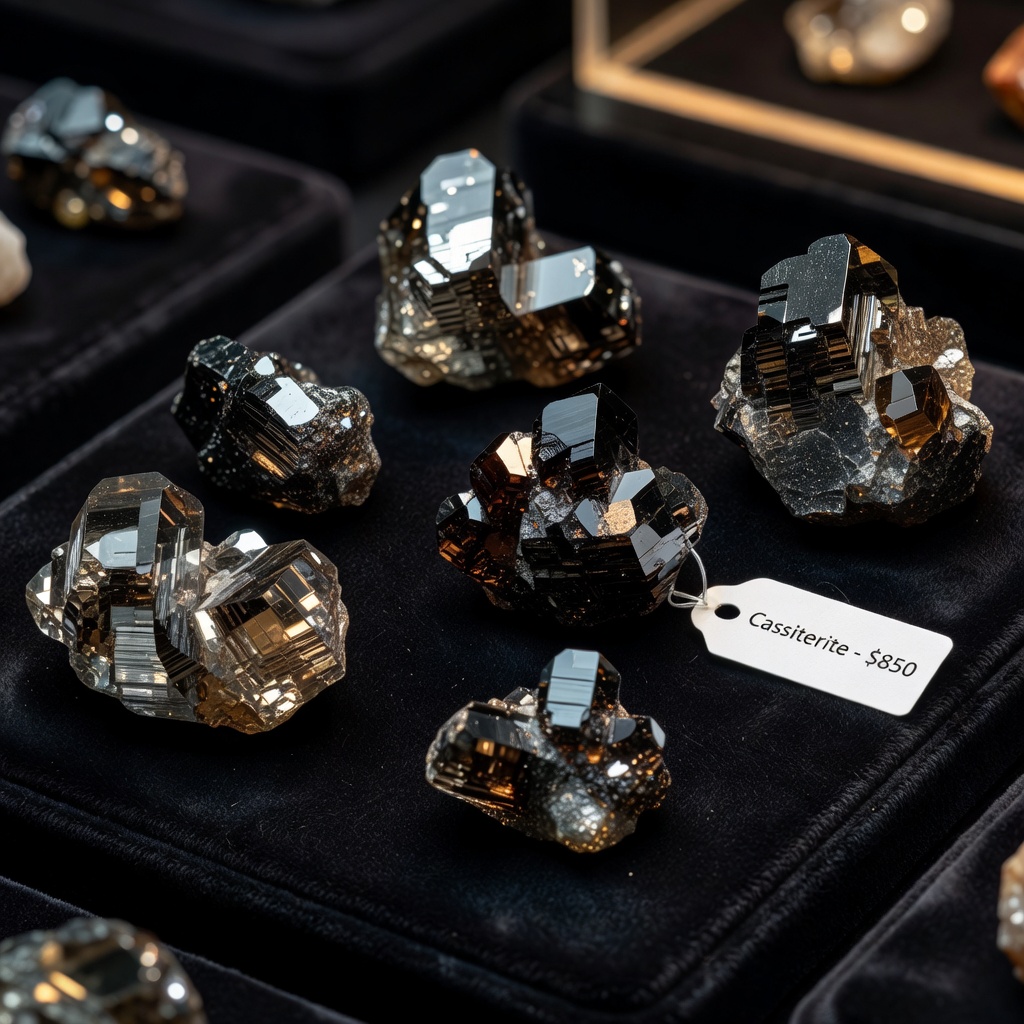
Historically, cassiterite fueled the Bronze Age civilizations of Mesopotamia and the Mediterranean, providing the tin necessary to alloy with copper and create bronze weapons, tools, and ceremonial objects. Modern applications extend far beyond metallurgy into electronics manufacturing, where fluctuations in the tin oxide price directly impact semiconductor and solar panel production costs. The dual identity of cassiterite creates unique opportunities for informed collectors who understand that industrial mining operations occasionally recover museum-quality crystals, which enter the specimen market through mineral dealers who recognize their aesthetic superiority over metallurgical grade. Recognizing the difference requires examining crystal formation patterns; industrial material typically presents as massive, granular aggregates without visible crystal faces, while specimen-grade material displays distinct euhedral crystals with well-developed faces and edges.
Current Cassiterite Prices: Per Gram, Carat, and Kilogram Rates
The cassiterite price per gram varies by orders of magnitude depending on grade classification, creating a pricing spectrum that demands careful navigation by both buyers and sellers. Industrial-grade rough material, typically containing 60-70% SnO2 and lacking visible crystal structure, trades globally at approximately $2 to $10 per kilogram, translating to roughly $0.002 to $0.01 per gram based on London Metal Exchange tin pricing and processing costs. Collector-grade crystals command significantly higher rates, with standard matrix specimens ranging from $5 to $50 per gram for opaque black crystals with moderate luster, while transparent honey-brown varieties from premium localities can reach $100 to $500 per gram for exceptional pieces. Premium transparent cassiterite suitable for faceting, particularly material from Bolivia or Mexico displaying high clarity, sells for $50 to $200 per carat ($250 to $1,000 per gram), placing it among the more valuable collector gemstones despite its relative obscurity in mainstream jewelry markets.
Bulk rough material pricing follows commodity trading patterns, with large tonnage purchases of alluvial cassiterite sand and gravel concentrates negotiated through metals brokers rather than mineral dealers. Individual matrix specimens, however, undergo individual valuation based on crystal size, aesthetic presentation, and damage-free surfaces, with a 10-centimeter crystal cluster potentially retailing for $2,000 while a kilogram of crushed ore sells for under $5. Wholesale purchasing at mineral shows like Tucson or Munich typically offers 30-50% discounts from retail pricing, though buyers must factor in travel costs and accommodation expenses when calculating true acquisition costs. Online marketplaces show extreme variance, with unverified listings sometimes pricing common material at inflated rates while specialized dealers provide authenticated specimens with documented provenance at premium but justified prices.
Quality Factors That Drive Cassiterite Market Value
Determining rough cassiterite cost requires systematic evaluation of multiple quality indicators that separate display-worthy specimens from metallurgical feedstock. Crystal clarity represents the primary value determinant, with transparent to translucent varieties commanding exponential premiums over opaque black material, particularly when crystals exceed one centimeter in visible dimensions. The presence of twinning formations, specifically "knee twins" or "elbow twins" where crystals intergrow at characteristic angles, can increase value tenfold compared to single crystals, as these formations demonstrate the mineral's tetragonal crystal system in dramatic geometric displays. Color grading extends from common jet-black opaque specimens through reddish-brown translucent varieties to rare honey-yellow or colorless transparent crystals, with the latter categories achieving prices comparable to fine tourmaline or topaz in the gemstone market.
Surface luster significantly impacts valuation, with specimens displaying the characteristic adamantine (diamond-like) brilliance on crystal faces commanding higher prices than those showing submetallic or dull surfaces. Size thresholds create distinct market tiers; crystals under 2 centimeters typically sell as "thumbnail" specimens for $20-$200 depending on quality, while cabinet-sized pieces exceeding 10 centimeters with intact terminations can command $5,000 or more, particularly from classic depleted localities like Cornwall or Saxony. Practical collectors should examine specimens under bright point-source lighting to verify luster quality and use 10x magnification to check for micro-fractures or repair that might compromise structural integrity. Matrix associations also influence pricing, with cassiterite perched on contrasting white quartz or feldspar matrix typically commanding 20-30% premiums over loose crystals or massive ore specimens.
Geographic Origin Impact on Pricing Tiers
Provenance fundamentally drives mineral specimen pricing in the cassiterite market, with specific localities commanding consistent premiums based on historical significance, crystal quality, and current accessibility. Bolivian specimens, particularly those from the Viloco (Araca) mine or Huanuni district, represent the gold standard for transparent cassiterite, with well-formed crystals exhibiting honey-brown to colorless transparency routinely achieving $200-$1,000 per carat depending on size and clarity. Peruvian material from the Potosi or La Paz departments similarly commands respect, though typically at 10-15% discounts from comparable Bolivian pieces due to slightly more common availability. Chinese and Indonesian material dominates the industrial market, with pricing from these regions setting global benchmarks, though exceptional Chinese crystals from provinces like Jiangxi or Hunan occasionally enter the collector market at moderate price points of $5-$50 per gram.
African sources present complex valuation scenarios due to ethical sourcing concerns; Rwandan and Ugandan material with documented conflict-free certification commands 15-25% premiums over unverified Democratic Republic of Congo (DRC) material, regardless of comparable crystal quality. Classic European localities generate intense collector interest despite depleted mines; specimens from Cornwall, England, or the Erzgebirge (Ore Mountains) of Saxony, Germany, achieve prices disproportionate to their aesthetic qualities due to historical mining significance and 19th-century collection pedigree. When evaluating origin claims, serious collectors should request documentation or provenance letters for high-value pieces, as unscrupulous dealers occasionally mislabel common material as premium localities. Transportation costs and export licensing from remote mining regions like Rwanda's Rutongo mines or Bolivia's Altiplano also factor into final retail pricing, explaining why direct mine purchasing sometimes offers only marginal savings over established dealer networks once logistics expenses calculate.
Industrial Grade vs. Specimen Grade: Price Divergence Explained
The chasm between industrial and specimen markets creates distinct tin oxide price ecosystems that operate with minimal overlap, driven by incompatible valuation methodologies. Industrial buyers prioritize SnO2 content percentages, with ore concentrates containing 70-80% tin dioxide commanding premium smelter contracts, while material below 60% requires expensive beneficiation processing that reduces effective per-ton value. Specimen collectors largely ignore chemical assays, instead evaluating aesthetic crystal development, with a specimen containing 40% cassiterite by weight but displaying perfect 5-centimeter twin crystals potentially retailing for $3,000, while a homogeneous 95% pure tin oxide ore block of equal weight sells for under $50 to metallurgical processors. This divergence stems from differing utility; industrial applications require chemical tin for soldering, plating, and alloy production, while collectors seek crystallographic examples for educational display and mineralogical study.
Processing costs further separate these markets, as industrial material requires crushing, grinding, and flotation concentration to achieve smelter-ready grades, adding $50-$150 per ton in preparation expenses. Specimen preparation involves delicate cleaning using air abrasion, ultrasonic baths, and precise mechanical removal of matrix material to expose crystal faces, with professional preparation services charging $50-$500 depending on specimen complexity and fragility. Market liquidity differs dramatically; industrial cassiterite trades on commodity exchanges with daily price fluctuations based on London Metal Exchange tin futures, while specimen sales occur through specialized auctions, mineral shows, and dealer networks with price discovery taking weeks or months. Investors should recognize that industrial-grade material lacks appreciation potential as a collectible, whereas specimen-grade pieces from depleted mines function as appreciating tangible assets, though with limited liquidity compared to precious metals or stocks.
Authentication, Certification, and Associated Costs
Navigating current cassiterite market trends requires investment in proper authentication and certification, particularly as treatment methods become more sophisticated and synthetic materials occasionally enter the market. Professional laboratory testing, including specific gravity determination, X-ray diffraction analysis, and electron microprobe verification, typically costs $50-$200 per specimen at institutions like the Gemological Institute of America (GIA) or independent mineralogical laboratories. These services verify authenticity, detect potential heat treatments or artificial color enhancements, and provide documented chemical composition confirming natural origin versus synthetic hydrothermal growth. Origin documentation carries increasing importance, with verified provenance from classic localities adding 20-40% to resale value, while questionable attribution can render even beautiful specimens unsellable to knowledgeable collectors.
Insurance appraisals represent necessary expenses for high-value collections, with certified gemological appraisers typically charging 2-5% of declared value for detailed documentation suitable for rider policies or fine arts insurance. Photographic documentation under standardized lighting conditions serves dual purposes for insurance claims and resale marketing, with professional mineral photography services charging $100-$300 per specimen for publication-quality images. Buyers should budget for these ancillary costs when acquiring specimens exceeding $1,000, as proper documentation often proves essential for future liquidity. Emerging blockchain verification systems now allow for digital provenance tracking, with some high-end dealers offering NFT certificates of authenticity that trace ownership history and locality data, adding $25-$100 to transaction costs but potentially enhancing long-term investment security.
Where to Buy: Price Comparisons Across Sales Channels
Understanding tin ore value acquisition channels enables strategic purchasing that balances cost savings against risk mitigation and quality assurance. Direct mine purchasing in Bolivia, Rwanda, or China offers potential 40-60% savings below retail pricing, though requires establishing relationships with mine operators, navigating export licensing complexities, and accepting minimum order quantities typically exceeding $5,000. Mineral shows like the Tucson Gem and Mineral Show, Munich Mineralientage, or Denver Gem and Mineral Show provide opportunities for physical examination and price negotiation, though booth costs ($1,000-$10,000 depending on location) inflate dealer pricing by 20-30% compared to warehouse direct sales. Online marketplaces including eBay, Etsy, and specialized mineral sites offer convenience but require careful vendor vetting; established dealers with return policies and authenticity guarantees justify 10-20% premiums over unverified private sellers.
Auction houses including Heritage Auctions, Sotheby's Natural History department, and specialized mineral auctioneers cater to investment-grade specimens, though buyer's premiums ranging from 15-25% significantly increase acquisition costs. Estate sales and auction aggregators occasionally offer undervalued cassiterite from inherited collections, presenting opportunities for knowledgeable buyers to acquire specimens below market rates. When purchasing online, request multiple photographs under different lighting conditions, specific gravity data, and locality documentation before committing to high-value transactions. Payment methods also impact pricing; wire transfers often secure 3-5% discounts compared to credit card purchases due to processing fee elimination, while secured payment services offer buyer protection worth the additional fee for transactions with new or unverified dealers.
Investment Potential and Market Outlook for 2024-2025
The cassiterite crystal value investment thesis rests on increasing scarcity of high-quality matrix specimens combined with rising industrial tin demand that threatens to divert potential specimen material into smelters. Market analysis indicates that investment-grade twinned crystals from depleted localities appreciate at 8-12% annually, outperforming many traditional commodities while offering tangible asset security. Chinese industrial demand for tin in electronics and solar panel manufacturing continues growing at 4-6% annually, pressuring supply chains and reducing the likelihood that mining operations will prioritize crystal preservation over ore extraction. This supply constraint particularly affects classic localities like Cornwall, where mining ceased decades ago, or Bolivian veins showing declining crystal quality as operations deepen into lower-grade zones.
Investment-grade specimens share characteristics including documented provenance from known depleted mines, crystal sizes exceeding 3 centimeters with no visible damage, rare twinning formations, and transparency or exceptional luster. Diversification strategies suggest allocating 60% of cassiterite investment budgets to classic localities (Cornwall, Saxony, Bolivia) with established collector bases, and 40% to emerging high-quality sources like Rwanda or Uganda that offer growth potential as markets recognize their output quality. Unlike gold or silver, cassiterite lacks standardized grading, requiring investors to develop personal expertise or consult with specialized mineral investment advisors who understand crystallographic quality indicators. Liquidity remains the primary risk factor; while quality specimens appreciate steadily, converting them to cash requires 3-12 months through dealer consignment or auction channels, compared to immediate sales possible for precious metals or securities.
Care, Storage, and Maintenance of High-Value Cassiterite
Proper stewardship of valuable specimens ensures preservation of Cassiterite Price Guide valuations by preventing the degradation that can reduce high-end specimens to display-quality material. Storage environments should maintain stable humidity levels between 45-65% to prevent matrix mineral degradation, with temperature controlled between 65-75°F (18-24°C) to avoid thermal expansion stress on crystal-matrix interfaces. While cassiterite itself remains chemically stable, associated matrix minerals like pyrite or marcasite may oxidize and stain specimens, requiring sealed display cases with activated carbon or silica gel desiccants for pieces containing sulfide minerals. Direct sunlight exposure can potentially fade rare colored varieties, particularly the honey-brown transparent crystals from Bolivia, making UV-filtering glass or acrylic cases essential for long-term display.
Cleaning protocols require extreme caution; while cassiterite resists mild detergents, harsh acids including oxalic acid (commonly used for iron oxide removal) can etch crystal surfaces and destroy adamantine luster. Gentle cleaning with soft camel-hair brushes and compressed air removes dust without risking mechanical damage, while distilled water rinses address soluble contaminants. Display lighting significantly impacts visual appreciation, with full-spectrum LED spotlights positioned at 45-degree angles maximizing the reflective qualities that justify premium pricing. Documentation maintenance includes updating provenance files, photographing specimens annually to track condition, and maintaining appraisal currency for insurance purposes, with high-value pieces ($5,000+) warranting professional re-appraisal every 3-5 years to reflect market appreciation.
Frequently Asked Questions
How much does cassiterite cost per gram?
Cassiterite prices vary dramatically by grade. Industrial rough material costs $0.002-$0.01 per gram, while collector-grade crystals range from $5-$500 per gram. Exceptional transparent specimens with rare twinning can exceed $1,000 per gram.
What makes some cassiterite crystals more expensive than others?
Value determinants include crystal transparency (transparent varieties are rarest), twinning formations (knee twins command premiums), size (larger crystals over 5cm are uncommon), and origin (classic localities like Bolivia and Cornwall add provenance value).
Is cassiterite a good investment for mineral collectors?
High-quality cassiterite from depleted mines shows steady 8-12% annual appreciation. Investment-grade pieces feature undamaged crystals, documented provenance, and rare twinning. However, industrial-grade material lacks liquidity as a collectible investment.
How can I tell if cassiterite is real or synthetic?
Authentic cassiterite has a specific gravity of 6.8-7.1 (heavier than most minerals), distinct adamantine to submetallic luster, and characteristic high refractive index. Synthetic materials often lack natural inclusions and growth zoning visible under magnification.
What is the difference between industrial and specimen cassiterite pricing?
Industrial cassiterite is priced by tin content (SnO2 percentage), typically $2-$10 per kilogram for ore concentrate. Specimen pricing depends on aesthetic crystal formation, with matrix pieces selling for $50-$5,000+ based on visual appeal regardless of tin content.
Where is the best place to buy cassiterite specimens?
Reputable sources include specialized mineral dealers at shows (Tucson Gem Show, Munich Show), established online dealers with return policies, and direct from mining operations in Bolivia or Rwanda. Avoid unverified online auctions for high-value pieces.
Does cassiterite require special care or storage?
Store cassiterite away from acids and extreme temperature changes. While durable (hardness 6-7), crystals can chip along cleavage planes. Display away from direct sunlight to prevent potential fading of rare colored varieties, and dust with soft brushes only.
What color cassiterite is most valuable?
Transparent to translucent honey-brown to colorless varieties are most valuable, particularly from Bolivia and Mexico. While black opaque cassiterite is common, gemmy reddish-brown crystals with high clarity can command prices exceeding $100 per carat.