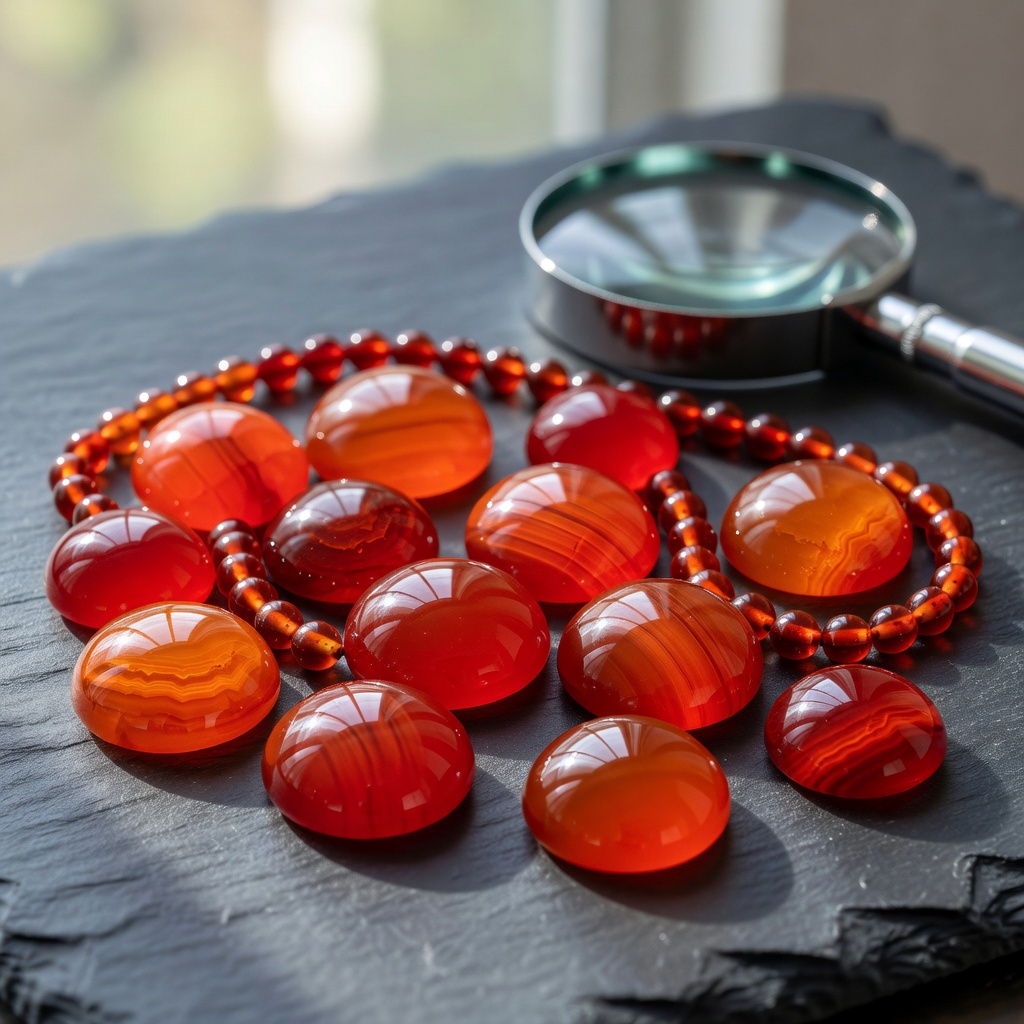
What Is Carnelian? Understanding This Ancient Chalcedony
Carnelian belongs to the chalcedony family, a cryptocrystalline variety of quartz characterized by its fine-grained structure and waxy luster. This captivating orange chalcedony forms through the deposition of silica-rich solutions in volcanic and sedimentary rock cavities, creating the gemstone's distinctive bands and color variations. With a Mohs hardness of 7 and a specific gravity ranging from 2.58 to 2.64, carnelian offers excellent durability for jewelry applications while maintaining a warm, inviting appearance that has captivated civilizations for millennia.
Historical records reveal that ancient Egyptians prized carnelian as a stone of vitality and protection, often crafting it into heart-shaped amulets for the afterlife and using it extensively in jewelry for pharaohs and high priests. Roman warriors wore carnelian signet rings and carved seals, believing the stone provided courage in battle and enhanced eloquence during public speeches. The gem's rich, warm hues symbolized the setting sun and the life-giving blood, embedding deep spiritual carnelian meaning across Mediterranean and Middle Eastern cultures that persists in crystal healing practices today.
Understanding the distinctions between carnelian and its close relatives helps collectors make informed purchasing decisions. While carnelian typically displays bright orange-red to reddish-brown colors, sard presents darker, brownish-red to almost black tones with a more opaque appearance. Sardonyx combines alternating layers of sard and white chalcedony, creating striking banded patterns prized for cameo carvings. When evaluating specimens, examine the stone's color depth and transparency, as true carnelian maintains a certain degree of translucency when held to light, whereas sard remains largely opaque even in thin sections.
Evaluating Carnelian Quality: Color, Clarity, and Cut
Exceptional carnelian gemstone quality manifests through a specific spectrum of warm hues ranging from vibrant honey-orange to deep, rich reddish-brown. The most coveted specimens display intense saturation without appearing muddy or brown-dominated, striking a perfect balance that resembles the glow of a sunset. Semi-translucent material commands premium prices because light penetration through the stone creates a lively, glowing effect that opaque specimens cannot achieve. When examining potential purchases, hold the stone against white paper under natural daylight to accurately assess its true color without the interference of artificial lighting or colored backgrounds.
Clarity standards for carnelian differ significantly from transparent gemstones like diamonds or sapphires, as collectors typically expect and appreciate the stone's natural inclusions and subtle banding. However, the highest quality pieces exhibit uniform color distribution without distracting dark spots, cracks, or cloudy areas that diminish the stone's luminosity. Banded or mottled patterns occur naturally in many carnelian specimens, and while these create interesting visual textures suitable for bohemian or artisan jewelry styles, uniformly colored stones generally command higher prices in the fine jewelry market. Inspect the gem from multiple angles to ensure color consistency throughout the entire piece.
The cutting style dramatically influences how carnelian displays its color and interacts with light. Traditional cabochon cuts with smooth, domed surfaces remain the most popular choice because they maximize the stone's color saturation and showcase its waxy luster while protecting the relatively soft material from chipping. However, modern lapidaries increasingly experiment with faceted cuts for high-clarity carnelian, creating brilliant sparkles that rival more expensive orange gems like spessartite garnet or fire opal. When selecting faceted carnelian, examine the pavilion facets through the table using a jeweler's loupe to ensure precise alignment and symmetry, as poorly executed faceting can create windowing effects that make the stone appear lifeless.
Natural vs Synthetic: How to Identify Authentic Carnelian
Distinguishing natural carnelian vs fake materials requires careful observation and basic gemological knowledge, as the market unfortunately contains numerous imitations ranging from dyed agate to colored glass. Authentic carnelian possesses a distinctive cool, heavy feel when held in the hand due to its quartz composition and specific gravity, while glass imitations often feel warmer and lighter. Examine the stone under magnification for natural inclusions, color zoning, or banding patterns that indicate geological formation processes, whereas synthetic materials typically appear unnaturally perfect or contain telltale bubbles and swirl marks characteristic of manufactured glass.
Dyed agate represents the most common imitation encountered by buyers, with unscrupulous vendors treating pale chalcedony with iron salts or organic dyes to simulate carnelian's rich orange-red coloration. To detect these treatments, examine the stone's fractures and surface-reaching cracks under magnification, as dye concentrations often appear darker in these areas, creating an unnatural color distribution. Perform a simple spot test by rubbing the stone vigorously against a white cloth dampened with acetone or nail polish remover; genuine carnelian will not transfer color, while dyed stones may leave orange or red residue indicating artificial color enhancement.
Hardness testing provides another reliable method for separating genuine carnelian from plastic or glass imitations, as quartz-based materials resist scratching from common metal objects. Attempt to scratch an inconspicuous area with a steel knife blade or key; real carnelian should remain unmarked, while glass may scratch and plastic will definitely show damage. For definitive identification, professional gemologists employ refractive index testing, measuring how light bends through the material at 1.535 to 1.539 for chalcedony, significantly different from glass readings around 1.5 or plastic measurements near 1.46. When investing in expensive specimens or antique pieces, always request documentation from recognized laboratories like GIA or AGL to verify authenticity and disclose any treatments.
Carnelian Origins: Mining Locations and Quality Differences
Carnelian sources span multiple continents, with current production concentrated in Madagascar, India, Brazil, and Uruguay, each region imparting distinct characteristics to the material. Madagascar currently produces some of the finest carnelian available, yielding deep, saturated orange-red stones with exceptional translucency and minimal banding. Indian deposits, particularly those from Gujarat and Maharashtra, have supplied the gemstone trade for centuries, offering material that ranges from pale peach to intense vermillion, often displaying the subtle color variations prized by traditional jewelry makers. When evaluating carnelian mining locations, consider that geological conditions specific to each region influence the stone's chemical composition and resulting appearance.
Brazilian carnelian typically originates from volcanic geodes in the Rio Grande do Sul region, frequently displaying distinctive banding patterns and agate formations that lapidaries cut to showcase natural landscapes within the stone. Uruguayan material often presents darker, more saturated colors with excellent consistency, making it ideal for high-end cabochons and beads. The geological formation process involves silica-rich solutions permeating gas cavities in ancient lava flows or filling fractures in sedimentary rocks, where iron oxide impurities create the characteristic red-orange coloration through natural irradiation and oxidation over millions of years.
Sustainability and ethical sourcing considerations increasingly influence purchasing decisions among conscious consumers. Artisanal mining operations in India and Madagascar often employ traditional, low-impact extraction methods, though working conditions vary significantly between operations. Reputable dealers should provide transparency regarding their supply chains, including information about fair labor practices and environmental protection measures. When buying premium carnelian, ask sellers specifically about the mine of origin and whether the material was extracted using mechanical equipment or hand-gathered methods, as these factors can affect both the stone's energy properties according to metaphysical beliefs and its ethical footprint.
Carnelian Price Guide: Budget to Premium Expectations
Understanding the carnelian price guide helps buyers establish realistic budgets while recognizing exceptional value opportunities across different market segments. Commercial-grade carnelian beads and cabochons typically range from $1 to $5 per carat, offering accessible entry points for jewelry enthusiasts and craft practitioners. Mid-grade material with good color saturation and minimal inclusions commands $5 to $15 per carat, suitable for fine silver jewelry and artisan collections. Collector-grade specimens featuring vivid, uniform orange-red colors, exceptional translucency, and large carat weights can reach $20 to $50 per carat or higher for museum-quality pieces with provenance or exceptional cutting.
Several factors significantly impact carnelian value beyond basic quality grades. Size matters considerably, as carnelian deposits rarely yield large, clean pieces; cabochons exceeding 20 carats with uniform color command disproportionately higher prices per carat than smaller stones. The cut quality and polish dramatically affect value, with custom-cut designer pieces fetching premiums over mass-produced commercial shapes. Additionally, antique carnelian carved intaglios or Victorian-era jewelry pieces carry historical premiums that can exceed the intrinsic material value, particularly when documentation verifies period authenticity and craftsmanship.
Market trends in 2024 reflect growing interest in affordable luxury and earth-toned jewelry, positioning carnelian advantageously between inexpensive synthetic alternatives and costly precious gems. Rough material suitable for lapidary hobbyists typically sells for $10 to $30 per pound depending on quality, offering creative opportunities for custom cutting. Finished bead strands range from $15 for basic 6mm rounds to $200 or more for high-grade, large graduated strands with consistent color. When comparing prices between vendors, calculate the per-carat or per-bead cost to ensure accurate comparisons, as packaging variations and strand lengths can obscure true value differentials.
Choosing Carnelian for Jewelry: Settings and Durability
Successful carnelian jewelry buying requires matching the gemstone's warm tones with complementary metal settings and appropriate designs that protect the material while showcasing its beauty. Yellow gold settings enhance the stone's natural warmth, creating cohesive, classic appearances that reference ancient Egyptian and Roman designs. Sterling silver provides striking contrast that makes the orange-red colors pop vividly, particularly effective in contemporary and bohemian jewelry styles. Bronze and copper settings complement carnelian's earthy origins, though these metals require more maintenance to prevent oxidation from affecting the stone's appearance over time.
Different jewelry types present unique considerations for carnelian placement and wearability. Rings face the highest risk of impact damage and abrasion, making bezel settings preferable to prong settings as they wrap the stone's edges in protective metal. Pendants and earrings experience less mechanical stress, allowing for more delicate prong settings or open-back designs that maximize light transmission through the stone. Beaded bracelets remain perennial favorites for carnelian, but ensure the drill holes are smooth and properly sized to prevent string from cutting into the stone edges; silk knotting between beads prevents scratching and loss if the strand breaks.
When selecting carnelian ring settings, consider your daily activities and lifestyle requirements. While carnelian's Mohs hardness of 7 suits everyday wear, avoid wearing rings during activities involving hard impacts against metal or stone surfaces, such as weightlifting or construction work. Protective cabochon settings with raised metal rims guard against chipping better than exposed faceted designs. For statement pieces featuring large carnelian specimens, ensure the setting includes proper ventilation to prevent moisture accumulation behind the stone, which can cause setting deterioration and potential stone loosening over time.
Treatments and Enhancements: What Buyers Must Know
The majority of heat treated carnelian available in today's market undergoes thermal enhancement to intensify natural coloration, a practice accepted within the gemstone industry but requiring transparent disclosure. Natural carnelian often forms with pale orange or brownish tones that heating improves to the desirable vivid red-orange colors consumers prefer. This treatment involves slowly heating the material to 300-400 degrees Celsius in controlled environments, permanently altering the iron oxide inclusions responsible for color without adding foreign substances. Reputable dealers clearly label such material as "heated" or "enhanced," while untreated natural carnelian with strong color commands premiums among purist collectors.
Dye treatments present more concerning issues for buyers seeking authentic material, as some vendors inject pale chalcedony with iron salts or chemical dyes to simulate high-quality carnelian. Treated carnelian through dyeing lacks the permanence of heat treatment, with colors potentially fading under prolonged sunlight exposure or chemical contact. Detect dyed stones by examining them under magnification for color concentrations along fractures or surface pits, where dyes accumulate unevenly. Additionally, dyed material often displays unnaturally vivid, uniform colors lacking the subtle variations characteristic of natural geological formation processes.
Industry standards established by organizations like the International Gemological Institute (IGI) and American Gem Trade Association (AGTA) require sellers to disclose any treatments that significantly affect a stone's appearance or durability. When purchasing carnelian, specifically ask sellers whether the material has been heated, dyed, or treated in any way, and request written confirmation of their response. Untreated, naturally vivid carnelian represents a small percentage of the market and typically costs 30% to 50% more than heated material of similar appearance. For investment purchases or collector specimens, prioritize documented untreated stones, while heated carnelian offers excellent value for decorative and jewelry purposes when properly disclosed.
Where to Buy Carnelian: Online vs Brick-and-Mortar
Deciding whether to buy carnelian online or through physical stores involves weighing convenience against the ability to inspect material firsthand, though both channels offer legitimate pathways to quality acquisitions. Established online gemstone dealers specializing in cabochons and rough material often provide superior selection and competitive pricing compared to local jewelry stores, with inventory ranging from commercial beads to rare collector specimens. When evaluating online vendors, examine their photography practices carefully, looking for multiple angles, videos showing light transmission, and neutral backgrounds that accurately represent color. Be wary of listings using heavily saturated photos or exotic lighting that may disguise color zoning or treatments.
Physical brick-and-mortar locations allow tactile evaluation of carnelian's weight, temperature, and surface quality before purchase, particularly valuable when selecting large investment pieces or matching stones for jewelry sets. Lapidary shows and gemological conferences offer opportunities to meet cutters directly, examine rough material, and commission custom cuts tailored to specific jewelry designs. When visiting physical stores, bring a jeweler's loupe and small LED flashlight to examine stones for internal characteristics, and request to view material away from their bright display lighting which often uses colored LEDs to enhance appearance.
Regardless of purchase channel, verify seller credentials through industry associations like the AGTA or Better Business Bureau, and review return policies carefully before committing to purchases. Reputable carnelian dealers offer inspection periods ranging from seven to thirty days, allowing time for independent verification by a gemologist. Essential questions to ask sellers include: "Has this material been heat-treated or dyed?", "What is the exact country of origin?", "Can you provide certification for treatments?", and "What is your policy if the stone proves to be imitation rather than natural chalcedony?" Document all communications and keep receipts, as carnelian's relative affordability sometimes leads buyers to skip due diligence that would be automatic with more expensive gems.
Caring for Your Carnelian: Maintenance and Cleaning
Proper carnelian care ensures your gemstone jewelry maintains its warm luster and structural integrity for generations, requiring simple but consistent maintenance routines. Clean carnelian using mild dish soap diluted in lukewarm water, gently scrubbing with a soft-bristled toothbrush to remove accumulated oils and debris from settings and surface crevices. Avoid ultrasonic cleaners and steam cleaning equipment, as the thermal shock and vibrations can aggravate existing fractures or loosen stones from their settings. After washing, pat dry with a soft lint-free cloth rather than air-drying to prevent water spots from forming on the polished surface.
Storage practices significantly impact long-term preservation, as carnelian can scratch softer materials while sustaining damage from harder gemstones. Store carnelian jewelry in individual soft cloth pouches or compartmentalized jewelry boxes, keeping pieces separated from diamonds, sapphires, rubies, and other gems ranking higher than 7 on the Mohs scale. Avoid exposing carnelian to prolonged direct sunlight, which can gradually fade heat-treated colors over years of exposure, and keep pieces away from windowsills or car dashboards where temperature fluctuations and UV exposure concentrate.
Cleaning carnelian gemstone pieces requires avoiding harsh household chemicals including bleach, ammonia, and abrasive cleaners that can etch the surface or damage metal settings. Remove carnelian rings before swimming in chlorinated pools or using cleaning products, as chemical exposure can dull the polish and potentially affect any dyes in treated material. Professional cleaning and re-polishing services become necessary when surface scratches accumulate from years of wear, with lapidaries able to restore the original luster by lightly buffing the surface. Inspect settings annually for loose prongs or worn bezels, particularly for frequently worn rings, and seek immediate professional repair if you notice the stone shifting in its mounting or hear rattling sounds.
Frequently Asked Questions About Carnelian
How can I tell if my carnelian is real or fake?
Real carnelian has a Mohs hardness of 7, feels cool to the touch, and shows natural variations in color. Fake carnelian made from glass often has bubbles, perfect uniformity, or feels lighter. Dyed agate imitations may show color concentrations in cracks. When in doubt, consult a gemologist for refractive index testing.
What is the best color for high-quality carnelian?
The most valued carnelian displays a vivid, uniform orange-red to reddish-brown color with semi-translucency. While personal preference varies, intensely saturated colors without muddy brown tones command higher prices. Avoid stones that appear too bright or neon, as these are often dyed.
Is carnelian expensive compared to other gemstones?
Carnelian is considered an affordable gemstone, typically ranging from $1 to $30 per carat depending on quality. Even high-grade specimens with exceptional color and clarity remain budget-friendly compared to precious gems like ruby or sapphire, making carnelian excellent for statement jewelry pieces.
Can carnelian be worn every day?
Yes, with a Mohs hardness of 7, carnelian is durable enough for daily wear in rings and bracelets. However, protect it from hard impacts and harsh chemicals. While resistant to scratching from daily activities, store it separately from harder gems like diamonds or sapphires to prevent surface damage.
Where does the highest quality carnelian come from?
Madagascar and India currently produce the finest carnelian, known for deep, saturated orange-red colors and excellent translucency. Brazilian and Uruguayan material is also highly regarded. Historically, carnelian from Yemen was prized, though modern deposits there are largely depleted.
Is most carnelian on the market heat-treated?
Yes, a significant portion of commercial carnelian has been heat-treated to enhance its natural red-orange color. This treatment is permanent and widely accepted in the industry, but reputable sellers should disclose it. Untreated natural carnelian with strong color commands a premium among collectors.
What should I look for when buying carnelian beads?
When purchasing carnelian beads, check for consistent drilling holes, smooth surface polish without cracks, and uniform color if that's the style you want. For natural look, slight color variation is normal. Ensure beads aren't dyed by checking for color rubbing off on a white cloth or concentrating around drill holes.
Do I need a certificate when buying carnelian?
For most commercial carnelian purchases under $500, a certificate isn't necessary. However, for investment-grade specimens, antique pieces, or high-value jewelry, request documentation from recognized labs like GIA or IGI. Certificates verify natural origin, treatments, and authenticity, protecting your investment.