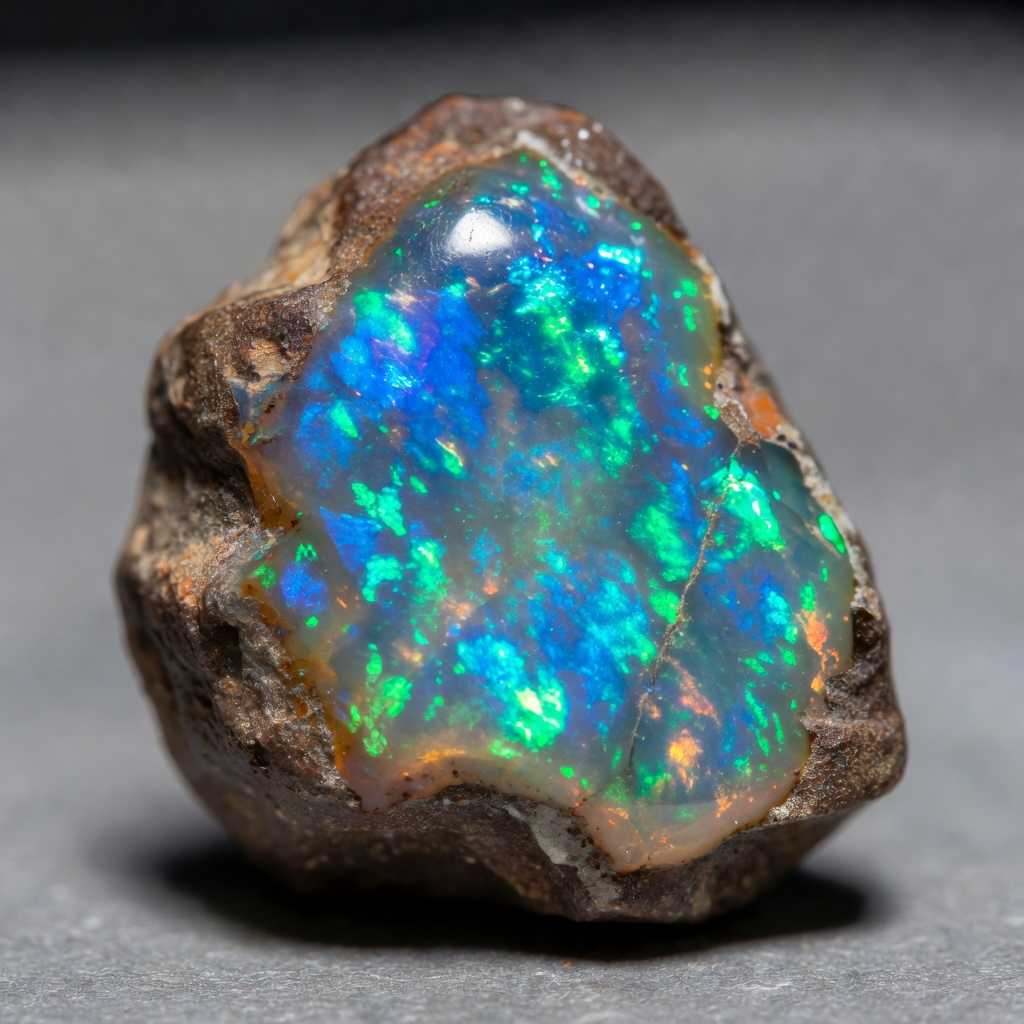
Introduction to Boulder Opal
Boulder opal represents one of nature's most fascinating geological creations, forming when precious opal infiltrates the cavities and cracks of ironstone boulders over millions of years. Unlike other opal varieties that occur as distinct seams or nodules, this unique gemstone remains naturally attached to its host rock, creating striking visual contrasts between vibrant silica formations and earthy brown matrices. When examining Boulder Opal Properties and Information, collectors immediately notice how these stones showcase opal color in its most natural state, with the dark ironstone background serving to amplify the brilliance of the opal layer.
The discovery of Queensland boulder opal in the late 19th century transformed the Australian gemstone industry and introduced the world to a previously unknown opal variety. Early prospectors in the remote outback regions initially dismissed these ironstone-encased gems as inferior to the precious black opals of Lightning Ridge, only later realizing that the unique matrix patterns and enhanced durability offered distinct advantages for both jewelry and collecting purposes. Historical records indicate that commercial mining began in earnest around 1872, with the first significant finds near Quilpie and later discoveries in Winton that would establish Queensland as the premier source for this distinctive gemstone.
Contemporary jewelry designers and collectors have embraced natural boulder opal stone for its organic aesthetic and exceptional individuality. Each piece tells a geological story through its irregular shapes and natural matrix patterns, making every gemstone truly one-of-a-kind in ways that manufactured or treated stones cannot replicate. The growing appreciation for sustainable and ethically sourced gemstones has further elevated boulder opal's status, as the mining methods typically involve smaller-scale operations with lower environmental impact compared to large-scale industrial gemstone extraction.
Geological Formation and Structure
The formation of Queensland boulder opal requires specific geological conditions that occur only in particular sedimentary environments found primarily in Australia's Cretaceous-age geological basins. Approximately 100 to 110 million years ago, silica-rich water solutions permeated through weathered sandstone layers and deposited microscopic silica spheres within the cracks and voids of ironstone boulders. Over countless millennia, these silica deposits gradually solidified into precious opal, creating the distinctive bond between gem-quality opal and its ironstone host that defines this variety.
The specific chemistry of Queensland's sedimentary basins played a crucial role in determining the quality and color range of the opal deposits formed there. Unlike the volcanic-hosted opals found in regions like Ethiopia, Australian boulder opal formed in sedimentary settings where iron oxide concretions provided the perfect host material for silica deposition. The slow cooling and drying cycles of the ancient inland seas allowed for the formation of larger silica spheres, which correlate directly with the ability to display red and orange color flashes—the most valued hues in the opal market.
Understanding the Ironstone opal matrix reveals why these gemstones exhibit such remarkable structural integrity compared to other opal types. The ironstone serves not merely as a backing material but as an integral component that prevents the delicate opal layer from cracking under pressure or temperature fluctuations. Matrix patterns vary significantly between specimens, ranging from sparse precious opal veining through the ironstone to extensive coverage where the opal permeates throughout the host rock, creating intricate networks of color that gemstone cutters carefully preserve during the cutting process.
Physical and Optical Properties
When analyzing Boulder Opal Properties and Information, gemologists note specific measurable characteristics that distinguish these stones from other precious opal varieties. Boulder opal typically registers between 5.5 and 6.5 on the Mohs hardness scale, though the presence of ironstone backing effectively increases the overall toughness and resistance to breakage compared to solid precious opal. Specific gravity measurements range from 1.98 to 2.50 depending on the ratio of opal to ironstone content, with purer opal sections exhibiting lower density than the surrounding host rock.
The refractive index of boulder opal varies between 1.44 and 1.46, with higher values typically indicating denser silica structures capable of displaying more intense color phenomena. Transparency levels range from opaque in the ironstone sections to semi-transparent or transparent in thin precious opal layers, allowing skilled lapidaries to orient cuts that maximize light transmission through the color bar. These optical properties combine with the stone's natural structure to create the distinctive appearance that makes boulder opal immediately recognizable to experienced gemologists and collectors.
The science behind play-of-color in boulder opal involves the diffraction of light through regularly arranged silica spheres that act as natural diffraction gratings. When white light enters the opal structure, these microscopic spheres separate the light into spectral colors based on their uniform size and packing arrangement. Boulder opal often displays this optical phenomenon in unique ways because the irregular interface between opal and ironstone can create additional reflective surfaces that enhance brightness and create complex color interactions not typically seen in solid opal varieties.
Color Patterns and Classifications
Distinguishing between different Opal color bar patterns requires understanding how the precious opal layer interacts with the ironstone matrix to create visual effects. Color bar patterns refer specifically to the horizontal or vertical bands of precious opal that run through the ironstone, often displaying as thin lines, broad flashes, or intricate veining that follows the natural fractures in the host rock. Matrix patterns, conversely, describe the appearance when opal permeates the ironstone in dendritic formations, creating pictures or scenic views within the stone that collectors sometimes refer to as "nature's artwork."
The body tone of boulder opal ranges from N1 (very dark) to N9 (very light) on the standardized opal body tone chart, with darker tones generally commanding higher market values due to the enhanced contrast they provide for color display. Brightness assessment evaluates how intensely the stone flashes color under standard lighting conditions, with ratings from B1 (brilliant) to B7 (dull) helping determine commercial value. Professional graders examine these characteristics under controlled lighting to ensure consistent evaluation, as the ironstone backing naturally provides darker body tones that can make even moderate color appear exceptionally vivid.
Rare pattern types elevate certain specimens to museum-quality status among serious collectors. The "Chinese Writing" pattern features geometric linear arrangements resembling calligraphy, created when opal fills intersecting fracture networks within the ironstone. "Harlequin" patterns display diamond-shaped patches of color that align in mosaic-like arrangements, representing one of the most difficult patterns to find in boulder opal due to the specific geological conditions required for their formation. "Floral" patterns create flower-like arrangements of color that seem to bloom across the ironstone surface, often combining multiple colors in symmetrical arrangements that command premium prices at international gem shows.
Mining Locations and Sources
Australian opal mining for boulder opal concentrates primarily within the vast expanse of Queensland's opal fields, stretching across remote outback regions that experience extreme temperature variations and minimal rainfall. The town of Winton serves as the commercial hub for the northern fields, where miners extract high-quality specimens from depths ranging from surface level to thirty meters underground. Quilpie functions as the center for the southern fields, producing stones characterized by thicker color bars and more extensive ironstone coverage, while the legendary Yowah district specializes in "Yowah Nuts"—ironstone concretions that occasionally contain precious opal centers prized by collectors worldwide.
Underground mining techniques dominate Queensland boulder opal extraction, involving the digging of shafts and tunnels following opal-bearing levels within the weathered Cretaceous sediments. Miners use jackhammers and hand tools to carefully extract ironstone boulders without damaging potential opal formations, as mechanized equipment risks shattering the valuable color bars hidden within the rock. Open-cut operations occur less frequently and typically involve removing overburden to expose opal-bearing levels, though environmental regulations increasingly restrict such methods to minimize landscape disruption in these fragile arid ecosystems.
Sustainable mining practices have gained traction among Queensland boulder opal operations, with many miners implementing rehabilitation programs that restore digging sites to natural conditions after extraction concludes. The remote location of these mines necessitates self-sufficient operations powered by solar generators and supported by limited water recycling systems that minimize environmental impact. Modern prospectors also utilize advanced ground-penetrating radar and resistivity surveys to locate opal-bearing formations before digging, reducing unnecessary land disturbance while improving the efficiency of finding high-quality specimens.
Quality Factors and Valuation
Understanding Boulder opal value factors requires appreciation of how multiple characteristics interact to determine market price, with brightness serving as the primary value determinant regardless of color hue. A stone displaying brilliant flashes that remain visible under normal indoor lighting conditions commands significantly higher prices than equally colorful stones that appear dull or only show fire under direct sunlight. Red color presence dramatically increases value, particularly when combined with orange and green in multi-color displays, while blue and green single-color stones remain more accessible to entry-level collectors despite their inherent beauty.
Bar thickness—the vertical measurement of the precious opal layer attached to the ironstone—directly impacts both durability and cutting options, with thicker bars allowing for more versatile jewelry applications and greater longevity. Cut orientation represents a critical decision in the valuation process, as skilled cutters must balance maximizing color display against preserving carat weight and structural integrity. Stones cut with the color bar oriented parallel to the surface display broader flashes of color, while perpendicular orientations might create pinfire or harlequin effects but risk revealing the ironstone boundary too prominently.
Size considerations follow different rules in boulder opal compared to other gemstones, where larger stones often command exponential price increases per carat. While substantial specimens certainly hold value, the market particularly favors stones between 5 and 20 carats that offer sufficient surface area to display pattern complexity while remaining practical for jewelry settings. Specimen pieces featuring exceptional matrix pictures or rare patterns may exceed the value of cut stones regardless of size, as the unique geological artistry captures the interest of serious mineral collectors who prize natural formation over lapidary refinement.
Durability and Hardness Considerations
Evaluating Boulder opal durability reveals significant advantages over other precious opal varieties, primarily due to the structural support provided by the ironstone backing. While the precious opal portion maintains the standard 5.5-6.5 Mohs hardness rating common to all opals, the composite nature of boulder opal creates a tougher gemstone that resists chipping and cleaving better than solid black or white opal. The ironstone acts as a natural stabilizer, absorbing impact forces that might otherwise fracture pure opal, making these stones particularly suitable for rings and bracelets subject to daily wear.
Water content stability concerns affect all opal varieties, though boulder opal generally demonstrates superior resistance to crazing—the development of surface cracks due to dehydration or thermal shock. The ironstone matrix helps regulate moisture exchange between the opal and environment, buffering the silica structure against rapid humidity changes that cause other opals to crack. However, extreme temperature variations still pose risks, as differential expansion rates between the opal and ironstone can create stress at the interface, necessitating protection from sudden exposure to high heat or freezing conditions.
The Ironstone opal matrix contributes to structural integrity in ways that enhance the gemstone's suitability for various jewelry applications. Unlike doublet or triplet opals that rely on artificial adhesives to attach backing materials, the natural chemical bond between boulder opal and its host rock creates a permanent union that will not delaminate over time. This natural integration allows jewelers to set boulder opal with greater confidence in bezels or prong settings, knowing that the stone can withstand the pressures of mounting without the risk of separating layers that plagues assembled opal products.
Care and Maintenance Guidelines
Proper cleaning techniques for boulder opal emphasize gentleness and avoidance of mechanical or chemical stresses that might compromise the stone's integrity. Owners should clean their gemstones using lukewarm water mixed with mild, phosphate-free soap, applying the solution with a soft microfiber cloth or natural bristle brush to remove accumulated oils and debris. Ultrasonic cleaners and steam cleaning devices pose significant risks to boulder opal, as the vibrations and thermal shock can initiate crazing or loosen the natural bond between opal and ironstone, potentially ruining valuable specimens.
Storage recommendations focus on maintaining stable humidity levels and protecting stones from physical abrasion, as the opal surface remains softer than common jewelry materials like diamonds or sapphires. Individual soft cloth pouches or compartmentalized jewelry boxes prevent scratching from contact with harder gemstones, while storage in moderately humid environments—avoiding both desert-dry conditions and damp basements—helps maintain the stone's natural water content. Direct sunlight exposure should be minimized during storage, as prolonged UV radiation and heat can gradually dehydrate the silica structure, potentially leading to color fading or cracking over extended periods.
Re-oiling or hydrating boulder opal becomes necessary only when stones show signs of surface drying or diminished luster, though such interventions require careful execution to avoid damage. Mineral oil or specialized opal preservation solutions can be applied sparingly to the stone surface, allowed to penetrate for several hours, then wiped clean with a soft cloth to restore appearance. However, excessive oiling can attract dust and create buildup that dulls the stone's appearance, so owners should consult professional gemologists before attempting hydration treatments on high-value specimens, ensuring that preservation efforts enhance rather than compromise their investment.
Uses in Jewelry and Collecting
The versatility of natural boulder opal stone manifests in diverse cutting styles that embrace the material's organic characteristics rather than forcing it into standard geometric shapes. Freeform cutting follows the natural contours of the ironstone boulder, preserving maximum color and creating one-of-a-kind cabochons that showcase the stone's unique personality. Calibrated stones—cut to standard dimensions for commercial jewelry production—require more material waste but allow designers to incorporate boulder opal into traditional settings alongside diamonds and other precious gems.
Setting considerations for boulder opal jewelry must balance protection with visibility, as the ironstone backing typically precludes light transmission from behind but requires secure mounting to prevent chipping at the opal's edges. Bezel settings provide optimal protection by wrapping the stone's perimeter in metal, guarding the vulnerable junction between precious opal and ironstone against impacts that could cause delamination. Prong settings offer greater light access to the stone's surface but require careful design to ensure prongs contact only the ironstone portions, avoiding pressure on the softer opal color bar that might cause cracking.
Specimen pieces featuring natural matrix patterns hold particular appeal for mineral collectors who value geological significance alongside aesthetic beauty. These uncut or minimally processed stones display the raw interaction between opal and host rock, often revealing dendritic formations, fortification patterns, or scenic pictures that cutters would eliminate during commercial gemstone preparation. Museums and private collectors seek exceptional specimens that demonstrate the full range of boulder opal formation possibilities, from sparse precious opal veining to extensive coverage that transforms the ironstone into a canvas of natural art, with values sometimes exceeding those of cut gemstones due to rarity and educational significance.
Investment Potential and Market Trends
Serious investors examining Boulder opal value factors recognize rarity drivers that suggest strong long-term appreciation potential for high-quality specimens. Unlike diamonds or sapphires that occur in multiple global localities, genuine boulder opal originates exclusively from Queensland's limited geographic range, with no significant discoveries outside Australia despite extensive exploration. Depletion of accessible deposits coupled with increasing mining costs and regulatory restrictions suggests diminishing supply, while growing international awareness of this unique gemstone continues expanding demand among collectors and jewelry connoisseurs.
Current market dynamics show particular strength in Asian markets, where Chinese and Japanese buyers increasingly appreciate boulder opal for its natural appearance and connection to Australian mining heritage, while American collectors value the stone's individuality in an era of mass-produced jewelry. Auction results from major houses indicate steady price increases for exceptional specimens exceeding ten carats with bright multi-color displays, with top-tier stones achieving prices comparable to fine sapphires or emeralds on a per-carat basis. The democratization of information through online platforms has also expanded the collector base beyond traditional gem centers, creating global competition for premium pieces.
Authentication and certification have become essential components of Australian opal mining investment strategies, as treatments and synthetic materials increasingly infiltrate the market. Reputable gemological laboratories provide documentation verifying natural origin, absence of artificial color enhancement, and specific quality parameters that support valuation. Investors should prioritize stones accompanied by certificates from recognized institutions such as the Gemological Institute of America (GIA) or the Gemmological Association of Australia (GAA), ensuring that their acquisitions represent genuine natural boulder opal with documented characteristics that will retain value through future market fluctuations.
Frequently Asked Questions
What makes Boulder Opal different from other types of opal?
Boulder opal forms naturally within ironstone host rock, creating a unique appearance where precious opal permeates the brown matrix. Unlike black or white opal, it remains attached to its host stone, offering enhanced durability and distinctive natural patterns that cannot be replicated in other varieties.
How is the value of Boulder Opal determined?
Value depends on several factors including brightness (how intensely the stone flashes color), color range (red being most valuable), pattern uniqueness, bar thickness, and overall size. The contrast between the vibrant opal and dark ironstone matrix also significantly impacts desirability and price per carat.
Is Boulder Opal durable enough for everyday jewelry?
Yes, boulder opal is actually more durable than many other opal types because the ironstone backing provides structural support. With a hardness of 5.5-6.5 Mohs, it resists chipping better than solid opal, though it still requires protection from hard knocks, extreme heat, and harsh chemicals.
Where is Boulder Opal mined?
Almost all boulder opal comes from Queensland, Australia, specifically around the towns of Winton, Quilpie, Yowah, and Koroit. These remote outback regions contain the unique geological formations where silica deposited in ironstone boulders millions of years ago.
Can Boulder Opal lose its color or crack over time?
Quality boulder opal is generally stable, but lower-grade stones may craze (develop surface cracks) if exposed to extreme temperature changes or dehydration. Unlike some treated opals, natural boulder opal rarely loses color, though proper storage in moderate humidity helps maintain its appearance indefinitely.
What are the most valuable color patterns in Boulder Opal?
The most prized patterns include 'Chinese Writing' (geometric linear patterns), 'Harlequin' (diamond-shaped patches), and 'Floral' (flower-like arrangements). Red multicolor flashes against dark ironstone command the highest prices, while single-color blue or green stones remain more affordable.
How should I clean my Boulder Opal jewelry?
Clean boulder opal using warm water, mild soap, and a soft cloth or brush. Avoid ultrasonic cleaners, steam cleaners, and harsh chemicals. Since the stone contains water, never store it in sealed containers with desiccants or expose it to prolonged direct sunlight which may cause drying.
Does Boulder Opal have metaphysical properties?
Many crystal healers attribute boulder opal with grounding properties due to its ironstone base combined with the amplifying qualities of opal. It's believed to enhance creativity, emotional balance, and connection to the earth, though these properties are not scientifically proven and vary by cultural tradition.