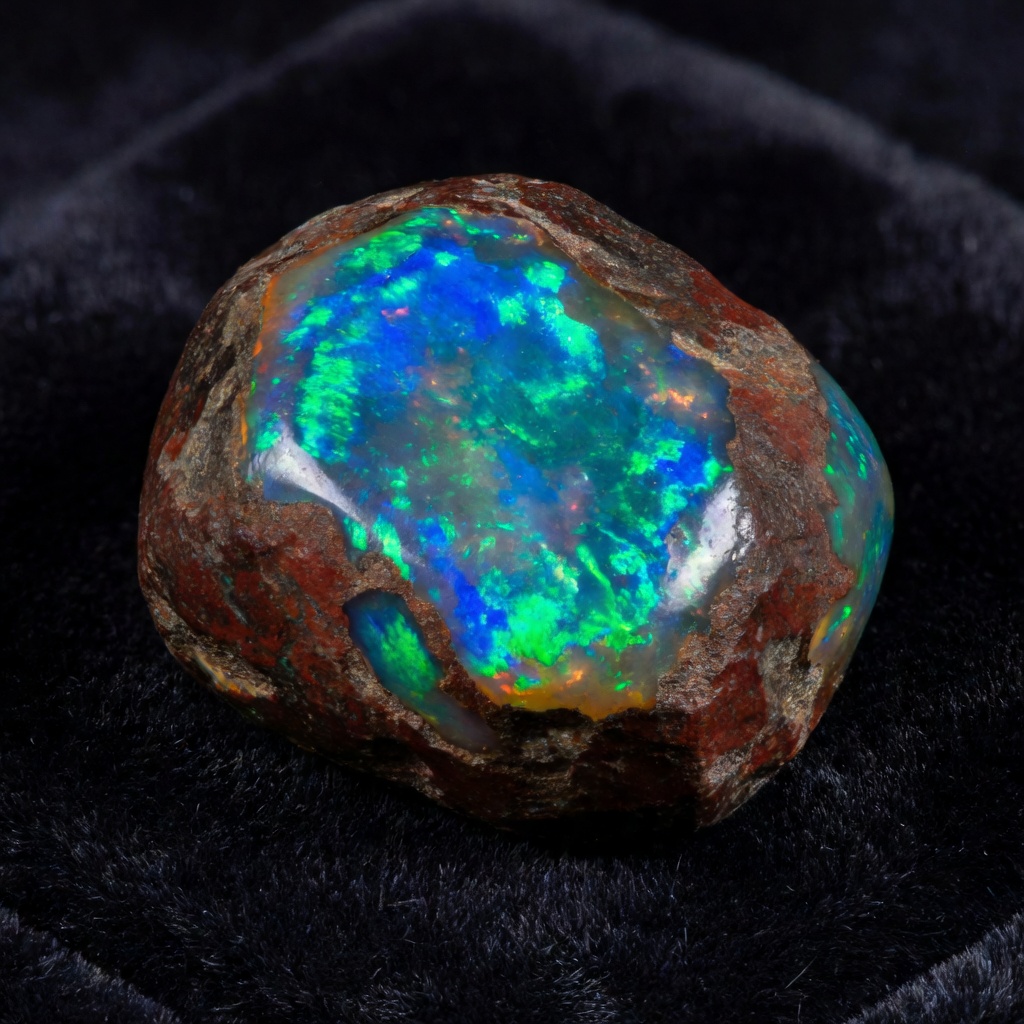
Understanding Boulder Opal: Formation and Unique Characteristics
Boulder opal represents one of Australia's most distinctive gemstones, formed when precious opal naturally occurs within the cavities and fissures of ironstone host rock. Unlike other opal varieties that form in sedimentary clay layers or volcanic environments, boulder opal develops specifically within the ironstone boulders of Queensland's ancient Cretaceous deposits, where silica-rich water percolated through the host rock over millions of years to create brilliant color flashes. This unique geological formation process results in stones that display precious opal seamlessly fused with their natural ironstone backing, creating a striking contrast between the vibrant play-of-color and the deep brown or rust-colored host material.
When evaluating Australian boulder opal value, collectors must understand the fundamental differences between this variety and both black opal from Lightning Ridge and white opal from Coober Pedy. While black opal commands premium prices due to its dark body tone and rarity, boulder opal offers exceptional value because the ironstone backing provides natural stability and eliminates the need for artificial treatments often required for thinner opal seams. The boulder opal formation process creates stones that are typically more durable than their black or white counterparts, though the visible matrix backing means pricing structures differ significantly based on the percentage of precious opal versus host rock content.
Professional gemologists distinguish boulder opal by its natural composite structure, where the opal layer remains permanently attached to the ironstone base, unlike doublets or triplets that artificially combine separate materials. This natural adhesion creates unique visual effects where the opal appears to float within the ironstone matrix, particularly in specimens from specific Queensland fields where the silica penetration created intricate veining patterns. Understanding these formation characteristics proves essential for buyers navigating the boulder opal market, as stones with thicker opal seams command substantially higher prices than those with surface-level color bars.
Key Quality Factors That Determine Boulder Opal Prices
The valuation of boulder opal relies heavily on standardized quality assessments, particularly the brightness rating scale that ranges from B1 (dull, milky appearance) to B5 (brilliant, neon-like flashes visible even in low lighting conditions). Professional dealers utilize this brightness classification system alongside body tone measurements to establish baseline values, with B4 and B5 stones commanding premiums of 300-400% above B1 or B2 specimens of similar size. When assessing opal quality factors, experienced buyers examine stones under multiple lighting conditions, including natural daylight, incandescent bulbs, and LED sources, to verify that the boulder opal brightness remains consistent and does not rely on specific angles or artificial enhancement.
Pattern rarity significantly influences pricing hierarchies within the boulder opal market, with harlequin patterns—displaying distinct geometric patches of color—representing the pinnacle of value, often fetching $3,000 to $10,000 per carat for high-quality examples. Pinfire patterns, characterized by tiny pinpoints of color scattered across the surface, typically occupy the mid-range pricing tier, while broadflash or flash patterns that display large color sweeps across the stone appeal to jewelry designers seeking dramatic visual impact. Exceptional specimens exhibiting rare floral patterns, cat's-eye effects, or Chinese writing patterns (resembling calligraphic strokes) can exceed standard pricing matrices entirely, selling at auction for prices determined by competitive bidding among specialized collectors.
Body tone darkness and transparency levels create additional value stratification, with darker body tones (N1 to N3 on the standardized scale) generally commanding higher prices due to the enhanced contrast they provide for the play-of-color. However, boulder opal occasionally produces crystal or semi-crystal varieties where the opal material remains translucent to transparent, allowing light to penetrate and create three-dimensional color effects within the ironstone cavity. These transparent boulder opals, particularly those from the Quilpie region displaying red or orange fire, occasionally surpass the value of equivalent black opals due to their extreme rarity and the unique "window" effect they create when backlit.
Current Boulder Opal Price Per Carat: 2024 Market Ranges
The boulder opal price per carat in today's market spans an extraordinary range, reflecting the vast quality differences between commercial material and museum-grade specimens. Commercial grade stones, typically featuring limited color range (primarily blue or green with minimal red), moderate brightness (B2-B3), and significant ironstone backing, currently trade between $50 and $200 per carat in wholesale markets. These stones suit mass-market jewelry production and entry-level collectors, though they rarely appreciate significantly in value and often serve as educational pieces for those beginning their opal collection journey.
High-quality specimens exhibiting vivid multi-color flashes with red or orange components, brightness ratings of B4 or B5, and attractive pattern formations command substantially higher prices, typically ranging from $500 to $2,000 per carat depending on size and origin. For example, a five-carat stone from Winton displaying bright red pinfire against a dark blue background might retail for $7,500 to $10,000, while a similar-sized stone with predominantly green flash and B3 brightness might sell for $1,200 to $1,800. These mid-tier stones represent the sweet spot for serious collectors seeking both aesthetic beauty and potential appreciation, particularly when sourced with documentation confirming their Queensland field origin.
Exceptional museum-grade pieces featuring rare harlequin patterns, intense red-on-black color play, or extraordinary size (exceeding 20 carats with solid gem content) regularly exceed $5,000 per carat at specialized auctions and private sales. Recent auction records include a 15-carat Winton boulder opal displaying full-spectrum harlequin pattern that sold for $85,000, representing approximately $5,667 per carat. When evaluating raw boulder opal prices, rough material suitable for cutting typically sells for 30-40% of finished stone values, accounting for the significant risk involved in cutting—experienced cutters anticipate 50-70% material loss during the shaping process due to the unpredictable nature of ironstone inclusions and color bar orientation.
How Matrix Patterns and Ironstone Backing Affect Value
Understanding the distinction between matrix opal and solid boulder opal proves crucial for accurate valuation, as matrix opal pricing operates on entirely different economic principles than solid gem material. Matrix opal occurs when precious silica permeates the ironstone host in fine veins, spots, or dendritic patterns throughout the rock, creating an artistic "landscape" effect where the opal and host material remain visually integrated rather than distinctly layered. These specimens, particularly those from Koroit and Yowah, typically command $20 to $100 per carat depending on pattern density and color intensity, appealing to collectors who appreciate the natural artistry of the stone rather than pure gem content.
Solid boulder opal, by contrast, features distinct seams or nodules of precious opal attached to the ironstone backing, creating the classic "face-up" appearance where brilliant color plays against the dark brown host rock. The percentage of ironstone host rock versus precious opal content directly impacts per-carat calculations, with gemologists using specialized formulas to estimate the "solid opal equivalent" when pricing these composite stones. A 10-carat boulder opal containing approximately 30% precious opal and 70% ironstone effectively contains 3 carats of solid gem material, explaining why such stones cost significantly less per carat than equivalent black opals of pure composition.
The natural ironstone boulder opal backing provides crucial stability and durability that adds practical value despite reducing the pure gem weight percentage. Unlike thin-seam black opals that require careful mounting to prevent cracking, boulder opal's ironstone foundation allows for robust jewelry settings suitable for daily wear, including rings and bracelets that would risk damaging more fragile opal varieties. Some contemporary designers specifically seek boulder opal with attractive matrix patterns where the transition between precious opal and host rock creates organic, freeform shapes that require no cutting or shaping—nature's own jewelry designs that command premium prices in the artisan market despite lower traditional gem grades.
Origin Matters: Queensland Field Price Variations
Specific provenance within Queensland's boulder opal belt significantly influences valuation, with stones from the Winton and Quilpie fields commanding premium pricing due to their historical association with intense red flash and exceptional brightness. The Winton formation, particularly material from the Opalton and Koroit regions, produces stones renowned for their stability and vibrant color saturation, with red-fire specimens from these fields regularly achieving 20-30% price premiums over equivalent quality stones from lesser-known deposits. When calculating Queensland boulder opal cost, dealers maintain detailed field-specific price lists, recognizing that buyers increasingly demand documentation proving a stone's origin from depleted or restricted mining areas where future supply remains uncertain.
Yowah nuts represent a specialized category within the boulder opal market, consisting of ironstone concretions (naturally formed spherical rocks) that occasionally contain opal centers or kernel patterns visible only after cutting. These specimens, unique to the Yowah field approximately 160 kilometers southwest of Cynthiana, command specialized pricing structures based on the probability of finding opal within the nut and the aesthetic quality of any pattern revealed. High-quality Yowah nut opal prices range from $100 to $800 per nut for specimen-grade pieces, while exceptional "kernel" nuts displaying concentric color rings can exceed $2,000 per carat for the opal content alone, attracting collectors who value the gambling excitement and natural curiosity aspect of these geological formations.
The Koroit field produces distinctive matrix opal characterized by intricate dendritic patterns and rich chocolate-brown ironstone that provides dramatic contrast to bright green and blue opal veining. While traditionally considered less valuable than Winton material, top-tier Koroit specimens featuring "picture stone" patterns—where the matrix resembles landscapes, animal forms, or abstract art—have developed dedicated collector followings willing to pay premium prices exceeding $500 per carat for exceptional examples. Mining restrictions and increasing difficulty of extraction in established fields continue to drive location-specific price appreciation, with material from historically significant claims that have ceased production commanding "heritage premiums" among serious Australian opal connoisseurs.
Cut, Shape, and Carat Weight: Additional Pricing Variables
The methodology of boulder opal cutting significantly impacts final valuation, with freeform shapes that follow the natural contour of the opal seam commanding different premiums than calibrated cuts designed for standard jewelry settings. Freeform boulder opals, which retain the organic outline of the original ironstone boulder while exposing the maximum precious opal surface, typically achieve higher per-carat prices in the designer jewelry market, where uniqueness and natural aesthetics outweigh the convenience of standard sizing. Conversely, calibrated oval or round boulder opals suitable for commercial ring or pendant settings require substantial rough wastage—often 60-70% of the original rough weight—explaining why these standardized shapes cost 40-50% more per carat than equivalent quality freeform stones.
Opal carat weight price relationships follow non-linear progression, with significant price jumps occurring at critical weight thresholds, particularly the 5-carat, 10-carat, and 20-carat marks where stones become suitable for statement jewelry pieces or investment collections. A 9.8-carat exceptional boulder opal might retail for $8,000, while the same quality stone weighing 10.2 carats could command $12,000 or more due to the psychological and practical significance of the double-digit carat milestone. Large boulder opals exceeding 30 carats with solid gem content and high brightness ratings become exponentially rarer, occasionally achieving prices of $10,000 to $15,000 per carat when they appear at specialized opal auctions or high-end gem shows.
The choice between domed cabochon cuts and flat or undulating surface profiles affects both durability and marketability, with high-domed cabochons (featuring significant vertical curvature) generally preferred for rings and daily-wear jewelry due to their structural integrity. However, boulder opal occasionally requires flat or slightly concave cutting to maximize color visibility when the opal seam runs parallel to the surface, particularly in matrix specimens where deep cutting would destroy the intricate pattern. Buyers should expect to pay 15-25% premiums for expertly cut domed cabochons that display excellent symmetry and polish while maintaining maximum color bar thickness, as these stones offer both immediate visual impact and long-term durability for heirloom jewelry applications.
Retail vs Wholesale: Where to Buy for Best Value
Understanding the pricing structure difference between wholesale and retail markets enables savvy buyers to avoid excessive markups that can reach 300-500% above source prices in tourist-oriented jewelry stores and airport boutiques. When seeking to buy boulder opal at fair market value, collectors should investigate wholesale opal prices available through direct relationships with Queensland mining operations, where rough material and cut stones sell for 40-60% less than equivalent retail inventory. Many Winton and Quilpie mining families maintain direct sales operations or participate in regional opal shows, offering consumers the opportunity to purchase stones with documented provenance while supporting artisanal mining operations rather than middleman distributors.
Major Australian opal shows, including the annual Lightning Ridge Opal Festival, the Winton Opal Show, and the Quilpie Opal Festival, provide excellent venues for comparing prices across multiple vendors while accessing material rarely available through conventional retail channels. These events allow buyers to examine stones under consistent lighting conditions, consult with cutting experts about rough potential, and negotiate prices based on current market trends rather than fixed retail margins. First-time buyers attending these shows should allocate at least two days for education and comparison shopping, bringing a jeweler's loupe (10x magnification) and requesting that dealers show stones both wet (to simulate polishing) and dry to assess true color stability.
Online marketplaces present both opportunities and risks for boulder opal acquisition, with verified sellers on specialized gem platforms offering competitive pricing but requiring careful scrutiny of return policies and certification standards. Reputable online dealers should provide high-resolution photographs under multiple lighting conditions, detailed video showing the stone's play-of-color from various angles, and third-party certification for stones exceeding $1,000 in value. Red flags in online purchasing include sellers who refuse inspection periods, provide only heavily edited or backlit photographs that exaggerate brightness, or offer "boulder opal" at prices significantly below wholesale market rates ($20-$30 per carat), which often indicate synthetic material, treated stones, or ironstone doublets with artificial color layers.
Investment Potential and Long-Term Value Retention
High-quality boulder opal has demonstrated consistent appreciation over the past two decades, with investment-grade specimens (B4-B5 brightness, rare patterns, red color components) appreciating at annual rates of 8-15%, significantly outpacing inflation and many traditional investment vehicles. Boulder opal investment strategies focus on acquiring stones from depleted mines or fields facing increasing extraction costs, such as the historic Opalton field where surface mining has given way to expensive deep drilling operations that limit new supply. Unlike diamond or gold markets subject to artificial supply controls, boulder opal availability depends entirely on natural geological factors and mining difficulty, creating genuine scarcity that supports long-term opal value retention for premium specimens.
The collector market for exceptional boulder opal operates somewhat independently from fashion jewelry trends, providing price stability even during economic downturns that affect luxury goods markets. While commercial-grade boulder opal (B2-B3 brightness, limited color range) may fluctuate with jewelry industry demand, museum-quality stones with documented provenance and unique characteristics maintain liquidity among serious collectors who view these pieces as tangible art objects rather than commodity gems. Investment portfolios should emphasize stones over 5 carats with solid documentation including field of origin, brightness ratings, and professional photographs, as these records become essential for resale to serious buyers or auction houses specializing in Australian gemstones.
Professional certification from the Gemological Institute of America (GIA), the Gemmological Association of Australia (GAA), or equivalent laboratories adds significant resale value and authentication security for investment-grade purchases. These certificates verify natural origin, absence of treatments, and specific quality parameters including body tone, brightness, and pattern descriptions that protect both buyer and seller during future transactions. Investors should budget an additional $100-$300 per stone for comprehensive certification and maintain detailed records of purchase prices, provenance documentation, and market comparisons to support capital gains calculations and insurance valuations, as high-value boulder opals require specialized jewelry insurance riders that recognize their replacement value rather than generic "opal" categories.
Red Flags: Avoiding Overpriced or Treated Stones
The boulder opal market, like all precious gem sectors, contains potential pitfalls for unwary buyers, particularly regarding treated stones that artificially enhance color appearance through smoking, sugar-acid processes, or polymer impregnation. Smoking treatments, which darken the ironstone backing to increase color contrast, and sugar treatments, which carbonize within the opal structure to simulate black opal body tone, permanently alter the stone while remaining difficult to detect without laboratory analysis. When evaluating genuine boulder opal, buyers should examine the stone under magnification to check for color consistency—treated stones often display unnaturally uniform darkening or color concentrations along fractures that differ from natural formation patterns.
Price discrepancies that seem too advantageous often indicate synthetic opal created in laboratories or assembled doublets featuring thin slices of natural opal glued to ironstone backings with artificial color layers. Treated opal detection requires careful observation of the stone's side profile; natural boulder opal displays a seamless transition between opal and ironstone with no visible glue lines or color stratification, while synthetic material may show columnar structures or "chicken wire" patterns under magnification. Extreme caution applies to stones offered at "liquidation" prices significantly below documented wholesale rates, particularly from sellers who cannot provide specific field origin information or who pressure buyers into immediate decisions without independent verification opportunities.
Verification methods for high-value purchases should include examination by independent gemologists familiar with Australian opal characteristics, consultation with opal association member dealers who adhere to ethical disclosure standards, and requests for spectral analysis or advanced testing for stones exceeding $5,000 in value. Reputable sellers maintain membership in organizations such as the Australian Opal Association or the International Colored Gemstone Association (ICA) and willingly provide detailed disclosure of any treatments, enhancements, or assembly methods used on their inventory. Buyers should establish relationships with multiple dealers to cross-reference pricing and quality assessments, creating a network of trusted sources that reduces the risk of acquiring misrepresented or artificially enhanced material in an otherwise rewarding collecting field.
Final Buying Checklist: Maximizing Your Budget
Establishing realistic expectations based on budget tiers enables strategic purchasing decisions, with $100-$500 budgets best suited to small matrix opal specimens or commercial-grade solid boulder opals under 2 carats suitable for pendant or earring settings. Mid-range collectors operating with $1,000-$5,000 can acquire impressive 3-5 carat stones with B3-B4 brightness and partial red flash from established Queensland fields, particularly when purchasing directly from miners or at opal shows where retail markups remain minimal. High-end budgets exceeding $10,000 open access to investment-grade material featuring harlequin patterns, intense red-orange color play, and sizes exceeding 10 carats with full documentation and certification from recognized gemological laboratories.
Documentation requirements for any significant purchase should include detailed invoices specifying carat weight, dimensions, field of origin, brightness rating, and any treatments or enhancements, alongside high-resolution photographs showing the stone's appearance under various lighting conditions. Return policies merit careful scrutiny, with reputable dealers offering 7-14 day inspection periods allowing buyers to examine stones in their own lighting environments and consult independent appraisers before finalizing transactions. Long-term care instructions should accompany every purchase, emphasizing the importance of avoiding ultrasonic cleaners, harsh chemicals, and extreme temperature changes while storing boulder opal in slightly humidified environments to prevent dehydration of the precious opal content over decades of ownership.
This comprehensive boulder opal buying guide emphasizes that education and patience yield the best results, with collectors advised to view multiple stones across price points before committing to significant purchases. Building relationships with Queensland miners, attending educational seminars at gem shows, and studying auction results from houses specializing in Australian opals provides the market knowledge necessary to recognize exceptional value. Whether acquiring a modest matrix specimen for its natural artistic beauty or investing in a museum-grade red-flash stone for long-term appreciation, understanding the quality factors, origin variations, and pricing structures outlined in this guide ensures that every boulder opal purchase represents genuine value in a market where natural beauty meets geological rarity.
Frequently Asked Questions About Boulder Opal Pricing
How much does boulder opal cost per carat in 2024?
Commercial grade boulder opal typically ranges from $50-$200 per carat, while high-quality stones with vivid red or orange flash command $500-$2,000 per carat. Exceptional museum-grade specimens can exceed $5,000 per carat depending on pattern rarity and brightness. Rough material suitable for cutting generally sells for 30-40% of finished stone values, accounting for the significant cutting risks and material loss inherent in working with ironstone host rock.
Why is boulder opal generally cheaper than black opal?
Boulder opal typically costs less than black opal because it contains visible ironstone matrix backing, which reduces the pure opal content per carat. However, top-tier boulder opals with exceptional patterns can actually exceed black opal prices due to their unique natural formations and increasing rarity. The ironstone backing provides natural durability that thin black opal seams lack, offering practical advantages that partially offset the lower per-carat gem content in pricing structures.
What color of boulder opal is most valuable?
Red is the rarest and most valuable color in boulder opal, followed by orange, green, and blue. Stones displaying multiple colors simultaneously (especially red against green or blue) command premium prices. The brightness and intensity of the color significantly impact value more than hue alone, with a brilliant B5 blue stone potentially exceeding the price of a dull B2 red stone due to superior light return and visual impact.
Does the ironstone backing add or decrease value?
The ironstone backing decreases per-carat price because it adds non-precious weight, but it adds durability and stability that pure opal lacks. Some collectors specifically seek beautiful matrix patterns where opal veining interacts with the host rock, creating unique artistic specimens valued differently than solid gem opal. The natural backing eliminates the need for artificial treatments or protective settings required for fragile thin-seam opals, providing practical value for jewelry applications.
How can I tell if a boulder opal price is fair?
Compare the stone's brightness (B1-B5 scale), color range, pattern complexity, and size against recent auction results. Fair pricing should account for visible ironstone percentage, cutting quality, and origin. Always request certification for stones over $1,000 and compare prices across multiple reputable dealers. Examine the stone under various lighting conditions including natural daylight and artificial sources to verify that the play-of-color remains vibrant and does not depend on specific viewing angles.
Where is the best place to buy authentic boulder opal?
The most reliable sources include direct purchases from Queensland mining operations, established Australian opal shows (like the one in Lightning Ridge or Winton), and reputable dealers with GIA or professional opal association memberships. Avoid tourist trap shops with heavy markups and verify online sellers through independent reviews. Building relationships with specific mining families or cutters often provides access to material before it reaches broader retail markets, ensuring both authenticity and fair pricing.
Do boulder opals increase in value over time?
High-quality boulder opals have shown steady appreciation over the past decade, particularly rare pattern stones and large red-flash specimens. While commercial-grade stones may not appreciate significantly, investment-grade boulder opals from depleted mines often outperform traditional investments, though liquidity depends on market demand. Stones with documented provenance from historically significant fields that have ceased production typically command premium prices among collectors seeking "heritage" Australian material.
What is the difference between matrix opal and solid boulder opal pricing?
Matrix opal, where precious opal permeates the ironstone in fine veins or spots, typically costs $20-$100 per carat depending on pattern density. Solid boulder opal featuring thick seams of precious opal with natural backing commands $200-$5,000+ per carat due to higher gem content and more dramatic color play. Matrix specimens appeal to collectors valuing natural artistry and landscape patterns, while solid boulder opals attract those seeking traditional gem characteristics and intense play-of-color suitable for high-end jewelry.