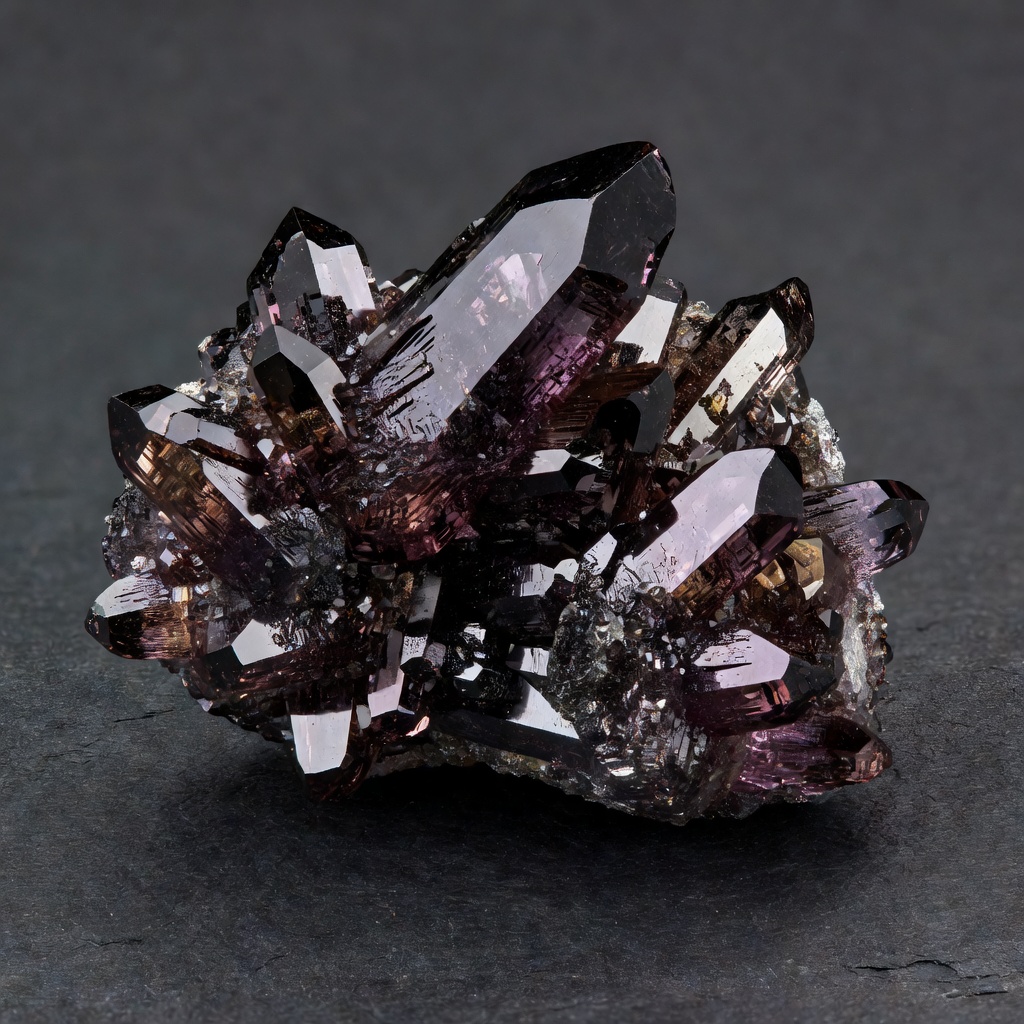
What Is Axinite? An Overview of This Rare Mineral
Axinite represents a fascinating group of complex borosilicate minerals that captivates geologists and collectors alike with its distinctive crystal morphology and chemical complexity. This rare mineral group belongs to the triclinic crystal system and is characterized by its unique calcium aluminum borosilicate structure that accommodates various metal substitutions, creating a diverse family of related species. Unlike more common silicate minerals, axinite contains significant boron content, which significantly influences both its formation conditions and physical properties, setting it apart in the mineral kingdom.
The etymology of this intriguing mineral traces back to the Greek word "axina," meaning axe, a direct reference to the sharp, blade-like crystal formations that typically terminate in wedge-shaped or hatchet-like configurations. French mineralogist René Just Haüy officially named and described axinite in 1797 after examining specimens from the French Alps, recognizing the distinctive geometric relationships between the crystal faces that resembled cutting tools. When examining axinite mineral specimens in the field or in collections, collectors should look for these characteristic sharp terminations and the often translucent to transparent nature of high-quality crystals, which distinguish it from similar-looking minerals like andalusite or staurolite that may share brownish colors but lack the distinctive boron chemistry and crystal habit.
Physical Properties of Axinite Gemstones
Understanding the physical characteristics of axinite gemstone properties requires careful examination of its durability, density, and optical behaviors that make it both challenging and rewarding for lapidary work. On the Mohs hardness scale, axinite registers between 6.5 and 7, providing moderate resistance to scratching but requiring protection from harder materials such as quartz, topaz, or corundum that could easily mar its surface during daily wear or storage. The mineral exhibits perfect cleavage in one direction, meaning it can split cleanly along specific atomic planes, a property that demands expert handling during cutting and creates vulnerability in finished jewelry pieces if subjected to sharp impacts or extreme pressure.
The specific gravity of axinite ranges from 3.18 to 3.35, making it noticeably heavier than many common minerals of similar size and contributing to its substantial feel when held in the hand. This density variation depends largely on the chemical variety, with iron-rich specimens typically registering higher specific gravity values than their magnesium-dominant counterparts. When polished, axinite displays a vitreous to resinous luster that ranges from glassy to slightly oily in appearance, while its fracture patterns vary from conchoidal, producing curved breakage surfaces similar to glass, to uneven breaks that appear rough and irregular. Perhaps most striking is axinite's strong pleochroism, an optical phenomenon where the crystal displays different colors—ranging from honey-brown to violet-blue or pale pink—when viewed from different crystallographic angles, a property that requires careful orientation during gemstone cutting to maximize color display.
Chemical Composition and Crystal Structure
The axinite chemical composition reveals a complex substitution series represented by the general formula Ca2(Fe,Mn,Mg)Al2BO3Si4O12(OH), where iron, manganese, and magnesium can interchange within the crystal lattice, creating distinct mineral species within the group. This complex chemistry explains why axinite specimens from different localities may exhibit varying colors and densities despite sharing the same basic structural framework, with the specific dominant cation influencing both the physical appearance and specific gravity of individual crystals. The presence of boron in the structure is particularly significant, as this element requires specific geological conditions for incorporation, typically involving the interaction of boron-rich fluids with calcium-aluminum silicate host rocks during metamorphic processes.
Crystallographically, axinite belongs to the triclinic system, the least symmetric of all crystal systems, characterized by three unequal axes intersecting at oblique angles that result in the mineral's distinctive wedge-shaped or blade-like habit. This structural arrangement produces the characteristic sharp terminations and flattened crystals that give axinite its name, with well-formed specimens displaying complex striations and multiple crystal faces that reflect light in unique patterns. The role of iron, manganese, and magnesium as chromophores within the structure cannot be overstated; ferrous iron produces the characteristic brown axinite stone colors ranging from clove to plum, while manganese substitutions create delicate lilac and violet hues, and magnesium-dominant compositions yield rare pale green to colorless varieties that command premium prices among collectors.
Color Varieties: From Ferroaxinite to Manganaxinite
The axinite group encompasses several distinct varieties defined by their dominant chemical constituents, with ferroaxinite variety being the most common and widely recognized due to its characteristic clove-brown, honey, and deep plum colorations. These warm, earthy tones result from ferrous iron occupying specific sites within the crystal lattice, creating absorption spectra that favor the transmission of reddish-brown wavelengths while absorbing greens and blues, though iron-rich specimens may also display subtle violet undertones when viewed in certain lighting conditions. Collectors seeking ferroaxinite should examine specimens from classic localities like Le Bourg-d'Oisans in France or the Jersey Highlands in New Jersey, where contact metamorphism between granite and limestone has produced exceptional examples of this variety.
In contrast, manganaxinite exhibits delicate lilac, pink, and violet hues that distinguish it immediately from its iron-rich cousins, with color intensity varying directly with manganese concentration within the crystal structure. This variety often displays the most pronounced pleochroic effects, showing dramatic color shifts from pale pink to deep violet depending on viewing angle, making it particularly prized for gemstone cutting when lapidaries can orient the stone to display multiple colors simultaneously. Beyond these common varieties, magnesioaxinite presents as rare pale green to colorless crystals found primarily in magnesium-rich geological environments, while tinzenite represents an extremely rare manganese-zinc variety known from limited localities in Italy and Switzerland that exhibits unique orange to yellow-brown coloration. Some axinite specimens demonstrate color change phenomena under different lighting sources, appearing brownish in incandescent light while shifting toward violet or blue tones under daylight or fluorescent illumination, adding another layer of complexity to this already fascinating mineral group.
Geological Formation and Occurrence
Axinite formation requires specific and somewhat unusual geological conditions that explain its relative rarity compared to more common silicate minerals, typically occurring in contact metamorphic zones where hot, boron-rich granitic intrusions meet reactive carbonate rocks such as limestone or dolomite. This geological setting, known as a skarn environment, provides the necessary chemical ingredients—calcium from the carbonate rocks, aluminum and silica from the granite, and boron from volatile-rich fluids expelled during the cooling of the magma—combined with the high temperatures and moderate pressures required for crystallization. The process typically occurs at temperatures between 300°C and 600°C under relatively low pressure conditions, allowing the complex borosilicate structure to nucleate and grow within the narrow reaction zones between the contrasting rock types.
Additionally, axinite occurs in alpine-type fissures and hydrothermal vein deposits where mineral-rich fluids circulate through fractured rock at moderate temperatures, depositing crystals in open cavities and vugs that allow for the formation of well-developed, undamaged specimens. Field collectors should search for axinite occurrence in association with characteristic mineral assemblages including quartz, prehnite, calcite, epidote, and various zeolites, which serve as indicator minerals suggesting favorable conditions for axinite crystallization. In the Alps and similar mountain ranges, axinite frequently forms in the clefts and fissures of metamorphosed sedimentary rocks, where it can develop exceptional transparency and crystal size due to the slow cooling and consistent fluid chemistry maintained within these sealed geological systems over thousands of years.
Major Mining Locations Worldwide
The type locality for axinite mineral discovery remains Le Bourg-d'Oisans in the French Alps, specifically the Allemont area, where Haüy first described the species in 1797 and where exceptional specimens continue to set the standard for the species. French deposits typically produce the classic ferroaxinite variety with deep brown colors and exceptional transparency, often associated with quartz and epidote in the contact zones between granitic bodies and surrounding metamorphic rocks, though commercial mining has diminished significantly as accessible surface deposits become exhausted. The historical significance of French specimens cannot be overstated, as they provided the original reference material for mineralogists worldwide and established the morphological and chemical standards against which all subsequent discoveries are measured.
In the United States, significant axinite locations include the Franklin and Sterling Hill mining districts of New Jersey, famous for producing intense brown to violet crystals associated with the unique zinc ore deposits of the region, as well as various localities in California's Riverside and San Diego counties where alpine-type veins yield transparent crystals suitable for faceting. Colorado's Calumet Mine and various pegmatite districts have also produced notable specimens, though often smaller than those from the East Coast deposits. International localities contributing to the collector market include the Soreiyama and Suisan areas of Japan, which produce exceptional manganaxinite with delicate violet hues; the Minas Gerais region of Brazil, known for large crystal clusters; and notable occurrences in Tasmania, Australia, and the northern regions of Pakistan, where recent discoveries have introduced new color variations to the market. While axinite mining rarely occurs as a primary commercial venture due to limited industrial applications, specimen mining continues at many of these localities, with accessibility for mineral collectors varying from easily accessible road cuts to remote mountain locations requiring significant hiking and technical climbing skills.
Metaphysical Properties and Crystal Healing
Practitioners of axinite crystal healing attribute powerful grounding and stabilizing energies to this mineral, associating it primarily with the root chakra and earth star chakra to facilitate deep connections with terrestrial energies and promote a sense of security and physical presence. Unlike more ethereal high-vibration stones, axinite is believed to anchor spiritual energies into the physical body, making it particularly useful for individuals who feel spaced out, disconnected, or overwhelmed by psychic or emotional turbulence, as it supposedly creates a stable energetic foundation from which personal growth can occur. Crystal healers often recommend placing axinite specimens at the base of the spine during meditation sessions or sleeping with the stone under the pillow to enhance dream recall while maintaining energetic boundaries that prevent spiritual exhaustion.
The gentle vibrational frequencies associated with axinite are said to provide stress relief and anxiety reduction by dissipating accumulated tension held within the muscular and nervous systems, similar to the way the mineral forms under pressure yet maintains structural integrity in the earth. Many practitioners utilize brown axinite stone varieties specifically for enhancing endurance and physical vitality during challenging times, carrying tumbled stones in pockets during athletic events, lengthy work projects, or recovery from illness to supposedly boost stamina and perseverance. For meditation purposes, holding an axinite crystal while focusing on the breath is believed to help achieve deeper states of relaxation and inner peace by quieting mental chatter and aligning the physical body with present-moment awareness, making it a valuable tool for both beginner and advanced meditation practitioners seeking to ground their spiritual practice in physical reality.
Axinite in Jewelry and Mineral Collecting
Working with axinite gemstones presents unique challenges for lapidaries and jewelers due to the mineral's perfect cleavage and inherent brittleness, which demand specialized cutting techniques and protective settings to prevent damage to finished pieces. When cutting axinite, lapidaries must orient the table of the stone perpendicular to the cleavage direction to minimize the risk of splitting during the polishing process, using gentle pressure and diamond-impregnated laps rather than the aggressive cutting methods suitable for tougher materials like corundum or quartz. Successful faceting requires patience and experience, as the stone's pleochroism must also be considered to maximize color display, often resulting in lower yields from rough material compared to more forgiving gem species, which contributes to the limited availability of faceted axinite on the commercial market.
For jewelry applications, axinite performs best in protective settings such as pendants and earrings, where the stones receive less physical impact than they would in rings or bracelets subjected to daily wear and potential knocks against hard surfaces. Bezel settings that fully encircle the girdle of the stone provide superior protection compared to prong settings, while keeping axinite jewelry away from ultrasonic cleaners, steam cleaning, and harsh chemical solvents is essential, as these can exploit cleavage planes or damage the surface luster. Mineral collectors value axinite specimens based on crystal size, transparency, color intensity, and the presence of associated minerals, with matrix specimens showing the crystal in its natural geological context often commanding higher prices than loose crystals; investment-grade specimens typically feature damage-free terminations, gemmy transparency, and aesthetic arrangement on contrasting matrix material such as white quartz or gray calcite.
How to Identify Genuine Axinite
Accurate axinite identification requires careful observation of both macroscopic features and precise measurements, beginning with visual examination of the characteristic wedge-shaped or blade-like crystal terminations that distinguish it from similarly colored minerals like andalusite or staurolite. Genuine axinite typically forms flattened crystals with sharp edges and striated faces that terminate in chisel-like or hatchet-shaped ends, whereas staurolite commonly forms stubby prisms or cross-shaped twins, and andalusite tends toward blocky, nearly square prismatic forms without the bladed habit. When examining potential specimens, collectors should also note the specific gravity, as axinite feels noticeably heavy for its size compared to quartz or feldspar, registering between 3.18 and 3.35 on density tests, which can be performed using the suspension method in heavy liquids or precise electronic scales.
Advanced identification techniques include measuring the refractive index, which for axinite ranges from 1.656 to 1.704 depending on chemical variety, values that overlap with some other minerals but combined with the specific gravity and crystal habit provide definitive identification. Gemologists may also examine pleochroism using a dichroscope, expecting to see distinct color differences in iron-rich or manganese-rich varieties when rotating the stone or viewing it from different angles. Common imitations and synthetics to avoid include glass simulants, which lack the natural inclusions and specific gravity of genuine material, and dyed quartz or other treated stones that may mimic axinite's color but fail to display the complex crystal morphology and boron chemistry characteristic of authentic specimens; purchasing from reputable dealers who provide locality information and certification for high-value pieces remains the best protection against fraudulent material.
Frequently Asked Questions About Axinite Properties and Information
What Is Axinite Used For?
Axinite is primarily used as a collector's mineral due to its rarity and distinctive crystal formations that showcase complex geological processes. While occasionally cut into gemstones for jewelry, its perfect cleavage makes it challenging to work with, limiting its use in commercial jewelry to protective settings like pendants and earrings. Metaphysically, practitioners use it for grounding, stress relief, and meditation practices, believing it helps anchor spiritual energies and promote physical endurance during challenging circumstances.
How Rare Is Axinite?
Axinite is considered a rare mineral, especially in gem-quality transparent specimens suitable for faceting or display. While the mineral itself occurs in several localities worldwide, fine crystals large enough for cutting or aesthetic mineral display are uncommon due to the specific geological conditions required for its formation, making high-quality specimens valuable to collectors. The rarity increases significantly for certain varieties such as magnesioaxinite or tinzenite, which are known from only a handful of localities globally, while even common ferroaxinite becomes scarce when specimens exceed several centimeters in size with perfect terminations and transparency.
What Colors Does Axinite Come In?
Axinite typically occurs in brown, violet, blue, and lilac shades depending on its chemical composition and the dominant metal cations present in the crystal structure. Ferroaxinite displays brown to plum colors due to iron content, while manganaxinite shows pink to violet hues resulting from manganese substitutions. Some specimens exhibit strong pleochroism, appearing different colors when viewed from various angles, and rare color-change varieties may shift between brownish tones under incandescent light and violet or blue tones under daylight conditions.
Is Axinite a Gemstone?
Yes, axinite is considered a semi-precious gemstone, though it's rarely used in commercial jewelry due to its perfect cleavage and relative softness of 6.5 to 7 on the Mohs scale. When cut by expert lapidaries, it produces attractive gems with high brilliance and fire, displaying excellent transparency and distinctive pleochroic effects, but requires protective settings such as bezels or pendants rather than exposed ring settings. The gem-quality material is prized more by connoisseurs and collectors than by the general jewelry market due to its scarcity and the specialized knowledge required to cut and set it properly.
Where Is Axinite Found?
Significant axinite deposits occur in France at Le Bourg-d'Oisans in the Alps, which serves as the type locality, as well as in the United States particularly in California, New Jersey, and Colorado where contact metamorphic zones provide ideal formation conditions. Other notable localities include Japan, known for violet manganaxinite; Brazil, producing large crystal clusters; and Tasmania, Australia, and Pakistan, which have yielded exceptional specimens in recent decades. The mineral consistently forms in contact metamorphic zones, particularly where granite intrudes into limestone or dolomite, creating the boron-rich, calcium-aluminum environment necessary for crystallization.
What Is the Hardness of Axinite?
Axinite has a Mohs hardness of 6.5 to 7, making it relatively durable but susceptible to scratching from harder materials like quartz, topaz, or corundum that might be present in a jewelry box or encountered during daily wear. Its perfect cleavage in one direction makes it brittle and prone to breaking if struck or exposed to rough wear, representing a greater vulnerability than the hardness number alone might suggest. When storing axinite specimens or jewelry, it is advisable to wrap them individually in soft cloth to prevent contact with harder stones and avoid storing them in ways that might allow pressure against the cleavage planes.
Does Axinite Have Healing Properties?
In crystal healing traditions, axinite is believed to possess grounding and stress-relieving properties that help connect the user to earth energies and stabilize emotional states. It's associated with the root chakra and is thought to promote physical endurance, emotional balance, and deep meditation by creating an energetic foundation that prevents spiritual escapism or dissociation. Practitioners often use it during times of physical exhaustion or mental stress, carrying the stone to maintain energy levels throughout the day or placing it on the body during healing sessions to supposedly align the physical and energetic bodies.
How Much Is Axinite Worth?
Axinite value varies significantly based on quality, size, color, and the presence of matrix or associated minerals, with raw specimens ranging from $20 for small, damaged crystals to several thousand dollars for exceptional museum-quality pieces with perfect terminations and gemmy transparency. Faceted gemstones typically command $50 to $200 per carat depending on clarity, color intensity, and cutting quality, with rare large crystals or exceptional colors such as vivid violet manganaxinite fetching higher prices from serious collectors. Investment potential remains strong for high-quality specimens from classic localities like the French Alps or Franklin, New Jersey, particularly as mining becomes more restricted and high-grade material becomes increasingly difficult to obtain from the limited number of significant worldwide deposits.